
Plain brick outside, something terrible inside. Never open the box.
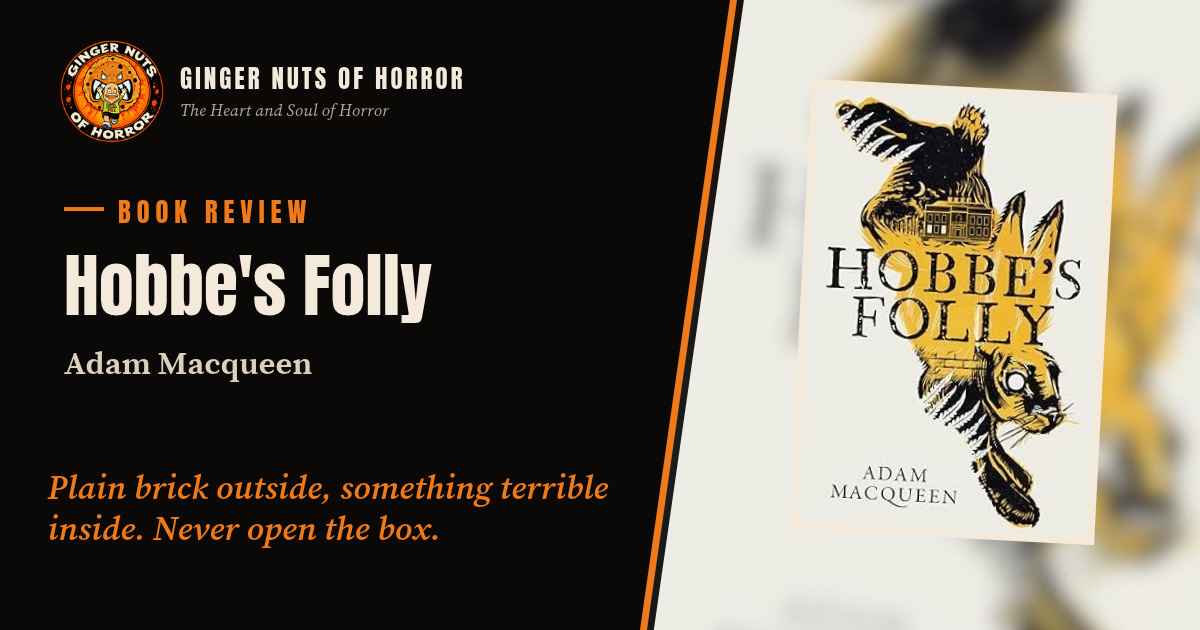
Hobbe’s Folly | Adam Macqueen | Swift Press | 8 October 2026 |
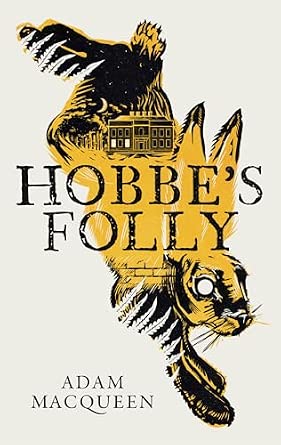
- Author Adam Macqueen
- Publisher Swift Press
- Published 8 October 2026
- Pages 240
- Format Hardback, ebook
- ISBN 9781800756922
- Subgenre Ghost story, occult horror
- Reviewed by Jim McLeod
In 1904 a prim bookseller catalogues a dead occultist’s library. Today a council officer must judge whether a windowless brick hut on a housing site is worth saving. Both are drawn towards something that should stay shut.
Hobbe’s Folly by Adam Macqueen is a dual-timeline ghost story about a brick building with no door and no window, and it earns all five of its stars. In 1904 a bookseller’s assistant is sent to value a dead man’s library in a house above the sea. In the present day a council conservation officer is told to prove that a scrap of old brickwork on a new housing site is worthless. The two stories take turns, and each one makes the other colder. Swift Press publishes it in hardback and ebook. It is Macqueen’s first full-length novel of the supernatural, after his story collection Haunted Tales.
Adam Macqueen has built his novel like the folly at its heart: plain on the outside, airtight on the inside, and holding something you must never let out. Two timelines, one cold room, and an ending that pays off every clue it planted. A five-star English ghost story.
Hobbe’s Folly Review: The Building Nobody Looked At
Every town has a building nobody sees. It sits at the edge of a field or behind a car park. It is too dull to photograph and too old to explain, so the eye slides off it on the way to something better. Most of the time that is because there is nothing there.
Adam Macqueen has written a novel about the other times.
Ben is a conservation officer for a seaside council. He is the sort of man who spends the run-up to Christmas choosing the right lime mortar for a listed rectory, and enjoys it. On the first working day of January his boss’s boss is waiting at his desk. A plan for 250 homes on the West Headland is about to be waved through.
Local campaigners have dug up a reason to stop it. There is a small brick building in the middle of a field. It has no door. It has no window. His office mate Sarah spots it across the bay from their window on the eighteenth floor. The chapter ends on its shape. It is twice as tall as it is wide, like a gravestone.
Then the book steps back to 1904. Henry Canning is twenty-five and works for Britnell & Son, antiquarian booksellers of Cecil Court. He is courting the owner’s daughter, Isadora, and he quietly hopes to see his own name on the shop sign one day. His employer sends him to the coast to catalogue the library at Hareswood Lodge, home of the late Matthew Hobbe. Macqueen sums Henry up in one dry line: “If he had a fault, Henry’s was primness.” It is the perfect thing to know about a man who is about to open a shelf of grimoires.
The two strands take turns, Arabic numerals for Ben and Roman for Henry, and they rhyme. Both men go to church on the Sunday after something goes wrong. Both stand at the wrong window. Both worry about their eyes. Henry fears that cramped old type is ruining his sight. Ben’s glasses are filthy on page one and bent out of shape by chapter five. Hold on to that detail. Macqueen certainly does.
Is Hobbe’s Folly Scary?
Yes, in two very different keys.
The 1904 half is all slow, polite wrongness. Henry is a fine narrator for it because he refuses to see what is in front of him. The best example comes on April Fool’s Day. Two gardeners are at work outside the library. Henry decides to play a prank on the younger one, who is crawling along the gravel path below the sills. He sees the lad’s boots in the corner of the left window. He waits for the head and shoulders to pass across the middle pane.
They never come. So Henry creeps up to the middle sash to shout boo through it, and it will not budge. He yanks up the left one instead. The boy is a few feet to his right, on all fours, hard at work. He is right where the middle window showed nothing at all.
Nothing in that scene says ghost. Macqueen gives us geometry and lets the reader do the sum before Henry does. Henry likens the lurch in his stomach to “the ‘missing’ final step on a staircase descended at speed”. That is as close as a man like him will come to saying he is scared. Then he reasons his way back to safety. Eyestrain. Bright sun. He plans a trip to Moorfields Eye Hospital, shifts his heavy chair so the light falls on his books, and gets back to work.
The present-day half is scarier in a blunter way, and this is where the book will split some readers. On a weekend visit to the folly, Sarah climbs onto its roof and something speaks through her. She turns cruel and sexual and not quite herself. Ben’s own response later is just as ugly, and Macqueen does not look away. It is meant to be unpleasant. The point is the horror of being worked like a puppet by a place, and the shame of not knowing which feelings were yours. I think it lands. A reader who wants a gentler ghost story may not.
The other set pieces are pure nightmare. Take the Mass on the feast of the Epiphany. There is an old anchorite’s cell in the church wall, and a pair of hands with nails rimmed in dried blood reach out through its cross-shaped slit. A housekeeper’s account of her master’s last night that ends with his head turned much further than a head should go. A blast of cold so fierce that a library fire gutters and dies.
How Hobbe’s Folly Plays Fair With Its Ending (Spoilers)
The cleverest thing Macqueen does is let the two timelines touch. One night in 1904, Henry and his new friend Bill Hobbes leave the library. In the dark beyond the middle window, a slit of bright LED light opens up, the size of a brick. A face looks in. It wears thick black glasses, slightly crooked. It is Ben, a century later, with his chisel through the wall. Think of Henry’s warped reflection on his first night, the freezing glass, the view that does not match the season. It was the folly all along, seen from the inside.
Before Hobbe’s Folly, Macqueen was best known for his nonfiction. He has written for Private Eye since 1997 and wrote its fiftieth-anniversary history. His biography of the soap magnate William Hesketh Lever, The King of Sunlight, was named a book of the year by The Economist. He then wrote two Tommy Wildeblood crime novels, Beneath the Streets and The Enemy Within.
Swift Press published his ghost stories, Haunted Tales, in 2024. You can feel the Eye in this book. The acknowledgements thank the writer of its Nooks and Corners column on architecture. The council chapters have the bite of a man who has read a lot of planning papers. Harrington, the head of planning, treats the phrase fast-tracked like a swear word. Ben pictures the lead campaigner beside an Aga in a gilet. A posh volunteer records an old man’s memories. She gushes that he must have dreamed of driving trains. He tells her: “I sold the tickets.”
The satire is fair, though, and that matters. The campaigners want the green fields for their own view. The developers have been generous to the party in power. Ben thinks the site is practically brownfield, and the surveys back him. Nobody here is clean, and the old man in the care home is the only one telling the truth.
The prose shifts register with the timeline. The Ben chapters are plain and modern: email chains, Costa coffees, a weather app. Next to Henry’s chapters they can read a little thin, and that is the one small cost of the structure. Henry’s voice is the real feat. It is a pitch-perfect Edwardian pastiche, full of brandy and water, dustsheets and buttoned-up dread, and never once does it wink at us. Reading the two together is like looking at the same field through a magic lantern and a council webcam. The picture is the same. Only one of them is honest about the dark.
On the shelf, this sits squarely in the line of M.R. James. A bookish young man with a catalogue to finish is the most Jamesian hero there is. It also owes a debt to Susan Hill’s The Woman in Black. There, too, a young clerk is sent to sort a dead stranger’s papers in a lonely house by the sea. Fans of Nigel Kneale’s Quatermass and the Pit will smile at a building site, a buried horror and a local name for the Devil, Old Hob.
Readers of Algernon Blackwood will recognise the Dr Silence named late in the story. Macqueen’s own afterword points to Heinlein, C.S. Lewis’s wood between the worlds and the TARDIS. The furniture is familiar: the grimoire, the secret society, the chalk circle. Macqueen knows it and uses that familiarity as bait. You think you know this house. You do not know what is behind the middle window.
Under the ghost story there is a serious book about guarding. Who keeps watch over the things we bury, and what happens when the money for the watchmen runs out? As a boy of thirteen, the nephew who builds the folly was the target of his uncle’s abuse. Macqueen handles that thread with real restraint.
The novel also lets the prejudice of 1904 stand in the room without comment. A housekeeper sneers at the Gypsy family whose son vanished. Henry nods along, and the novel lets us see what he cannot. Our British Fantasy Awards 2026: Best Horror Novel Shortlist Ranked shows how strong British horror is right now. Hobbe’s Folly belongs in that company. You will find more like it among our horror book reviews on Ginger Nuts of Horror.
Macqueen has built a perfect little box. Whatever you do, do not put your eye to the hole.
The Verdict: Is Hobbe’s Folly Worth Reading?
The verdict
A cold, clever and cruel English ghost story whose two timelines lock together like a key turning, with an ending that pays off every clue.
Read it if: you love M.R. James, Edwardian libraries, occult paperwork and a finale that bites.
Skip it if: you want a gentle ghost story with no sex, no gore and no unhappy endings.
Keep reading on Ginger Nuts of Horror
 Cthulhu Cymraeg: The Night Country by Mark Howard Jones Review: Lovecraft, Welsh Style
 Portal Cover Reveal: K.M. Walton’s Pennsylvania Ghost Story
 Bringing It Gloam: Jack Mackay on Winning The Week Junior Book Award
About Ginger Nuts of Horror
Ginger Nuts of Horror is an independent horror review and culture site based in Edinburgh, Scotland. Edited by British Fantasy Award nominee Jim McLeod, it publishes horror book reviews, film reviews, author interviews, features and cover reveals. Ginger Nuts of Horror won Best Inclusive Film & Book Review Platform at the SME News UK Enterprise Awards 2026.