
The monster wears a face you love. The men with the maps wear their own.
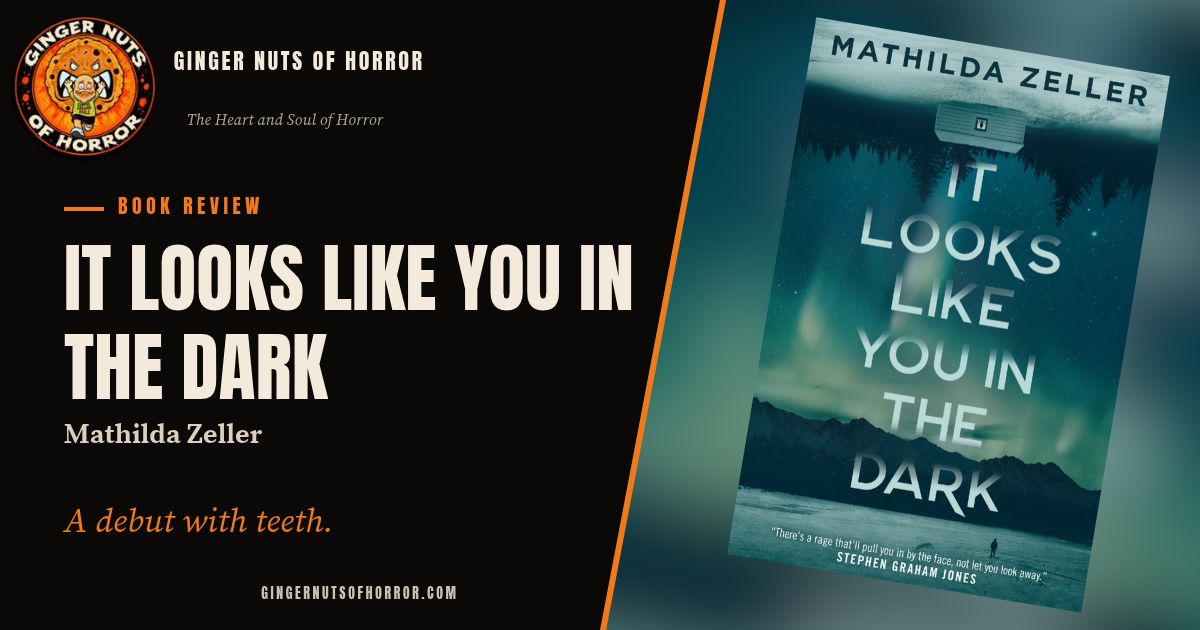
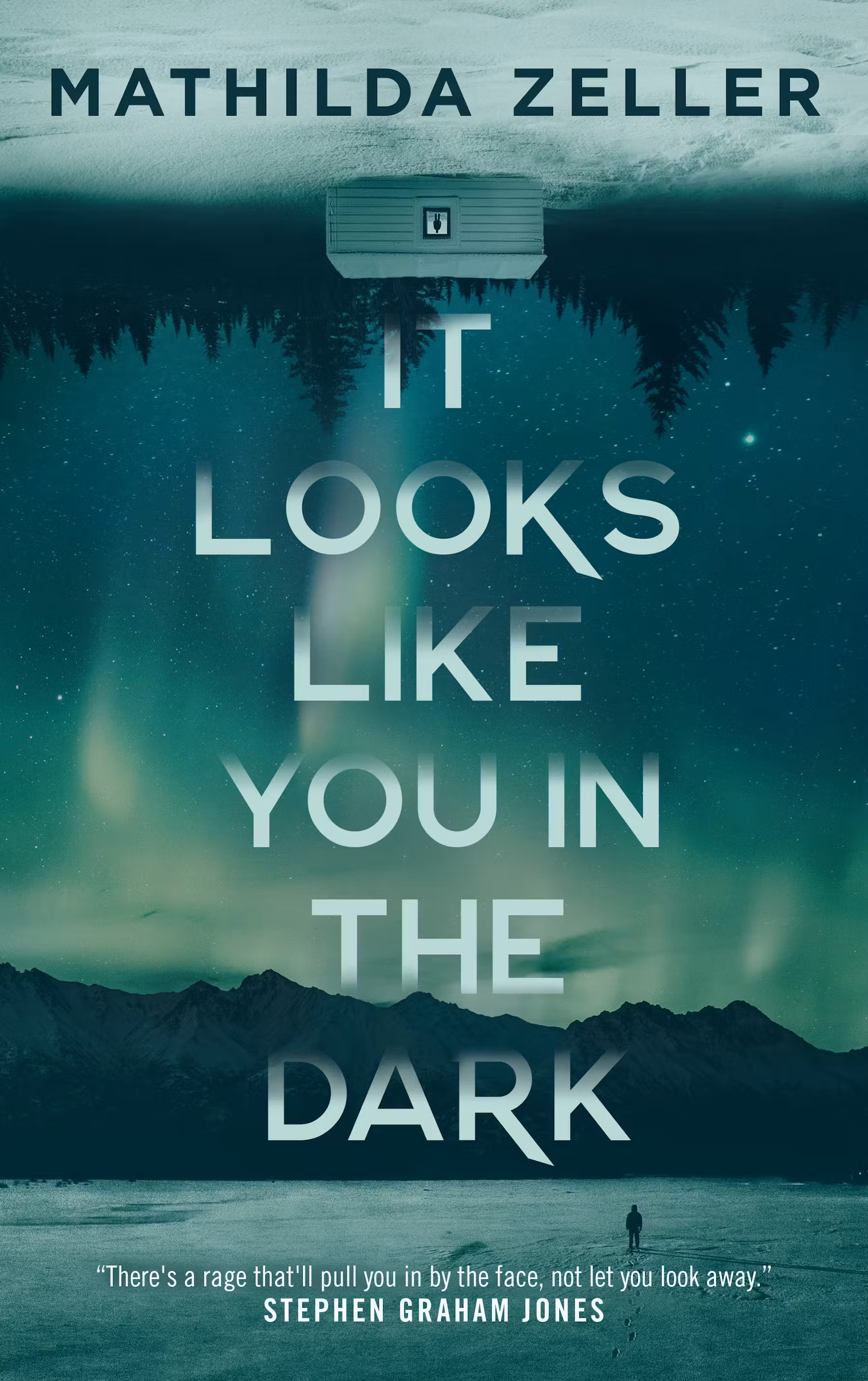
It Looks Like You in the Dark | Mathilda Zeller | Tor Nightfire | 13 October 2026 |
- Author Mathilda Zeller
- Publisher Tor Nightfire
- Published 13 October 2026
- Pages 288
- Format Hardback, ebook, audiobook
- ISBN 9781250402035
- Series Kobuk Valley
- Subgenre Indigenous folk horror
- Reviewed by Jim McLeod
Chukchi, Alaska, 1994. Nineteen-year-old Tapeesa guts fish, holds her family together and hears her grandmother’s warnings about the kushtuka. Then a mining company moves in north of the village, and her sister vanishes.
It Looks Like You in the Dark is the debut Indigenous horror novel from Mathilda Zeller, out from Tor Nightfire on 13 October 2026. It grows out of “Kushtuka”, the short story that opened the anthology Never Whistle at Night, and sets it in a remote Inupiat village in 1994, where a mining company has just arrived and a young woman’s sister has gone missing. The creature at its heart comes to you wearing the face of someone you love. In this It Looks Like You in the Dark review.
Zeller takes an old warning, the thing in the dark that wears a loved one’s face, and sharpens it against a real history of men who came to take the land. The monster frightens. The men frighten more. This is a debut with teeth, and it bites hard.
A Monster That Borrows the Faces You Trust
Every family has one voice you would follow anywhere. Your gran calling you in from the yard. Your little sister shouting your name across a dark road. You do not stop to check. You just go.
Mathilda Zeller builds her first novel on that reflex, and she builds it to last. The kushtuka, a creature from Alaska Native lore, comes to you looking like someone you love. It wants you to follow. Where it leads is anyone’s guess, because the people who went never came back to say.
It Looks Like You in the Dark is set in 1994, in Chukchi, an Inupiat village in the Kobuk River Valley. Tapeesa is nineteen. School is done, and she works at the fish plant while she figures out what comes next. Her mother drinks, and likes to tell her she has bad blood. Her Ahna, her grandmother, tells her the old stories and pushes her to go away to college, so she can come home with the tools the village will need. Her younger sister Esther is the bright one, the one everyone adores, the one already talking about getting out.
Then the white men arrive with plans for an open pit, a rare earths mine just north of the village. They bring talk of jobs and money. The valley has heard that talk before. A prologue dated 15 November 1898, back when gold was the thing pulling outsiders up the Kobuk, makes sure we have heard it too.
Then Esther goes missing.
That is the bones of it, and none of it is spoiled by knowing it. What matters is how Zeller tells it.
Look at how the book opens. The first line of that 1898 prologue is as plain as a plank: “The darkness came earlier than they were anticipating.” Read it once and it is weather. Read it again and it is a warning. The dark is not a thing that falls here. It comes, like a visitor with its own clock. And then there is that one stiff word, anticipating, the word of people with a plan and a schedule and a stake. Somebody had worked out when the light would go, and the land did not agree. The whole novel lives in that gap, between what the outsiders plan for and what the place does to them.
Zeller’s prose works like an ulu at the fish plant: short, curved, made for one job, and through the skin before you feel it. She does not decorate. Her sentences are clean and quick, and she trusts a flat line to do the work a page of mood would do in weaker hands. When a line does open out, it lands. Look at the words her publisher put at the top of the jacket:
The only people who know are the people who have gone. Those people no longer have throats to tell us.
The first sentence is soft and round, the kind of thing a grandmother says by the stove. The second takes that saying and makes it bleed. No throats. Not “they cannot tell us”, which is folklore, but a picture of what is left of them, which is horror. That is the move the whole book makes, again and again. Lore is passed on kindly. Then Zeller makes it literal.
She is just as good on the small things. The book swaps the stock phrases you would expect for comparisons that come out of the place itself, out of fish and ice and dogs and family. It sounds like Chukchi, not like a writing class. You come away feeling you have smelt the plant and heard the generator, and you never once caught her trying.
Is It Looks Like You in the Dark Scary?
Yes. But it is scary in a particular way, and it pays to know which way going in.
This is not a creature feature. The kushtuka is kept to the edges for much of the book: a shape at the window, a figure where no figure should be, a thing stalking Tapeesa that is not quite a person and not quite an animal. Zeller keeps it there on purpose. A monster that looks like your sister only works if you are never sure what you are looking at. The more she holds it back, the more every familiar face starts to look wrong.
And the dark keeps coming. The days shrink as the book goes on, and the night eats more of each one. By the last stretch the light is a rumour. When the novel finally shows its teeth, it does not hold back, and the gore is real and hard. But the cold dread before that is the true achievement, and it builds slowly, the way the dark does up there.
There is a second fear running under the first, and it may be the worse one. It is the fear of not being believed. When an old man dies, wolves get the blame, because that is the easy answer and nobody with a badge wants a hard one. When Esther vanishes, one night of teenage drinking is all it takes for the village to decide she has simply run off. Outsiders talk about “you people”. The police are a shrug. Zeller does not need a monster to show you how a young Native woman can disappear in plain sight. She just needs to show you who stops looking.
How the Novel Grows From Kushtuka
You could call the book young. Its people are barely out of school, and they sound it. They argue, they sulk, they talk in circles about leaving and staying. I think that is the point, not a slip. Nineteen is the age when the whole future sits on your chest. Tapeesa is clever and careful and furious, and she has been half a parent to Esther for years. Of course she goes round and round. Real people do.
The one place the novel drags its boots is right there, in the talk about whether she should go or stay. The same argument comes back more than once, and a sharper edit could have cut a lap. It is a small thing, and it never stops the book in its tracks.
Some may also find the miners too plain, too obviously the villains. I don’t. The men who came up the Kobuk for gold were not subtle, and the companies that came after them were not subtle either. Zeller is not writing a debate. She is writing from the side of the people the mine is dug beside. The book is angry, and it has every right to be. That rage is the engine. Take it out and the book would be safer, and much less alive.
What I like most is how she uses the generations. The young want to fight. They think the right letter to the right office might stop the mine. The elders have watched this before. They know words seldom matter, and they wait for the land to settle its own accounts, losses and all. Zeller does not tell you who is right. She lets both sides cost something.
This is a debut novel, and Zeller has kept it in the family. Mathilda Zeller is a pen name honouring two of her great-grandmothers, and her agency describes her as being of Inuit descent. Her story “Kushtuka” was the first thing you read in Never Whistle at Night, the anthology edited by Shane Hawk and Theodore C. Van Alst Jr., which went on to Bram Stoker and Shirley Jackson Award nominations.
Tapeesa was born in that story. The novel gives her a family, a village and a whole history to stand in. If you read the story, you may well see where the book is heading. It does not matter. The pleasure is in watching her walk you there, step by step, with the light going.
The book is billed as the first in a Kobuk Valley series, and the deal for a second novel about the qalupalik, the sea creatures of Inupiaq lore, is already done. On this showing, I want it now.
Where does it sit on the shelf? Right in the current wave of Indigenous horror, and near the front of it. It shares a nerve with The Only Good Indians by Stephen Graham Jones, a name on this year’s British Fantasy Awards horror novel shortlist. In that book, the past comes back with a long memory and a grudge. It shares a winter with Waubgeshig Rice’s Moon of the Crusted Snow, where a northern community, cut off and pressed by outsiders, has to decide what it will become.
And the creature puts it close to Cherie Dimaline’s Empire of Wild, another story about a thing that comes back wearing a face you love. Outside books, the screen echo is True Detective: Night Country, with its Alaskan dark, its mine and its Native women nobody looks for. Go further back and you hit John Carpenter’s The Thing. Same cold, same copying, same question at the core. Is that really who it looks like?
But Zeller’s book is its own animal. It is not about paranoia among strangers. It is about trust inside a family, and what it costs when that trust becomes the trap. The scariest thing the kushtuka can do is not kill you. It is make you hesitate before you open the door to your own sister.
Read it as the nights draw in. Better still, read it once they have, when the window is black and someone you love is standing in it, smiling.
The verdict
A fierce debut that turns an old Inupiat warning into a modern horror novel, where the men digging the land are every bit as frightening as the thing in the dark.
Read it if: you want folk horror rooted in a real place and real anger, or you loved The Only Good Indians and Moon of the Crusted Snow.
Skip it if: you want a monster on every page, or you like your horror kept well away from politics.
Keep reading on Ginger Nuts of Horror
 Hollow Folk by Andrew K. Clark Review: Love and Terror in a Frozen Hotel
 Find Me Where It Ends by Cassandra Khaw Review: Death Comes Home to Heel
 Paul Finch’s In the Forest of the Night: A Black Shuck Shadows Review

About Ginger Nuts of Horror
Ginger Nuts of Horror is an independent horror review and culture site based in Edinburgh, Scotland. Edited by British Fantasy Award nominee Jim McLeod, it publishes horror book reviews, film reviews, author interviews, features and cover reveals. Ginger Nuts of Horror won Best Inclusive Film & Book Review Platform at the SME News UK Enterprise Awards 2026.

