“Japanese Gothic doesn’t hold your hand. It buries you slowly, then asks you to stay. Kylie Lee Baker’s most ambitious novel yet — and her most unforgettable.”
Two centuries. One house. And the horror of what we inherit.
Kylie Lee Baker’s Japanese Gothic arrives as a masterful blend of historical horror and slow-burn family tragedy, weaving together a dual-timeline narrative that spans 1877 and 2025. For readers of gothic horror fiction and Japanese folklore-infused fantasy, this novel offers a challenging, atmospheric experience. It follows a female samurai in the Meiji era and a modern man hiding from his past, both tethered to a single, haunting house. The book explores generational trauma, cultural upheaval, and the visceral nature of violence, demanding patience as it builds toward a devastating, unforgettable conclusion.
Japanese Gothic Review: Kylie Lee Baker’s Haunting Dual-Timeline Horror
Kylie Lee Baker’s Japanese Gothic arrives as a masterful blend of historical horror and slow-burn family tragedy, weaving together a dual-timeline narrative that spans 1877 and 2026. For readers of gothic horror fiction and Japanese folklore-infused fantasy, this novel offers a challenging, atmospheric experience. It follows a female samurai in the Meiji era and a modern man hiding from his past, both tethered to a single, haunting house. The book explores generational trauma, cultural upheaval, and the visceral nature of violence, demanding patience as it builds toward a devastating, unforgettable conclusion.
Japanese Gothic Review: Kylie Lee Baker’s Haunting Dual-Timeline Horror
There’s a particular kind of dread that lives in old houses. Not the jump-scare kind, but the slower rot, the one that settles into floorboards and waits. You can feel it when the walls seem to breathe. When a doorway holds the memory of blood long after it’s been scrubbed clean.
That’s the house Kylie Lee Baker builds in Japanese Gothic. It’s a structure with two front doors, one opening to 1877 and the other to 2026. The same creaking stairs, the same gardens, but the world outside has aged a hundred and fifty years. Inside, time folds.
Lee arrives first, in the contemporary timeline. He’s fled New York after a violent act he can’t fully explain, landing at his estranged father’s home in Japan. He carries the weight of his mother’s disappearance, a decade-old wound that never healed. His father, distant and strange, offers little comfort. The house offers less.
Then there’s Sen. In 1877, she stalks the borders of her family’s estate, a female samurai in a world that’s outlawed her class. The Meiji Restoration has dismantled everything she was raised to be. Her father, a man who once commanded respect, now drinks and rages. He threatens to kill her. She believes he’s an imposter, a thing wearing her father’s face.
The two timelines collide when the house reveals a door between them. Lee sees Sen. Sen sees Lee. What follows isn’t a straightforward ghost story but something more slippery: a conversation across centuries, two broken people trying to make sense of the violence that defines them.
Baker’s prose here operates like a scalpel left out in the rain. It’s precise but rusted at the edges, carrying a weight of decay that suits the material. Reading it feels like watching someone sand a rough plank. You can hear the grit, feel the texture, but the wood underneath is solid, beautiful even. The sentences lean into discomfort. They don’t rush.
If you’ve read Baker’s earlier work, specifically The Keeper of Night duology, you’ll recognize the care she brings to Japanese folklore and historical detail. If you came in through Bat Eater, her previous horror novel, you might find this one slower, less immediate. The horror here is patient. It settles into the bones rather than exploding outward.
That’s where the divide in reader reaction seems to sit. Some want the relentless pace of Bat Eater’s intensity. Others appreciate how Japanese Gothic lets its dread breathe.
The house becomes the central character. Baker does this thing where architecture carries memory. The ferns that grow wild around the entrance, the bloodstain on a doorway that appears and vanishes, the sense that the structure itself is watching. It’s gothic horror in the truest sense. The setting isn’t a backdrop. It’s the engine.
Thematically, Baker is circling inherited trauma and the weight of shame. Sen’s story is one of family violence passed down through generations, her father’s cruelty rooted in his own humiliation after the samurai class falls. Lee’s trauma is more concealed, a mystery the book unwinds slowly. Both characters exist in the shadow of parents who failed them, and both have become something dangerous as a result.
There’s a question the book never directly asks but keeps pressing against: what do we owe the people who hurt us? Is blood thicker than the violence that runs through it?
Baker doesn’t offer easy answers. She doesn’t redeem anyone. Instead, she shows how damage replicates. How the abused child becomes the abuser, or the self-destroyer, or something worse. It’s grim work, and the book doesn’t flinch.
On the craft side, the structure is ambitious. Two timelines, two narrators, one shared space. Baker handles the transitions well, using the house as the anchor point. The chapters don’t alternate mechanically; they unfold with the logic of memory, skipping forward and back as the story demands. It works, mostly. There are moments where the timeline shifts feel abrupt, where a chapter ends mid-thought and the next begins in a different century with no breath in between. That might be intentional (a kind of narrative vertigo), but it occasionally pulls you out of the immersion.
The middle section sags a little. Baker inserts chapters of folklore and mythology, stories within the story that explain the house’s origins. They’re beautifully written, rich with Japanese myth, but they arrive late and sit heavy. You’re invested in Lee and Sen by that point, and the detour feels like a lecture when you’re hungry for resolution. I found myself skimming one, then circling back because I felt guilty. The writing deserved better attention than my impatience.
But when the book hits its final act, it hits hard. The revelations about Lee’s past (what happened to his mother, what he did, what was done to him) unfold with the slow horror of a bruise darkening. Sen’s story reaches its inevitable, brutal conclusion. And the house, that old house, finally reveals what it’s been holding.
There’s a gothic tradition, stretching back to The Castle of Otranto and Wuthering Heights, where the architecture reflects the family’s moral decay. Baker updates that tradition with a distinctly Japanese sensibility: the house as a repository of mononoke, restless spirits bound to place and bloodline. It’s not quite Mexican Gothic; Silvia Moreno-Garcia’s novel shares the house-as-monster concept but moves at a thriller’s pace. Baker’s novel is closer to The Reformatory by Tananarive Due in its patient accumulation of historical weight and personal tragedy. Both books understand that horror works best when it’s grounded in real, systemic violence.
I kept thinking about the difference between the two timelines as I read. Sen’s world is overtly violent: swords, threats, the collapse of a social order. Lee’s world looks safer on the surface, but the violence is just as real, just more hidden. His father’s coldness. The secrets in the walls. The blood he can’t remember spilling. Baker suggests that modernity doesn’t erase horror; it just repackages it.
One thing that stands out about Baker’s growth as a writer is her willingness to risk alienation. Japanese Gothic is not a crowd-pleaser. It doesn’t hold your hand. The characters are not likeable in any conventional sense. Sen is brutal. Lee is unsettling. The book asks you to sit with them anyway, to understand rather than forgive. That’s a harder thing to pull off than making readers root for someone. It requires craft and trust.
Some readers will bounce off this. The pacing is deliberate, almost stubborn. The folklore interludes feel like asides. And if you’re here for the same level of visceral horror as Bat Eater, you’ll find something quieter, more interior. That’s not a flaw. It’s a choice. Baker could have written the same book again. She didn’t.
The book’s strength, ultimately, is its atmosphere. Baker builds a world that feels heavy with history, with unspoken things, with the weight of choices made and avoided. The prose has a stillness to it, even in violent moments. A sword swings, a door opens, a character realizes something they’ve always known, and the sentences don’t speed up. They hold steady. It’s unsettling in the best way.
I appreciated the ending for its strong resolutions, which feel well-earned after the careful buildup. The final pages move with a refreshing efficiency that contrasts nicely with the patient slow burn of the previous two hundred pages. This swift conclusion feels purposeful, highlighting that sometimes horror doesn’t need to linger once it has made its impact.
A slow-burn dual-timeline horror that earns every page of its dread. Kylie Lee Baker’s Japanese Gothic is part haunted-house nightmare, part generational trauma meditation, and entirely impossible to shake.
What do you do with a house that has already buried you? The answer, as Baker gives it, is you stay. You find the others buried there. And you wait.
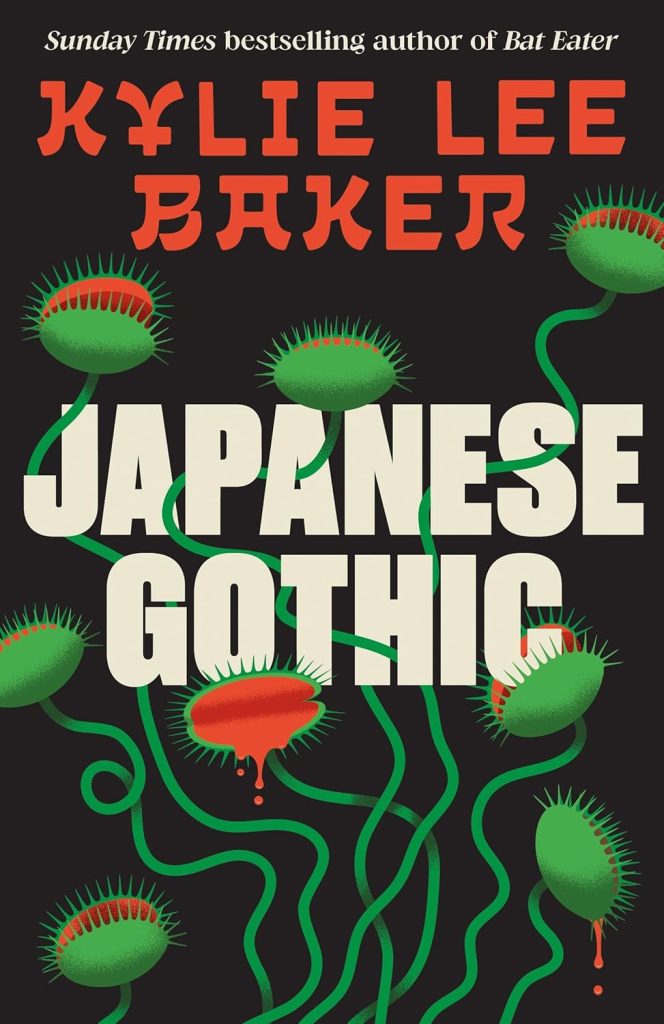
Japanese Gothic by Kylie Lee Baker
Kylie Lee Baker returns with another addictive, gory, horror PHENOMENON
‘Brilliantly inventive. A must read – I couldn’t turn the pages fast enough’ MONIKA KIM
‘This book is a complete mindf*ck and I loved every minute of it’ MIA BALLARD
‘Audacious, surreal . . . An exquisite expression of human pain held tight across centuries’ LEIGH RADFORD
2026
Lee can’t remember exactly where he hid the body, but he can remember the blood. Hiding out at his father’s centuries-old home in Japan, Lee knows something is wrong with him, and he knows it has something to do with his mother’s disappearance almost a decade ago.
1877
A female samurai, Sen, stalks the borders of her home to protect her family from slaughter after the abolition of the samurai class. She’s not sure how they’ll ever survive, not without her father, who has returned from war with a different soul behind his eyes.
When Lee and Sen find one another through a door between their worlds, they’re both looking for answers. But what they find in the creaking old house they share is beyond what either of them could imagine…
PRAISE FOR THE NEWEST VOICE IN HORROR:
🦇 ‘A profound reminder of the true horrors that lurk in the world’ TORI BOVALINO 🦇
🦇 ‘A serial killer mystery and a heartbreaking portrayal of grief’ KIRSTY LOGAN 🦇
🦇 ‘This book dug its claws into me and would not let go’ LING LING HUANG 🦇
🦇 ‘Body horror and female rage fiction combine in a powerful novel that will leave you quaking’ ALMA KATSU 🦇
🦇 ‘A poignant, searing portrait of the hostility and violence that plagued pandemic-era NYC’ VERONICA G. HENRY 🦇