- Jo Salazar on If We Survive the Night, a YA Zombie Reckoning
- If We Survive the Night Review: Jo Salazar’s YA Horror Doesn’t Blink
Too dangerous for the old world. Perfectly built for the one that replaced it.
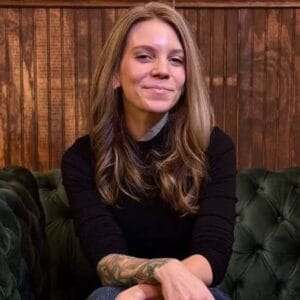
Most zombie novels hand you a hero to root for and hope you do not look too closely at the body count. Jo Salazar had a different idea. Her YA zombie novel If We Survive the Night puts a girl called Quinn at its centre, and Quinn is exactly the sort of person the world locks away for everyone else’s safety. Then the world ends, the rules change, and the girl who never fit starts to look like the only one built to last.
Salazar first released the book herself in 2024 as The Dead Weight. Sourcebooks Fire brings it to a wider readership in 2026 under a new title, and the new title asks a harder question. If these girls survive, what does that say about the rest of us?
I sat down with Salazar to talk about writing a protagonist you follow without ever quite trusting, about drawing on years of social work without reducing her characters to a diagnosis, and about why she flatly refuses to hand Quinn the redemption arc the genre keeps promising. This is an interview about survival, and about who gets to have it.
Jo Salazar refuses the recovery arc the genre has trained us to expect. Quinn does not heal or soften; the world simply shifts until the girl locked away for being dangerous becomes the one built to survive. How you feel about her, Salazar suggests, is really about you.
Jo Salazar on If We Survive the Night, a YA Zombie Reckoning
The original version of this book came out in 2024 under your own banner. Now Sourcebooks Fire is bringing it to a much broader readership in 2026. Beyond the practical differences in distribution, did you find yourself making substantive creative changes when you revisited the manuscript for this edition, and if so, what pulled at you most?
It’s very rare to have the opportunity to launch the same book twice, but I’m so grateful for it. My editor, Gabbi Calabrese at Sourcebooks Fire, truly understood this story and was happy with it as-is. So, she didn’t request any changes, but she did give me the opportunity to make revisions if I wanted to. I had spent three years writing the book, though. I knew every plot point by heart, the characters felt very real to me, and I had put so much thought into each sentence. In the end there wasn’t anything I wanted to change, so Gabbi and I agreed to keep the traditionally published version the same, and I’m so glad we did.
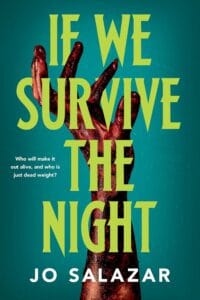
If We Survive the Night is actually a brand new title for the traditionally published version. The original title of the book was The Dead Weight, which is now serving as the series title instead. I liked the double meaning of it. It could be taken literally to refer to the things, places, and people the girls believed were weighing them down. But then, when the title is heard instead of read, it brings to mind an image of the dead waiting to attack. I thought it was fun wordplay.
But we wanted something fresh for the new version and If We Survive The Night was a great option. I think this new title goes deeper. It asks the question I want weighing on readers’ minds as they turn each page. If these girls actually survive, what does it say about humanity? What does it say about who gets to live at the end of the world? What does it say about us, if we reach the last page and find ourselves rooting for the final girl(s)? If We Survive the Night is an uncomfortable title for an uncomfortable book.
Quinn is a character whose particular neurological and psychological makeup, specifically her attenuated empathy and her hypervigilant, predatory awareness of other people, makes her ideally suited for the world she finds herself inside after the carriers arrive. That’s an uncomfortable proposition for the reader to sit with. At what point in the writing did you understand that the book was not going to flinch from that discomfort, and how did you decide how much of Quinn’s interiority to let readers access?
I knew from the very start that Quinn would be a tough character to love, but I did want readers to find moments of empathy for her—enough that they kept rooting for her, despite her nature. Quinn’s mindset is an atypical one, and I think that’s why it’s so tempting for readers to crawl inside her mind, even if it’s uncomfortable at times. For many, it’s an entirely new perspective on life, love, and survival.
I’ve been incredibly lucky to have a group of engaged, early readers who have had no problem pouring out their feelings about Quinn in their reviews. Some readers talk about Quinn as if she’s a total badass. Some are absolutely repulsed by her. Those strong feelings—one way or another—were exactly what I was hoping readers would feel.
I always knew Quinn wouldn’t have a typical hero’s journey. People like Quinn don’t suddenly develop a conscience. They’re adaptable, they’re self-serving, and they only grow when survival requires it. That’s not to say Quinn is completely incapable of finding her place among others. There will be plenty of room in the next two books to explore that! But for now, Quinn will be Quinn, whether we agree with her or not. Her pathology demands it.
The residential treatment centre functions in the novel as a space where the girls inside are already categorised as too dangerous for the society that is about to collapse. There’s a particular irony in that framing. Was that structural irony something you built the book around, or did it arrive as you drafted, and do you think it shapes how readers are meant to feel about society’s definitions of who is and isn’t dangerous?
I’m very much a “pantser,” so a lot of the story developed as I wrote it, but the idea that these “dangerous girls” were born for this dangerous world was absolutely central to my early concepts of this novel. I loved the idea that just because someone isn’t perfectly suited for this world doesn’t mean they wouldn’t thrive if circumstances changed. I think Quinn and Keisha are a very extreme embodiment of that, but I think a gentler version of that idea holds true for all of us. Society is constantly changing and shifting its standards for what is acceptable. What’s feared today just might be an asset tomorrow.
Quinn’s relationship to her own body seems crucial to how the reader experiences the threat in the novel. You’ve talked about her mind, but the physical experience of being Quinn, the way she registers threat through her skin, the way she weaponises her own physicality, the way institutional containment has already taught her body what an apocalypse only reinforces, deserves its own interrogation. Can you talk about the craft of writing a character whose body is both a survival instrument and a site of prior institutional damage, and was there a particular scene where you felt you’d finally rendered that physical consciousness without over-explaining it?
By the time the zombie apocalypse hit, Quinn had already spent a lifetime honing her survival skills. But for her, that had nothing to do with the physical demands of outrunning carriers and swinging a weapon. Instead, she had been preparing to enter a world full of people who can’t be trusted. That meant paying very close attention to her own internal signals (goose bumps, gut feelings, intuition) and learning to read signals from others.
She’s studied people carefully, and eventually she developed the ability to understand them. She’s learned to read microexpressions, hear subtle changes in someone’s tone of voice, and understand behavioral patterns. These understandings don’t always translate to “appropriate” social interactions, though. Some readers have labeled Quinn as an unreliable narrator, believing that Quinn’s understanding of others might not always be correct, and I’ll leave that open to interpretation! But overall, the zombie apocalypse is a high-stakes test of Quinn’s own intuition and bodily awareness. And, as Quinn proves, sometimes that’s more important than physical strength.
I think my favorite example of Quinn’s intuition manifesting physically happens early in the book when she’s telling us about Mr. Josh. The way he smells… the way that just the brush of his sleeve sends goose bumps across her skin. Her physical reaction to him lets us know that this is a character we should feel repulsed by. Writing that moment turned my stomach, but also felt like a very important moment to include in the story.
The carriers in this story aren’t called zombies within the fiction; they’re called carriers, a term that feels clinical and public-health-adjacent, which is a meaningful choice. The language we use for monsters shapes the moral architecture of the story they inhabit. What was behind that naming decision, and does it connect to how you wanted readers to think about contagion, blame, and victimhood in the world Quinn is trying to escape?
In this story, the zombies didn’t just appear suddenly. You don’t see it on the page, because Quinn and the girls have been so isolated, but the carrier plague had been growing for weeks before they ever caught wind of it. The world had time to develop a shared language for what they were seeing. So, I liked the idea of a more clinical term. Carriers felt like something the CDC might discuss, or a term you’d hear on the news—which is exactly where Quinn first heard it. It felt fitting.
In ensemble survival stories, the protagonist’s moral gravity usually draws others into orbit, but Quinn seems like she functions more as a centrifugal force, people either fall away or learn to move at her speed. Among the other girls or survivors she encounters, which relationship cost you the most to write honestly, not because it was tender, but because it forced you to let Quinn remain unsentimental in a way that even you, as the writer, found painful to witness? And how did you stop yourself from stepping in to soften it?
I once heard someone say that if you can’t be the most dangerous person in the room, befriend the most dangerous person in the room. I liked that idea in the context of this story, and I think that’s how a lot of the other characters feel about Quinn. They follow her because they think it’s safer than the alternative, not because they trust her. The relationship between Quinn and Keisha is multifaceted in that way. It’s tender, yet hostile. It’s genuine, but transactional. I’m hesitant to say more because I would hate to spoil the story for new readers! But let’s just say it was the most challenging relationship to write.
You built your understanding of troubled adolescents and institutional psychology through years of direct professional experience before you wrote a word of fiction about it. But professional knowledge and narrative knowledge are different things, and they’re sometimes in tension. Was there material from your social work career that you understood deeply but found genuinely hard to translate into something a reader could experience rather than simply be informed of?
There wasn’t anything that I found difficult to translate, but I did have to resist the urge to get too clinical with my characters’ descriptions. I think exercising restraint in that capacity ended up serving the story and maintaining the dignity of the characters and all their complexities.
I have a master’s degree in social work and a clinical license to practice therapy, but one thing I didn’t want to do is give the girls formal diagnoses. Given my background, it would have been easy to do, and in some cases, their diagnosis is more or less implied. But people are so much more than their diagnosis. Quinn is an excellent example of that. Early in the story, there is a scene where Quinn is reading her chart and remarks on the fact that her therapist will likely diagnose her with antisocial personality disorder when she turns eighteen.
Readers have often called her a psychopath or sociopath and a lot of that diagnostic criteria is there, but Quinn is more than a list of diagnostic criteria, just like all of us. She’s a whole person with feelings and idiosyncrasies and I didn’t want to limit her character. Quinn wrestles with her diagnosis throughout the remainder of the series, and I’m interested to hear what readers think about who Quinn is in the end.
The self-publishing path you took, including the experience with Hilary Harwell and the decision to bring the book out yourself, has been discussed in your podcast appearances. But what’s less often talked about is what the self-published run of The Dead Weight taught you about the book itself, not the industry, but the actual fiction. Did two years of reader response to that edition change how you understand what the story is doing?
I don’t think reader responses changed how I understood the story. More than anything, I think two years of feedback just helped me feel affirmed—and I’m so grateful for that. Before this book, I had only written non-fiction. I had no idea if I had the chops to write a novel, I just knew that once I started, I couldn’t stop. I had never had so much fun doing anything in my entire life. When readers loved the book as much as I did it just felt like permission to keep going. So that’s what I’ve done. Having readers understand what I was trying to say just felt like magic.
Zombie fiction has a long tradition of using the undead as a frame for examining the failure of social institutions, from Romero’s original critique onwards. But what’s less common is a book that puts an institutionalised girl, someone the system has already deemed pathological, at the centre, and asks the reader to follow her judgment rather than a more conventionally moral protagonist. Where do you see If We Survive the Night sitting within that tradition, and what do you think it’s doing that the tradition hasn’t typically done?
I’m a very big fan of Romero’s work and have a lot of respect for the way zombie fiction has been leveraged for social commentary. I think If We Survive the Night follows that tradition, but maybe not in a way that’s immediately obvious. People have asked me, ‘what do your zombies represent?’ but that’s not exactly where my focus was. I wanted to center my story around society’s outliers and create a scenario where the things that once kept them locked away, actually allowed them to outlast everyone else.
The idea that the rules of society can change quickly and swing the odds in a different direction was addictive to think about. I think it’s easy for people to fall into patterns—we believe things have always been this way, and will always be this way… but we’re always one event away from upsetting the way of the world. That feels really hopeful and empowering to me.
The YA zombie space is increasingly crowded, particularly with books that foreground mental health, female protagonists, and post-apocalyptic ensemble dynamics. But most of those books, even the good ones, are fundamentally about psychological recovery, about characters who are fractured and need to become whole. Quinn’s arc doesn’t work that way. What do you think readers who are used to that recovery narrative make of her, and is there something you’re deliberately refusing them?
I think there’s a good reason for why there have been so many great zombie stories that center around recovery. I really love the idea that people can find peace and healing at the end of the world, and I’ll read those books over and over and over again.
But readers who are looking for a story of redemption and healing won’t get that in If We Survive the Night. With that said, there are still two more books in this series and there’s a lot more story to tell. Quinn will always be Quinn, but I would encourage readers who have made up their mind about her to give her time. The end of the world has plenty of lessons in store for her.
Tell me about a horror book by another writer that changed how you think about the genre, not because it was the most frightening thing you’ve read, but because it solved a problem you hadn’t realised was a problem until you encountered the solution.
I’ll never forget reading the first few chapters of Kate L. Mary’s Broken World series. By the time I found her books, I had already read dozens of zombie stories and many of them were male fantasies about being the toughest, smartest guy at the end of the world. Don’t get me wrong, I’ll read just about any zombie story and find something to love about it, but I was looking for something different.
Kate’s books centered a woman with a complicated past and a tough-as-nails exterior who was given a second chance at happiness in the apocalypse. That was the moment I saw myself in the genre. Not because I could see myself in the main character, but because I could see a place for the kinds of stories I wanted to tell. I loved reading about the flawed characters with messy pasts, and horrifying plots that kept me up past my bedtime. Her books opened the door for me.
A lot of zombie fiction since then has quietly shelved that social intelligence in favour of spectacle. What do you think the genre has been consistently bad at, and what would it need to do to actually live up to its own radical possibilities?
Writing an unreliable or morally unsentimental narrator means building a voice that the reader follows even when they shouldn’t. That’s a sentence-level problem as much as a structural one. How do you write Quinn’s interiority in a way that keeps the reader inside her head without flattering her, and can you point to a specific moment in If We Survive the Night where you found the right calibration only after getting it wrong multiple times?
I think what keeps us cheering for Quinn is the fact that her choices, while often brutal, are also totally logical. She isn’t violent for the sake of violence, she’s just doing what needs to be done, and she doesn’t feel the emotional consequences that a typical person would feel. That’s not to say that Quinn doesn’t have feelings. She does. That was difficult to convey on the page.
But, I think it’s Quinn’s self-awareness that ultimately allows us to empathize with her. Through her interiority, we learn that she understands exactly what she’s doing and how others feel about her—there’s even just a hint of shame there, at times. She doesn’t want to be hated, but she doesn’t let that stop her either. I think there’s something compelling about that struggle. That hint of vulnerability keeps us on board.
There’s a specific kind of dread that comes not from the supernatural but from recognising exactly how someone you’re with is going to make a choice that will cost everyone around them. Quinn generates that kind of dread. What are the craft mechanics of sustaining that kind of threat, when the danger comes from a character we’re also rooting for?
This was such a delicate process! For the most part, I wrote Quinn to be completely predictable, and yet the reader keeps expecting her to change—because Quinn’s companions keep expecting her to change. So, I think part of that process is building side characters whose thoughts, feelings, and behavior contrast with what our narrator (Quinn) is telling us. I don’t think I realized I was doing that until it was already done. But I think it helped build that sense of dread and discomfort.
If you could go back and tell yourself one thing about horror writing before you started, not about the industry or the process, but about the actual work of making fear function on the page, what would it be? And specifically, why did it take you as long as it did to understand it?
I’m still not sure I fully understand it! I’ve always written based on raw instinct and somehow, it’s worked. I think a lot of that instinct comes from being immersed in so many horror books and movies. Maybe someday I’ll have an epiphany about how and why fear works on the page, but for now, it’s just a feeling.
You spent years working directly with young people who society had already given up on, then you left that work to write about one of them surviving the end of the world. Quinn doesn’t heal. She doesn’t become grateful or newly empathetic or reformed. She just becomes more fully what she already was. Is there something in that refusal of redemption that feels, to you, more honest than the alternative, and did writing it cost you anything?
Throughout my career as a social worker, I had the privilege of seeing the very best of humanity in action. I also saw the darkest sides of humanity and what we’re capable of doing to each other. Redemption and growth isn’t always in the cards. We’re human. We’re not all built for the world we end up in. In Quinn’s case, the world she was born into was most definitely not built for her.
But when the world shifts on its axis she actually has a shot at thriving. I think that kind of reversal is so interesting. Usually, we’re asked to bend to society’s rules. In this case, the rules bent in Quinn’s favor. It’s not always easy to imagine, but even in the worst of times, someone is always having the time of their life. What an uncomfortable idea… that someone’s experience of an event can be so different from your own! It felt very real to go down that path, though, I admit, it can be unsettling.
Quinn feels more alive inside the apocalypse than she ever did inside the world it replaced. That’s the book’s most disturbing idea, and it’s never exactly stated. But here’s what I want to ask you, not about Quinn: what does it mean that we find her so compelling? What does the readerly pleasure we take in following someone like her tell us about the bargain horror fiction asks its audience to make, and are you comfortable with what that bargain reveals?
I’ve always believed that the way readers feel about Quinn says a lot more about them than it does about Quinn. For some, Quinn’s story feels empowering, some feel deep empathy for her, and others are revolted. I think the way we feel about Quinn can really shine a light on some of our deepest fears about who we are, while also exposing some of our deepest desires.
When readers hate Quinn, I always wonder – are they afraid of meeting someone like her? Or are they afraid that they might become her if no one was watching? On the other hand, when readers love Quinn, I wonder if they’re loving the idea of the freedom that comes with leaving their people-pleasing tendencies behind, or whether they long to be as brutal as she is. When they feel sorry for her, what kind of brokenness do they see? I think it’s fascinating to hear people’s reactions, but I’ll let the readers decide what their reaction means.
Jo Salazar has written the one YA zombie novel where the shambling dead are the least of your problems. If We Survive the Night reckons that when society collapses, the agreeable go first and the girl everyone crossed the street to avoid inherits the earth. Deeply reassuring for those of us who never once got picked for the team.
If We Survive the Night (The Dead Weight Book 1) by Jo Salazar
It’s kill or be killed in this heart-pounding apocalyptic horror. The first book in a new series, If We Survive the Night combines the ruthless zombie perils of The Last of Us with the every-woman-for-herself angle of Yellowjackets. What type of person does it take to survive the end of the world?
Sixteen-year-old Quinn is used to being told that what she feels inside isn’t quite right. After getting kicked out of multiple foster homes and narrowly escaping juvenile detention, she’s undergoing therapy at a residential treatment center for “troubled” girls. Looking for a night of freedom, Quinn sneaks onto the roof with her best friend Keisha, and what she sees changes everything…
She witnesses the start of the zombie apocalypse.
As zombies, or “carriers” as the news calls them, infiltrate the treatment center, escape becomes crucial. Quinn and Keisha make a pact to leave together, but several unexpected complications screw up their plans.
As the girls battle the carriers and wrestle with their doubts about each other, Quinn realizes she has never felt more alive. Maybe this is exactly the kind of world she was built for. And part of thriving in this cutthroat environment means cutting off the dead weight – even if that means putting other lives at risk…But even if she’s willing to sacrifice everything, can anyone really outlive the apocalypse?
Ginger Nuts of Horror: The Heart and Soul of Horror Reviews
Every feature is built to sell your work. We include backlinks to your website or Amazon author page, a full synopsis, and a universal purchasing link that sends readers straight to their local store. Add a large, engaged social following and an 18-year archive of trusted horror coverage, and you have a platform genuinely built to grow your readership.
Whether you’re an established author, an indie filmmaker, or a debut voice in indie horror, there’s a way for us to help you reach more fans. Explore our horror book reviews and horror movie reviews, then get your horror book or film featured today.