

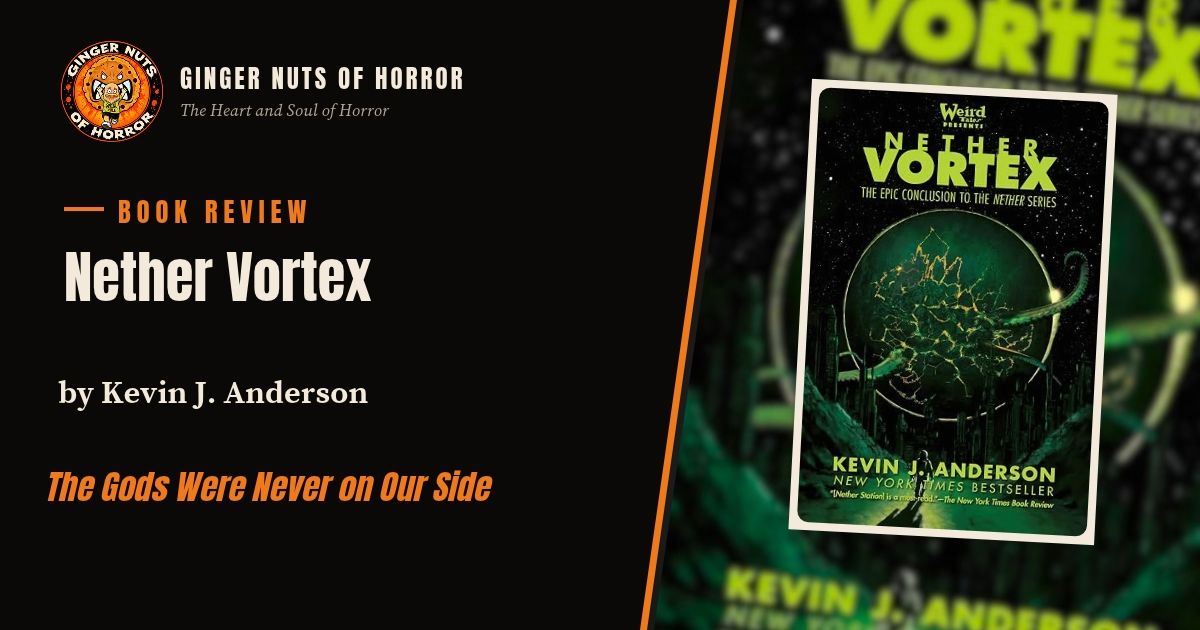
Nether Vortex | Kevin J. Anderson | Blackstone Publishing | 27 October 2026 |
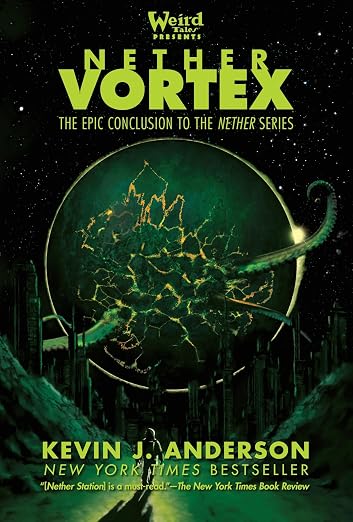
- Author Kevin J. Anderson
- Publisher Blackstone Publishing
- Published 27 October 2026
- Pages 410
- Format Hardback, ebook, audiobook
- ISBN 9798874816872
- Series The Nether Series, Book 2
- Subgenre Cosmic horror, space opera
- Reviewed by Jim McLeod
Five years after Nether Station went dark, its lost crew have become soldiers in an alien war against the soul-eating Agoc, while the woman left behind races home to warn an Earth that would rather not listen.
This Nether Vortex review looks at the second book in the Nether series. Kevin J. Anderson picks up five years after the hole in space swallowed the crew of Nether Station. He takes a small, cold space horror and blows it out into a war across the galaxy. I came to it with one question. Could a writer this at home with big space opera keep the Lovecraft part honest? It is one of the larger cosmic horror novels to reach our horror book reviews this year. The answer turned out to be more interesting than I thought it would be.
Nether Vortex turns a lonely space horror into a war across the stars, then asks the right Lovecraftian question: what if the gods on our side are worse? The prose is plain and the jokes come thick, but the scale, the pace and that late turn make it a sequel worth the trip.
Nether Vortex Review: When the Gods on Your Side Are the Problem
There is a special kind of fear that comes with being saved. The rescue ship turns up. The door opens. Someone kind hands you a hot drink. Then you notice the badge on their sleeve, and you do not know it.
Kevin J. Anderson builds a whole book on that fear. It starts at the cold rim of the solar system. Margo Noor sits in her cabin with a steak and a glass of red wine, as her ship closes on the hole in space that took her brother. She is rich enough to bring her own chef on a four-year trip. She is sharp enough to call her brother’s grand dream his folly. It is a dry, funny start. Then she looks out of the window, and the joke dies.
The wormhole looked like a blinded eye, closed permanently, but distorted and bulging, as if something horrible pounded against it, trying to break out.
Hold on to that eye. Anderson does.
From there the book splits in two. On our side, Karla Arkourian wakes up. She is the tough old soldier who sent the last message from Nether Station, and she has spent almost five years frozen in a failing pod. Now she has to make Earth listen. On the far side of the hole, Cammie Skoura, Warren Drake and Glinda Roybal have spent the same five years at war. They fly the battered Neil Armstrong in a vast alien fleet.
Their comrades are insect folk, fungus folk and cold lizard folk, and all of them answer to the star beings. The foe is the Agoc, who eat souls. And Benedict Noor, the rich man whose bad choice woke the Agoc up, now hangs in a cell as a living window into their minds.
That is a lot of book. Nearly eighty short chapters, five or so points of view, two ends of a galaxy. It should be a mess. Mostly it is not. The short chapters help. Each one ends on a push, and the cuts between the strands feel like a film editor at work. You are never lost for long.
Is Nether Vortex Scary?
Yes, but not in the way the first book was. Nether Station was a haunted house in a tin can. Its fear came from being alone in the dark. Nether Vortex is much louder. There are battles over whole planets, bombs that burn worlds, and a monster the size of a moon made of eyes and limbs. You might think the dread would drain away once the fleets turn up. Some of it does.
What takes its place is a slow, sour unease, and it lives in the small scenes. Cammie goes to see Benedict in his cell, where alien brains sit and record his screams for study. It is hard to read. His sister’s talk with him later on is worse. Margo is the most sure of herself of anyone in the book. We watch that nerve crack in one short call. Anderson is good at this. He lets a strong person meet a thing that does not care how strong they are. Then he lets them feel it.
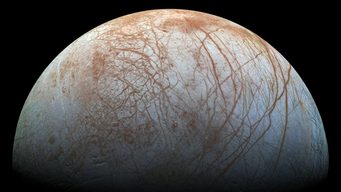
He is good at strange places, too. On Mars, Karla climbs a ridge above a frozen alien city as the sun comes up. The low light throws “shadows as sharp as guillotine blades” across buildings older than our species. Out at Jupiter, a small crew scans under the ice of Europa. The shape they find looks to one of them like a scan of an unborn child, “an embryonic spider inside a gigantic egg.” That is a lot of work for one image. It is the moment the book tells you the solar system is not empty. It never was.
Reading Anderson at his best is like a tour of an old church with a builder as your guide. He cares more about the walls that hold the roof up than the stained glass. But he never lets you forget how high the roof goes.
The Eye That Keeps Watching
Here I want to slow down. The best thing in Nether Vortex is a pattern you could read straight past.
Look at how often an eye turns up. The hole in space is a blind eye. The great red storm on Jupiter glares like one. The cracks on Europa are the red lines in a bloodshot eye. The star beings have heads like starfish, each with one still eye that seems to see it all. The badge of their alliance, painted on the hull of the Neil Armstrong, is a star with an eye in the middle. And the beast that comes for Earth at the end is a ball of eyes.

None of this is flagged. Anderson writes in a plain, quick style, and the motif hides in that plainness. But by the last act it adds up to a point. Everything out there is watching us. Almost nothing that watches us is on our side. That is the oldest idea in cosmic horror, and Anderson slips it into a war story through the back door.
It also answers a charge some readers made against the first book. They felt its Lovecraft was only skin deep, a few borrowed names laid over a space thriller. This time the debt is out in the open. Archibald Benton, a geologist from the 1930 Miskatonic trip to the South Pole, has lived with the aliens since his team stumbled through a gate in the ice. Cammie digs through old files and finds Cthulhu and Dagon. The alien base is called Kadath. These could have been winks and no more. Instead they feed a real idea about why Earth matters, and about who left the old horrors buried deep in our minds.
Spoilers follow for the last act of Nether Vortex. Skip to the verdict if you have not read it.
The star beings are the villains. Not cold allies. Not a needed evil. They are the root of the whole mess. Benedict, clear-headed for a rare moment, tells Cammie that the Agoc are pure evil, but the star beings are worse, because they made the Agoc. The huge ring the star beings build around Earth is not a shield. It is a trap. It is meant to swallow the Agoc and our planet in one gulp, with us as the bait.
This is the turn that lifts the book. For most of its length, Nether Vortex looks like a story we know well. A noble alliance, an old foe, plucky humans who prove their worth. Then Anderson pulls the floor away, and the story we know turns into a truly Lovecraftian one. The universe is not split into good and evil. It is split into things that eat souls and things that farm them.
The end belongs to Cammie, and that is right. She has always been the heart of the series. She is brilliant and awkward, and happiest deep in a sum. Here, with Benton and a half-free Benedict buying her time, she bends the ring into a hole that loops back on itself. The Agoc and the star beings both drop into it, and the fall has no floor. It is a win built from who she is, not from guns. It lands.
Not everyone makes it out. Margo Noor dies as her oil rig falls and an old city rises out of the Pacific beside it. Her last wish is that her brother could have seen it. It is a quiet, sad beat for a woman who spent the whole book refusing to be helpless.
End of spoilers.
The one thing that holds the book back from full marks is the prose line by line, and the jokes that come with it. Anderson writes for speed. His sentences are clear and his chapters move. But the talk leans on quips, most of all from Warren and Glinda, and not every quip earns its keep.
When a moon-sized horror is bearing down on Earth, a crack about overtime pay can let the air out of a scene that should stay tight. A few of the minor voices, such as the NOOR executive Ram Antilles, feel more like ways to move the plot than people. If you want cosmic horror told in a dense, uneasy style, this is a brighter, faster ride than you may like.
It is a real flaw, but a small one, since the book is not trying to be that kind of novel. It wants to be a big screen space opera with a rotten heart. At that, it wins.
This is a Kevin J. Anderson book through and through. The sprawl of The Saga of Seven Suns is here, with its habit of cutting between many people on many worlds. So is the dark wit of his Dan Shamble, Zombie P.I. books, though turned well down. His long years in other people’s worlds, Dune with Brian Herbert, Star Wars and The X-Files, show in how cleanly he runs a huge cast across a huge map. What feels new is how far he lets the horror win the fight.
The plain film match is Event Horizon. Anderson has named it as an influence on the series, and Paul W.S. Anderson, who made that film, has now signed on to direct both books for the screen. On the page, the nearest kin are At the Mountains of Madness, which the book builds on in the open, and the dead and dying star empires of Alastair Reynolds and his Revelation Space. If you want something smaller and closer, the Korean retelling A Plagued Sea makes a good pair. For a wider view of where the field is going, our look at cosmic horror in 2026 is worth your time.
Nether Station asked what was waiting on the far side of the dark. Nether Vortex gives the answer. It has been looking back at us all along.
The Verdict: Is Nether Vortex Worth Reading?
4.5out of 5
The verdict
A bigger, bolder sequel that turns space opera into true cosmic horror, held back only by plain prose and a few too many jokes.
Read it if: you enjoyed Nether Station, love space opera on a galactic scale, or want your Lovecraft with fleets, ancient ruins and a twist that changes everything.
Skip it if: you want slow, dense, literary dread, or you have not read the first book and dislike starting in the middle of a war.
Content warnings: body horror, graphic violence, torture, mass death and genocide on a planetary scale, death of major characters, strong language.

Keep reading on Ginger Nuts of Horror
 The Ravening Deep by Tim Pratt, Book Review
 A Plagued Sea by Kim Bo-young: The Korean Lovecraft Retelling That Grieves
 Cosmic Horror 2026: Ronald Malfi’s The Hive Novel & the Shadows Over Innsmouth Anthology

About Ginger Nuts of Horror
Ginger Nuts of Horror is an independent horror review and culture site based in Edinburgh, Scotland. Edited by British Fantasy Award nominee Jim McLeod, it publishes horror book reviews, film reviews, author interviews, features and cover reveals. Ginger Nuts of Horror won Best Inclusive Film & Book Review Platform at the SME News UK Enterprise Awards 2026.