
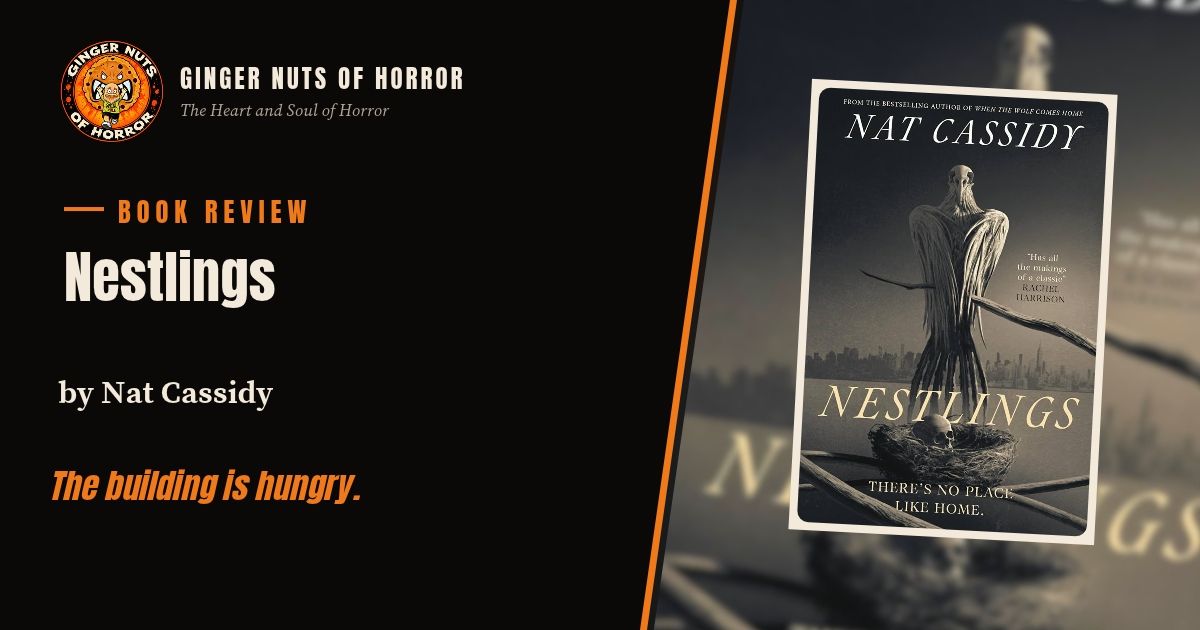
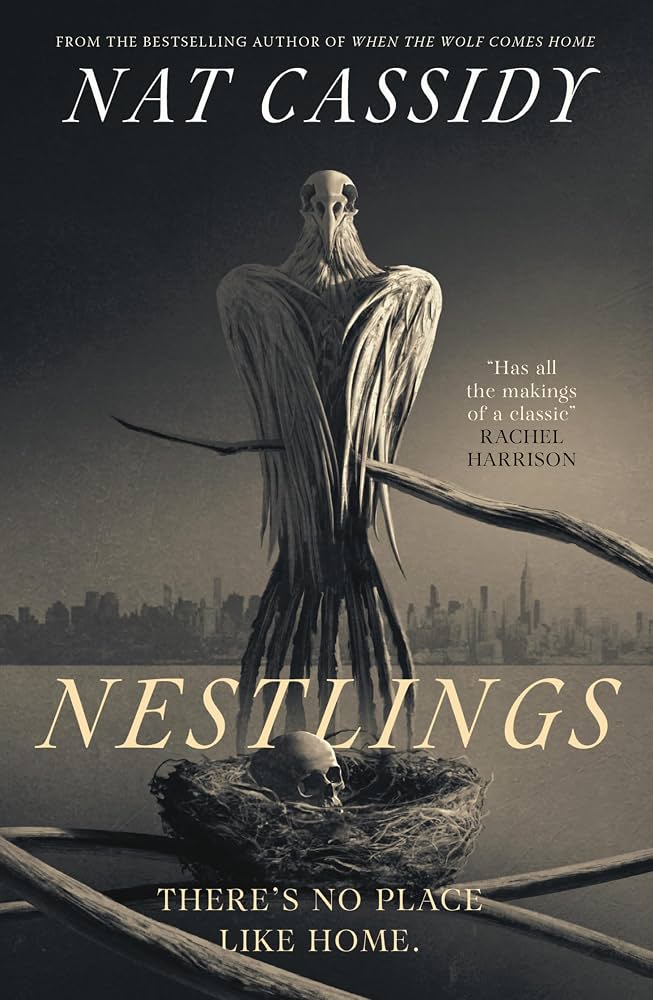
Nestlings | Nat Cassidy | Titan Books | 13 October 2026
- Author Nat Cassidy
- Publisher Titan Books
- Published 13 October 2026
- Pages 304
- Format Paperback, ebook
- ISBN 9781835418895
- Subgenre Apartment horror, vampire horror
- Reviewed by Jim McLeod
New parents Ana and Reid win a lottery flat in a grand Manhattan building overlooking Central Park. Their baby will not stop screaming, and the building seems to want something from all three of them.
Nestlings by Nat Cassidy came out in America in 2023, and the new Titan Books paperback brings it to British shelves at last. This Nestlings review looks at a vampire novel set in a grand Manhattan block, where a young couple and their baby win the flat of their dreams. Ana uses a wheelchair after a brutal birth. Reid is trying to hold everything up. The building has other plans for all three of them. Anyone who reads our horror book reviews will know how rarely an apartment novel gets past its debt to Ira Levin. Cassidy pays that debt in full, and then he keeps going.
Nestlings is the most controlled book Nat Cassidy has written: a Manhattan gothic about disability, new parenthood and the price of belonging, where the building does the biting. The last act explains a little more than it needs to, but the dread before it is as good as modern horror gets.
Nestlings Review: A Building That Wants Your Baby
New York has always sold its flats as a kind of luck. You do not earn the view of the park. You win it, or you inherit it, or you marry into it, and then you spend the rest of your life afraid that someone will notice you do not belong.
Nat Cassidy understands that fear in his bones, and his second novel is built on top of it. Ana and Reid are broke, worn out and barely speaking. Their daughter, Charlie, came after years of fertility treatment that drained their savings, and her birth left Ana paralysed from the waist down. Then an affordable housing lottery hands them a flat in the Deptford, an old and much admired building that looks out over Central Park. It is the break they have been praying for.
It is also, of course, a trap.
So far, so Bramford. Cassidy knows you have seen Rosemary’s Baby, and he does not pretend otherwise. The concierge with the fixed smile, the lift operators with their odd little grins, the neighbours who seem to have lived there forever: all of it is a nod to Levin and to Polanski’s film. What impressed me is how fast the book stops nodding and starts doing its own work.
The first piece of that work is Ana. She is angry. She is stubborn. She resents her husband, her own body and, worst of all, her baby. Most novels would treat that last feeling as the twist, the dark secret saved for page two hundred. Cassidy puts it on the table early and makes you sit with it. It is an uncomfortable choice, and it is the right one, because the horror of the Deptford grows straight out of the horror Ana already carries. When a mother is told by every book and every relative that she should feel joy, and she feels only dread, who is going to believe her when the dread turns out to be real?
The building makes that worse. The Deptford was not made with a wheelchair in mind, and every trip out of the flat becomes a fight. Cassidy never turns that into a plot device. It is simply Ana’s life, drawn with patience and without pity. She is not brave in the way disabled characters are so often forced to be brave. She is furious, and she is right to be.
Reid gets the other half of the book, and the two points of view rub against each other like stones. Where Ana is trapped, Reid is drawn in. He falls in with an elegant older resident who takes an interest in him, and he starts digging into the history of the place. As far as he can tell, only one book has ever been written about it. He is flattered by the attention of the old guard. He wants to belong. Cassidy is sharp on what that wanting costs a man who has spent his life on the outside, and sharper still on what it does to a marriage that was cracking long before the move.
Under all of this runs a very old story about class. The Deptford is old money, and old money has never liked new neighbours. Ana and Reid did not buy their way in. They were let in, by a lottery, and everyone in the building seems to know it. The lift is polite. The halls are quiet.
The residents smile. Yet every exchange carries the same small message, the one any tenant in any grand block will recognise: you are here because we allowed it. Cassidy makes that feeling as frightening as anything with teeth. In a city where a good flat can matter more than a good job, the question of who gets to stay is already a horror story. He just follows it to its end.
Is Nestlings Scary?
Yes, though not always in the way the cover suggests. The early scares are small and almost polite. A baby who will not stop crying. A strange film on the windows. A noise in the walls that might just be the pipes. A delivery driver who will not come past the door.
That last one is the cleverest touch in the book. In paraphrase, the scene is simple: Reid orders a takeaway, and the person bringing it refuses to set foot inside. No ghost appears. No blood is spilled. Yet the whole city has just told Ana and Reid something they do not want to hear. Everyone outside knows. Only the people inside are pretending.
Then there are the gargoyles. Early on, Ana looks out of the window and sees that the stone figures on the building, which were there the day before, have gone. I am paraphrasing here rather than quoting, but the way Cassidy handles it is worth a close look. The horror arrives as an absence, not a presence. Ana sees it from her chair at the window, the one view of the world the flat allows her.
Reid is not there to back her up. The prose stays flat and level, almost bored, as if she were noting the weather. That flatness is the point. A mother who has not slept in months has learned to doubt what she sees, and so the book teaches you to doubt it too. By the time the tiny, needle-like bite marks turn up on Charlie, you are as unsure of Ana’s eyes as she is.
Reading Cassidy’s prose here is like lying awake while an old radiator knocks in the next room. It is regular. It is domestic. And once you have noticed it, you cannot stop hearing it.
There is real horror later, and plenty of it. Cassidy is not shy with the body, and the creatures, when they come, are strange and nasty and wholly his own. The vampire has been done to death, but here it is braided with gargoyles, insects and Jewish lore into something I have not met before. I will say no more than that. The less you know going in, the better this book works.
The pandemic matters too. The story is set in that strange stretch when every flat in the world became a cell, and Cassidy uses it well. Ana cannot leave. Reid cannot stay away. Nobody can visit. In an afterword, Cassidy explains the personal reasons the book grew out of that time, and it adds a sad, human weight to everything before it. Do not skip it.
How Nestlings Compares to Mary and When the Wolf Comes Home
Cassidy came to novels from the stage, after years of writing plays and playing villains on American television. His first book was a novelisation of the podcast Steal the Stars in 2017. Mary: An Awakening of Terror followed in 2022, a big, loud debut of more than four hundred pages that sometimes let its plot run off the leash. Nestlings came a year later and is a tighter, colder thing. Rest Stop, the novella that earned him a Bram Stoker Award nomination, showed how much he could do in a small space. When the Wolf Comes Home, from 2025, is his wildest ride, and the one Stephen King called a classic.
Of all of them, Nestlings is the most controlled. Mary shouted. The wolf book howls. This one whispers, and the whisper carries further. You can see the playwright in it: the long scenes between two people in one room, the ear for how couples fight in half sentences, the way a single door can carry a whole act.
It also sits well beside the new wave of motherhood horror. Zoje Stage’s Baby Teeth and Rachel Yoder’s Nightbitch both ask what happens when a mother does not feel the love she is told to feel. Cassidy asks the same question from inside a marriage, with both parents given a voice, and he adds a layer those books do not have. Ana and Reid are Jewish, in a city and a country where old hatreds are waking up again. The antisemitism in Nestlings is quiet, social and constant, a remark here and a look there, and it lands all the harder for never being shouted.
And it belongs to a strong run of books that have taken the vampire back from the romance shelf. Stephen Graham Jones did it with history and grief in The Buffalo Hunter Hunter. C. J. Tudor did it with a small-town mystery in The Gathering. Cassidy does it with a housing lottery. His monsters are not lovers or kings. They are something closer to landlords, and they are hungry.
Now the flaw. Most of the dread in Nestlings comes from not knowing. Is Ana right, or is she ill? Is the building alive? What does the old guard want with Reid? In the last stretch, Cassidy starts to answer, and the answers, though inventive, are never quite as frightening as the questions. The pace slows somewhere around the three-quarter mark as the book stops to explain how its world works. Readers who like their horror left in the dark may feel some of the air go out of it. It is a real flaw, but a small one, and the closing pages win back most of the ground.
The other thing worth knowing is that neither lead is easy to like. Ana says cruel things. Reid makes selfish choices. If you need someone to cheer for from the first page, you may struggle. I think that is the book’s courage, not its weakness. People in pain are not always kind, and Cassidy trusts you to care about them anyway.
What stays with you, in the end, is the title. A nestling is a bird too young to leave the nest. It cannot fly. It cannot feed itself. It can only open its mouth and wait. Cassidy spends three hundred pages asking who in this family is the nestling, and who is doing the feeding.
The answer is not the one you want.
4.5out of 5
The verdict
A tense, sad and truly frightening Manhattan gothic, held back only slightly by a last act that explains more than it needs to.
Read it if: you love Rosemary’s Baby, slow dread, and horror that takes disability and new parenthood seriously.
Skip it if: you need likeable leads, or birth trauma and harm to babies are things you would rather not read about.
Content warnings: infertility, birth trauma, medical trauma, postpartum depression, suicidal thoughts, harm to babies, body horror, insects, ableism, antisemitism.
Keep reading on Ginger Nuts of Horror
 The Gathering by C. J. Tudor
 Keith Rosson’s Coffin Moon: A Gripping Descent into Darkness
 Reign of Terror: How Brian Lumley and Keith Rosson Reforged Modern Vampire Mythology
About Ginger Nuts of Horror
Ginger Nuts of Horror is an independent horror review and culture site based in Edinburgh, Scotland. Edited by British Fantasy Award nominee Jim McLeod, it publishes horror book reviews, film reviews, author interviews, features and cover reveals. Ginger Nuts of Horror won Best Inclusive Film & Book Review Platform at the SME News UK Enterprise Awards 2026.