Every franchise monster starts as pure terror and ends up on a leash.
Every great horror monster starts as pure terror and ends up as merchandise. What began as the unknowable other gets named, codified, branded, and finally leashed like a pet. The creatures that stay frightening are the ones nobody ever turned into a franchise. The monster that stays wild stays scary.
Re-run of the Repressed (or why every franchise monster you’ve ever loved ends up as a dog on a leash …) by Philip A. Suggars
[Contains mild spoilers for Alien: Earth, Halloween, Friday the 13th, My Bloody Valentine and A Nightmare on Elm Street]
The idea for this issue has been gestating in my chest ever since I watched the last couple of episodes of FX’s Alien: Earth series, so look away now if you don’t want any spoilers.
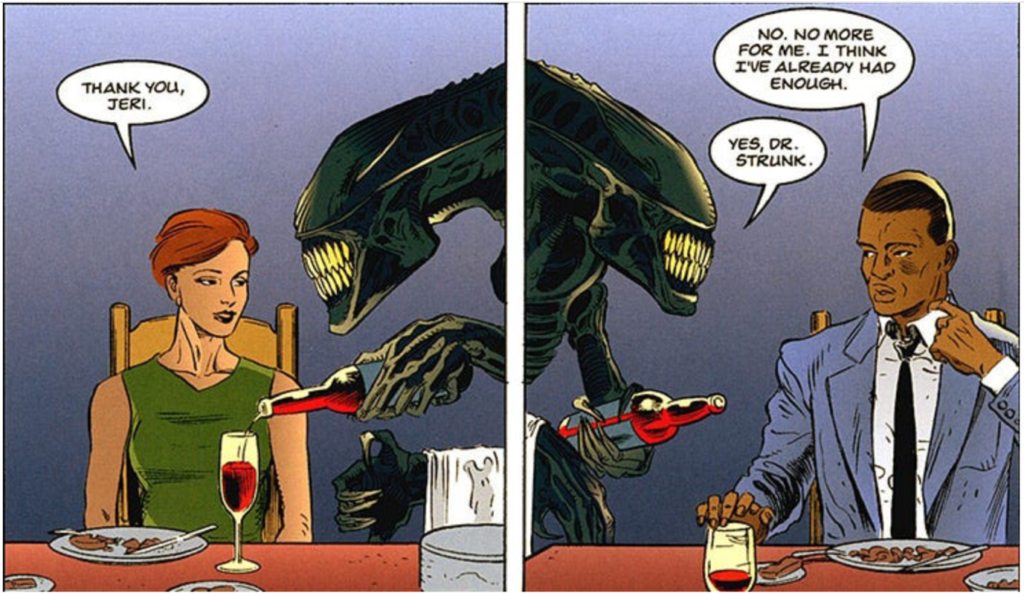
In those final episodes, as Wendy and the rest of the Lost Boys assert their autonomy to escape Prodigy control they wind up recruiting a Xenomorph as a sort of acid-breath-Lassie that comes at Wendy’s call to tear their corporate henchie pursuers into dog food.
What this series really crystallised for me was the way that in any long running horror franchise there is an almost inevitable slide towards the domestication of the monster. Something which begins as pure unbridled terror, always seems to end up completely defanged: a pet.
But to work out why something isn’t scary anymore perhaps we have to explore what made it scary in the first place.
How horror gets horroring
In terms of scare factor, or the horror affect, there are two main theories and they both begin with Freud. I think most people these days would agree there’s probably quite a lot wrong with Freud, but his concept of the Uncanny outlined in his 1919 essay ‘Das Unheimliche’ (the Uncanny) is quite a useful jumping off point for this discussion.
In this essay, Freud defines the Uncanny as, “that class of the terrifying which leads back to something long known to us, once very familiar”. Heimlich means something that belongs to the house, familiar and intimate, but can also mean concealed, kept from sight or withheld from others. Consequently, Unheimliche describes something eerie and frightening. Something that was intimate, hidden and/or buried but which is now revealed. The unexpected and terrifying return of that which has been repressed.
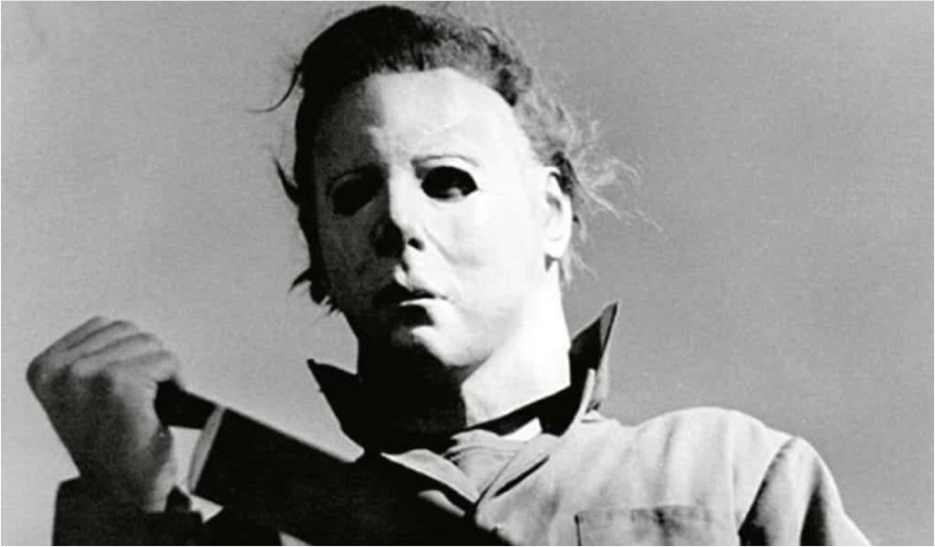
Years later in his seminal essay for Film Comment magazine, “The Return of the Repressed”, Robin Wood used this psychoanalytical framework to explore how movie monsters can be read as the reemergence of what society represses in order to function. Specifically (but non-exhaustively), female sexuality, threats to the nuclear family, questions of race, class and heteronormativity.
The evidence seems hard to argue with. Taking these one by one, readers will be only too familiar with the “horny women die first” or “sex signals death” trope. This can be seen in the opening of Friday the 13th, the death of Tina at the hands (talons) of Freddy Krueger in A Nightmare on Elm Street (1984) or the gruesome end of Mike and Harriet in My Bloody Valentine (1981).
Freddy also maps to the idea of parental sin (in this case he really is the return of repressed familial guilt), while Night of the Living Dead transforms racial violence into stumbling disinterred flesh. Frankenstein’s creature and Jason Voorhees, both throwaway children, are proxies for the dispossessed underclass and finally, homoeroticism and inversion of the family are common themes in many vampire movies.
As Wood points out, each of these films present opportunities for society (i.e. the monster’s victims) to attempt to deal with the repressed that the monster represents. In what Wood terms reactionary horror, victims must return to the bounds set by society (i.e. “good values“) in order to banish the threat (A Nightmare on Elm Street, I’m looking at you). In more progressive films (e.g. the original Night of the Living dead and The Texas Chainsaw Massacre) the underlying injustice/original sin must be exorcised before the status quo can be restored (at least temporarily).
Weird be getting weirder
But not all horror seems to work this way. Mark Fisher uses his book The Weird and the Eerie (2016) to suggest that there is another category of monster altogether: those threats that are ontological, that is to do with the nature of being, rather than merely psychoanalytical. For him, something like Lovecraft’s cosmic horror or Carpenter’s The Thing are eruptions into human reality of “the outside”.
Where the psychoanalytical uncanny can be said to make the familiar strange, these xenosemic horrors introduce the genuinely untranslatable. The term (from xenos, foreign, and sema, sign) describes monsters that operate outside human symbolic systems entirely. In contrast to hidden meanings that are uncovered, these are meanings that were never human to begin with.
If all monsters are scary because they function either as something which has been hidden through repression or something that is totally outside human meaning, then both are essentially categories of the unknowable “other”. Given this understanding it’s possible to see how successive franchise outings tend to cancel this out.
Phase 1: eruption (“I admire its purity”)
In this phase we get the monster as its purest manifestation of “the outside” or “the repressed”.
If we think of the original Alien, the title tells us everything that we need to know about the eponymous creature. Back in 1979 there were no taxonomies, it was just “that goddamn thing”. Much of its horror derived from its unintelligibility.
Similarly, Michael Myers was credited as just “the shape” in his inaugural outing and described as “purely, simply, evil,” by Doctor Loomis, the psychologist who treated him for years. Myers’ fixation on Laurie appears to have no logic or motive. (In fact, Myers is an interesting example of an entity that sits within both of the categories we’ve defined here. Although he’s positioned as the return of repressed familial violence, he functions in the film as a kind of xenosemic intrusion, in that he is both motiveless and essentially unkillable.)
Freddy Krueger for his part is at his most psychotically primal in, A Nightmare on Elm Street. Returning to the notion of the Unheimliche, he inhabits the most familiar and intimate place that his victims should be safe within, their dreams. In Nightmare Freddy hardly speaks at all, and while an origin story exists, the film itself doesn’t explore it.
Phase 2: codification (“There are certain rules that one must abide by”)
Once that first movie has been a success, well then, the amputated head is well and truly rolling.
Subsequent franchise films demand lore and as fans and films build meaning around the creature, it starts to become explicable. Mythologies arise, witness Jason’s immortality, the Alien lifecycle (absent from the original instalment) or Freddy’s dream lore. Even naming a creature lessens its otherness. The viewer’s attention shifts from asking the question, “what the hell is that?” to “who dies next?”
Phase 3: icon (“Welcome to prime time, bitch!”)
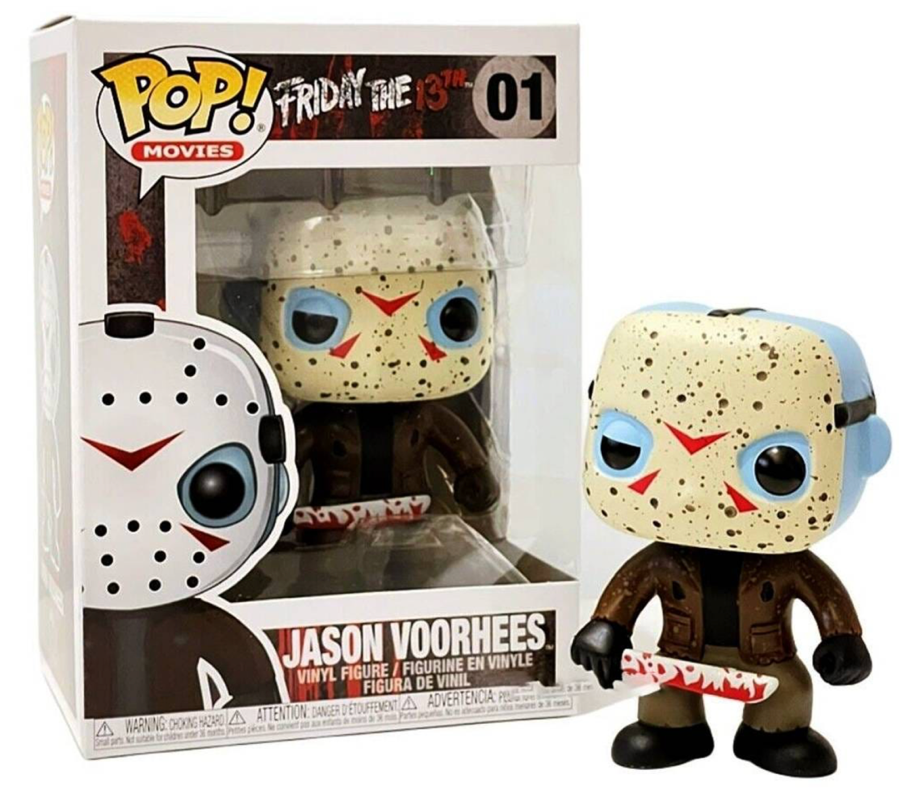
Success breeds success and consequently, the monster becomes a brand identity. It appears on lunch boxes, becomes a Halloween costume, or is the focus of thirteen limited edition Funko Pops (yeah, yeah, I’ve got them all too).
Now franchise instalments increasingly dwell on filling out esoteric bits of lore, providing backstory and/or are peppered with endless easter eggs.
Phase 4: domestication (“This is a multi-million-dollar installation. He can’t make that kind of decision. He’s just a grunt.”)
By this final stage all of the creature’s otherness has been neutralised, the poor creature’s ability to scare hollowed out and filled with merch. Witness Alien: Earth or those annoying pet raptors from Jurassic World.
Here Xeno! Fetch!
Each successive phase of domestication builds upon the last, smoothing over the entity’s essential unknowability, locating its contradictions and otherness within a familiar web of meaning, estranging it further and further from its original horror affect and turning it into (gasp!) a product.
In much the same way that Adorno theorised that radical art is always disarmed by the culture industry, horror’s monsters face extinction not from pitchfork wielding mobs, but from familiarity and the relentless appetite of our cultural metabolism.
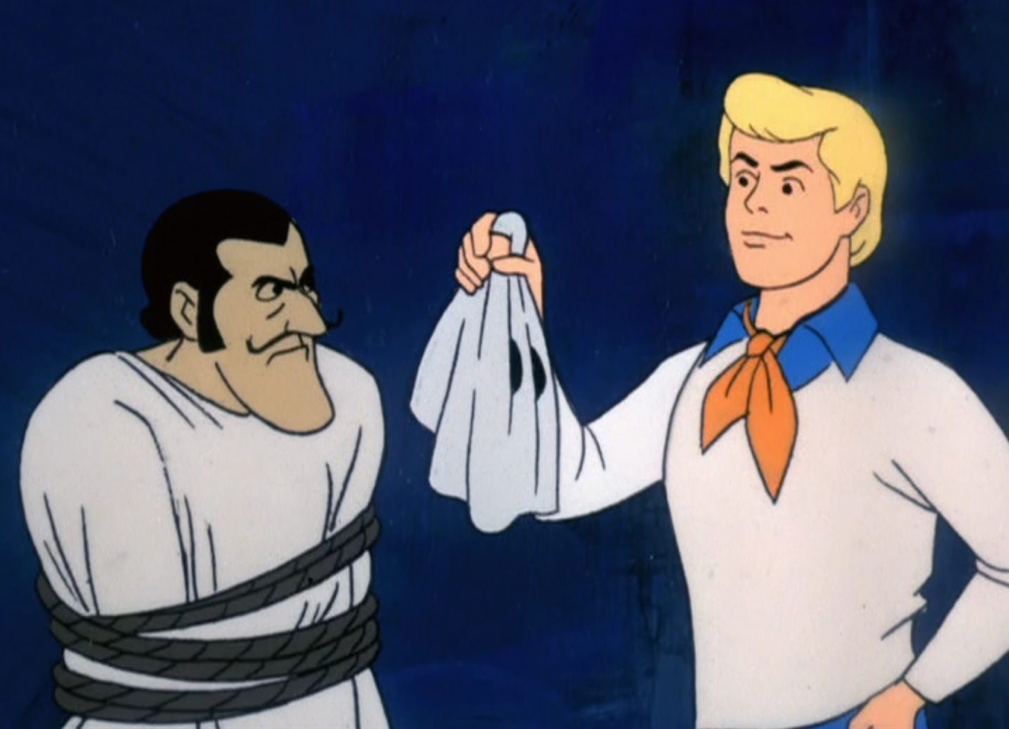
And yet, some monsters resist.
Carpenter’s The Thing endures perhaps because it never spawned a franchise. There is no mythology, no merchandise, no (un)happy meals. Similarly, the “It” in It Follows remains unnamed and undigested (for now at least). These remain what they always were: unknowable, unassimilated and genuinely terrifying.
The monster that stays wild stays scary.
Cities of the Drift – The Lighthouse at the End of the World by Philip Suggars
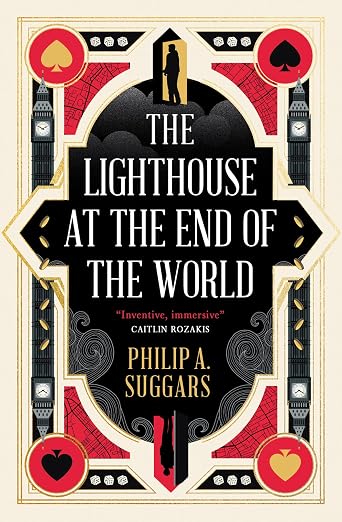
Enter a London like no other in this fast-paced, captivating fantasy novel, perfect for fans of V.E. Schwab and Genevieve Cogman.
Oyster McLellen has spent his life causing mischief. Running with a small-time gang and fleecing money from tourists in Hyde Park to support his struggling family in the absence of his father, who abandoned them years ago.
When a simple money drop for his boss, Big Mickey, goes wrong, Oyster’s future looks bleak. His only chance to redeem himself in the eyes of Mickey is to get the money back, but as he pursues the thieves across South London he suddenly finds himself washed up on a beach, surrounded by broken phones and shattered office furniture.
His new world: Greater London. A city built on the detritus of our own, where leviathans crafted from broken skyscrapers roam the seas, where ink beetles nestle beneath the skin of its residents and where Oyster’s father, Lucas, may well have escaped to all those years ago.
But there are bigger things at stake. Oyster’s allegiances are torn between the enigmatic Nonesuch, the eccentric escapist Marya Petrovna, and the terrifying Mr Primrose – and he will have to choose who to align himself with quickly. Because plans are afoot: something ancient is brewing, and a choice needs to be made, the consequences of which will determine the fate of Londons, and life, everywhere.
Philip A. Suggars

Philip A. Suggars has a single yellow eye in the middle of his forehead and a collection of vintage binoculars.
His weird fiction/fantasy debut The Lighthouse at the End of the World was selected by Barnes and Noble as their speculative fiction pick for April 2026. His work has also appeared in a range of publications including Strange Horizons, The Guardian and Interzone as well as being featured on many short-form podcasts.
His writing has won the Ilkley short story prize, been long-listed for the BSFA short story award and been included in The Best of British Science Fiction Anthology series. He has an MFA in Creative Writing from Birkbeck University.
When not writing words, he records music as one half of the post-punk electronica outfit, we are concrete. Born in South London, he currently lives on the south coast with his family. His debut novel, The Lighthouse at the End of the World, was published by Titan Books and was Barnes and Noble’s speculative fiction pick for April 2026.
Ginger Nuts of Horror: The Heart and Soul of Horror Reviews

Looking to get your horror book or film in front of the genre’s most dedicated audience? Ginger Nuts of Horror is one of Europe’s largest independent horror review websites, with over 30 contributors publishing horror book reviews and horror movie reviews almost every single day.
We offer far more than reviews. Authors, filmmakers and publishers can promote their work through in-depth horror book reviews, horror film reviews, comic and video game coverage, news features, and our popular author and director interviews like Five Minutes With. Our guest feature series, The Horror of My Life, Childhood Fears, The ? That Made Me and more, let creators tell their story while promoting their latest release.
Every feature is built to sell your work. We include backlinks to your website or Amazon author page, a full synopsis, and a universal purchasing link that sends readers straight to their local store. Add a large, engaged social following and an 18-year archive of trusted horror coverage, and you have a platform genuinely built to grow your readership.
Whether you’re an established author, an indie filmmaker, or a debut voice in indie horror, there’s a way for us to help you reach more fans. Explore our horror book reviews and horror movie reviews, then get your horror book or film featured today.


Jim "The Don" McLeod has been reading horror for over 35 years and reviewing it for more than 16. He's the editor of Ginger Nuts of Horror, Europe's largest independent horror review and culture site, and a British Fantasy Award nominee for his work in the genre. When he's not busy inflicting his opinions on the horror community, he can be found annoying his family or getting thoroughly outwitted by his two dogs, Casper and Molly.