
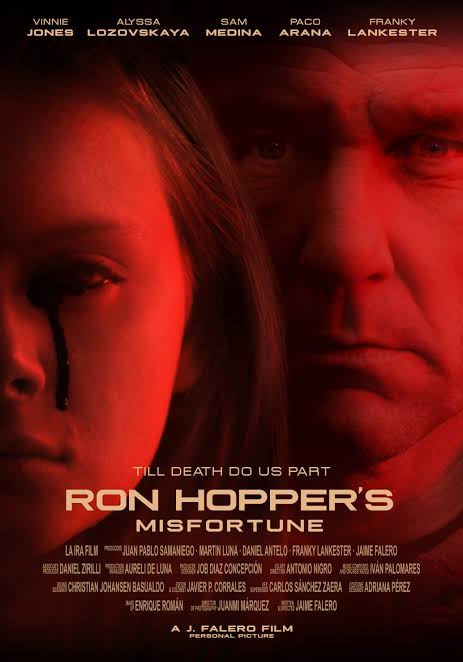
- Director Jaime Falero
- Starring Vinnie Jones, Alyssa Lozovskaya, Sam Medina
- Released 2020
- Runtime 1 hr 33 min
- Certificate Unrated (US)
- Distributor Indie Rights (US)
- Subgenre Dark fantasy
- Reviewed by Jim McLeod
A young woman keeps returning to an abandoned garage in the middle of nowhere, where a mysterious man called Ron Hopper has waited for longer than anyone can remember, ready to share the secrets of his strange existence.
Ron Hopper’s Misfortune is the third feature from Tenerife director Jaime Falero, a dark fantasy fable with Vinnie Jones as a mysterious figure who has waited in an empty garage for longer than anyone can say. This Ron Hopper’s Misfortune review looks at what happens when a former football hard man is cast as the patient host of a place between worlds, and why it works far better than it has any right to. The film is slow and painterly, soaked in deep reds, and full of talk about love, time and death. It is not quite horror, but it lives next door. Here is why I think it is worth your evening.
Ron Hopper’s Misfortune is a slow, painterly fable about love, time and death, built around a sincere and gravel-voiced Vinnie Jones. It takes its time, then takes a little more, but Jaime Falero’s eye and Jones’s lived-in presence make a lonely garage at the end of the world a place worth lingering.
— GINGER NUTS OF HORROR
Ron Hopper’s Misfortune Review: Jaime Falero Lets Vinnie Jones Be Vinnie Jones
A car talks. Not in the Christine way, all headlamps and grudges, but in a quieter and odder way. A young woman walks into a dead garage in the middle of nowhere, starts talking to herself, and something inside an empty car answers back. That voice belongs to Vinnie Jones. Of course it does. There are few voices in British film you would sooner hear coming out of the dark, and fewer still you would trust less.
That is the hook of Ron Hopper’s Misfortune, the third feature from Jaime Falero and the first he wrote on his own. Sarah, played by Alyssa Lozovskaya, keeps coming back to this abandoned workshop to sit with Ron Hopper, a being who has been anchored to the place for as long as anyone can tell.
He greets every soul who wanders in. He offers each of them a look at the secrets of his odd little life. What follows is not a horror film in the strict sense. It is a fable about love, time and death, shot like an oil painting, with a man best known for squaring up to people in Guy Ritchie films at its gentle, gravelly heart.
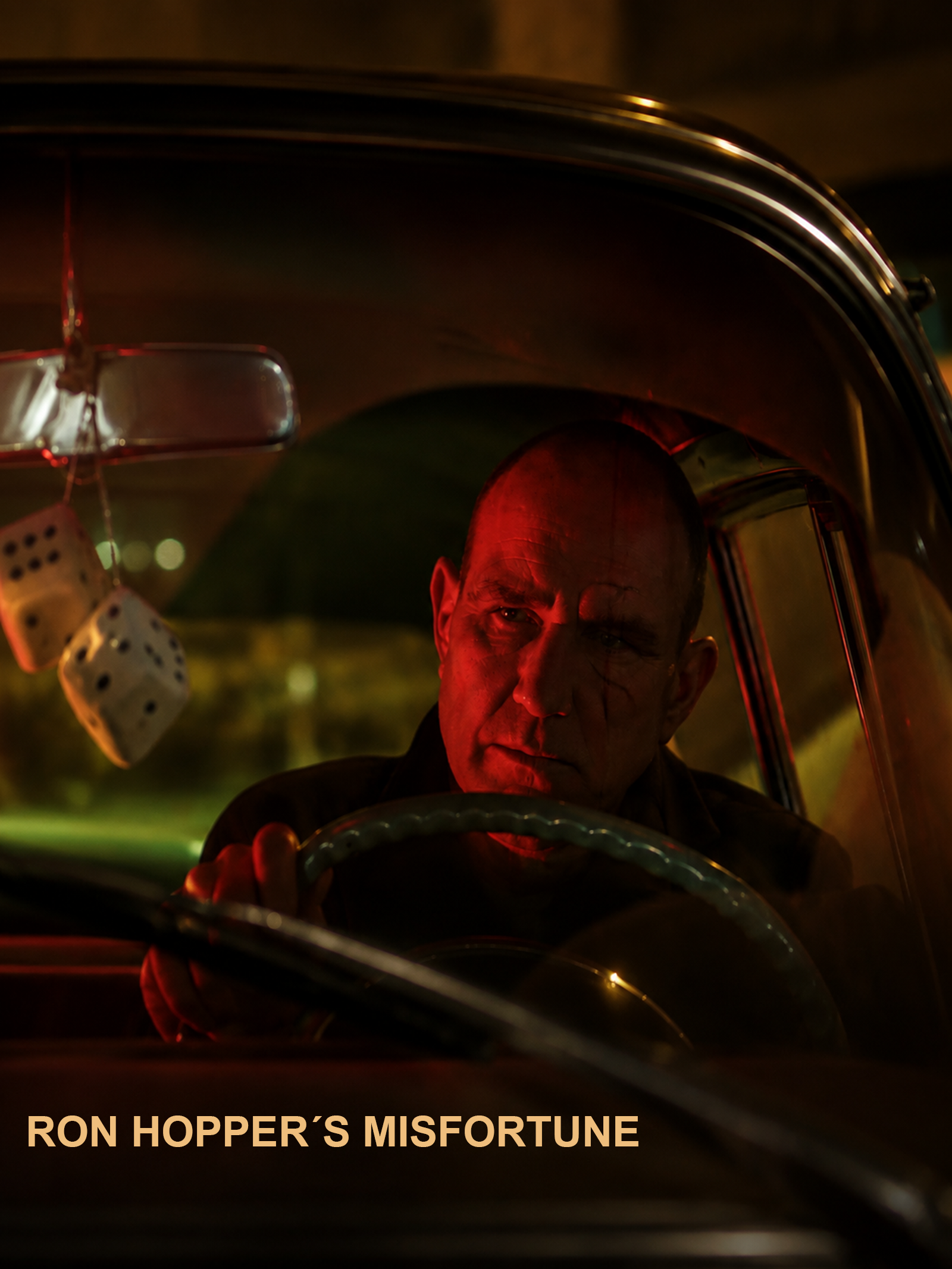
The best way to describe the experience is that it feels like being told a story by someone who will not be hurried. Falero builds the film out of conversations. Sarah and Ron circle each other and trade lines about beginnings and endings, pleasure and pain. Ron talks in proverbs. Sarah answers in riddles. At one point he asks if she is afraid, and she says she is, and that she rather likes it. That little exchange is the whole film in miniature. The fear is real, but it is the pleasurable kind, the kind you get from a fairy tale read aloud with the lights off.
The official synopsis nudges you towards Little Red Riding Hood, and the nudge is fair. Sarah is pale and curious, and she keeps straying off the path. Ron is the thing waiting at the end of it. The garage is the cottage in the woods, only with oil on the floor. Is he the wolf, or the woodcutter? The film dangles that question for a long time, and it is a good question to dangle.
Then the story starts to travel. Falero moves between medieval Europe, Europe in the 1940s, and a timeless pocket of the world that borrows its look from the 1950s and the 1980s. I will not say how or why, because the why is half the fun. What matters is the effect. Each jump feels like someone turning the page of an old storybook to find a fresh illustration, and the film is at its best when it lets those pages breathe.
They breathe a lot, mind. This is slow cinema, on purpose. Falero leans hard on slow motion and lets moments hang long after a quicker film would have cut away. That is where my one real reservation lives, and I will come back to it.
First, the look of the thing, because the look is where Falero earns his keep. This was made for around two and a half million dollars, raised from private investors, by a director working out of the Canary Islands. On screen it looks like a good deal more. Deep reds soak almost every frame. The sets are theatrical in the best sense, built to be looked at rather than lived in, and the camera finds angles that keep a single location from ever going stale. Late on there is a stretch in black and white that is the most striking passage in the film, a sudden drain of colour that makes everything around it feel warmer.
Falero has named Hitchcock, Leone, Polanski, Zemeckis, Scorsese, Tornatore, Kurosawa and Carpenter as his touchstones, and he wears them openly. You can feel Leone in his patience and Tornatore in his fondness for old cinema. He has also said that some scenes nod to The Seventh Seal and Sin City, and that black and white stretch feels like the place where those debts get paid. None of it plays like theft. It plays like a fan who has finally been handed the keys and wants to show you every room in the house.
There is also a unicorn. I will say nothing more about it than that, except to note that any film brave enough to put a unicorn in the same story as Vinnie Jones has earned a bit of respect. It is that kind of film. It commits. When it reaches for something strange, it does not wink at you while it does it, and that lack of irony is a large part of its charm.
Now, let us talk about Vinnie. Let us be fair to him, too, because he deserves it.
Nobody is going to finish this film and start drafting his BAFTA speech. He is not suddenly Daniel Day-Lewis. He is Vinnie Jones, and Falero knew exactly what he was getting. The director has said he wanted one recognisable star, and that he picked Jones for his imposing presence, his strong voice, and the simple fact that he had barely touched a dramatic role before. That honesty runs right through the casting. Jones does not vanish into Ron Hopper. Ron Hopper moves into Jones, puts the kettle on and makes himself at home.
And it works, far more often than you would expect. The voice is the key. That low gravel and flat Hertfordshire delivery give Ron’s proverbs a weight the lines might not carry alone. Talk about being born alone and dying alone would sound like a fridge magnet from most actors. From Jones it sounds like a warning from a man who has watched it happen more than once. The face helps as well. It is a face with a few stories in it, and Falero is smart enough to point the camera at it and wait.
There are moments where his stillness tips over into plain stiffness, where you can almost see him working out what to do with his hands. But it is a sincere performance, and sincerity matters more here than technique. Horror fans will know him best as Mahogany in The Midnight Meat Train, all silent menace and meat hooks. Here he gets to talk, and soften, and wonder aloud about love. Watching the hard man from Lock, Stock and Two Smoking Barrels play a lonely soul in a garage is funny for about two minutes. After that it is oddly moving, and I mean that kindly.
Alyssa Lozovskaya has the harder job, because Sarah is more question than character for much of the running time. Falero found her online through a reel of facial expressions with no dialogue, and cast her without a screen test. That makes sense once you see her, because her face does most of her work.
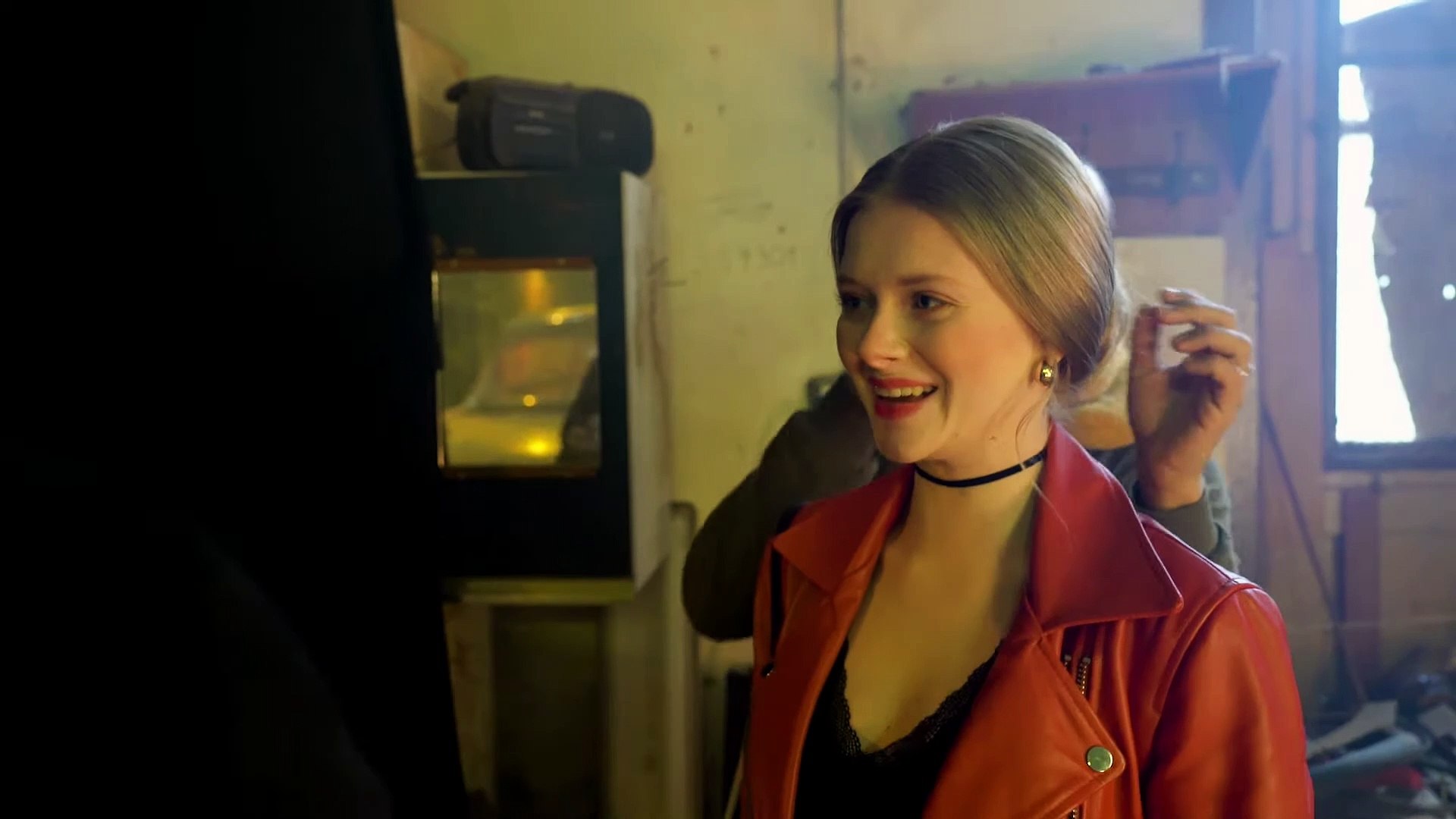
She is good at listening, which in a film built on long conversations is half the battle. Around the two of them drift a gangster played by Sam Medina, Franky Lankester’s Lord Lankester, Román Reyes as Jamie, Lou Di Giorgio as the Judge and Paco Arana as the Man in Black. They pass through like figures from a tarot deck, there to mean something rather than to be someone.
So what is it all about? Falero has called it a film about love, the passage of time and death, and that is as good a summary as any. At one point Ron tells Sarah that death loves life more than words can say, and that line is the key that opens the rest. The garage is a waiting room.
The empty car is a sort of coffin with a radio in it. Ron is a man, or something like a man, who has turned waiting into its own kind of devotion. The fairy tale warning was always to stay on the path. Here the straying is the point, because the path only ever led to the same lonely place.
There is something quietly brave about a film that treats death as a romantic partner rather than a monster. It is not a new idea, and Meet Joe Black got there with far more money. But Falero comes at it from the fable end rather than the romance end, and that gives it a strange, old world flavour. You feel you are being taught something, even when you are not sure what.
That flavour is new for Falero. His first film, El Clan, was a thriller with a streak of dark humour, made for around 500,000 euros and shot in 21 days. His second, Bunker: Project 12, was a full-blooded tribute to 80s action films, with James Cosmo and Eric Roberts chasing a buried Cold War secret. Both were genre jobs done fast and done cheaply, and both found buyers around the world. Ron Hopper’s Misfortune keeps the same knack for stretching a budget, but this time the credits call it his first personal film. You can tell. This is a genre craftsman deciding he has something to say, and saying it with his whole chest.
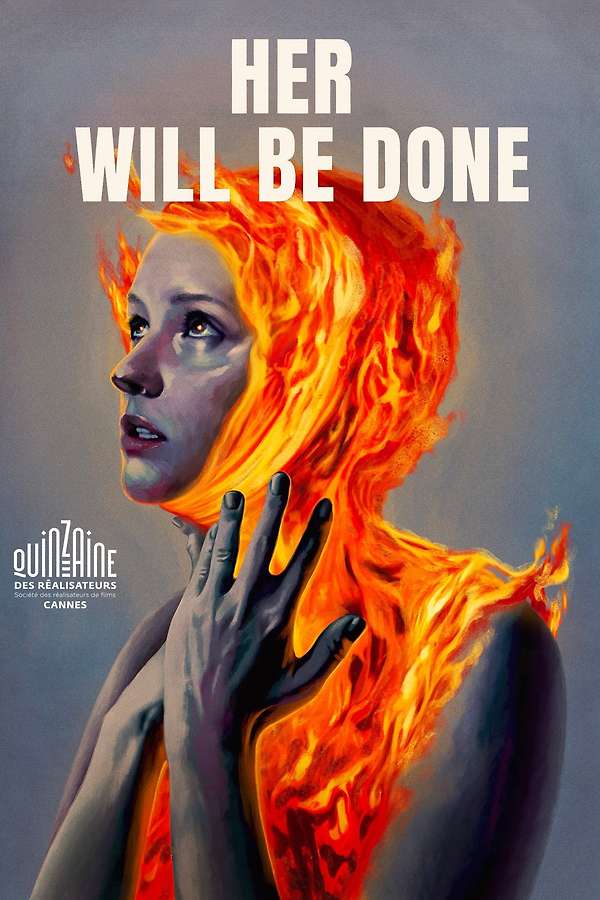
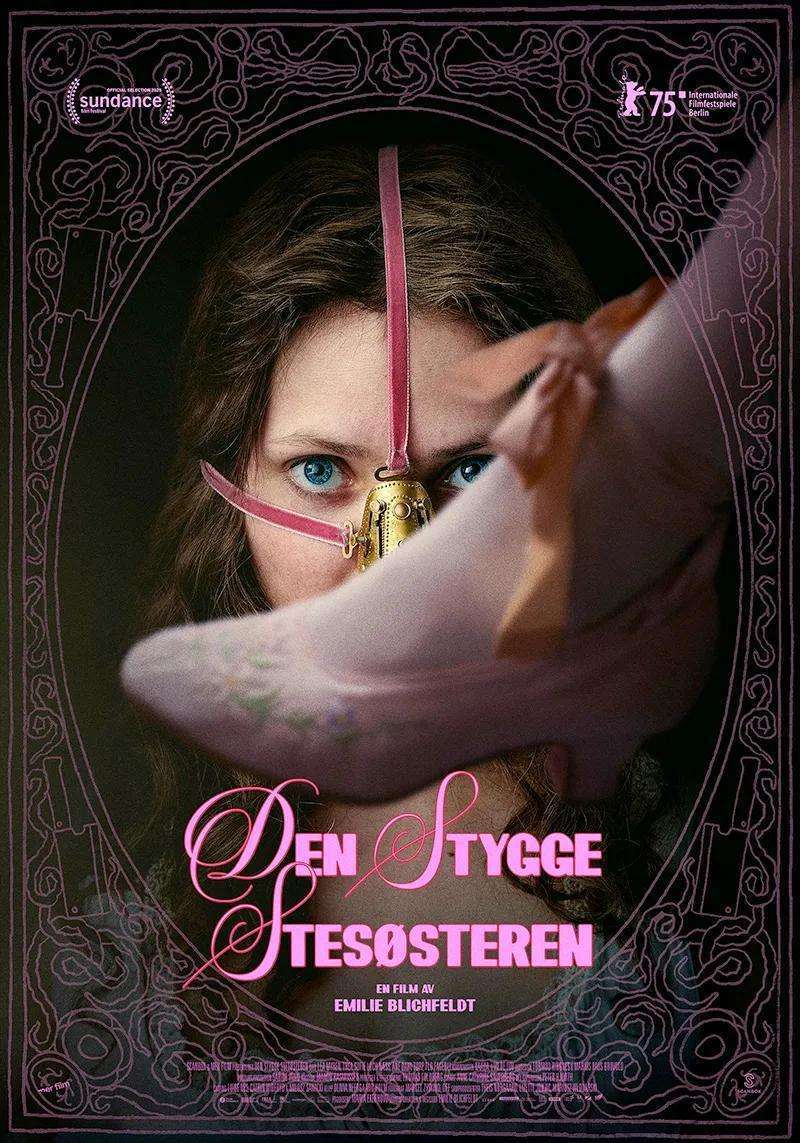
Where does that leave it in the genre? On the edge, happily. The fairy tale has had a bloody few years, from Emilie Blichfeldt’s grisly The Ugly Stepsister to the grindhouse snarl of Dolly. Ron Hopper’s Misfortune is the opposite of those. It has no interest in gore and very little in shocks. Its true neighbours are films like Oz Perkins’ Gretel & Hansel, with its patience and its painted frames, or the gentle death rattle of The Seventh Seal, with a dash of Christine for the talking car.
What sets it apart is the casting. No one else would have put Vinnie Jones at the centre of a fable this tender, and that one odd choice gives the whole film its personality.
Is Ron Hopper’s Misfortune Scary?
Not really, and I do not think it wants to be. It is unsettling rather than frightening. The dread comes from the slow sense that Sarah is walking towards something she cannot walk back from, and from Ron’s calm certainty that she will keep coming. If you want jump scares, you will be waiting a long time. If you like the feeling of a story closing around you like fog, there is plenty here.
Which brings me to that reservation. The film is too long by a good stretch. There are three or four moments near the end where it could stop and leave you on a perfect note, and each time it decides to keep going. The slow motion that looks so lovely early on starts to feel like a habit by the final act. None of this sinks the film, but it does test the patience of anyone not already under its spell, and a tighter cut would have made the ending land harder.
Still, I keep coming back to that garage. To the reds, to the unicorn, to the sight of Vinnie Jones talking softly about love to a girl in a red hood. It is a rare thing, a low budget fantasy that takes itself seriously and earns the right to. It belongs among the stranger corners of our horror movie reviews, and I am glad it found its way there.
Ron Hopper has waited in that garage forever. Give him ninety-three minutes, and let Vinnie Jones talk you into staying.
The Verdict: Is Ron Hopper’s Misfortune Worth Watching?
4out of 5
The verdict
A gorgeous, unhurried fable that knows exactly what Vinnie Jones is for, even if it lingers a little longer than it needs to.
Watch it if: you like dark fairy tales that swap jump scares for mood, painterly low budget fantasy, and the idea of Vinnie Jones talking philosophy in an empty garage.
Skip it if: you want fast horror with a body count, or slow motion tries your patience.
If you liked this, watch

Content warnings: death and mortality themes.
Keep reading on Ginger Nuts of Horror
 Fairy Tales & Horror by Shannon Knight
 Latino Horror Unleashed: The Fright Club Picks the 6 Spanish Language Horror Movies You Can’t Miss
 The Best Horror Movies of 2025 and Why 2026 is Already Twitching
About Ginger Nuts of Horror
Ginger Nuts of Horror is an independent horror review and culture site based in Edinburgh, Scotland. Edited by British Fantasy Award nominee Jim McLeod, it publishes horror book reviews, film reviews, author interviews, features and cover reveals. Ginger Nuts of Horror won Best Inclusive Film & Book Review Platform at the SME News UK Enterprise Awards 2026.