
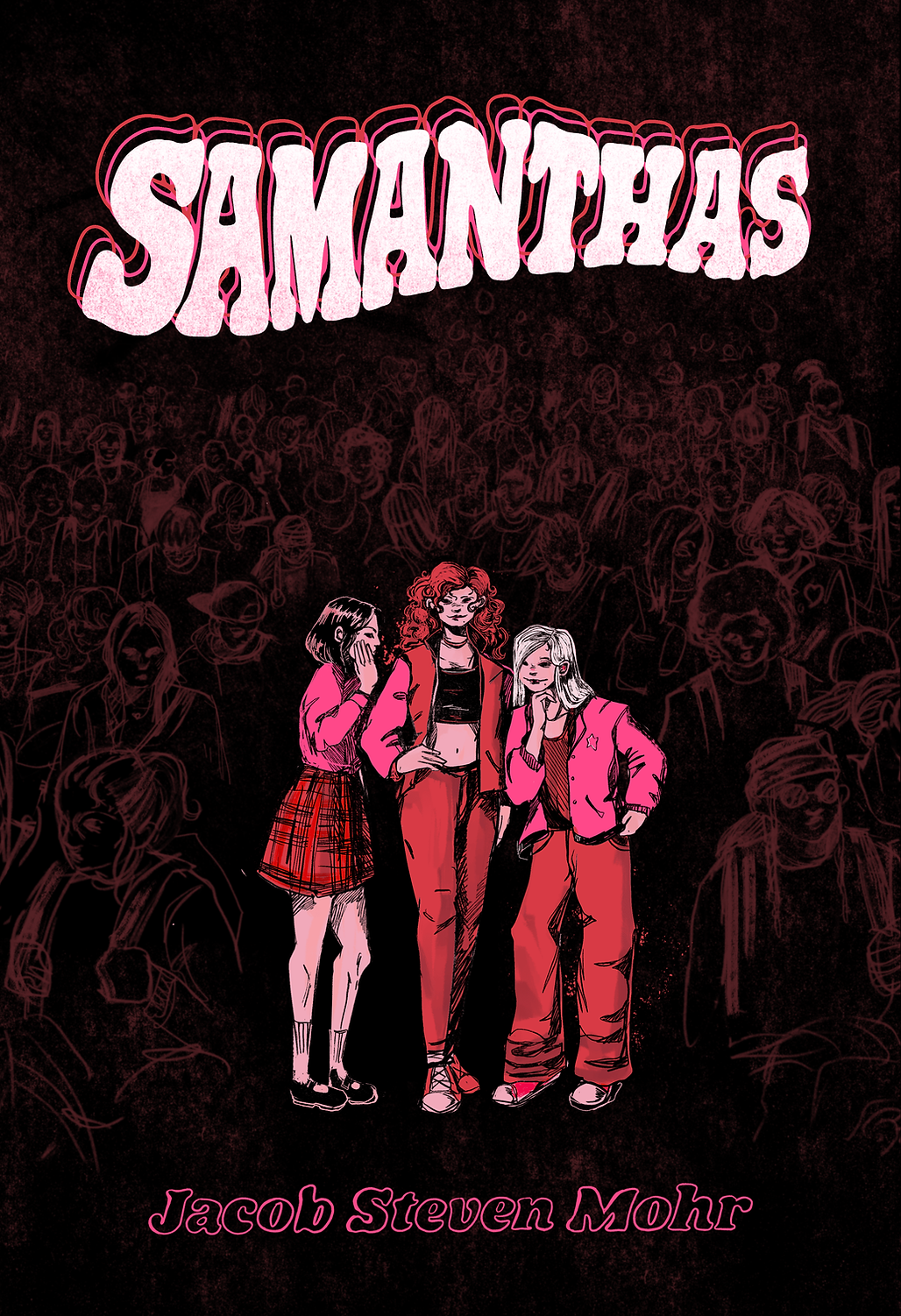
Samanthas | Jacob Steven Mohr | The Laughing Man House Publishing | 19 January 2027 |
The new girls all share one name. They only want the lonely ones.
- Author Jacob Steven Mohr
- Publisher The Laughing Man House Publishing
- Published 19 January 2027
- Format Novella, with three bonus stories
- Subgenre Body horror, teen noir
- Reviewed by Jim McLeod
Winter, 1992. A teenage essay writer on a small island goes looking for a missing swimmer and finds three new girls at school who share one face, one strange accent and one first name.
Samanthas is the new horror novella from Jacob Steven Mohr, out from The Laughing Man House Publishing in January 2027. This Samanthas review starts where the book does, in a high school corridor in the winter of 1992, where a teenage essay writer goes looking for a missing swimmer and finds three new girls who share one face and one first name. Mohr’s short fiction has turned up in Cosmic Horror Monthly, Weird Horror Magazine and The Best Horror of the Year, and this is a fine showcase for that sharp, strange voice. Below, I look at the noir patter, the body horror and the lonely heart beating under both, plus the three bonus stories that close the book.
Samanthas plays its teenage noir dead straight and lets the monsters in through the front door. The wisecracks are armour, the body horror is strange and cruel, and under it all sits a sad, tender story about being alone. The patter sometimes tries too hard, but this novella has real bite.
Samanthas Review: Lonely Hearts With Their Mouths Open
Every school has a kid who sells what he knows. Essays, mostly. A B-plus for fifty dollars, cash in an envelope, no questions asked. He sees everything because nobody looks at him, and he tells himself that this is the same thing as being safe.
It isn’t. Ask Finn Bracken.
Finn is that kid, and Jacob Steven Mohr’s Samanthas is his case file. It is January 1992 on Burnack, a cold little island with a rotting pier, a boardwalk shut up for winter and a high school whose halls are laid out like two figure eights stacked on top of each other. A swimmer called Caleb Clarke has gone missing.
Caleb paid Finn to write his English essays, and he was meant to meet Finn in the park on the night he vanished. Then three new girls turn up at school. One blonde, one with black hair, one a fireball red. Same dark eyes, set a touch too wide and pushed a touch too far forward. Same flat, drowned accent. Same first name.
Mohr tells the rest as a hard-boiled mystery, and he plays it dead straight. Finn is Philip Marlowe in a cardigan and glasses, all clipped lines and cool shrugs, working his case between bells. He leaves notes in lockers. He trades a free essay for a class timetable. He swaps barbs with Enid Mars, who runs the school paper and dated Caleb, and with whom Finn clearly has history. He climbs the bleachers to deal with Kirk Sarnicci, the swim captain who calls everyone “buddy pal”. And he dodges Kent Doocey, the guidance counsellor who put Finn back together once before and does not fancy doing it again.
It is a lovely set-up. The fun is in how seriously the book takes it.
The noir is not a costume, either. The book opens on a line from Raymond Chandler, and when Finn goes to ground he does it in bed with Bogart on VHS, The Big Sleep first and then Casablanca. He talks like Bogart because Bogart always sounds like a man in control of his ship. That is the whole point.
The wisecracks are armour, a frightened boy’s night light, and Mohr lets us see the fear leaking round the edges long before Finn admits to any of it. Late on, Enid punctures the whole Bogart fantasy with one flat, practical remark, and it lands like a slap. It is one of the best moments in the book, and it is not even a scary one.
Spoiler warning: from here to the bonus stories, I describe the book’s central horror in broad strokes, from about the halfway mark. Nothing here gives away how it ends.
For the first stretch, the Samanthas are just wrong. Their faces do not sit right. Mohr says each one looks like a jigsaw with pieces that do not fit, and Finn calls the blonde “Picasso’s idea of a pinup”. They blow smoke without breathing it out. They ask the same question again and again, a question that sounds like flirting from anyone else: “Are you alone?” When the answer is yes, they open.
A seam runs from between the eyes down to the belly, the halves fold back like a coat held out for someone to step into, and the lonely boy steps in. The sounds Mohr gives that scene, a wet slurp and a soft, almost kind “Shh”, are far worse than any scream.
Here is what I love about it. Look at the clothes. In the prologue the girls crawl out of the surf naked and steal jeans and a T-shirt off a washing line. Later, they wear the boys’ letter jackets, swimming in them, drowned in them. Then they wear the boys. When one of them rises from her meal, her first words are an order to get rid of his jacket. Mohr builds the whole monster out of a high school ritual, the girl in her boyfriend’s coat, and then turns it inside out.
Watch what he does with the smile, too. Early on, Finn sees the red-haired Samantha with Kirk, and Mohr writes it simply:
Her smile was a cat smile, turned down slightly at each corner and full of secrets.
It reads like a throwaway. A smile turned down at the corners is just a pout, a bit of teen mystery. Mohr keeps coming back to it, the same upside-down grin on each face, until near the end Finn finally sees it clearly and realises it was never a smile at all. It was the seam. The clue sat in plain sight for most of the book, dressed up as a description. That is detective fiction doing its job and horror cashing the cheque.
The real sting, though, is that the Samanthas are lonely too. They came a long way across a cold, black sea, from a crowded beach where they stood and stared at “all the bright living lights” on the far shore. They feed, and it does not help. Samantha Clarke, the blonde, says as much to Finn down a phone line, in calls that form the strange, tender heart of the book. She saved his life once. She cannot say why. She tells him to “stay sick”, which is a threat, a plea and a love letter all at once. In a noir, the blonde is always the danger. Mohr just makes her literal, and then makes her sad.
Reading Mohr is like hearing a jukebox in a flooded diner. The songs are all old standards, the snap and swagger of a 1940s private eye, but there is seawater rising round the stools, and it is cold.
At its best the prose is tight and odd and very good. He can be funny: Finn sizes up Doocey as someone who would lose two inches he cannot spare if he took his shoes off. He can be cruel. And he can make a sentence do two jobs at once. At the climax, Finn stands still in a monster’s embrace and thinks:
My death smelled of salt wind and nectar. I prayed she couldn’t smell hers.
Two short sentences. One is pure sensation, the other a plan, and the plan is a bluff. That is Finn all over.
There is one real limit, and it is the flip side of the voice. Now and then the similes stack up three deep and the patter starts to wink at us, so the swagger gets in the way of the dread. Once Finn has his plan, the last act runs on a fairly straight line. Neither of these does much harm. They are the cost of a voice this bold, and it is a price worth paying.
The book closes with three short stories, and none of them is filler.
“Empty Shells on a Cold Shore” first ran in Cosmic Horror Monthly #38. It is told in the second person, which is a gamble, and it pays off. A team of turtle-watch volunteers walks an October beach at night, counting nests. Then they find a body in the surf, and it comes apart in layers. The second person matters. By the end, you are not watching the story. You are doing it.
“Who Has to Know?” first appeared as “Samanthas” in The Joining: Scenes of Wedding Terror, the Crystal Lake anthology Mohr edited, so this is where the girls began. It moves the Samanthas to a bachelor party in a Nashville hotel suite, where a coked-up best man has ordered some company and a groom named Manny would rather be anywhere else. It is the most grown-up piece in the book. It is about guilt, and second chances, and what it means to choose someone every single day. Read it after the novella and the refrain lands differently: the voyage was long and lonely. Different shore, same hunger.
Then there is “The You Inside of Me”, and it is the one that hurts most.
Spoiler warning: this story is set after the novella ends. I keep the details vague, but read the novella first.
It is told by Samantha Clarke, the blonde, and it is spoken to “you”. She drifts through a boardwalk arcade, a graduation, a rose garden and a near-empty cinema, hunting the lonely the way her sisters taught her and taking no joy in it. The film on screen is plainly John Carpenter’s The Thing: a husky splits open, and two men sit in the snow trying to work out which of them has changed. Mohr could not have picked a better double bill. Back in the arcade, a game keeps asking DO YOU WANT TO CONTINUE?, and that question follows her all the way to the water’s edge.
In the novella, the Samanthas are things that want. Here, one of them has to live with it. It reads like a love letter written by a shark, and Mohr finds real grief in it. It also turns the book’s refrain round one last time. “Are you alone?” has been a hunting call for the whole novella. By the final line it sounds closer to a prayer. It is the right note to end on, and it makes the whole book as much Samantha Clarke’s story as Finn’s.
Put together, the four pieces work like a small shared world. A sea of stars. A beach. Things that look like us coming up out of the water to fill the empty space inside them. Mohr’s 2023 collection Nightfall and Other Dangers, from JournalStone, included mass drownings on a beach, by the publisher’s own description, so the tide has been pulling at him for a while.
As for where it sits on the shelf, fans of Rian Johnson’s Brick will know the move: a teen mystery told with a straight face in the language of the old private eye films. Jennifer’s Body is in the mix too, for the girl who eats the boys. But the nearest cousin on the page is Stephen Graham Jones.
Like Night of the Mannequins by Stephen Graham Jones, this is a short book narrated by a teenage boy who is not as in control as he sounds, and whose voice is both the joke and the wound. And for readers who liked the bite of Teenage Girls Can Be Demons by Hailey Piper, the Samanthas offer the same mix of menace and sorrow from the other side of the locker room.
What sets Mohr apart is the sadness. Most body horror wants you to look at the wound. Mohr wants you to think about why it is open. Finn, Enid, the Samanthas: they are all of them alone, and the book never pretends that being alone is a choice, or a phase, or something a party can fix. Mohr has edited anthologies of epistolary and wedding horror, and written novels and a collection besides. On the evidence of Samanthas, his best ground may be right here, where the shore meets the water and the lights on the other side look warm.
Read it with the lights on and someone else in the room. Being alone, it turns out, is the one thing the Samanthas can smell.
The Verdict: Is Samanthas Worth Reading?
4out of 5
The verdict
A sharp, sad and properly strange teenage noir whose monsters understand loneliness better than anyone, held back only now and then by patter that tries too hard.
Read it if: you like your horror hard-boiled, your monsters sad and your body horror strange enough to stay with you.
Skip it if: wisecracking narrators wear you out, or you want a slow-burn ghost story with no gore.
Keep reading on Ginger Nuts of Horror
 The God at the Bottom of the Ledger: Jonathan Wood on Washed Up on Dark Shores
 Dark Tide 20: Urban Legends Review, Three Novellas Worth Reading
 Murphy’s Lore by Dan Soule: A Science Fiction Horror Novella That Gets Under Your Skin
About Ginger Nuts of Horror
Ginger Nuts of Horror is an independent horror review and culture site based in Edinburgh, Scotland. Edited by British Fantasy Award nominee Jim McLeod, it publishes horror book reviews, film reviews, author interviews, features and cover reveals. Ginger Nuts of Horror won Best Inclusive Film & Book Review Platform at the SME News UK Enterprise Awards 2026.