Scott Hawkins on why Blacktail is dark fantasy, not horror
Scott Hawkins spent eleven years between books, and readers of The Library at Mount Char have spent every one of them waiting for whatever came next. That wait ends with Blacktail, a wolf’s revenge saga that Hawkins still insists on calling dark fantasy rather than horror, even though many of his most devoted readers found Mount Char on the horror shelf for good reason.
In this interview for Ginger Nuts of Horror, Hawkins talks through the line he draws between the two genres, why the horror label buys a writer more room to be ruthless with a villain, and how three unpublished novels taught him to anchor every scene, hunt for sensory detail, and cut anything he finds boring on the page.
He also traces a direct line from the structural lessons of those failed drafts to the finished shape of Mount Char, and explains what he was chasing with Blacktail: not a message about violence or nature, but the plain satisfaction of a revenge story done right, closer in spirit to The Outlaw Josey Wales than to any ghost story. It is a conversation about craft as much as fear, and about what a writer owes a reader who has just watched a villain get away with something terrible.
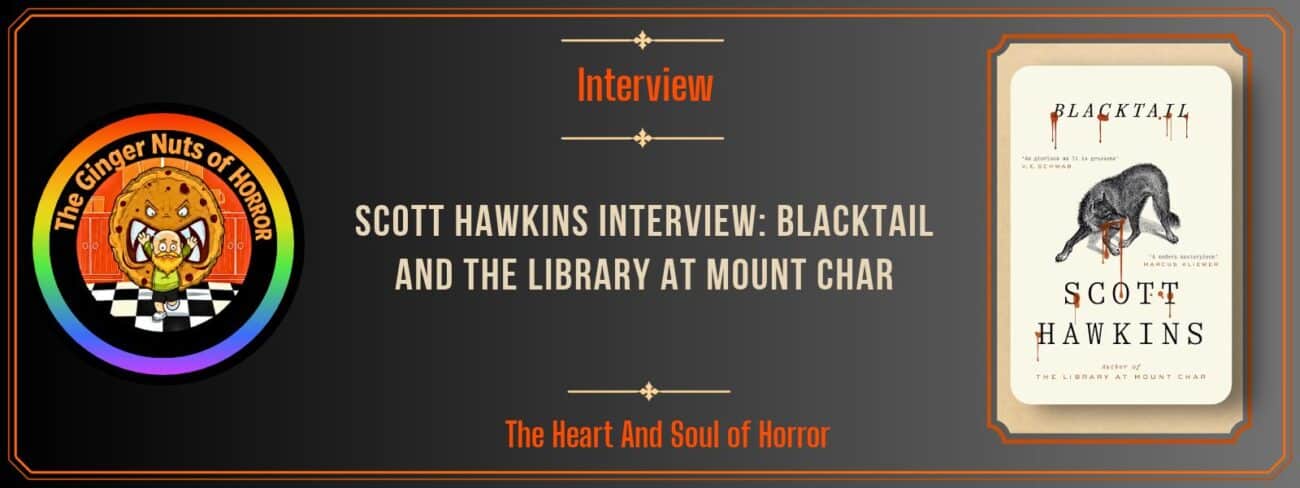
Scott Hawkins Interview: Blacktail and The Library at Mount Char | Interview | Ginger Nuts of Horror |
The horror label buys a writer permission to go further than dark fantasy allows, and the villain’s cruelty only matters if it makes the reader crave his downfall. Revenge fiction runs on hatred earned page by page, not shock for its own sake.
Scott Hawkins Interview: Blacktail and The Library at Mount Char
Given that Mount Char and Blacktail both sit at the edge of horror’s institutional borders — claimed by dark fantasy as much as horror, celebrated for literary qualities what do you think horror does that no other genre can? Not what it explores, but what the mechanism of fear actually accomplishes that, say, tragedy cannot.
I really, honestly feel like both Blacktail and Mount Char are dark fantasy more than horror. It’s on the darker end of the bell curve, yes, but at no time in either book was there any effort to make them explicitly horrifying.
Well…maybe the “bull scene” in Mount Char is the exception that proves the rule. If you know, you know.
But to answer your question, I find it personally liberating as a writer to not have to self-censor. I really don’t put the ghastly stuff in gratuitously. In general, if you see the Bad Guy doing something really horrific to the protagonist or some other innocent in Chapter X, it’s a deliberate decision to heighten the catharsis when said Bad Guy gets their comeuppance in chapter X+1. I think that the more the reader is appalled by the antagonist’s crimes the more satisfaction that reader will take in their downfall.
If you’re willing to accept the “horror” label you lot more latitude in what you can write. I am willing to accept that label. Not every book is for everyone.
That said, one of the top five antagonists I ever read was from The Art of Racing in the Rain. If you’re not familiar, it’s a novel told from the perspective of a dog who wanted to be a Formula 1 driver. There wasn’t a hint of blood or horror in the entire book, at least not that I recall, but I hated the bad guy so much I could taste it.
That’s quite a feat. I’m still meditating on it.
The Library at Mount Char was not only your debut novel but, as you’ve said, the fourth novel you wrote and the one where you finally felt the writing was pulling level with the vision in your head. Looking back at the three that didn’t make it, including the early version of Blacktail, what’s the most specific thing you learned across those novels that shows up as something concrete in Mount Char — a structural habit, a technique for managing point of view, a way of handling exposition in a world that refuses to explain itself?
It was mostly little things.
- Anchor each scene in time and place, ideally in the first paragraph or two. Where are we? When is this taking place? This goes a long way towards eliminating reader confusion, particularly with a structurally complex book such as Mount Char. It’s always a good idea, though.
- Try to have at least one strong sensory detail on every page—not just sight, but sound, texture, everything. Scent in particular is underutilized.
- I’ve noticed that readers will forgive a lot if you can get a chuckle out of them every so often. I do a draft specifically for that.
Other stuff was a little less concrete.
- Cut, cut, trim, cut, cut. There are lots of reasons for this, but chief among them—for me, at least—is that if I’m bored with a scene the reader is going to be really bored—cut it or rewrite. Some of these fall into the category of “stuff that I as a writer need to know as background information that doesn’t necessarily need to be part of the narrative.” Others are just boring or otherwise wrong.
- In general, cut everything that doesn’t absolutely need to be in the book.
Horror fiction often asks readers to sympathise with monsters, to identify with death, to find the thing that frightens them also beautiful or necessary. But Blacktail doesn’t ask that abstractly: it puts you, specifically, in the body of the thing that wants you gone. What is that experience supposed to leave behind? Not in the story, but in the person who finishes it and puts it down, what is the residue you were trying to deposit in the reader, and what would it mean if the book worked exactly as intended?
Hmm. Good question.
I honestly didn’t have any sort of overarching message. The prompt from the writing workshop that I mentioned earlier was to write a fantasy from the perspective of a non-traditional protagonist.
As a dog person, I went with a canine. Probably some of my personal views leaked into the subtext, but Blacktail really wasn’t intended as a sermon.
Mainly what I was shooting for was a good Our Hero is Pushed Too Far and Seeks Revenge story—think Clint Eastwood’s movie The Outlaw Josey Wales or maybe Conan the Barbarian. I love that stuff. That, if anything, is what I want the reader to walk away with—the catharsis of having read a jolly romping revenge.
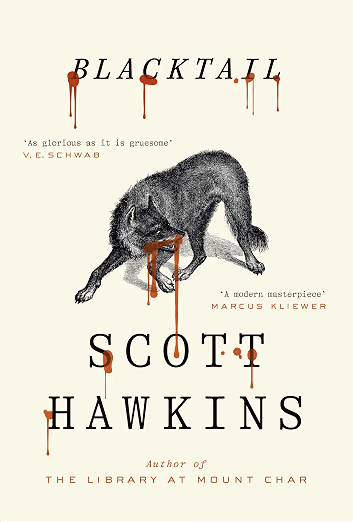
Blacktail by Scott Hawkins
‘A modern masterpiece. Blacktail will consume you’ – Marcus Kliewer
‘Blacktail is as glorious as it is gruesome’ – V. E. Schwab
‘Utterly unique . . . an outstanding, majestic animal story’ – Daily Mail
A wolf embarks on a primal hunt for revenge. Blacktail is a dark work of animal fiction from Scott Hawkins, the critically acclaimed author of The Library at Mount Char.
Blacktail is a half-breed wolf, born to hunt. When he finds love beyond a garden wall, he dares to imagine a peaceful life – until men butcher his mate and unborn pups in a surgical act of cruelty. His grief ignites a rampage of torn throats and shattered bone, a slaughter so absolute it draws the gaze of an ancient feline witch. She sends him south to wake the sleeping Forest God and end the age of reason.
Fuelled by a rage that frightens Hell itself, Blacktail wages war against men and the beasts who dare defend them. From a gore-soaked wilderness to a burning confrontation with Heaven, Blacktail is a feral odyssey of vengeance.
The Forest God sleeps. But what will be the price of waking him?
* * *
‘Touching, horrifying, and entertaining . . . You should all get excited for this book’
– Mark Lawrence, Sunday Times bestselling author of The Book That Wouldn’t Burn
‘Blacktail is one to savor; one to delight in the eccentricities of; one to sit with long after it ends’
– Olivie Blake, New York Times bestselling author of Girl Dinner
‘Beautiful, brutal fantasy, red in tooth and claw’
– Chuck Wendig, Sunday Times bestselling author of The Staircase in the Woods
Ginger Nuts of Horror: The Heart and Soul of Horror Reviews
Every feature is built to sell your work. We include backlinks to your website or Amazon author page, a full synopsis, and a universal purchasing link that sends readers straight to their local store. Add a large, engaged social following and an 18-year archive of trusted horror coverage, and you have a platform genuinely built to grow your readership.
Whether you’re an established author, an indie filmmaker, or a debut voice in indie horror, there’s a way for us to help you reach more fans. Explore our horror book reviews and horror movie reviews, then get your horror book or film featured today.

Jim "The Don" McLeod has been reading horror for over 35 years and reviewing it for more than 16. He's the editor of Ginger Nuts of Horror, Europe's largest independent horror review and culture site, and a British Fantasy Award nominee for his work in the genre. When he's not busy inflicting his opinions on the horror community, he can be found annoying his family or getting thoroughly outwitted by his two dogs, Casper and Molly.