Killed by her own politeness, Lucy comes back angry, and the anger moves her.
She’s a Doll by Barbara Truelove: Killed by Politeness | Review by Luna Gray
Some horror novels open with a dead woman and get on with the plot. She’s a Doll by Barbara Truelove spends a long, awful stretch inside the manners that killed her, and that is where this book review starts. Lucy McQuinn is twenty, freshly qualified, and too polite to shut the door on the uninvited man who turns up with vodka, to refuse the drink, or to leave when she wants to.
She dies of her own courtesy and wakes inside a porcelain bride doll on her grandmother’s shelf. Then she gets angry, and the anger is what finally moves her. What follows is a supernatural revenge story that refuses the easy shapes. Truelove ties the horror to consent, to class, and to who a town chooses to believe when the wrong kind of person tells the truth. A former school acquaintance rebuilds Lucy out of glue and salvage, asking permission at every step, and that friendship carries more weight than the revenge does. It is not sweet, it is not tidy, and it does not pretend to heal anyone. This is queer horror with a brutal, morally unsettled payoff.
The most frightening thing in She’s a Doll is not the doll. It is the etiquette that killed Lucy McQuinn, the small negotiations she loses one polite step at a time. Then she gets angry, and the anger moves her. Dead, as she puts it, but not done.
She’s a Doll by Barbara Truelove: Killed by Politeness
The politeness trap
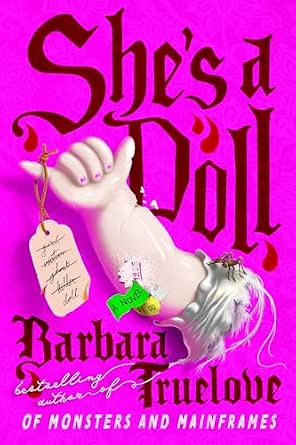
The most frightening chapter in She’s a Doll contains no ghost at all.
Lucy McQuinn is twenty, freshly certified in business administration, and too embarrassed to mention it at a tea party where every other woman seems to have her life assembled already. She goes home, calls her best friend, and reaches the wrong twin. Kyle Lawson arrives uninvited with vodka and a face full of concern.
What follows is not a monster in a mask. It is a series of small negotiations Lucy loses one at a time. The door she opens because closing it would be rude. The drink she accepts. The compliment he keeps fishing for until she supplies it. The exit she attempts and then softens into an apology for attempting. Barbara Truelove writes the whole sequence from inside Lucy’s anxious self-monitoring, and the horror of it is that Lucy spends the final stretch of her life worried that she is the one being impolite.
I have read plenty of horror that opens with a dead woman. I have read very little that makes me sit that long inside the etiquette that killed her.
A body you are not allowed to leave
Lucy comes back inside a porcelain bride doll on a shelf in her grandmother’s workroom, and the premise snaps shut with something close to cruelty. Stiff. Mute. Immobile. Smiling. Dressed for a wedding she never had. Every condition forced on Lucy in her final hours becomes her literal physical situation. Time runs strangely for her too: numb gaps of months, moments frozen solid, sudden accelerations. Trauma rendered as mechanics rather than as therapy vocabulary, which is why it lands.
Then Lucy gets angry, and the anger moves her.
Rage is not a moral failing in this book and it is not a poison Lucy has to purge before she is allowed an ending. It is her motor function. It gives her movement, physical agency, and a flat refusal of the passivity arranged around her in life. Truelove also refuses the easy inverse. Lucy’s anger distorts her. She needs Kyle to be a supernatural aberration because an ordinary man choosing this is unbearable, and the need makes her worse at seeing everyone else, including the one person keeping her intact. She uses people, and she knows it. The novel holds her accountable without ever implying she brought any of this on herself, a narrow beam Truelove walks well.
Forty cents and a glue gun
The emotional center of She’s a Doll is not the revenge. It is Nicola Novković, a former school acquaintance working at a thrift shop, whose hearing aid starts picking up a dead girl’s thoughts and who reasonably concludes she is losing her mind.
Nicola buys the broken doll for forty cents and rebuilds her with hot glue, duct tape, Bubble Wrap and salvaged porcelain. Those repair scenes are the tenderest writing in the book, and they are built almost entirely out of consent. Nicola asks before she touches. She asks before the glue. She distracts Lucy when flashbacks surface and offers to stop. For a character whose death was a study in ignored boundaries, being asked is the actual restoration, and the improvised body that results is the first form rebuilt according to Lucy’s own wishes.
Every subsequent body follows that logic. Bride doll, thrift-shop wreck, patched-together salvage, and stranger configurations later on, each one marking a stage in how Lucy conceives of herself. Repair here never means restoration. Nothing returns her to pristine. Functional and self-authored is the whole prize, and the book argues that this is not a consolation.
Their friendship is not sweet. It starts with Lucy harassing a frightened woman into believing in her, curdles into a real betrayal, and produces a rupture where both parties are correct about the injury done to them. Nicola is not a savior and Lucy is not a rescued object. They bicker over horror TV, they wound each other precisely, and when they reconcile, nobody is absolved. Nicola names the harm out loud and keeps choosing Lucy anyway. That is a better love story than most romances I read this year.
Ordinary evil, and who gets believed
Kyle is deliberately, insultingly normal. Ambitious, image-conscious, well-liked, entitled, fluent in the vocabulary of losing control and being misunderstood. Truelove withholds his interior life partly because Lucy cannot access it and partly because no explanation would be sufficient. He is frightening because he is plausible, and because he keeps choosing this.
Around him the novel builds a chain of failed belief. Lucy’s family is poor and her grandmother is a hoarder, which makes them easy to suspect. Nicola is poor, traumatized, and publicly treated as unstable, which makes her easy to dismiss. Kyle’s family owns a quarry, which makes him easy to protect. Testimony from the wrong kind of person is not evidence, and the book is clear-eyed about how fast a town rewrites its memory once the paperwork changes.
Threaded through all of it is Lucy’s slow queer self-recognition, arriving only after her body is gone. She never got to discover it the ordinary embodied way. The novel treats that as one more theft, and as one more thing Kyle does not get to decide for her.
Pacing, payoff, and what you are in for
The middle sags. The haunting campaign becomes episodic, and the same accusation is repeated so often it starts to feel like wallpaper. I would trim two or three of those beats. I would not trim the domestic material around them, because the TV nights and the bad ideas and the car rides are what make the eventual rupture cost anything.
On content: strangulation, coercion, confinement, shattering porcelain, improvised-body horror, dead animals and one memorably decomposed kangaroo, and a long revenge climax that is psychologically brutal rather than splatter-heavy. The worst of it is experiential. Not being able to breathe. Not being able to move.
The payoff is viscerally satisfying and morally unsettled, and Truelove never pretends it repairs anything. Lucy gets what she wants. She is not healed by it. The final stretch compresses several large developments faster than I would like, but it earns its argument: closure is a story shape rather than an obligation, and Lucy declines to fade on schedule.
Dead, as she puts it, but not done.
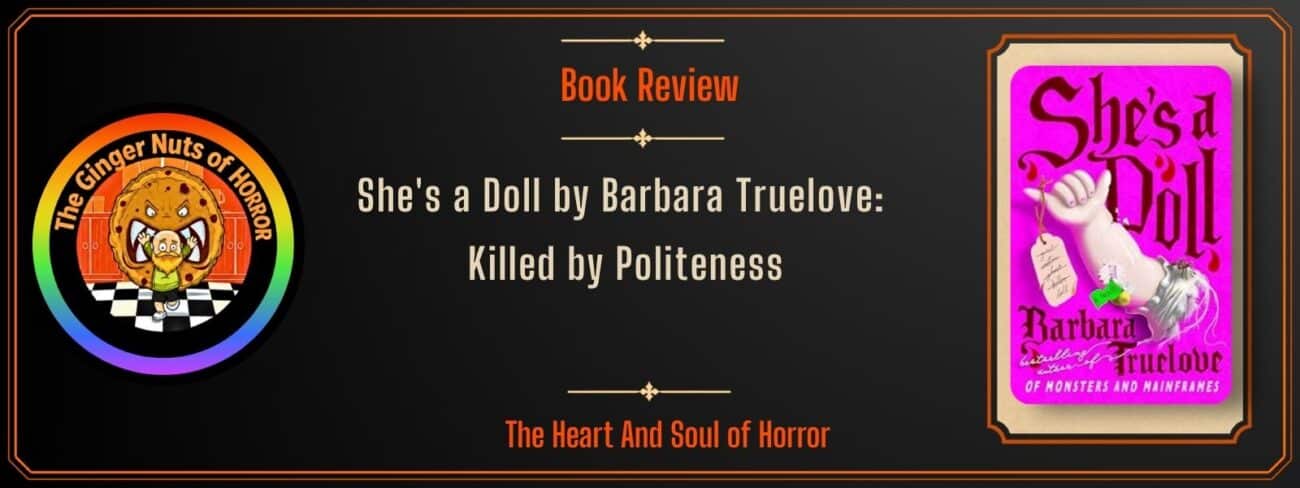
She’s a Doll by Barbara Truelove
Publisher: Ezeekat Press, an imprint of Bindery Books
Official book page:Ezeekat Press / Bindery Books
Lucy isn’t like other girls. She’s a doll on a mission—to find the man who killed her and return the favor.
Lucy McQuinn has been murdered, but she’s not about to go quietly.
If she doesn’t get to keep breathing, then neither does Kyle, her killer. Possessing the body of an antique doll, she sets out on a quest for revenge. But it’s hard when you’re eighteen inches tall and made of porcelain.
For help, she turns to Nicola, a human and fellow outsider with her own reasons to hate Kyle. But in their small idyllic town, no one wants to hear the truth, especially not about such a promising young man. If they can’t expose his crimes, Lucy will have to roll up her lacy little sleeves and teach him a lesson the old-fashioned way—as slowly and painfully as possible.
From LA Times bestselling author Barbara Truelove, She’s a Doll is a ghoulish and gleeful tribute to the unstoppable power of female rage and a love letter to the friends who have our back—in this life and the next.
Luna Gray
Luna Gray is a trans horror critic, Senior Staff Writer at iHorror, and author of No House Is Empty. She specializes in cult, independent, folk, queer, international, streaming, and physical-media horror, along with horror history, haunted history, and folklore. Her reviews, interviews, features, and cultural criticism appear at iHorror. She also writes The Void Writes Back, a Substack about horror history, folklore, cursed media, strange movies, and the things that refuse to stay buried.
Contributor links
Website:LunaGrayHorror.com
iHorror:Luna Gray’s author archive
Newsletter:The Void Writes Back
Portfolio:Muck Rack
Letterboxd:@LunaGrayHorror
Instagram:@LunaGrayHorror
Bluesky:@lunagrayhorror.bsky.social
Threads:@lunagrayhorror
Facebook:Luna Gray Horror
Book:No House Is Empty
Ginger Nuts of Horror: The Heart and Soul of Horror Reviews
Every feature is built to sell your work. We include backlinks to your website or Amazon author page, a full synopsis, and a universal purchasing link that sends readers straight to their local store. Add a large, engaged social following and an 18-year archive of trusted horror coverage, and you have a platform genuinely built to grow your readership.
Whether you’re an established author, an indie filmmaker, or a debut voice in indie horror, there’s a way for us to help you reach more fans. Explore our horror book reviews and horror movie reviews, then get your horror book or film featured today.

Jim "The Don" McLeod has been reading horror for over 35 years and reviewing it for more than 16. He's the editor of Ginger Nuts of Horror, Europe's largest independent horror review and culture site, and a British Fantasy Award nominee for his work in the genre. When he's not busy inflicting his opinions on the horror community, he can be found annoying his family or getting thoroughly outwitted by his two dogs, Casper and Molly.