The supernatural is frightening. The friendships are worse.
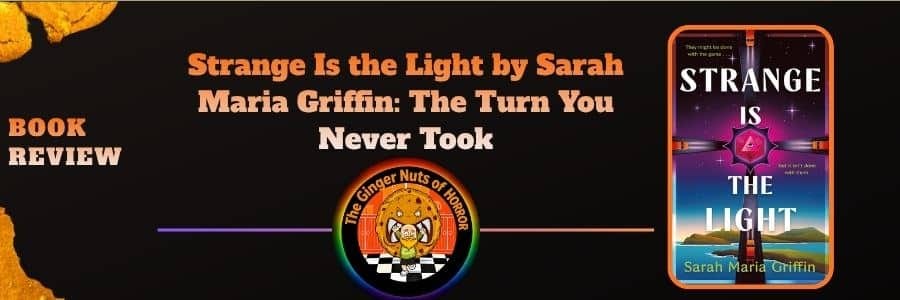
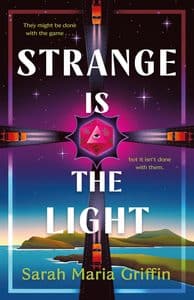
Strange Is the Light | Sarah Maria Griffin | Titan Books | 8 September 2026 |
Sarah Maria Griffin follows her Sunday Times Irish Book of the Year, Eat the Ones You Love, with Strange Is the Light, a literary horror novel that turns a childhood game into a reckoning. On Valentia Island, four friends once invented a world called Wonder Wonder; twenty years later they are called back to finish the turn they never took and settle a debt owed across a rift in reality. This is Irish gothic at its most precise and most quietly brutal, a tabletop RPG horror where the monster is real and the friendships are the deeper wound. Our full Strange Is the Light review is below.
“A haunted-game premise that could have been a gimmick becomes, in Griffin’s hands, the horror-novel version of the oldest sad truth there is: you can spend twenty years beside someone and be strangers the whole time. The rift is frightening. The friendships are worse.”
There is a particular self you only get to be for two months a year, in one place, with a handful of people who never meet the rest of your life. You are braver there. Funnier. The version of you that exists between June and August on a specific patch of coast belongs to nobody back home, and when the summer ends you fold it away like a costume and go back to being ordinary. Sarah Maria Griffin understands that self completely, and in her new novel she does something quietly savage to it.
Strange Is the Light gives us four children on Valentia Island, off the south-west coast of Kerry, who spend their summers at a place called the Starcade playing a game of their own invention. Daphne, Ronan, Leonie and Finn. The game is Wonder Wonder, a made-up world that Daphne pours into journal after journal, and it becomes the table they gather round year after year, the thing they get to be themselves inside.
For children whose ordinary lives are thin on comfort, and Daphne’s is thinner than most, given a fraught bond with her brother Daithi, the game is oxygen. Then a summer turns violent. Someone from outside gets hold of Wonder Wonder and it curdles into something dark, and Daphne makes a choice that costs more than she can pay in the moment.
Twenty years on, the four of them are called back to the old Starcade for one last game. Only now the game is a tabletop RPG, the rules have changed, and something has been at the table the whole time, waiting. Daphne never took her final turn. The debt did not go away just because she stopped looking at it.
You could describe that premise in a way that makes it sound like a gimmick. Childhood game becomes real, portal opens, cosmic bill comes due. Put it on a back cover and it sits a shelf away from a dozen novels where the board game bites back.
What Griffin does with it is the entire point, because she is not really writing about a haunted game at all. She is writing about the specific dishonesty of a friendship that only exists in one season, the way four people can love each other for two decades and never once meet properly, and the terrible arithmetic of a secret kept so long it hardens into the shape of the person keeping it.
The four of them are drawn tightly enough that the book earns the word early readers keep using for the group, entangled. These are not four neat character sketches taking turns to speak. They are a knot, the kind that forms when children invent a private country together and then have to keep living in the ordinary one for ten months of the year.
Griffin has always written desire and closeness without flattening either, going back to the queer lives woven quietly through her YA, and she brings the same refusal to tidy things up here. Who loved whom, who knew, who chose not to know, all of it stays gloriously unresolved in the way real long friendships are, right up until the game insists on an answer. That insistence is the engine. A group can survive almost anything except being made to say the thing out loud.
Griffin came up through poetry and essays, with the collection Follies in 2011 and the emigration memoir Not Lost in 2013, before she turned to fiction, and she turned to it well. Spare and Found Parts, her 2016 debut, dropped a girl with a mechanical heart into a post-apocalyptic Dublin remade as Black Water City. Other Words for Smoke, which took the Teen and YA prize at the 2019 Irish Book Awards, put witches and a house that would not stay a house near the same city. Both were doing the thing she has said, plainly, is her only real subject: monsters, growing up, and everything those two things have in common.
What changed with Eat the Ones You Love, her 2025 adult debut and a Sunday Times Irish Book of the Year, was the register. A carnivorous orchid in a dying shopping centre let her write about desire and consumption for grown-ups without softening the corners for a teenage reader. Strange Is the Light is the book where that new confidence stops reading like a promotion and starts reading like a home address. She has found the exact distance from her characters that adult horror needs. Close enough to bruise, far enough to see the whole wound.
It helps, too, that she writes about video games for a living. A novelist who spends her weeks thinking seriously about how games make meaning, how a rule set produces feeling, is exactly the right person to build a horror novel out of a game and not have it collapse into whimsy. The mechanics here are respected. They matter.
The prose is doing an enormous amount of the work, and it is worth slowing down to watch it. Her sentences are sensory to the point of being tactile, all greenery and salt and skin, but the texture is never decoration; it is load-bearing. When a writer makes the world this vivid, the horror lands harder, because you have been made to want the beautiful thing before it turns on you. Reading her is like being handed a set of dice you can feel are weighted, rolling them anyway, and watching every number come up heavier than the last.
The pleasure and the dread arrive in the same motion, which is a very difficult trick and one she performs without appearing to try. Notice, too, how she paces the horror. This is not a book that opens with a scream. It accretes, the way real dread does, letting you settle into the warmth of the friendships and the island and the invented world before it starts, very gently, closing the doors. Readers who want their horror fast off the mark may find the first stretch demands patience. That patience is the price of admission, and the book pays it back with interest.
Consider what she does with the game itself, structurally, because this is the cleverest move in the book and the one a lesser writer would have fumbled. A turn-based game has a moral engine built into it. You take your turn, you accept the consequence, you pass the dice along. Daphne’s unfinished turn is guilt rendered as a game mechanic: the one action she refused to complete, hanging over two decades like an unpaid tab, quietly accruing interest.
Griffin has taken the most abstract thing a horror novel can be about, the way the past comes back for its settlement, and given it rules. A debt you can actually count. That is not a metaphor stapled onto a plot. It is a plot that thinks like a metaphor the whole way down.
And she sets it, with what I take to be full deliberateness, on Valentia Island. This is the point where I am reading the map rather than being handed the answer, so treat it as mine and not hers, but the choice is too apt to be accident. Valentia was the eastern terminus of the first permanent transatlantic telegraph cable, the spot where, in 1866, Europe was first plugged into North America across two thousand miles of ocean that had always been uncrossable.
An island whose real history is about opening a channel across an impossible distance, now hosting a game that opens a rift across an impossible distance. The land remembers what it is for. Griffin reads video games and telegraph history and the Irish coastline with the same attention, and it shows in how much the setting quietly carries.
If I have a reservation, and at this height it is a small one, it is that the novel shares connective tissue with Eat the Ones You Love, an image or two and a returning face that ARC readers have taken great pleasure in spotting. A first-time Griffin reader will get everything the book is doing without noticing any of it, while a returning reader gets a little extra shiver. That is not a flaw. It is barely a caveat. It is the sound of a writer building a world large enough to walk back into.
Where does it sit? In the strong recent run of Irish literary horror, alongside Deirdre Sullivan and the darker end of Caroline O’Donoghue, and in the older lineage of reunion horror, the shape Stephen King poured It into and Grady Hendrix keeps polishing, where a childhood group has to come back and answer for what the child versions of them did. Griffin subverts that shape by refusing to let the supernatural be the real threat.
The rift is genuinely frightening. The friendships are worse. She sits comfortably too beside the recent monster-as-intimacy strand of the genre, the John Wiswell school where the creature is a way of talking about love, though she runs colder and sadder than that comparison first suggests.
Underneath all of it is the theme she cannot stop writing, which is that growing up is itself a kind of haunting. The child you were does not die; it sits at a table on an island and waits for you to come back and finish your turn. The secrets four people keep to protect a friendship turn out to be the same secrets that guarantee they never quite have one. Griffin has written the horror version of the oldest sad truth going, that you can spend twenty years beside someone and remain strangers the entire time, and she has made it terrifying by making it literal.
Read this one in the light while you still can.
Strange Is the Light by Sarah Maria Griffin: The Turn You Never Took
Strange is the Light by Sarah Maria Griffin
A childhood game of wild imagination takes a frightening turn in this moving tale of intense friendship, tangled secrets and betrayal from the acclaimed author of Eat the Ones You Love, one of the Sunday Times’s Top Ten Irish Books of 2025.
For Daphne McSharry, Valentia Island was a place of joyful childhood holidays: independence, adventure and playing with her beloved friends, Ronan, Leonie and Finn. They returned to one game of their own making year after year, and let their imaginations roam free. But when the game is stolen from them by an outsider, it becomes something dark and strange, forcing Daphne to make a choice with a terrible cost. When tragedy brings her back to the island years later, she and her friends finally have to face the consequences of what she did.
Daphne never took her final turn… And there is a debt that must be paid.
Ginger Nuts of Horror: The Heart and Soul of Horror Reviews
Every feature is built to sell your work. We include backlinks to your website or Amazon author page, a full synopsis, and a universal purchasing link that sends readers straight to their local store. Add a large, engaged social following and an 18-year archive of trusted horror coverage, and you have a platform genuinely built to grow your readership.
Whether you’re an established author, an indie filmmaker, or a debut voice in indie horror, there’s a way for us to help you reach more fans. Explore our horror book reviews and horror movie reviews, then get your horror book or film featured today.