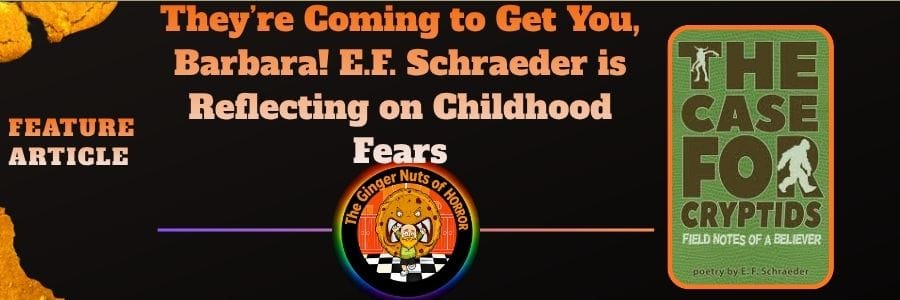
They’re Coming to Get You, Barbara! E.F. Schraeder is Reflecting on Childhood Fears
The horror writer on slasher films, the satanic panic, goth subculture and what the woods were really for!
The dead coming back to life were never the frightening part.
Some people come to horror through a video nasty passed round the playground. E.F. Schraeder came to it because the genre was the only thing telling the truth. In this essay for Ginger Nuts of Horror, Schraeder looks back at a Midwestern childhood in the 1980s and sets the ordinary against the monstrous. Milk cartons with missing children on the back. Teachers who kept neither their hands nor their jokes to themselves. Neighborhood dads who called their gawking harmless. Against all that, the dead climbing out of the ground barely registered.
This is a piece about childhood fears and where they go when you grow up. Schraeder traces a line from those evening walks to a teenage life of beer, black clothes and bisexuality, through the satanic panic, and into an adult appetite for slashers, the undead, campy horror and folk horror. Each one did a job. The slashers gave a reason to scream. The undead were honest about what they wanted. Folk horror put something protective in the woods. E.F. Schraeder, author of The Case for Cryptids, writes here about the fears that horror turns to dust, and the ones it does not.
The dead coming back to life were significantly less scary than the men on the sidewalk. Horror was an average Tuesday. Slashers gave me a reason to scream, the undead were at least honest about their cravings, and folk horror let me believe the woods were on my side.
Somewhere around 1982 on a humid Midwestern summer evening I’m a white kid enjoying a hike at a nearby park. When a stocky, mustached white man asks me if I’d have sex with him I become aware, quite suddenly, of something unforeseen: I’m a girl.
I take note that he is short, somewhat muscular, and unsmiling. I say no. Feign confidence while my heart races. I turn toward home. Imagining safety that is not really there either.
Something in me hits pause. A familiar, unsettling awareness permeates my consciousness. I know am supposed to be uncomfortable. I was raised to tolerate and accommodate discomfort. That this is wrong will take years to unpack. Ambiguously gendered and prone toward a fluidity that hadn’t yet fully entered the popular imagination, I was younger than 15 years old and looked tomboyish, as we said then. I wore everything two sizes too big to hide any hint of a cursed hip-to-chest combination that suggested girlishness.
The dead coming back to life were significantly less scary. Horror was an average Tuesday. If boys were encouraged to be boys. girls were just damned out of luck. Tease up your hair, and enjoy a jolly rancher. Everything is fine! Just keep your hands free. Always make eye contact. Never make eye contact. Avoid trouble. Be polite. Walk quickly. Walk with purpose.
I was unconvinced but used to this pretend stride. This pretense of acceptable indecency. I had been faking a combination of invisibility and invincibility since I was at least seven. By twelve I often pretend to smoke on nighttime walks to appear older. Tougher. I practice a casual strut with my shoulders set broadly and chin up. I wanted a body that communicated I was the danger in the night. I would kick your fucking ass. Not because I wanted to (I was already a nerdy book worm and vegetarian). I just didn’t want anyone to talk to me.
This was not the first or last inappropriate encounter I experienced before turning 18. They weren’t all ‘harmless.’ These were endemic scares of childhood. I wonder, now, why I have so many memories of evening walks outside. Probably because those memories were successfully stored by my brain. They were good nights. Nobody got hurt.
Missing children smiled blankly from the back of milk cartons, and a chain-smoking mother encouraged me to go outside. Obligingly, I spent hours wandering a nearby woods in search of mysteries and solitude. The woods never frightened me as much as humans. I was convinced creatures unknown dwelled there in the mossy dark, and I was determined to find them. I belonged among that which lurked in those wilds more than on the sidewalks that seemed replete with leering adults and their looming threats.
Teachers who didn’t keep their hands or sexual humor to themselves, overly affectionate neighborhood dads who liked gawking, talking, and flirting ‘harmlessly.’ As if being underage, simply being kids was an invitation. There were terms for this kind of thing, but I didn’t know them.
I was groomed to hide, doubt my own perception, blink away tears, smile, and blend into a blurry background of low hopes and a dimmed expectation of bodily autonomy.
No wonder I loved slashers. I was aching for an outlet, for a reason to scream, for stories of wild-eyed and tattered survivors. No wonder I loved the undead. They were at least honest about their predictably perverse cravings. No wonder I loved campy horror. It was brutal but ended with a wink. Nobody got hurt in any way that mattered beyond the final credits. No wonder I loved folk horror. I needed there to be something protective in those woods I loved so much.
By the time of the satanic panic I was actively cultivating a gentlemanly, Goodwill-bought, goth aesthetic that was equally defined by music, community, and sexuality. Fully invested in three Bs, my teen life was about beer, black clothes, and bisexuality. Determined to find misfits like me, I found friends that’d wander in the woods to hide, to think, to dance, and to find something that felt true. More than anything, the yearning of youth led me to people as eager as I was to call out hypocrisy and reject immoral authority figures. My friends in the horror community are very much grown up versions on the same theme.
Nothing scared me. Everything scared me. That’s still kind of true, and it shows up in the kind of horror that I consume and produce. I am drawn to horror that exposes false safety of norms and centers moments when the most vulnerable people in the story find a deep, transcendent power. I still crave horror that turns those old fears into dust.
The Case for Cryptids: Field Notes of a Believer
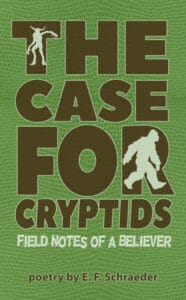
Description: E.F. Schraeder’s sophomore collection, The Case for Cryptids, brings a humorous tone to the life and politics of the [possibly] mythological. Half guidebook, half protest sign, these poems question assumptions and test the limits of belief, inviting readers into a liminal space of wonder and doubt. And sure, okay…on the odd page, the Mothman just might try to seduce you. But don’t worry. Local authorities have already been contacted.
E. F. Schraeder is the author of The Case for Cryptids (Raw Dog Screaming Press, 2026), The Price of a Small Hot Fire (Raw Dog Screaming Press, 2023), the Saturday ‘Visiter’ Award nominee What Happened Was Impossible (Ghoulish Books, 2023) and other works. Schraeder’s short writing has appeared in numerous journals and anthologies including Under Her Eye, Strange Horizons, and Ghoulish Tales. A Rhysling and Pushcart-nominated poet, Schraeder believes in ghosts, magic and dogs.
Links
Raw Dog Screaming Press: https://rawdogscreaming.com/book/the-case-for-cryptids/
Goodreads: https://www.goodreads.com/author/show/5989787.E_F_Schraeder
Ginger Nuts of Horror: The Heart and Soul of Horror Reviews
Every feature is built to sell your work. We include backlinks to your website or Amazon author page, a full synopsis, and a universal purchasing link that sends readers straight to their local store. Add a large, engaged social following and an 18-year archive of trusted horror coverage, and you have a platform genuinely built to grow your readership.
Whether you’re an established author, an indie filmmaker, or a debut voice in indie horror, there’s a way for us to help you reach more fans. Explore our horror book reviews and horror movie reviews, then get your horror book or film featured today.

Jim "The Don" McLeod has been reading horror for over 35 years and reviewing it for more than 16. He's the editor of Ginger Nuts of Horror, Europe's largest independent horror review and culture site, and a British Fantasy Award nominee for his work in the genre. When he's not busy inflicting his opinions on the horror community, he can be found annoying his family or getting thoroughly outwitted by his two dogs, Casper and Molly.