Kitt Carver finds futures for a living, and someone just tried to kill her for the last one she found.
That opening hook, a diviner marked for death because of what she knows, is the kind of premise that could go anywhere. Brooks takes it somewhere unexpected. Not just across the Timeless Lands, though that happens. Not just into the company of a street duellist, a vision-plagued mage, and a one-night stand who accidentally started this whole mess. Somewhere stranger: into the question of whether knowing the future is a gift, a curse, or something closer to a wound that won’t stop bleeding.
This is the kind of fantasy that knows horror isn’t about monsters, it’s about caring too much to look away. Brooks builds dread through accumulation, humour through character, and hope through sheer stubbornness. The future bleeds, but these characters refuse to let it die.
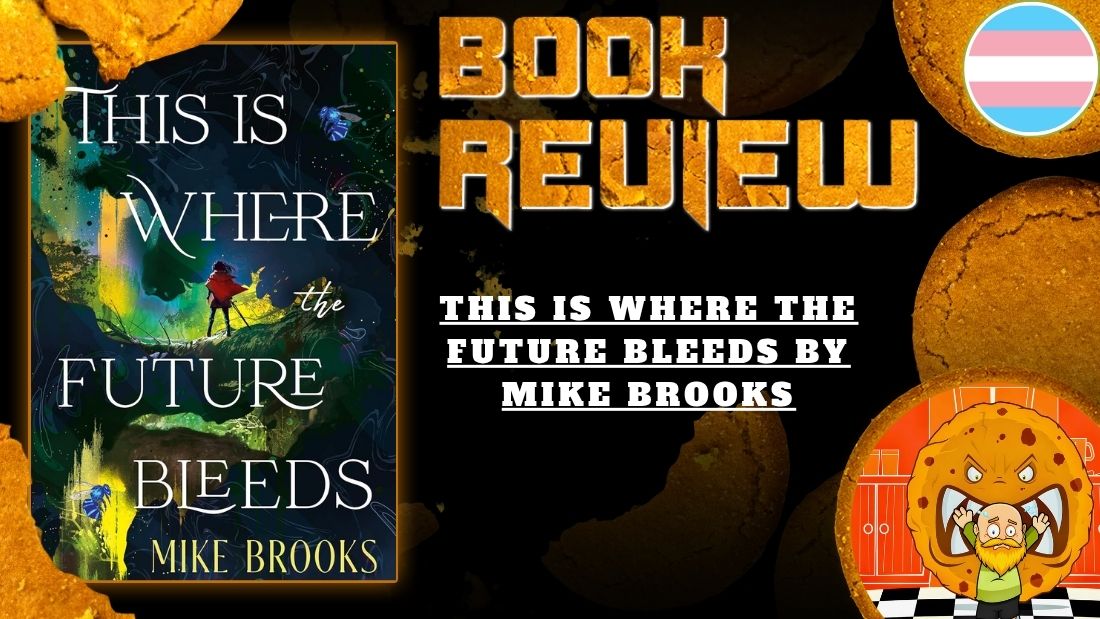
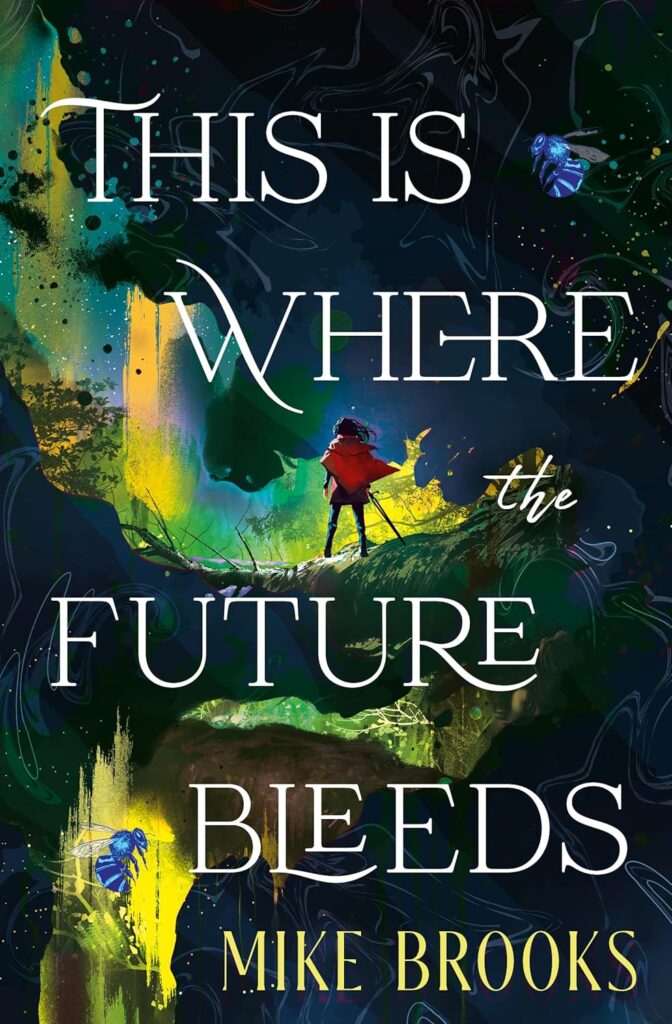
THIS IS WHERE THE FUTURE BLEEDS BY MIKE BROOKS — REVIEW
This Is Where the Future Bleeds | Mike Brooks | Titan Books | 30 June 2026 |
The dread here is slow and creeping. It arrives in the spaces between things, in the fact that Kitt’s broker is dead and no one knows why, in Sulian’s visions that she can’t control, in the growing sense that the future itself is not a fixed line but something frayed and unravelling. Brooks builds atmosphere through accumulation rather than assault. A detail here. A glance there. A piece of dialogue that lands a little too heavily.
The pacing is a deliberate animal. Early reviews have called it “a little weird”, and I get why. The first half of the book moves at a walk. Not a drag, never a drag, but a measured, purposeful stride. Brooks is doing something unusual: he’s letting us sit with these characters before throwing them into the fire. We get to know Kitt’s sharp edges, Derna’s swagger, and Sulian’s fractured attention. We travel with them. We bicker with them. We start to care about them.
And then the floor drops.
Because that’s the trick, isn’t it? Brooks knows that horror, real horror, the kind that sticks, doesn’t come from monsters. It comes from caring about people and watching them walk into something they don’t understand. The last 40% of this book hits like a wave. Not because the action is relentless (though it is) but because by then, you’re invested. You’ve done the work. You’ve earned the dread.
What does it do to your nervous system? It keeps it humming. Not screaming. Humming. A low, constant vibration that you only notice when it stops. And when it stops, when Brooks lets you breathe, you realise you’ve been holding your breath for longer than you thought.
Brooks writes sentences that know what they’re doing.
There’s a precision here that feels earned. Not showy. Not literary for its own sake. Just right. Every word pulls its weight. Dialogue snaps without feeling rehearsed. Description lands without feeling overwrought.
His POV choices are worth noting. Multiple perspectives, yes, but not the sprawling army of viewpoints that can sink lesser epic fantasies. Brooks keeps his cast tight. Kitt is the centre, but we get enough of Derna and Sulian to understand their stakes without losing the thread. The chapter construction feels organic; each one ends with a reason to turn the page, not because of a cliffhanger (though there are those too) but because Brooks has made you need to know what happens next.
The dialogue is where he really shines. These characters talk like people who’ve known each other long enough to insult each other with love. The banter is sharp without being cruel, funny without undercutting the tension. Brooks has written crews before – the Keiko series is built on exactly this dynamic – and he’s refined it here. There’s a rhythm to the exchanges that feels lived-in. You believe these people would die for each other because you’ve first heard them argue about something stupid.
Structurally, the book is a quest narrative that knows it’s a quest narrative and doesn’t apologise for it. The mismatched group, the journey across strange lands, the looming threat. Brooks isn’t reinventing the wheel. He’s making the wheel turn more smoothly than most. The linear storytellingis a strength, not a weakness. It gives the book a clarity that allows the thematic complexity to breathe.
And the humour. God, the humour. Brooks manages to make you laugh in a book where people are dying. That’s not easy. That’s a craft choice – a deliberate refusal to let the darkness win completely. It works because the jokes come from character, not from the author winking at the reader. Kitt is funny because Kitt is funny, not because Brooks is trying to be.
Beneath the adventure, beneath the banter and the battles and the bleeding future, this book is asking a question: what do we owe each other when the world is ending?
Not if the world is ending. The future in this book is not a promise. It’s a possibility. A fragile one. Kitt can find destinies, but finding something doesn’t mean you can change it. Or does it? That tension between what is written and what can be rewritten runs through every page.
The found family element is central. Kitt doesn’t assemble her group because she likes them (though she does). She assembles them because she needs them. And they stay because they need each other. That’s the horror, in a way. Not the violence or the threat or the existential dread. The horror is that we’re all each other has. Brooks has written about this before – the Keiko series, the God-King Chronicles – but here it feels more urgent. More necessary.
The queerness of the book isn’t a theme. It’s a fact. Characters exist on the full spectrum of identity without it being a plot point or a lesson. Brooks is queer himself, and that authenticity shows. Representation isn’t performative here. It’s just how people are. In a genre that has historically struggled with inclusion, this feels like a quiet revolution.
There’s also something about knowledge and power. Kitt’s profession, finding destinies for the rich and powerful, is a metaphor for how information is weaponised. Her broker is murdered because of what she found. Knowledge, in this world, is dangerous. Not because it’s forbidden, but because it’s valuable. And anything valuable can be taken.
The real-world resonance is clear. We live in an age of information overload, of futures predicted and sold back to us. Brooks is asking: what happens when the prediction is wrong? When the future you were promised turns out to be a lie? When the destiny you paid for kills you?
It’s a book about hope, too. Not cheap, hope. Not optimism. The hard kind. The kind that says the future might be broken but we can still fight for it. That’s the Brooks signature hope in the midst of darkness. It’s what makes his horror bearable. It’s what makes it matter.
Mike Brooks has been building toward this book his entire career.
That sounds like hyperbole. It’s not. Look at the throughline. His Keiko series grimy space-opera about a crew of misfits. His God-King Chronicles epic fantasy about cultural collision and found family. His Black Library work tie-in fiction that somehow still manages to feel personal and distinctive. Every book has been a step toward something.
The Black Coast was shortlisted for the British Fantasy Award. It established Brooks as a writer who could do epic scale without losing character intimacy. The Splinter King deepened that, adding complexity to the themes. The Godbreaker brought it all together in a battle-filled finale.
And now this.
This Is Where the Future Bleeds feels like Brooks taking everything he’s learned and applying it to something new. The humour is sharper. The pacing is more deliberate (even if it’s “weird”). The themes are more integrated. He’s not repeating himself. He’s refining.
The queerness, too, has become more central. Not as a statement. As a fact of the world. Brooks’s earlier work included queer characters, but here it feels foundational. The world doesn’t just tolerate difference. It’s built on it.
What’s striking is how Brooks has managed to write for multiple audiences epic fantasy readers, Warhammer fans, space-opera enthusiasts without losing his voice. His voice is the constant. Grounded. Humorous. Hopeful. He’s not a chameleon. He’s a writer who knows what he does well and does it better each time.
This book confirms what his previous work suggested: that Brooks is one of the most versatile and consistently engaging voices in contemporary speculative fiction. It deepens his engagement with fate and choice. It breaks from the epic fantasy tradition by centring queerness and found family over kings and prophecies.
Where does this book sit?
On the border. That’s the short answer. Between epic fantasy and something darker. Between adventure and dread. Between the swashbuckling fun of Kings of the Wyldand the existential weight of something like Perdido Street Station.
The comparisons are useful. Tasha Suri, Richard Swan, Samantha Shannon. Writers who do big fantasy with real stakes and real people. But Brooks is doing something slightly different. His world isn’t just magical. It’s wrong. The future is bleeding. The Timeless Lands don’t obey normal rules. Sulian’s visions aren’t a gift, they’re a torment.
That’s the horror adjacency. Not gore. Not monsters. A fundamental instability in the fabric of reality. The sense that things are not as they should be. That’s cosmic horror, in a way – the universe doesn’t care about you, and also it’s broken.
But Brooks doesn’t lean into nihilism. That’s what sets him apart from the grimdark crowd. His characters fight. They care. They hope. The horror is real, but so is the resistance.
In the current landscape, where horror is expanding into every genre and sub-genre, Brooks occupies a specific space. He’s not writing horror, exactly. He’s writing fantasy that understands horror. That uses horror’s tools – dread, uncertainty, the weight of the unknown – without becoming horror. It’s a delicate balance, and he nails it.
For readers who want their fantasy with a side of existential unease, this is the book. For horror readers who want something with more adventure and less gore, same. For anyone who wants to watch a writer at the top of his game, absolutely.
The future might be bleeding. But that doesn’t mean it’s over.
THIS IS WHERE THE FUTURE BLEEDS BY MIKE BROOKS
A thrilling adventure packed with laughs, escapes and kick-ass action, about a smart-talking bunch of rogues and dropouts being thrust into an epic quest to save the future and meddle with the destinies of empires. From the Audible-bestselling author of The Lion: Son of the Forest, and perfect for fans of Tasha Suri, Richard Swan, Samantha Shannon and Netflix’s Arcane.
Kitt Carver is one of the best diviners in the business at finding destinies for the rich and powerful. When she’s nearly killed, and her regular broker is murdered, it becomes clear someone has an issue with the last destiny she found.
Determined not to let anyone else die, Kitt gathers a mismatched group – including Two Tongue Derna, her childhood friend and now a renowned street duellist, and Sulian the Swallowmage, powerful but plagued with intrusive visions of futures – and sets off across the Timeless Lands to warn the destiny’s recipient.
However, unbeknownst to Kitt, she has her own destiny; one which might spell disaster for everyone.
Ginger Nuts of Horror: The Heart and Soul of Horror Reviews

Looking to get your horror book or film in front of the genre’s most dedicated audience? Ginger Nuts of Horror is one of Europe’s largest independent horror review websites, with over 30 contributors publishing horror book reviews and horror movie reviews almost every single day.
We offer far more than reviews. Authors, filmmakers and publishers can promote their work through in-depth horror book reviews, horror film reviews, comic and video game coverage, news features, and our popular author and director interviews like Five Minutes With. Our guest feature series, The Horror of My Life, Childhood Fears, The ? That Made Me and more, let creators tell their story while promoting their latest release.
Every feature is built to sell your work. We include backlinks to your website or Amazon author page, a full synopsis, and a universal purchasing link that sends readers straight to their local store. Add a large, engaged social following and an 18-year archive of trusted horror coverage, and you have a platform genuinely built to grow your readership.
Whether you’re an established author, an indie filmmaker, or a debut voice in indie horror, there’s a way for us to help you reach more fans. Explore our horror book reviews and horror movie reviews, then get your horror book or film featured today.


Jim "The Don" McLeod has been reading horror for over 35 years and reviewing it for more than 16. He's the editor of Ginger Nuts of Horror, Europe's largest independent horror review and culture site, and a British Fantasy Award nominee for his work in the genre. When he's not busy inflicting his opinions on the horror community, he can be found annoying his family or getting thoroughly outwitted by his two dogs, Casper and Molly.