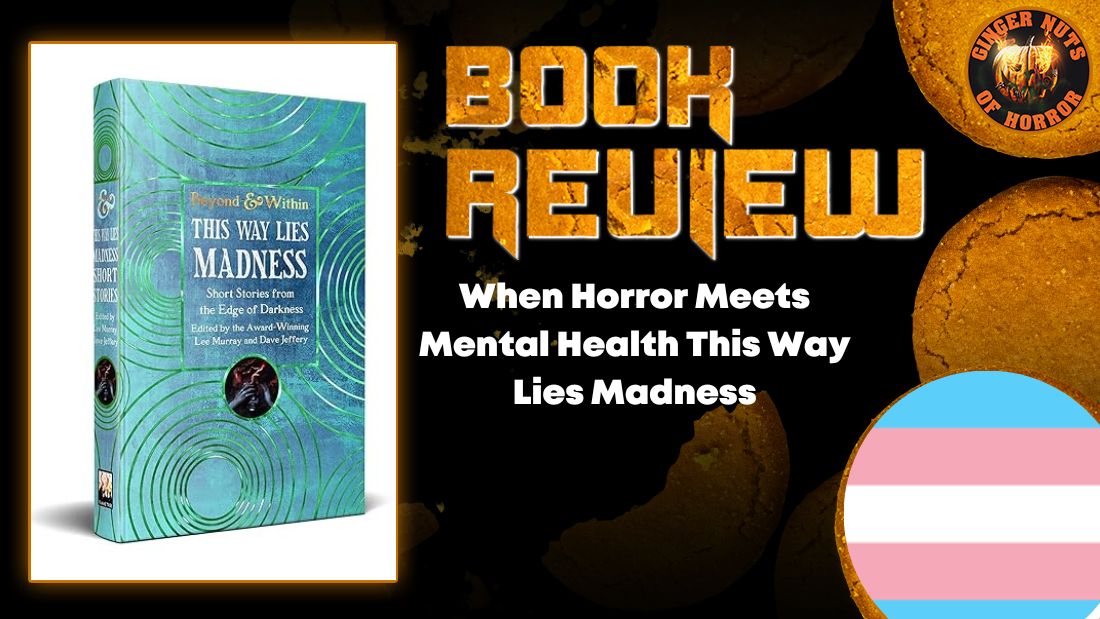

When Horror Meets Mental Health: This Way Lies Madness, edited by Dave Jeffery & Lee Murray
A Horror Book Review by Benjamin Kurt Unsworth.

From the very first moments of the submissions call, what editors Dave Jeffery & Lee Murray wanted to do was tell tales which shine a light on mental health without stigma or invective language. As such – not least because they wholeheartedly succeed in their task, incidentally – I shall be writing something about every story featured; it feels only right given the subject matter.
They are of course fabulous writers in their own right, both featuring on my ‘Top 10 Short Stories of 2024’ list – and I’m happy to say that they’re great editors too. An intriguing, honourable aspect of the anthology is the set of notes at the end of each story where the author divulges the lived experience which fuelled their tale. It’s entirely symptomatic of their personalities, kind-hearted and nurturing before all else, but it also makes the anthology stand out because there’s never the suggestion they’re doing this merely to put money in a pocket.
The first author featured is Kayleigh Dobbs whose tale ‘TBR’ I imagine most people in writing circles shall empathise with intensely. The premise itself is very simple, asking what the thoughts of a book constantly at the bottom of a TBR pile are. The answer? Jealousy.
Like every story collected here, the writing is intelligent and adroit and story as a whole is a nice segue into the overall anthology, slight and unassuming and driven by emotion instead of blood. In essence, horror that isn’t really horror, more an attempt to pull at your emotional cords like a bell-ringer does the ropes in a belfry. The majority of the narrative is in fact a romance of sorts, waiting until its final few pages before flirting with blood. Perhaps ironically, it pummels you increasingly like a series of paper cuts as opposed a punch to the face, yet the impact is fervid to the same degree.
Moreover, as the anthology’s first blood, it functions as an admirable exemplar of what Jeffery & Murray are curating; the horrors are a metaphor for a unstigmatised facet of mental health, in Dobbs’ case both the feeling of rejection and emotional abuse.
Jonathan Maberry is next up, the focus of his evocatively-named ‘The Scarlet Angels of Regret’ being obstinacy and the danger of single-mindedness, all told via a narrative involving a boy badly-named Osgood Poppleton, his various machinations, and the ghosts of a kind which come in his wake. From its first paragraph onwards, a clever nausea bubbles up through the tale and it unlocks horrors born of discomfort and subtle pessimism.
Due to how Poppleton’s various schemes possess a Machiavellian allure, he’s a character you could easily see demanding an entire novel to himself – and so it’s maybe best for humanity, fictional or otherwise, that he doesn’t. As a tragic villain he deserves sympathy for the exact same reason he doesn’t and a true strength of Maberry’s story is how he plays about with that.
A slight caveat on your enjoyment might be that you aren’t always sure whether the story is being comedic, satirical, or blunt; however the three tones overlap enough that more often than not the whiplash between them keeps you alert and almost sparring with the story. The haziness connecting the various tones and intensities adds a layer of mistrust to the narrative, pipetting the mistrust you’d expect from an unreliable 1st person narrator into the omnipotent 3rd person.
With ‘Bangs’ comes the first author on the contents page I was before now unfamiliar with: Emily Ruth Verona. I suppose the greatest accolade I can award this tale is that it made me immediately put the anthology down, go to t’internet, and ordered myself a copy of her novel ‘Midnight on Beacon Street’. The other is that I nearly didn’t finish it; not because it was bad though, the very opposite. A whack-a-mole of sensory horrors, it struck every nerve and exploited everything I’m squeamish about.
It also put me firmly in mind of the 2024 horror film THE SUBSTANCE. While they say comparison is the thief of joy, I take it as a good sign – there’s a reason it made me feel so uncomfortable and that was because it captured what made my favourite film of last year so fabulous.
Verona’s story plays out across its humble length as a mental monologue between a girl and the face she looks at in the mirror – harmless, right? Wrong! What you get treated to is a microcosm of beauty standards gone wrong, everything you might fear from unfettered body dysmorphia flung into your mind’s eye with no chance to renege. I can’t ever say I’ve suffered from body dysmorphia, but the shell-shock cultivated here makes me feel like I have.
If there’s one other accolade I can give to ‘Bangs’, it’s that it made a brief microcosm in someone’s life feel like a full-throated death knell. This will be on my end-of-year ‘Top 10 Short Stories’.
Stephen Volk’s ‘Sawn Wife’ is up next, and yes, this does involve a woman-is-sawn-in-half illusion going wrong. Sort of. This is far more Freudian, far more tragic, far more cyclothymic, and a little less Joan Crawford in BERSERK!. Alongside his usual wit and an attitude balancing the two sides of cynicism, Volk adds comedy and a situation which is either necrophilia, an advanced state of emotional abuse, or (most likely) both. Somehow, it’s also an mildly intractable tale, where the apogee and perigee of the story’s tones and styles clash diabolically and deliberately in every paragraph.
While source seems far removed from the mind which gave us GHOSTWATCH and MIDWINTER OF THE SPIRIT, its voice is nonetheless cinematic. The visuals it evokes either via suggestion or outlandish description are moreish in their macabre nature. A definite Chetwynd-Hayes element even pokes through and prods you with caustic characters, the ridiculous and sublime coming together splendidly. Plus, the epilogue is a recreative excerpt from the diary of a certain 19th-century Russo-Ukrainian author – what isn’t to like?
Next is a duo of tales, Cynthia Pelayo’s ‘Self Portrait’ and Grace Chan’s ‘The Mark’, neither of which I entirely know how to process. In both cases, they seem to owe a literary debt of some sort (although into her narrative Chan imbues a quality which wouldn’t be amiss in a Buttgereit exploitation film); the former is a ‘Picture of Dorian Gray’ for the twenty-first century but with more liminality and a restless and inward viewpoint as disconcerting as it is compelling, whereas the latter feels far more explicit, a hybrid between Clive Barker-esque body horror and King James’ ‘Dæmonologie’ inverted into being a feminist fog horn.
These two stories – and this is testament to Jeffery & Murray for their position in the anthology – have a certifiably female voice and emotional intelligence. However, there’s also something probing about the stories. The liminality detracts a little, since the lack of concrete ideas to latch onto might infuriate some, but the fact they both resolutely refuse to answer any questions is mostly advantageous.
As with the Pelayo/Chan duo, the following two stories make an excellent duo given the way they lock the reader into the stories’ driving seat – Freddie Bonfanti’s ‘Poppet’ and Sayan J. Soselisa’s ‘Dissolution of the Self on the Altar of Your Dreams: A Case Study’.
Bonfanti writes likely the most traditional story of the anthology, but don’t mistake that for meaning it’s quotidian. There’s a cutting, vampiric edge to it which you don’t anticipate until it’s too late and there’s a harmony between the tone here and the kind of paranoia-meets-apocalypse genre the 1970s specialised in. At least in narrative, Soselisa’s story is vastly different – and it gains points from moment one by referencing my favourite Cronenberg film. Somewhat more explicit than Bonfanti’s story without necessarily becoming exploitation, Soselisa throws you into a mad doctor story (which also could’ve launched straight out of the 70s) with a beautifully bizarre twist bolted onto it.
What unites these two then is the 2nd person narrator; neither author gives you a choice except to feel like the yoke has been fixed to your shoulders and by forcing you into the story’s emotional centre you feel the various horrors are their strongest. There are horror elements to both stories besides this, but the fervour of the voice which both authors beat you with is surprisingly fierce on its own.
C. D. Vázquez then contributes his debut short story ‘Calm Springs’ to the anthology, not that it reads like that. A Lovecraftian entity and generalised anxiety are, respectively, the villain and underlying theme and they pair nicely; a very simpatico relationship builds throughout the story between them both, a morose quality infecting most of the characters in spite of the graphic descriptions interspersed around them.
While not necessarily claustrophobic, the overarching scenario of people trapped in a bus heading to the idyllic Calm Springs – or are they? – has a creepy and instinctively dissociated quality. They’re characters like you and me, whether you can instantly empathise with or not, and the pungency of something soul-rending, like a lost TWILIGHT ZONE episode let loose in more fragile, less Manichaean contexts.
Taking the anthology into the realms of sci fi, parasitic aliens, and reality fraying at every available seam are a small team of astronauts in Callum Rowland’s ‘The Soup of Life’. The turn towards sci fi is an effective – albeit out of the blue – tonal shift for the anthology; those aspects, whether deliberately or not, actually deliver a harder impact than the horror ones here.
While premise itself is hardly original, I suspect it doesn’t have to be; at its core this is driven by emotion, journaling the collapse of someone’s mind, as opposed to by plot. There’s a bittersweet quality by the time the story wraps up which adds a retroactive, gravelly quality and helps the story properly hit the spot; its concessions towards positivity become more like lifelines and its darker elements suddenly have an isolating ambience all of their own.
One of the most impactful pieces of non-fiction I’ve ever read was the introduction to Ramsey Campbell’s novel ‘The Face That Must Die’. It’s horrifying as it is insightful into mental health issues, a horror short in its own right. The tales Campbell tells of his mother are, I imagine, the closest we shall ever get to understanding his powerhouse of a brain.
‘A Solitary Voice’, as he touches upon in the author note, exploits that part of his past; it’s a “day in the life” story of sorts gaining unintended consequences as a woman tries to fight off physical pain and her mental pain worsens. As you’d expect from one of the Masters of Horror, this is pure nightmare fuel, the frustrating made terrifying, the dialogue made irresistible, and the striations between reality and fiction made powerful no where you are in the story.
To anyone who argues with themselves and has an inner dialogue as opposed to just a monologue, Campbell’s story offers you the calm in the eye of the storm – which is, of course, where the true horrors live.
Amanda Cecelia Lang’s story ‘Nothing and the Boy’ is a story I can’t really say much about without giving its central horror away. My immediate impression was actually not of a horror story though (although it certainly is one!), but rather ‘The Boy, The Mole, The Fox and the Horse’ transformed into something with greater levels of woe and metafiction. The impression doesn’t necessarily last for long, but suffice to say the overall story is dynamic and impactful throughout; it gives you characters and ideas living in the liminal, through which Lang’s prose acts like some hypnotic spirit guide.
Alma Katsu picks up the baton next with her story, ‘The Familiar’s Assistant’. This might include a vampire, but fear not – it’s a vastly different fanged (yet similarly great) beast to Bonfanti’s contribution. While it would likely fall almost slap bang in the middle of any hypothetical Katsu short story ranking I did, she nevertheless brings well rounded characters to the table and paints relationships deftly and intriguingly but with a iron-clad humanity in both the logic and illogic.
It reminded me of a Rachel Harrison story, in that sense. You get an nice exploration of the abuser/abuser relationship and also the vicissitudes of tying yourself in mental knots – that it doesn’t quite manage the sting you want doesn’t belie the story’s overall zest for character and flavoursome emotion.
‘We Don’t Talk About the Sink’ by Ryan Cole is next, and it’s one I’m in two minds over. Because I really enjoyed it. The premise is good – focusing on someone trying to protect their brother from the creature in the sink, an obvious but pertinent metaphor for eating disorders – Cole’s style has natural balance of charm and anger.
However, there are two tones going on in the story and you can’t help but wonder if you’re missing something because of that. It’s like a mild whiplash as you adjust to how it flicks between the fantastical, childlike false reality and the serious, brooding one. The plot is always understandable though and manages to be very scary, even when the metaphor subsumes it a little.
‘Old Friends’ by Tim Waggoner is up next. Waggoner delivers a simple tale, but it has a short, sharp power hiding beneath it, the trenchancy of his prose quietly and effectively pinpricking you with a sense of dolour. One thing in particular which struck me was how it subverted the genre, inhabiting neither William Peter Blatty nor Peter Tremblay’s brand of exorcisms. As with a lot of the stories here, should you want a narrative where the real life voice bleeds through like an irrepressible wound you can do far worse than this. For all its grittiness, you’re never uncertain about where the emotional core is.
Sara Larner is next with her story ‘A Note for William Cowper’, taking you on a deep sea submarine mission gone horribly wrong. Told through the format of a transcribed audio, this is one of the anthology’s most “page-turning” romps – and despite its dark, depressing nature it truly is a romp, as easy to devour as it is gut-wrenching!
Because it is an emotional pressure cooker from beginning to end, Larner’s prose has an energetic quality, bombilating with both fieriness and honed romance. The equilibrium she finds between aquatic Donner Party and luridly descriptive ocean adventure works especially well. Moreover, while poetry ordinarily has to be quite special for me to take to it (on which more later), the way Larner syncs it with this tale I found undoubtedly effective.
Next is ‘There’s a Ghost in My House’, written by Marie O’Regan. You’d think a doctor visiting a patient would only be frightening in so many ways? Oh no! This eschews all these and O’Regan’s lightness of touch throws some dark ideas and visceral punches at you.
Her story contains, among other terrors, paranoia, the macabre realisation of Cotard’s syndrome, violence, ghosts, and – worst of all – the most disorientating description of someone eating a biscuit ever. Her humour is a nice touch too, playing the “If you don’t laugh you’ll cry” card well, and though how the characters manifest might at first prove a little annoying for those used to quicker, blunter shocks – as you cannot always be sure why the ambiguity is there – when the clarity comes and she draws the tendrils into a fully-fledged creature you feel its horror palpably.
But the strongest element O’Regan cultivates is the characterisation of everything as a disease. Neither overtly clinical nor overtly nauseous, the overall approach feels like a determined character dissection. You get the impression very little is isolated; some exploitative, dare I say parasitical, vortex is at the centre and pulling the strings. And while the ending isn’t quite the twist it maybe thinks it is, there are enough pustules of emotion or enmity around it that the result still creates both shock and severity.
‘The Book of Dreems’ by Georgina Bruce takes the anthology into the realms of fantasy, and – personal preference here – I’ll be honest and say that wasn’t really my thing. I like the idea that dolls are a metaphor for male control over women, but I’d argue actually having it as a fairytale “breaks” that because it makes the metaphor far too blunt and and connecting emotionally to the character becomes a struggle. Not to say it’s badly written or constructed either – the labyrinthine element is one I like – but if it were gritty, perhaps Lovecraftian drama, it’d have appealed more greatly.
With ‘The Dark Gets In’, Sean Hogan writes a very introspective, almost subverted J. G. Ballard tale, which translates itself onto the page like a conversation with an old friend. Sometimes old friends are reliable; sometimes they scare you witless; and sometimes you wish they’d never entered your life in the first place.
I imagine that if the Public Information Films of ‘Spirit of Dark and Lonely Water’ fame ever saw a revival, and let’s be honest they kind of did in the form of Boris Johnson’s broadcasts to the nation during the COVID Lockdowns (which was when Hogan wrote this story), this is how they’d manifest. A conversation with the viewer (and here, reader). Flavours of paranoia and fear delivered across the nation and also straight into your psyche.
Knowing Hogan’s love of meta-tales, it’s nice to see him going full-pelt angst and direct-to-the-reader as opposed to penning Christopher Lee’s Duc de Richleau and Niall McGinnis’s Julian Karswell finding themselves involved with Antichrist. Don’t get me wrong, I adore those tales, but there’s an ice-cold isolation here which I doubt you’d get in a story brought about by a bigger universe. The events of the story of ramifications, but Hogan delivers them with a quiet temerity and ability to make you feel victimised by the tale simply by reading it. Under Hogan’s pen, the dark certainly gets in – and exerts squatter rights before you can beseech it to leave.
‘Eighty-Five Per Cent, Give or Take’ by Alan Baxter is the anthology’s final prose contribution and it’s one heck of a gut-wrench. While Baxter’s prose is nothing especially provocative, you get the innate sense it’s holding back a dam of raw power, like a staring contest with an unstable Jenga tower being dared not to topple. The “Day in the life” narrative looks at its two main characters, one of whom is recovering from surgery where only 85% of his body (“give or take”) has been, and the somewhat aimless plot connected with that works surprisingly well. Everything, from tension to exposed character flaws, just builds – and it’s scary not having a trajectory to sense where it might stop.
Apropos of the mental health aspect, it focuses on the friend having undergone surgery and the black cloud hanging round him ever since. Sidestepping the more obvious INVASION OF THE BODY SNATCHERS route, Baxter’s approach to the story focuses on the personality disruption mental health problems can cause and the echoes of the story’s inner cogs reverberate with little regard for your sanity. For the record, I reckon this would make either a wonderfully intense short film or the nihilistic middle third in an anthology film.
In addition to the prose stories of the anthology, sprinkled through are three poems by L. E. Daniels, Sumiko Saulson, and Stephanie Wytovich. As someone who isn’t naturally drawn to poetry, I possibly wasn’t the ideal audience for these three and I’ll admit to feeling a slight urgency to getting back to the prose contributions However!
Daniels’ poem ‘Speak’ explores the implications of living with a stutter in a very tangible way and it’s telling that as much horror can be drawn from pure frustrations as from blood and guts; Saulson’s poem ‘My Ghosts Have Dream’ is a deliberately delirious feast, and while I think that a hazard of the poems here is their brevity, the macabre and tragic air that Saulson evokes has a potency; and in the case of Wytovich’s ‘The Carousel’ there’s a kind of reverse body horror weaved in to the poem which makes it intriguing and the subtext of PTSD and BPD is definitely evident if not always firing its potential for horror at full cylinders.
Suffice to say, there’s something there for the poem uninitiated like myself, even if I did find myself wishing they were longer so I could have a better chance at getting to grips with the garden of messages they are clearly and cleverly acuminating.
Ultimately, it’s a powerhouse of an anthology and any possible missteps are to do with personal preference than any outright flaws. Even if you can argue there’s a loose tassel or two on this magic carpet, a loose tassel is by no means a bad one. As a whole the anthology undoubtedly fits the bill of Flame Tree’s ‘Beyond & Within’ to a T (to “present a wide range of diverse and inclusive voices [with] an emphasis on the supernatural, science fiction, the mysterious and the speculative”). With Dave Jeffery & Lee Murray at the helm the heart and delicacy of their editing is on full display and guiding you along like some all-embracing religious figurehead.
There’s the unofficial rule that anthologists tend to place their favourite stories at the beginning and end of an anthology in order to ensure the opening salvo, middle, and denouement keep up the adrenaline, vivacity, and all-round panache; I highly doubt this case here, however. On most counts, every story holds their own and possesses a sagacity that ensures the entire anthology stays brilliant.
A second volume… when?
This Way Lies Madness, edited by Dave Jeffery & Lee Murray

In the tradition of Poe’s ‘The Tell-tale Heart’, This Way Lies Madness presents fictional interpretations of madness from some of the biggest names in the horror genre – an anthology of dark stories featuring monstrous manifestations of trauma and guilt, paranoia and persecution, anxiety, addiction, and crippling terror. With each contributor giving a unique introduction exploring their inspiration for their bone-chilling tale, This Way Lies Madness will provide a creative benchmark for writers, and challenge mental health stigma, awaken understanding, and offer hope to readers through the lens of horror fiction.
A mix of commissioned authors and stories selected from a hugely popular submissions call, the full list of featured authors in this book is: Alan Baxter, Freddie Bonfanti, Georgina Bruce, Ramsey Campbell, Grace Chan, Ryan Cole, L.E. Daniels, Kayleigh Dobbs, Sean Hogan, Alma Katsu, Amanda Cecelia Lang, Sara Larner, Jonathan Maberry, Marie O’Regan, Cynthia Pelayo, Callum Rowland, Sumiko Saulson, Sayan J. Soselisa, C.D. Vázquez, Emily Ruth Verona, Stephen Volk, Tim Waggoner, and Stephanie M. Wytovich.
The Flame Tree Beyond and Within short story collections bring together tales of myth and imagination by modern and contemporary writers, carefully selected by anthologists, and sometimes featuring short stories from a single author. Overall, the series presents a wide range of diverse and inclusive voices with myth, folkloric-inflected short fiction, and an emphasis on the supernatural, science fiction, the mysterious and the speculative. The books themselves are gorgeous, with foiled covers, printed edges and published only in hardcover editions, offering a lifetime of reading pleasure.
Horror Book Reviews on Ginger Nuts of Horror
For fans of horror literature, The Ginger Nuts of Horror website is an essential destination that should not be overlooked. This platform offers a dedicated horror book review section that caters specifically to the needs of horror enthusiasts. With its unique blend of insightful critiques, expert recommendations, and a vibrant community, the site serves as a treasure trove for anyone seeking their next spine-chilling read.
One of the standout features of the horror book review section is its diversity. Readers can discover everything from classic horror novels to contemporary indie gems, ensuring that there’s something for everyone. Each review is thoughtfully penned, providing not just a summary but also a deep dive into the themes, writing style, and overall atmosphere of the works. This allows readers to gauge whether a particular book aligns with their preferences.
For those passionate about horror literature, checking out this section is a must!