
In Yule, the fires stay lit for a reason.
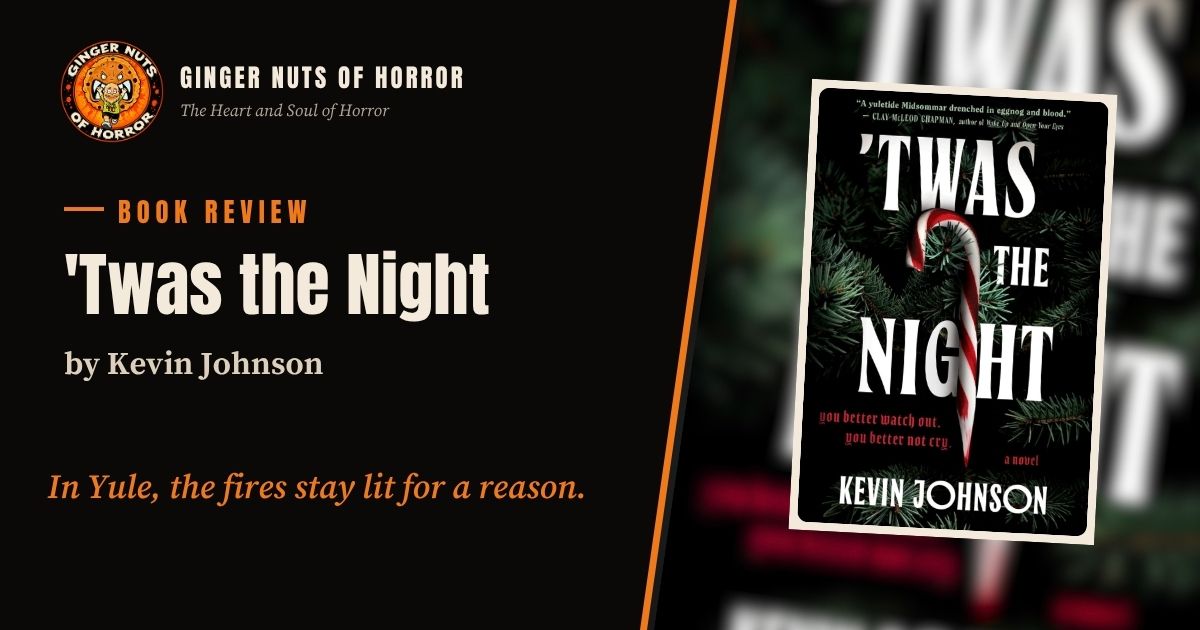
‘Twas the Night | Kevin Johnson | William Morrow | 13 October 2026 |
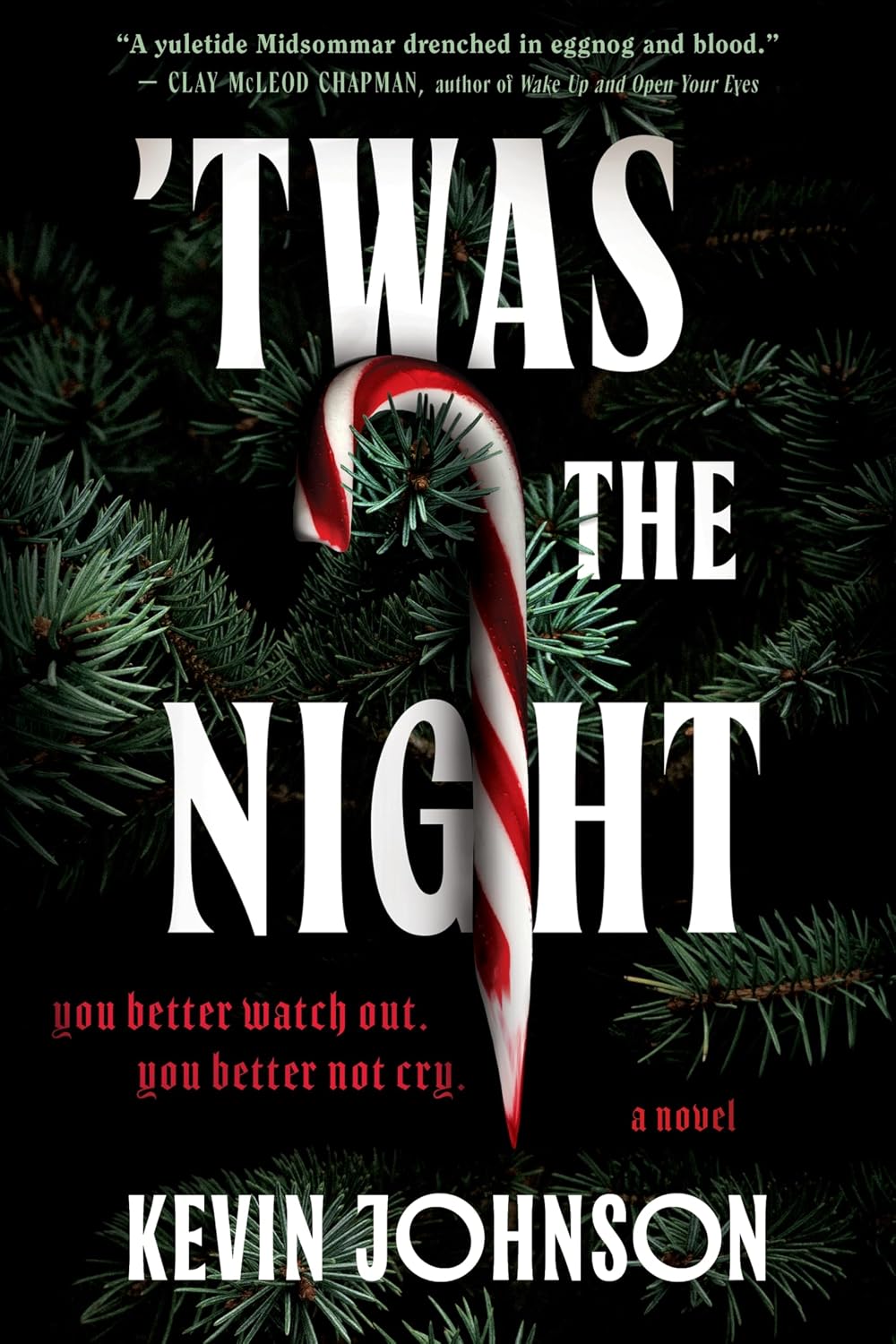
- Author Kevin Johnson
- Publisher William Morrow
- Published 13 October 2026
- Pages 288
- Format Paperback, ebook, audiobook
- ISBN 9780063459458
- Subgenre Christmas folk horror
- Reviewed by Jim McLeod
Halley Belanger, a reporter with no time for Christmas, follows a run of missing children across Maine to Yule, a village where the season never ends and Santa Claus is worshipped as a god.
‘Twas the Night is the debut novel from Kevin Johnson, out now from William Morrow, and it does to the Christmas village what The Wicker Man did to the May Day fete. A sceptical reporter goes looking for missing children in Yule, Maine, a place where the season never ends and Santa is worshipped as a god. In this ‘Twas the Night review I look at how Johnson turns cosy holiday images into Christmas folk horror, where his dark humour lands, and where a thin mythology holds the book back. It is a strong first novel with one clear weakness.
Kevin Johnson reads the old Christmas symbols backwards, and the result is a sharp, funny, nasty slice of holiday folk horror. Yule is a triumph of creeping dread. The mythology behind it is thinner than it should be, but this is still a debut that turns every lit fireplace into a warning
‘Twas the Night Review: Christmas as a Faith You Cannot Leave
There is a film that gets made every December, and you have seen it even if you swear you have not. A woman from the city who cannot stand Christmas is sent to a small town. The snow comes down. The locals are warm in a way that feels a little like a dare. By the last reel the town has won her over, and she has learned to love the season again. It is the most reliable story on television, and in all those years nobody has thought to ask what the town wanted from her.
Kevin Johnson asks.
His debut takes that exact frame, the sour woman, the snowbound village, the neighbours who will not rest until she believes, and turns the dial from cosy to something with teeth. Halley Belanger is a reporter who hates Christmas and has even less time for Santa. Children have been going missing across Maine, and the one place the vanishings seem to skip is Yule, a village where it is always Christmas and Santa Claus is not a story but a god. She goes there to find out why. Yule, it turns out, would like her to stay.
It is a sharp premise, and it is the right kind for a first novel, because it hands Johnson a shape every reader already knows by heart. He does not need to spend pages teaching us the rules of the festive TV film. We grew up on them. All his effort can go into bending them, and for most of the book that is a smart trade that pays off well.
Yule is the best thing here. Johnson builds it out of the parts of a Christmas card: lit windows, baking, carols, a square that looks dusted with icing sugar. Then he lets the details go slightly wrong. Nutcrackers that stand a little too tall. Snowmen massed in ranks, as if they are waiting for orders. A school that seems to have one subject on the timetable. None of this is gore. All of it gets under the skin, because the decorations are not decoration in Yule. They are worship. Every bauble is a prayer, every string of lights an act of faith, and once you see the town that way you cannot unsee it.
The food deserves its own mention. Johnson writes baking the way some horror writers write wounds, with close attention and real appetite. Cookies, cakes and warm drinks turn up so often, and are described with such care, that you start to feel full. That is the trap. Yule feeds people. It is kind and it is generous, and that generosity is the most frightening thing about the place, since sooner or later you wonder what it costs and who is paying.
That question is the engine of the whole book, and it is an old one. Ursula K. Le Guin asked it in “The Ones Who Walk Away from Omelas”, a story about a perfect city and the hidden price of its joy. Folk horror has been asking it ever since a policeman flew to Summerisle in search of a missing girl. Johnson knows the lineage and leans on it without apology. The difference is the costume. Swap the wicker for tinsel and the maypole for a fir tree, and the shape is the same: an outsider, a community that has made a bargain, and a growing sense that the outsider is part of the deal.
Is ‘Twas the Night Scary?
Yes, though not all at once, and not always in the way the cover suggests. The first half runs on dread more than blood. Halley is told to stay indoors. She does not. The book gets a lot of mileage from that small act of stubbornness, because every walk she takes through Yule shows us a little more of what the town hides behind its lit windows.
The real violence comes late. When it arrives, it is graphic and it does not flinch, and some of it touches children and animals. Readers who need to know that in advance should know it now. I do not think Johnson is being cruel for the sake of it. The whole premise rests on missing children, and a book that kept its hands clean would be lying about its own subject. But the turn from creeping unease to open slaughter is steep, and it will catch some people out.
What keeps all this from feeling grim is the humour. Halley is prickly, sarcastic and hard to warm to at first, and her running commentary on Yule’s cheer is very funny. She is the kind of heroine who meets a carol singer with a raised eyebrow, and the book is better for her sour streak.
Even better are Bob and Barry, the couple who run the inn where she stays. Their bickering, fussing affection is the warmest thing in the novel, and it does real work. You need someone in Yule to care about, or the town becomes a set of props. Bob and Barry make it a home, which makes it far worse when that home begins to look like a cage.
The jokes and the horror sit side by side rather than cancelling each other out. That is harder than it looks. Plenty of comedy horror lets the laughs drain the menace, until the monster is just a punchline in a red suit. Johnson’s timing is good enough that a laugh often sets up the next scare, the way a magician’s patter steers your eye away from the hand that matters.
The image I keep coming back to is the hearth. The title borrows from Clement Clarke Moore’s poem, the one that sends St Nicholas down the chimney on the night before Christmas with a sack of toys. That poem turned the chimney into a door. Johnson turns it into a weak point in the walls. In Yule the fires are kept burning, and not for warmth. They are lit to keep St Nick out.
I am paraphrasing the set-up here rather than quoting it, but the effect is plain enough. The fireplace, the warmest image in the whole of Christmas, the spot where stockings hang and families gather, becomes a barricade. A roaring fire stops meaning comfort and starts meaning fear. Every cosy scene in the book carries that charge afterwards. When someone puts another log on, you know exactly why.
It is a clever bit of engineering, and it shows the book’s method in miniature. Johnson does not invent new horrors so much as he reads the old symbols backwards. The chimney. The list of who has been naughty and who has been nice. The man who sees you when you are sleeping. The carols always had a watchful, faintly sinister figure tucked inside them, and ‘Twas the Night simply takes them at their word.
The prose suits the job. It is clean, quick and unshowy, built for pace rather than lyric flights. Reading it is a bit like walking through a department store grotto. Out front there is tinsel, warm light and a jolly man on a throne; then a door is left ajar, and you glimpse the corridor behind the plywood, all bare bulbs and cables, never meant for your eyes. Johnson is very good at leaving that door ajar. He is less good, for now, at showing us what is at the far end of the corridor.
Where the Mythology Runs Thin
That is the book’s one real problem, and it is not a small one.
Johnson’s Santa is a presence more than a mythology. We feel his weight on Yule. We see the fear and the devotion. What we never quite get is the why: where this Santa came from, how the town’s bargain works, what the rules are and who wrote them. A little mystery is healthy in horror. Explain the monster too much and it shrinks. But there is a difference between a gap that frightens and a gap that frustrates, and too often this book lands on the wrong side of that line.
It shows most in the middle. Once Yule is set up, the story circles for a while. Halley pokes at the town, the town pushes back, and the big answers are held over for later. The book is also keeping secrets about its own heroine, and I will not go near them, but the wait for those reveals is long enough that when they come, they explain less than they should. The final confrontation is loud and bloody, yet it lacks the weight that a fuller myth would have given it. You want to feel the full age and hunger of the thing at the heart of Yule. You get a glimpse.
Compare the Finnish film Rare Exports, which digs its monstrous Santa out of a mountain and builds the lore with grim, practical logic. Or Brom’s Krampus: The Yule Lord, which goes deep into old winter gods and lets the history do half the frightening. Johnson has the better premise of the three, I think. He has not yet built the cellar under it.
It helps to place the book. Christmas horror has a long and messy family tree. On one branch sit the slashers: Black Christmas, Silent Night, Deadly Night and their heirs, where the season is set dressing for a killer. On another sit the creature features, Gremlins and Krampus, where the holiday itself turns monstrous. Anthologies such as Christmas and Other Horrors, edited by Ellen Datlow, have shown how many dark corners the midwinter festival really has.
‘Twas the Night belongs to neither branch cleanly. Its bones are folk horror. The fear does not come from a man with an axe or a beast in the woods. It comes from a community and what it has agreed to. That makes it a cousin of The Wicker Man and of Midsommar, and it would sit well beside the rural novels in this modern folk horror roundup. The setting matters too. Maine is Stephen King country, the home of small towns with rot under the floorboards, and Yule takes its place in that tradition with a kind of festive cheek.
The book is pitched as a riff on the festive classics, and you can feel the stop-motion specials many of us watched as children somewhere in its bloodstream. Johnson takes the iconography of those shows, the toys, the reindeer, the jolly man at the top of the world, and asks what a town would look like if it believed in all of it with total sincerity. The answer is a theocracy with gingerbread on top.
That is the deeper theme. Christmas, for most of the West, is the one faith almost everyone still practises, whatever they believe. We light the candles, keep the rituals, tell the children about the man who watches. Johnson takes that habit seriously and pushes it to its end point. In Yule the ritual has become the religion, the comfort has become a duty, and the duty has a body count. Halley’s hatred of Christmas, which looks at first like simple grumpiness, starts to read as the only sane response.
There is a grief strand too, quieter than the gore. Christmas is the season of empty chairs, the time of year when missing people are most missed. A book about stolen children set in that season knows exactly which nerve it is pressing.
As a first novel, it is full of promise. Johnson has said he grew up on Goosebumps and on the horror shelves of his local Blockbuster, and you can feel both in the book. There is the page-turning drive of the first, the hunger for the next twist. There is the VHS bravado of the second, the willingness to go for the bloody set piece and enjoy it. He studied creative writing at Florida State, and the craft shows in the structure. The book knows where it is going and moves there briskly.
What it does not yet have is patience with its own world. That will come, I suspect. The instincts here, for character, for comedy, for the wrong detail in the right place, are strong enough that I want to see what he does next.
Leave the fire burning this Christmas Eve. After ‘Twas the Night, you will know exactly what it is for.
The Verdict: Is ‘Twas the Night Worth Reading?
The verdict
A funny, nasty and atmospheric piece of Christmas folk horror, held back from the very top only by a mythology that never gets the depth its premise deserves.
Read it if: you want The Wicker Man in a Santa hat, love dark humour with your dread, and think the cosy Christmas TV film has always been hiding something.
Skip it if: you need a fully explained monster and a tight middle act, or cannot face violence involving children and animals.
Keep reading on Ginger Nuts of Horror
 You Better Watch Out by James S Murray
 Naughty or Dead: A Killer Review of ‘Til The Yule Log Burns Out’
 The Advent Calendar: A Christmas Horror Review

About Ginger Nuts of Horror
Ginger Nuts of Horror is an independent horror review and culture site based in Edinburgh, Scotland. Edited by British Fantasy Award nominee Jim McLeod, it publishes horror book reviews, film reviews, author interviews, features and cover reveals. Ginger Nuts of Horror won Best Inclusive Film & Book Review Platform at the SME News UK Enterprise Awards 2026.