A cave horror novel that changes the light you read by.
Tatiana Schlote-Bonne’s What Feeds Below arrives on 6 October 2026 as the debut release from Bindery Books’ new Boozhoo imprint, and this review makes the case for five stars. The YA horror fantasy follows orphaned best friends Petra and Jade into a chasm called the Void, where a dive gone wrong sends Petra chasing her lost friend through six layers of monsters, carnivorous plants and fungal body horror. Pitched for readers of The Descent and Annihilation, it already carries a starred Kirkus review. Cave horror, sporror and quest fantasy meet here, and the combination genuinely works.
Schlote-Bonne descends into the Void and drags you down with her, layer by suffocating layer, until the darkness stops being a setting and starts being a character. What Feeds Below fuses cave horror, fungal body horror, and a devastatingly real friendship into something that feels genuinely new: a YA horror fantasy that trusts its readers to handle the dark without flinching. This book rearranges the light you read by.
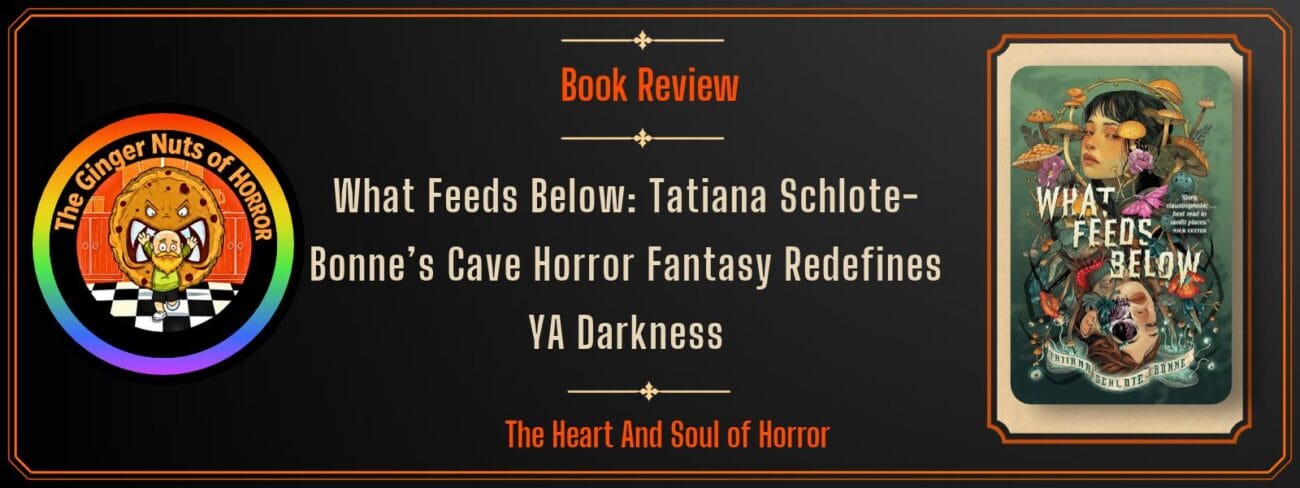
What Feeds Below Review: Tatiana Schlote-Bonne’s Cave Horror Fantasy Redefines YA Darkness
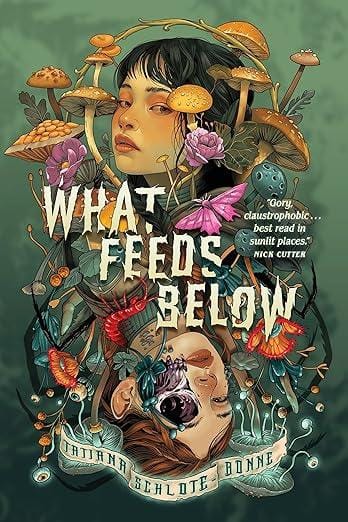
There is a line early in What Feeds Below where the darkness stops being a backdrop and starts breathing. You know the moment when you read it. The prose, which had been doing the brisk work of establishing Petra and Jade in their grim little corner of the City of the Void, suddenly slows, thickens, becomes something you wade through rather than glide across. The air gets heavy with spores. The walls glisten with something that is definitely not water.
And you realise Tatiana Schlote-Bonne has been luring you downward the entire time, one careful sentence at a time, until the surface feels like a rumour you once heard. That is the kind of horror this is: environmental, patient, utterly convinced of its own geography. You do not read this book so much as descend into it.
The novel, published through Bindery Books’ Boozhoo imprint on October 6, 2026, occupies an unusual generic territory. Marketed as YA horror fantasy, it borrows liberally from several traditions without pledging allegiance to any single one. Schlote-Bonne herself has described it as horror fantasy pitched for fans of The Descent and Annihilation, and those comparisons are earned. But they do not quite capture the peculiar alchemy at work here. This is cave horror refracted through an anime lens, fungal body horror married to a friendship drama, a quest narrative that feels structurally indebted to video game level design while remaining stubbornly character-driven.
The setup is deceptively simple. Orphaned best friends Petra and Jade live in the slums at the edge of the City of the Void, a settlement perched beside a massive chasm that plunges miles into the earth. The Void is overrun with vicious monsters and carnivorous plants, but it also attracts wealthy tourists hunting for treasure, and guiding those tourists down into the chasm is how Petra and Jade earn their living. Petra prefers the upper levels, where the dangers are understood.
Jade wants to descend to the Sixth Layer, the deepest and most mysterious stratum, because that is where the real payouts wait. Their friendship is Petra’s entire world; Jade’s approval means everything to her. So Petra agrees to do things Jade’s way. The job goes wrong. Jade is lost. Petra must plunge deeper than she has ever dared, and she does not know what the Void truly is, or what feeds below.
What reading this book actually feels like is worth dwelling on. Schlote-Bonne constructs dread not through jump scares or gore, although the body horror is present and unflinching, but through the systematic dismantling of safety. Each layer of the Void strips away something Petra believed she could rely on: light, distance, the reliability of her own senses, the assumption that the world operates according to comprehensible rules.
The pacing follows a descent pattern that mimics the cave itself. Early chapters move with the brisk efficiency of a tour guide ticking off known landmarks. Then the known runs out, and the book shifts into something more fluid, more hallucinatory. By the time Petra reaches the deeper layers, the prose has begun to feel like a fever dream, sentences loosening their grip on linear logic, imagery bleeding into symbolism, the line between the cave’s biology and Petra’s psychology becoming deliberately porous. This is not a book that wants to startle you. It wants to infect you.
Schlote-Bonne’s authorial voice is precise and unsentimental, but it carries an undertow of genuine tenderness toward her characters that prevents the darkness from becoming nihilistic. The dual-protagonist structure is one of the book’s sharpest achievements. Petra and Jade are opposites in ways that feel observed rather than engineered: Petra is cautious, inward, prone to overthinking; Jade is impulsive, charismatic, the kind of person who mistakes recklessness for courage. Their dynamic drives the entire narrative engine, and Schlote-Bonne is smart enough to let their friendship be complicated without ever letting the reader doubt its reality.
The prose itself is the product of a writer who knows exactly what register she wants to hit and sustains it with impressive control. Schlote-Bonne earned her MFA from the University of Iowa’s Nonfiction Writing Program, and that training shows in her attention to concrete detail and her resistance to stylistic inflation. The sentences are lean. The imagery is specific: carnivorous plants described with the clinical precision of a botanist who has stopped being surprised by what evolution can produce, monsters rendered in terms that owe as much to fungal biology as to traditional horror bestiaries.
When the book needs to move fast, it moves. When it needs to linger over something terrible, it lingers. The dialogue between Petra and Jade carries the rhythms of two people who have known each other so long they have developed their own shorthand, their own silences, their own ways of hurting each other without meaning to. This is craft deployed in service of immersion, never drawing attention to itself.
Beneath the cave horror and the quest narrative, the book is doing something genuinely interesting with the theme of codependency. Petra’s entire identity is wrapped up in Jade; her willingness to descend into mortal danger is presented not as heroic selflessness but as a kind of existential desperation.
What would you become, the book asks, if the person who defined you disappeared? The Void, in this reading, is not just a cave full of monsters. It is a psychological landscape, a place where identity dissolves and reforms. The deeper Petra goes, the more she is forced to confront who she is without Jade to reflect back at her. This is horror as identity crisis, and it lands with more weight than any monster could manage alone.
Schlote-Bonne descends into the Void and drags you down with her, layer by suffocating layer, until the darkness stops being a setting and starts being a character. What Feeds Below fuses cave horror, fungal body horror, and a devastatingly real friendship into something that feels genuinely new: a YA horror fantasy that trusts its readers to handle the dark without flinching. This book rearranges the light you read by.
The fungal horror elements deserve special mention. Schlote-Bonne taps into what the online horror community has been calling “sporror”, a subgenre concerned with fungi, spores, mycelial networks, and the queasy boundary between organism and ecosystem. The Void is not merely a cave; it is a living system, interconnected in ways that become increasingly disturbing as the book progresses. The body horror that emerges from this premise is both grotesque and philosophically unsettling, raising questions about autonomy, contamination, and the porousness of the self.
This is not body horror for shock value. It is body horror as existential inquiry, and it places the book in direct conversation with works like Silvia Moreno-Garcia’s Mexican Gothic and the fungal fiction that has been proliferating through the genre in recent years.
What sets What Feeds Below apart from those works, however, is its commitment to the emotional architecture of YA. Schlote-Bonne has spoken in interviews about her love for grief horror, citing films like The Babadook and The Orphanage as influences, stories where the monster is directly connected to the protagonist’s internal struggle. That principle is fully operational here. The Void’s horrors are not random; they are thematically coherent, each one reflecting some aspect of Petra’s psychological state back at her. The book is fast-paced without being shallow, dark without being bleak, and it earns its emotional devastation the hard way: by making you care about the people it puts through hell.
To understand what Schlote-Bonne is doing here, you need to look at the arc of her career so far. Her debut, Such Lovely Skin (2024), was a YA horror novel about a Twitch streamer whose demonic doppelganger begins destroying her life. That book established several of the tendencies that define her work: a fascination with the intersection of identity and technology, a commitment to grief as a central horror engine, a prose style that is simultaneously accessible and precise, and a willingness to engage with the specific anxieties of terminally online young people without condescending to them.
The novel earned strong reviews from Kirkus and Booklist, with critics noting the satisfying complexity of its plot twists and the depth of its engagement with guilt and self-forgiveness.
Her second book, The Mean Ones (2025), marked a sharp turn into adult horror. The novel follows Sadie, a twenty-nine-year-old woman haunted by the trauma of witnessing her best friend’s ritual murder at summer camp, trying to build a normal life while the past refuses to stay buried. It is an interior, psychological novel, more interested in immersion and atmospheric dread than in conventional scares. Reviews praised its rawness and its refusal to offer easy catharsis. In interviews around that book’s release, Schlote-Bonne was already teasing What Feeds Below, describing it as a return to YA territory but with the harder edge her adult work had sharpened.
Read in sequence, the three books reveal a writer who is systematically exploring the architecture of fear from different angles. Such Lovely Skin examines fear of exposure, of being seen and judged. The Mean Ones examines fear of memory, of what the past can do to the present. What Feeds Below examines fear of dissolution, of what happens when the structures that hold your identity together are stripped away. Across all three, the core preoccupation remains constant: the monster is never just a monster. It is always, in some way, a mirror.
Schlote-Bonne’s craft has evolved noticeably across these books. The prose in Such Lovely Skin was sharp and voice-driven, built for speed and immediacy. The Mean Ones slowed things down, trading velocity for texture, letting sentences breathe in ways that created a more suffocating atmosphere. What Feeds Below synthesises these approaches. It has the momentum of her debut and the atmospheric patience of her sophomore effort, and it deploys each mode exactly where it is needed. This is a writer learning in public, refining her tools, growing more confident with each book in her ability to control the reader’s nervous system.
Placing this book within the broader horror landscape requires acknowledging that YA horror is having a moment. The past several years have seen a resurgence of horror aimed at teenage readers, driven in part by the success of authors like Rory Power, Kat Ellis, and Nicole Lesperance. Schlote-Bonne belongs to this wave but also stands slightly apart from it.
Her work is less interested in the gothic traditions that shape much YA horror and more drawn to the visceral, immersive traditions of survival horror and creature features. What Feeds Below reads less like a YA novel that happens to be horror and more like a horror novel that happens to feature teenage protagonists. The distinction matters. It suggests a writer who trusts her audience to handle darkness without needing it diluted.
The book’s subgenre identity is hybrid in a way that feels distinctly contemporary. It is cave horror, a subgenre with a long pedigree in film but a relatively thin presence in YA literature. It is fungal horror, tapping into the same cultural aquifer that has produced the recent explosion of interest in mycelial networks and fungal cognition, from popular science books like Entangled Life to horror novels that treat fungi as a vector for ecological and bodily dread.
It is quest fantasy, structurally indebted to the logic of video games, which makes sense given Schlote-Bonne’s well-documented love of gaming. And it is a friendship story, a subgenre that YA does exceptionally well but that horror often neglects in favour of romance. The book’s insistence that the central relationship is platonic, that friendship can be as consuming and dangerous and necessary as any love affair, is one of its quietest and most radical moves.
Comparable books are not hard to identify, but none of them quite map onto what Schlote-Bonne has built. Wilder Girls by Rory Power shares the claustrophobic setting and the body horror preoccupations. House of Hollow by Krystal Sutherland shares the sisterly bond and the descent into a hidden world. The Luminous Dead by Caitlin Starling, though adult, shares the caving premise and the psychological intensity. Jeff VanderMeer’s Annihilation, the most obvious reference point, shares the sense of an environment that is actively, intelligently hostile.
But What Feeds Below feels like its own thing. It is warmer than VanderMeer, more emotionally legible than Power, more structurally adventurous than Sutherland. It borrows from all of these wells and produces water that tastes unmistakably like Schlote-Bonne: a specific blend of emotional vulnerability and biological grotesquerie, anime pacing and literary restraint, teenage yearning and adult consequence.
The boundaries between YA and adult horror continue to blur. The fungal horror trend shows no sign of exhausting itself; if anything, it is deepening, moving from novelty toward genuine thematic richness. The influence of video games on narrative structure is becoming more pronounced across all media, and Schlote-Bonne is one of the writers most comfortable with that influence, treating it not as a gimmick but as a legitimate storytelling grammar.
And the hunger for horror that earns its emotional weight, that refuses to coast on atmosphere alone, that understands dread as something to be cultivated rather than deployed, remains as strong as it has ever been. What Feeds Below meets that hunger directly. It feeds it, in fact, and then it asks what the feeding costs.
What waits in the Sixth Layer of the Void is not what you expect. It is worse, and it is more beautiful, and it makes a kind of sense that will rearrange how you read everything that came before it. I finished this book and sat in silence for a while, thinking about friendship, about hunger, about the things we descend into because someone we love asked us to. Then I went back and read the first chapter again, because I needed to see the surface with new eyes. That is the mark of a horror novel that has done its job. It changes the light you read by.
What Feeds Below by Tatiana Schlote-Bonne
The darkness isn’t empty. It’s hungry.
At the edge of the City of the Void, a massive chasm extends miles into the earth, its treacherous terrain overrun with vicious monsters and carnivorous plants. For orphaned best friends Petra and Jade, guiding treasure-seeking tourists down into the Void is the only way to earn enough to pull themselves up out of the slums for good.
Petra prefers to play it safe and take jobs only in the Void’s upper levels, where the dangers are better understood, while Jade wants to risk a descent to the deepest and most mysterious Sixth Layer. Because the deeper they go, the better the payout, and the sooner their dreams can become reality. Their friendship is Petra’s whole world, and Jade’s approval means everything—so Petra agrees to do it Jade’s way.
When their job goes wrong and Jade is lost in the Void, Petra must plunge deeper than she’s ever dared to save her friend. But she doesn’t know the truth of the Void . . . or what really waits for her in its depths.
Ginger Nuts of Horror: The Heart and Soul of Horror Reviews
Every feature is designed to help sell your work, build your audience and connect your horror story with readers who are actively looking for their next frightening read. Our horror book reviews and features include backlinks to your website, publisher page or Amazon author page, a full synopsis, relevant author information and a universal purchasing link that directs readers to their local bookseller or preferred retailer.
All editorial coverage is provided completely free of charge. We do not charge authors, publishers, filmmakers or creators for reviews or features. Ginger Nuts of Horror exists to support the horror community and help great books, films and independent voices find the audiences they deserve.
With a large, engaged social following and an 18-year archive of trusted horror coverage, Ginger Nuts of Horror is a horror review website built to support authors, filmmakers and creators. Our coverage spans horror novels, indie horror, gothic fiction, folk horror, psychological horror, supernatural fiction, dark fantasy, horror films and the wider creative world surrounding the genre.
Whether you’re an established horror author, an indie filmmaker, a publisher, or a debut voice in indie horror, we offer opportunities to place your work in front of dedicated horror fans, readers, viewers and genre enthusiasts. A feature on Ginger Nuts of Horror can help improve discoverability, strengthen your online presence and give potential readers a clear route from discovering your work to finding out more or making a purchase.
Although our coverage is free, we do have a Ko-fi page for readers, authors and supporters who would like to help us continue promoting horror books, films and creators. All donations are entirely voluntary and greatly appreciated. Every contribution helps support the time, research and ongoing work involved in running an independent horror review website.
Explore our horror book reviews and horror movie reviews, discover the kind of horror coverage we publish, then get your horror book or film featured today.