Where There’s Smoke | Rachel Louise Adams | Titan Books | 6 October 2026 |
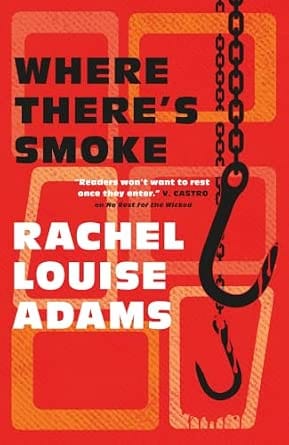
- Author Rachel Louise Adams
- Publisher Titan Books
- Publishes 6 October 2026
- Pages 368
- Format Paperback
- ISBN 9781835418765
- Series Coldren County, Book 2
- Subgenre Rural crime horror
- Reviewed by Jim McLeod
Newly divorced and working as a small-town medical examiner, Dolores Hawthorne is called to a Wisconsin slaughterhouse where its much-loved owner lies dead, and the FBI arrive with an old school rival in tow.
Where There’s Smoke, the second Coldren County novel from Rachel Louise Adams, takes medical examiner Dolores Hawthorne out of Halloween and into a Wisconsin slaughterhouse in deep winter. Titan Books publishes it in the UK on 6 October 2026, a year after No Rest for the Wicked first brought her home. This Where There’s Smoke review looks at why a crime novel set on a kill floor turns out to be one of the year’s sharpest horror crossovers, how Adams turns the language of the meat trade on the men who run it, and where the book sits beside Gillian Flynn and Agustina Bazterrica. It starts, as these things do, with a body.
Rachel Louise Adams turns a Wisconsin slaughterhouse into the sharpest moral machine in recent crime horror. Lyrical, grim and darkly funny, Where There’s Smoke asks who gets called merciful and who gets called meat, and it never once looks away. A couple of thin supporting players barely dent it.
Where There’s Smoke Review: Coldren County Goes to the Kill Floor
Every abattoir has a word for what happens on the kill floor, and it is never the honest one. Processing. Dispatch. Harvest. The meat trade runs on soft nouns, the same way a small town runs on the stories it tells about its best men.
Rachel Louise Adams knows this better than most crime writers. Before she wrote novels, she wrote a PhD thesis on American fast food and meat eating. That research hums under every page of her second Coldren County book. On the surface this is a murder mystery set in a Wisconsin slaughterhouse. Underneath, it is a book about who gets called kind and who gets called meat. The line between them is thin when the right man owns the building.
The set-up is simple and grim. Dolores Hawthorne, the forensic pathologist who came home to Little Horton in No Rest for the Wicked, has stayed. She is divorced now, out of Los Angeles, and working as the medical examiner in nearby Circe. The work is quiet. Too quiet, frankly, for a woman who used to spend her days inside other people’s worst ends. Then the night cleaning crew at Marcy’s Meats finds the owner, Benedict Marcy, dead inside his own plant.
Locals call him Mr. Mercy. He gave to every good cause in the county. Nobody can think of a single reason anyone would want him dead.
In a crime novel, that is the loudest alarm bell there is.
What follows is a proper investigation. It is built from autopsy findings, missing evidence and people who smile too much. Sheriff Kreme brings Dolores in. The FBI follows, in the shape of Paul Turner from the first book and his new partner, Kate Butcher. Kate is fresh out of Quantico, a former Little Horton cop, and she and Dolores share some unfinished business from their school days. A slaughterhouse case handed to an agent called Butcher tells you something about Adams. Her humour is black as a bin bag, and she trusts you to notice it without a nudge.
The plant’s manager is Magnus Peterson. He points the finger at animal rights protesters who staged a slaughter video for the cameras. It is the easy answer. Adams has no interest in easy answers. Evidence starts to vanish, and so do some of the people who handle it. The snow comes down. The county closes ranks. Each new fact about the beloved Mr. Marcy makes the halo look a little more like a noose.
Is Where There’s Smoke Scary?
Yes, though not the way a slasher is scary. Nothing leaps out of a cupboard here. The fear in this book is procedural. It comes from how calmly the plant works and how clean the steel is. The whole place is designed so that nobody has to think about what it does. Adams describes the line plainly, almost politely, and that politeness is what makes your stomach turn. A book that screamed about the abattoir would be easier to shrug off. This one simply shows you around.
Then there is the other thread, the one Dolores carries in her chest. The Halloween cards are still coming. Someone knows what happened to her as a teenager in Little Horton, and since she took it to the police, that someone wants her quiet. Adams opens the book with clear content warnings, and she means them. The novel treats sexual violence as a fact of her life, not a twist to be sprung. It never turns her pain into spectacle. Nor does it hand her a big speech about healing. She just starts, slowly and stubbornly, to put herself first. It lands harder than any speech could.
Home life offers no rest either. Her stepmother, Charlotte, is still scheming. Her half-sister, Josie, ends up sleeping under Dolores’s roof to get away from her own mother. The family scenes are short and sour, and they matter, because the book is asking the same question at home that it asks at the plant: who gets protected, and who gets processed?
The cleverest thing in the novel is a nickname.
Mr. Mercy. Say it aloud and it sounds kind, almost holy. Locals even call the plant Mercy’s rather than Marcy’s. Now set it against the place. The whole language of humane slaughter is built on the promise of a merciful death: the quick stun, the clean cut, the animal that never knows. Mercy is the abattoir’s favourite word for itself. Adams hangs that word round the neck of the man at the top. She lets a whole county repeat it with love. Then she lets you watch it curdle. She never has to underline the point. The town does it for her, every time someone says what a good man he was.
That instinct for naming runs through her style. In No Rest for the Wicked, Dolores calmed herself by counting the bones of her skull: sphenoid, frontal, lacrimal. It was a lovely tic, and it told you everything about her. Name the part and you can stand to look at it. Where There’s Smoke takes that habit and makes it the book’s method. The prose names things exactly. Bones, blades, machines, lies. Precision becomes a kind of anaesthetic, for Dolores and for us, right up until it stops working.
The title earns its keep too. Somewhere in the book, a character wonders whether people watching smoke ever see the face behind the magic trick. I am paraphrasing, but that is the novel in one breath. Coldren County is a town that has agreed to watch the smoke.
How Where There’s Smoke Compares to Sharp Objects
Reading Adams is like watching someone lay fine lace over a butcher’s block. The lines are lyrical, sometimes even pretty, and the thing underneath them is still a block, still wet, still stained. That contrast is the whole engine. A plainer writer would make the gore numbing. A fancier one would make it decorative. Adams keeps the lace thin enough that you always see the wood.
The obvious ancestor is Gillian Flynn’s Sharp Objects, where Camille Preaker goes home to a Missouri town whose richest family made its money from hog butchering. Both books know that small-town respect is often just debt with better manners. Both know that the women who come home are the ones who see clearest, because they have been somewhere else. Adams has less of Flynn’s venom, though, and more warmth. She likes her people, even the ones who are lying to her. That warmth is not softness. It is what makes the betrayals sting, because she has made you care about the liars as well as the lied to. You know these people. You have queued behind them at the bank.
On the police side, Dolores joins a long line of doctors of the dead who read bodies better than they read rooms. Kay Scarpetta. Maura Isles. Adams adds something they rarely had: a heroine who is still in the town that hurt her, still bumping into its people at the shop.
On the horror side, the book stands closer than you might expect to Agustina Bazterrica’s Tender Is the Flesh and Joseph D’Lacey’s Meat. Those are full allegories. Adams stays in the real world, yet she lets the same question seep in. If a system can make killing feel clean, what else can it make feel clean? Here that question reaches beyond the pigs. It reaches the local prison, the men with money, and the old story Dolores has been told to forget. The animals and the women are not the same, and the book never pretends they are. But they are caught in the same machinery of looking away.
No Rest for the Wicked was a fine debut. It was patient and led by its people. It was full of jack-o’-lanterns and family rot, and it was built around the vanishing of Dolores’s father, a former mayor turned senator. It took its time, and it needed to. It had a whole town to build.
This second book moves faster and cuts deeper. Adams has clearly learned how much weight her world can bear, and she loads it. The cast grows and the stakes climb. Best of all, the book adds a second point of view, Kate’s. It is the smartest choice Adams makes. Kate sees Dolores from outside. That gives us a heroine we can finally judge as well as pity. It also gives the novel a second brain, and the two women circle the case and each other with a wariness that feels earned.
Is anything wrong with it? Very little. Josie and Ash, Dolores’s half-siblings, still feel more sketched than drawn, and they deserve a bigger share of the light. The final stretch also lingers a little after the main reveal, tying knots that a braver editor might have left loose for book three. These are small faults in a big, bold book. They feel less like flaws than a series clearing its throat for what comes next.
The rest is control. Adams knows when to cut away from the blood and when to make you stay. She knows that the worst moment in a horror story is often the polite one, the handshake, the kind word at the funeral, the man everyone calls Mercy. She keeps her humour dry enough to let the reader breathe, never so loud that it breaks the spell.
Second novels in a series often play it safe. They repeat the trick that worked and hope nobody notices. Adams has done the opposite. She has taken a Halloween town and walked it into winter, into the cold room, into the part of the county everyone drives past.
Where there’s smoke, they tell you, there’s fire. Adams knows better. Where there’s smoke, there is usually a man fanning it, and a whole town that has agreed not to look.
The Verdict: Is Where There’s Smoke Worth Reading?
The verdict
A slaughterhouse murder that becomes a fierce, funny and deeply humane study of power, mercy and the stories small towns tell about their best men.
Read it if: you like your crime with horror’s nerve, and Sharp Objects left you wanting more blood on the floor.
Skip it if: plain descriptions of animal slaughter, or a central thread about sexual violence, would be too much for you right now.
Ginger Nuts of Horror: The Heart and Soul of Horror Reviews

Jim "The Don" McLeod has been reading horror for over 35 years and reviewing it for more than 16. He's the editor of Ginger Nuts of Horror, Europe's largest independent horror review and culture site, and a British Fantasy Award nominee for his work in the genre. When he's not busy inflicting his opinions on the horror community, he can be found annoying his family or getting thoroughly outwitted by his two dogs, Casper and Molly.