- Author Rachel Louise Adams
- Publisher Titan Books
- Publishes 6 October 2026
- Format Paperback, ebook
- ISBN 9781835418765
- Series Coldren County, Book 2
- Subgenre Dark crime thriller
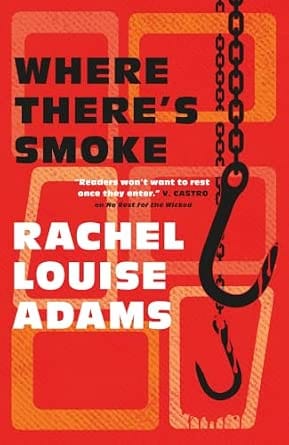
Divorced and newly working as a medical examiner in small-town Wisconsin, Dolores Hawthorne finds her quiet caseload upended when a beloved meat magnate is found dead in his own slaughterhouse, and the FBI comes calling.
Where There’s Smoke is the second Coldren County novel from Rachel Louise Adams. It swaps the jack-o’-lanterns of No Rest for the Wicked for the kill floor of a slaughterhouse. That choice was no stunt. While she wrote the series, Adams spent years on a PhD about meat and the violence we never see. A charming rich man found dead among the DNA of a thousand hogs was a gift for a crime writer. It was also a risk, because it made the book darker and far more personal. In this guest essay, she explains why this slaughterhouse crime novel was the only authentic answer she could give.
Rachel Louise Adams chose a slaughterhouse because her research left no other door open. Years spent studying meat and its hidden violence made the setting personal, and she admits it made Where There’s Smoke far darker than its Halloween predecessor. Her case is simple: a writer need not be original, but she must be authentic.
Where There’s Smoke | Rachel Louise Adams | Titan Books | 6 October 2026 |
It’s not that often writers land on a truly original idea.
I don’t mean a good idea. We better have those if we want to pay the bills on time. But, in my (maybe) controversial opinion? “Original” is overrated.
Yet when I started brainstorming where to set Book 2 of the Coldren County series, I landed on an idea that seduced me because it was original, before I could decide if it was good or bad.
What popped into my mind was, “Slaughterhouse”.
Not many of us think about slaughterhouses, ever. Yet when I started writing Where There’s Smoke, I was thinking of them every day. Every hour.
Let’s wind back. At twenty-seven, I’d just signed a book deal that included No Rest for the Wicked as well as a sequel. I was over the moon—you couldn’t pay me enough to stop writing about Dolores. There was only one problem.
In No Rest, the setting is a main character. Little Horton, Dolores’s Halloween-obsessed hometown, was a huge part of what pulled me into the book. It’s actually how I still call the book. Just thinking about those magical weeks of writing, I see pumpkin pies roasting at Ruby’s diner, the candlelit smiles of jack-o-lanterns, black cats crooking their backs at orange moons.
Yet there was no way Book 2 could take place in Little Horton. After that Halloween climax… how could another book set in this town have so deep and personal an impact? Sequels that paint over Book 1 are never half as good as those that get a fresh canvas.
Where There’s Smoke would be setting-oriented, too, because I’m a sucker for world-building.
But where?
Where to drop that body like a shot in the night?
My brain almost immediately answered, “A slaughterhouse.”
Not because I’m more deranged than your average person (though I probably am).
It was only that back then, I thought of slaughterhouses all the time.
Two years earlier (the year I started the Coldren County series), I got a scholarship to write a PhD about meat, and the often-invisible violence that comes with it. I knew I’d have to read hundreds of books about slaughterhouses. About what goes on behind those doors we never think about. How easy, to replace the reality of animals with cartoons on butcher shops, smiling cows on milk bottles.
Smell the smoke? What smoke?
The creatures that become bodies then body parts in our refrigerators. The baptism of blood that births those products, this flesh, unrecognizable, un-animal, wrapped in cellophane. So neat. So bloodless. It’s hard to think they were (some)bodies in the first place.
I knew my research would make me peer behind that curtain. That I would discover a symphony of suffering inaudible to everybody else.
What I didn’t know, was how isolating that music would feel. How close to madness.
Walking in a supermarket, passing the meat aisle. I would hear the squeal of pigs from leaked videos (it’s all on the internet if you look for it. But why would you?). My friends would be eating bacon or fish. I would walk into their kitchen and in the safe fog of their laughter, I would smell death (death is what meat smells like when the pink glasses drop.)
I would see a carcass on my friends’ table and all around me, their warmth and their love would peel like the skin of baked apples. Piercing the party’s joyful notes, I would start hearing the symphony only I could hear, the siren song of pain and slaughter.
Sometimes I think a single sentence would have been more impactful than a thesis. That I should have just looked at my jury and said, “There’s something irreversible about how human they sound when they scream.”
The pigs.
I could say “The animals,” because that’s really what I mean. But then you would be seeing too many things, not seeing anything. Pigs are the image I use in the book. Somehow, they’re the faces I remember the clearest. The melted brown of their eyes. They let you see it. The horror, and fear and defiance. The utter inability to understand, not what is going on, but why it’s going on. Then the knife, the absurd river unleashing from their bodies hooked upside down.
I wonder how anyone comes out of these waters unscarred.
And from this coppery tide came my original idea.
“Where to set my new murder mystery?”
A slaughterhouse.
A gamble, more like. It sounded good to me, but I’d spent three years feeling part of a community with dead animals.
Besides, Little Horton had been a Halloween town. A fun town.
Who wants to visit a slaughterhouse? Who wants to think of a slaughterhouse?
Even if I cloaked it in candy-bright colors, I knew this would make the bookdarker—much darker—than the last installment.
And yet I was more seduced by the idea as days wore on.
From a forensic standpoint, it was genius. What greater puzzle than a kill floor blurred by the DNA of a thousand hogs? What better hook than a charming magnate murdered in his own slaughterhouse?
Isn’t “Eat the rich” supposed to be the new black?
Yet I knew this decision would make me vulnerable. The slaughterhouse couldn’t only be a décor. Like Halloween, it’d become a theme. It would ask questions about what it means to butcher, to slaughter, to devour. It would be more personal even than Little Horton—because how could I write impersonally about my siren song?
The kinship that seemed to bind me to all flesh, casually dismembered, casually eaten. The cry that rose in my blood when I saw something as mundane as hamburgers. The desire to say stop, please, stop. To save what was already corpse.
The protest that would sound insane to the sane world. “I’ve been a pig, too.”
We’re all pigs when our bodies fall on the wrong side of hunger.
In the last part of my thesis, I’d focused on the ties between meat eating and gendered violence. That idea actually isn’t original. Read The Sexual Politics of Meat (Carol J. Adams). Think of the hundred ways in which female bodies are consumed daily. Of what we mean when we feel “like a piece of meat”; of the sister creatures mirrored in this analogy.
Knowing what meat feels like—isn’t it a tale of slaughter already?
As my main character is a survivor of violence, I knew these symbolic ties would be present. It’s important to say, slaughter as a metaphor makes sense to me, not intellectually, or politically. But viscerally.
You don’t have to be original to write a good book, but I do think you have to be authentic.
And that’s the only authentic way I can answer, “Why a slaughterhouse?”
Because of my siren song.
Because I couldn’t find a thread in my imagination untouched by their music.
Because I wanted others who’d survived slaughter to read this book and feel seen.
“Because I was a pig.”
That’s the short answer.
The long one is a 700+ page thesis.

Meet the Author
Rachel Louise Adams
RACHEL LOUISE ADAMS was raised in a small town in Brittany by a French father and a North American mother. After studying literature at university, she wrote her PhD thesis on American fast foods and meat-eating. When she isn’t writing or reading, she can be found advocating for animal rights, spending time with her fiancé, her friends, and her two cats.
Latest bookWhere There’s Smoke
A dark, suspenseful, Wisconsin-set thriller with a rich (opened) vein of pitch-black humour, this standalone novel sees No Rest for the Wicked’s pathologist heroine Dolores Diaz return to the Midwest to investigate a suspicious, grisly death in a small-town slaughterhouse. Perfect for fans of Ronald Malfi and Rachel Harrison.
Ginger Nuts of Horror: The Heart and Soul of Horror Reviews

Jim "The Don" McLeod has been reading horror for over 35 years and reviewing it for more than 16. He's the editor of Ginger Nuts of Horror, Europe's largest independent horror review and culture site, and a British Fantasy Award nominee for his work in the genre. When he's not busy inflicting his opinions on the horror community, he can be found annoying his family or getting thoroughly outwitted by his two dogs, Casper and Molly.