
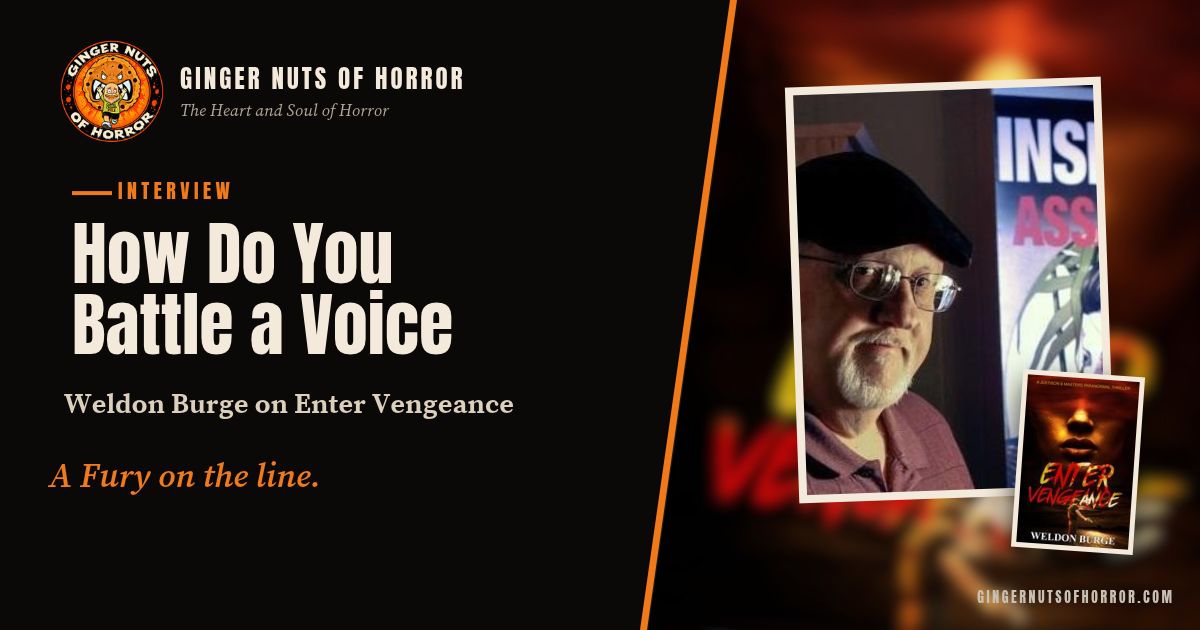
Enter Vengeance | Weldon Burge | Smart Rhino Publications | May 2026 |

- Author Weldon Burge
- Publisher Smart Rhino Publications
- Published May 2026
- ISBN 9798988062585
- Subgenre Paranormal police procedural
When a millionaire suspected of murdering his wife is strangled inside his locked, guarded bedroom, Detective Rex Justison and psychic Alicia Masters find themselves hunting a killer that answers to no human law.
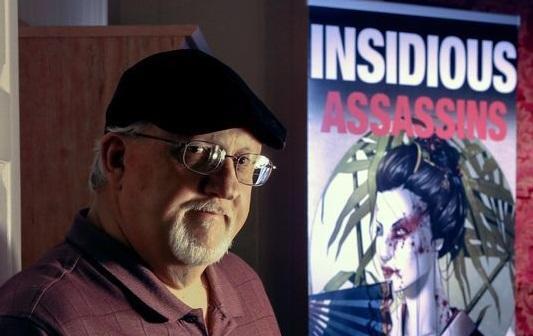
Weldon Burge spent decades as a professional editor, still runs Smart Rhino Publications, and in Enter Vengeance he sets a detective against a Greek Fury. Rex Justison is a cop who wants hard evidence. Alicia Masters is a psychic who keeps getting there first. Tisiphone is the one on the other end of the phone. I had plenty to say about the book in my review of Enter Vengeance, but a review only gets you so far with a paranormal police procedural this strange.
I wanted to know why the scariest object in the book is a telephone, why its antagonist gets chapters of her own, and how a writer who calls violent revenge anathema makes it so satisfying on the page. This Weldon Burge interview covers all of that, plus the short story that fed Justison’s guilt and the editing habit Burge had to break before he could finish a novel. It joins the rest of our horror interviews here at Ginger Nuts of Horror. Here is Burge on voices, Furies and the gap between justice and revenge.
Burge built his Fury as a voice before a face, then let her out of the shadows to savour a cup of coffee, and he insists that only deepened the unease. He trusts his characters to lead the plot, and keeps real vengeance at arm’s length.
Weldon Burge on Enter Vengeance
Enter Vengeance turns the telephone into one of its scariest instruments, ringing into an empty house with no caller ID and no warmth on the other end. That is a very specific choice for a novel to build its dread around. What put the phone in your hand as the delivery method for fear, rather than something more visual or physical?
The antagonist, Tisiphone, is faceless and unemotional when first revealed. The phone conversation reflected this sense of an entity, not something human. The assumption that Cullen, the first victim, was murdered by a human assailant is completely erased when Justison receives the phone call. I considered the development of Tisiphone a gradual thing, and the phone call gave a voice to the unseen. In many ways, that’s far worse than seeing her. How do you battle a voice?
You give Tisiphone her own point-of-view chapters rather than keeping her as an unseen force the detectives chase. That is a structural risk in a book built around a locked-room mystery, because it hands the reader information Justison does not have. What made you decide the reader needed to be inside her head, and what did you worry you might lose by letting her out of the shadows?
Up to that point, Tisiphone was unseen and a seemingly indestructible entity. Giving her a human persona was another step in her development. That human element adds a small sense of vulnerability and normality to the character, something I suspect makes the reader re-evaluate what’s occurring. I mean, what’s more normal than someone savoring a cup of coffee? That’s not at all how the reader likely envisioned Tisiphone. I wasn’t worried about divulging too much by taking her out of the shadows. If anything, it added more to the unease. And it added a different “flavor” of vengeance.
The book opens on an epigraph pairing Heraclitus on the Erinyes as ministers of justice with Francis Bacon’s line about revenge being a kind of wild justice. That is not a casual piece of set dressing. At what point in writing the book did that pairing arrive, and how much did it end up shaping everything that came after?
When I first started the book, the working title was A Wild Kind of Justice, based on the Bacon quote. I abandoned that title early on. I was reading Joseph Campbell when I was tinkering with ideas for the novel, and somehow I landed on the idea of mythological vengeance. That led to reading more about Furies, and it became clear that Tisiphone was the best antagonist for the story. (And notice the intentional use of antagonist instead of villain. I don’t consider her a villain.) The epigraph mirrors the theme of vengeance vs. justice, which permeates the book.
Alicia Masters’ defining scene comes early, when a psychometric touch drops her into a basement where a kidnapped boy sits bound while his captor eats popcorn and talks to him in a voice you call soft and pleasing, yet poisonous. It does more character work in a page than most backstory manages in a chapter. How much did you cut from that scene before it found the right amount of restraint, and how did you know when you had gone far enough without going too far?
Good question. Not much cutting actually. I wanted to leave the woman’s motivation and intention in the air, so I cut some of that. I didn’t give the boy a voice in the scene. The focus was on Alicia’s reaction to the situation and her inability to respond to the circumstances, the bane of her psychic abilities. The scene’s brevity forced that focus on Alicia’s dilemma. I think it worked.
I should also point out that I hope to revisit this scene in more detail in the sequel. I hinted at this with the cliffhanger at the end of the book when Alicia receives a phone call from Billy.
Tisiphone tells Justison flatly that she is a god and that the two of them are not so different, because they both want justice. That is a genuinely persuasive argument coming from something the book is not asking us to root for. How did you calibrate her case so it lands hard on the reader without tipping the book into agreeing with her?
Another good question. Our society battles with the differences between justice and revenge, perhaps because we see so little justice in the world. In an earlier squad room scene, Marma says, “Give ’em a badge and make it legal.” Vigilantism is a popular concept, but is it truly justice? The reader is fully aware of Justison’s background and guilt. And, when he confronts Tisiphone, the reader understands Justison’s guilt is unjustified. They side with him, not Tisiphone. Justison and Tisiphone are clearly different at that point.
Justison spends the entire novel demanding solid, indisputable evidence, even while living inside a case a psychic keeps solving for him ahead of the paperwork. That stubbornness could easily have curdled into the reader losing patience with him. How much did his scepticism change shape as you got deeper into the draft, compared with what you had planned for him at the start?
I wanted his skepticism concerning Alicia’s psychic ability to parallel his skepticism about their complicated relationship. Throughout the book, he is forced to face the truth of her abilities as well as the truth of their relationship. At some point, he had to toss aside his need for indisputable evidence and face the facts.
One of your most reprinted short stories, Blue Eye Burn, follows a Vietnam veteran who cannot outrun the ghost of a child he was forced to kill in the war. Justison carries a version of that same wound, a red-haired boy on a bicycle he could not stop for, years earlier. What did writing that story teach you about carrying an unforgivable accident through an entire narrative, and how much of it did you draw on consciously when you built Justison’s guilt?
The idea for Blue Eye Burn came from an article I read about the number of Vietnam vets who committed suicide after the war. The atrocities they’d witnessed drove them to depression and despair. The vet in Blue Eye Burn was in therapy, and the memory of the child haunted him. The end of that story had him come to terms with his guilt. When developing Justison’s character, I wanted to have a similar coming to terms with guilt. I think there is always a way to find the light at the end of a tunnel, no matter how deep the guilt.
Harvester of Sorrow runs two timelines across more than a decade, Edouard LeBorg’s history in 1982 Port-au-Prince braided against a six-month procedural core in 1993, and it took you over ten years to sequence into its final shape. What did wrestling with that structure teach you about timeline and pacing that you carried, consciously or not, into how Enter Vengeance moves between Justison, Masters and Tisiphone?
I love playing with POV, and much of the structure of both books was determined on that playground. I suspect most of this is embedded in my subconscious. I juggle POVs until something works (or works best). The timeline falls in place as I develop the characters. I don’t know if other writers share a similar technique, but it works for me. I do have a basic outline when I start a book, but the characters generally take me in different directions, and I eventually abandon the outline and let the characters take over the plot. They know what they’re doing.
Before Enter Vengeance, you had already read well over a hundred submissions for a single Smart Rhino anthology, editing and shaping other writers’ horror for more than a decade. What did all those years on the other side of the desk change about your own instincts as a novelist, and what is one habit you had to consciously unlearn once you were writing your own book instead of fixing someone else’s?
I was a professional editor with a consulting firm for decades, and I’ve always said I’ve learned more from working with other writers than they’ve learned from me. What works, what doesn’t work. If you have a chance to edit others’ writing, jump at it. It’s a learning experience well worth exploring.
That said, what I had to learn was to switch my editor’s hat for a writer’s hat at home. I was having an issue completing Harvester of Sorrow until I spoke with another novelist who asked, “How many times have you rewritten the first chapter?” I’d reworked it thirteen times. He was right. You can’t write a novel if you’re stuck in editor mode.
John Connolly has spent two decades sending Charlie Parker up against forces that are never quite explicable, and in 2020 he wrote a Charlie Parker novel literally called The Furies. You are now sending your own detective up against an actual Fury, Tisiphone herself.
I must confess that I’ve not read Connolly—something I need to do. So, the echo was not deliberate. Perhaps fortuitous. I don’t mind sharing the paranormal police procedural shelf with him.
The paranormal police procedural has historically been a small, oddly specific corner of the genre, and Connolly’s newest Parker book landed again this year to remind readers he still owns most of that shelf. Where do you see that shelf heading over the next few years, and what happens to the writers who staked it out early?
Well, paranormal romance seems to have hit its stride, so maybe the paranormal police procedural will find its stride as well. It’s hard to predict, but I guess it’s nice to be on the first wave. We’ll see how it goes.
When bodyguard Larry Krisgow sweeps the dark bedroom with his Glock, the prose goes clipped and procedural, all motion and no editorialising, right before the moment the shadow in the corner moves. That restraint is doing a lot of quiet work. How do you decide, sentence by sentence, when to hold the prose back like that instead of leaning into more description at the exact moment something frightening happens?
Author Everett De Morier wrote, “Weldon Burge writes with cinematic precision and emotional depth.” I like that and hope it’s accurate. When I get to a scene that I want to move faster and further pull in the reader, I go cinematic. Description has no place there–it interrupts the scene. But, even when I approach a scene cinematically, I try not to forget the emotion that underlies it. That’s the tricky part. I’m not striving for a John Wick scene. There has to be something the reader can relate to.
When Tisiphone calls Justison at home, her voice comes down the line in fragments, with no punctuation and no warmth, answered first by his own teenage daughter. That is dread built entirely out of rhythm rather than incident. What are the actual mechanics of writing a voice that is meant to sound wrong at the level of the sentence, and how many drafts did that particular effect take to land?
That was difficult, and took a good number of drafts. Isn’t it interesting how something that seems so simple to the reader can prove so difficult for the writer? I wanted Tisiphone to sound nonhuman, almost digital. When the recording of her voice is analyzed, it’s anything but human. The lack of punctuation is jarring to the reader, making Tisiphone even more alien.
You have spent years now on the other side of the writing desk as an anthologist, at Kirkwood Library, reading other people’s drafts and telling new writers the plain truth about the odds against them. Enter Vengeance is the first villain you have built entirely on your own time in years. (Jim, I’m confused about what you’re asking here.) What did building Tisiphone teach you about yourself that two decades of editing other people’s monsters never got round to?
Tisiphone’s whole argument to Justison is that she and he are not so different, because they both want justice badly enough to act on it, and the book never lets him, or the reader, off that hook. Setting Justison aside, what would a wrong done to you or someone you love have to look like before you understood, in your own gut, why she does what she does?
Interesting question. The idea of taking justice into my own hands, particularly to the point of using violence to address it, is anathema to me. Yet, at the same time, watching Tisiphone “execute” a murderer who has escaped justice is vicarious. There is something satisfying about seeing vengeance enacted when justice doesn’t prevail. So, although I probably wouldn’t be vengeful, I would certainly strive for justice. I believe in karma. You don’t get away with harming others. But, if Enter Vengeance is cathartic in any way for the reader, my job is done.
Get the book
Enter Vengeance by Weldon Burge is out now from Smart Rhino Publications.
If your landline rings tonight with no caller ID, let it go to voicemail. If this Weldon Burge interview proves anything, it is that nothing good comes down the line, least of all a caller who has given up on punctuation.
Keep reading on Ginger Nuts of Horror
 Enter Vengeance by Weldon Burge: A Fury Works a Murder Case
 Crones and Cold Cases: Tracy Fahey on Queens of the Crone Age
 Trust No Angel: J. Todd Kingrea on Only Angels Have Blue Eyes

About Ginger Nuts of Horror
Ginger Nuts of Horror is an independent horror review and culture site based in Edinburgh, Scotland. Edited by British Fantasy Award nominee Jim McLeod, it publishes horror book reviews, film reviews, author interviews, features and cover reveals. Ginger Nuts of Horror won Best Inclusive Film & Book Review Platform at the SME News UK Enterprise Awards 2026.