
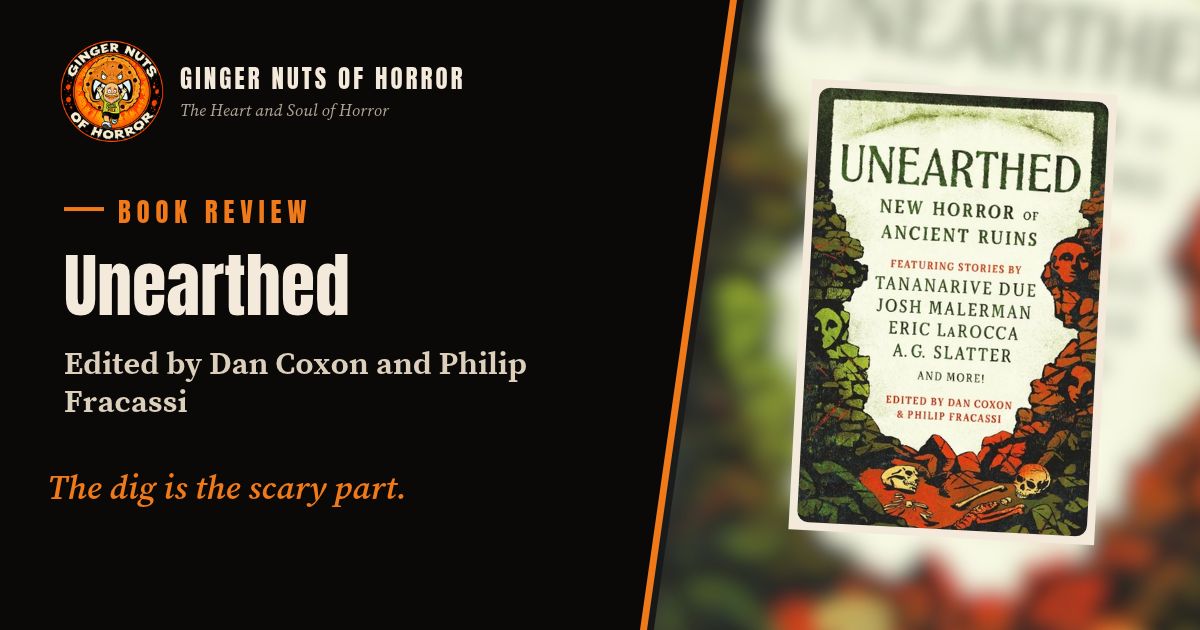
Nineteen stories of ruins, greed and the price of digging too deep.
Unearthed Review | Dan Coxon and Philip Fracassi | Titan Books | 15 September 2026 |
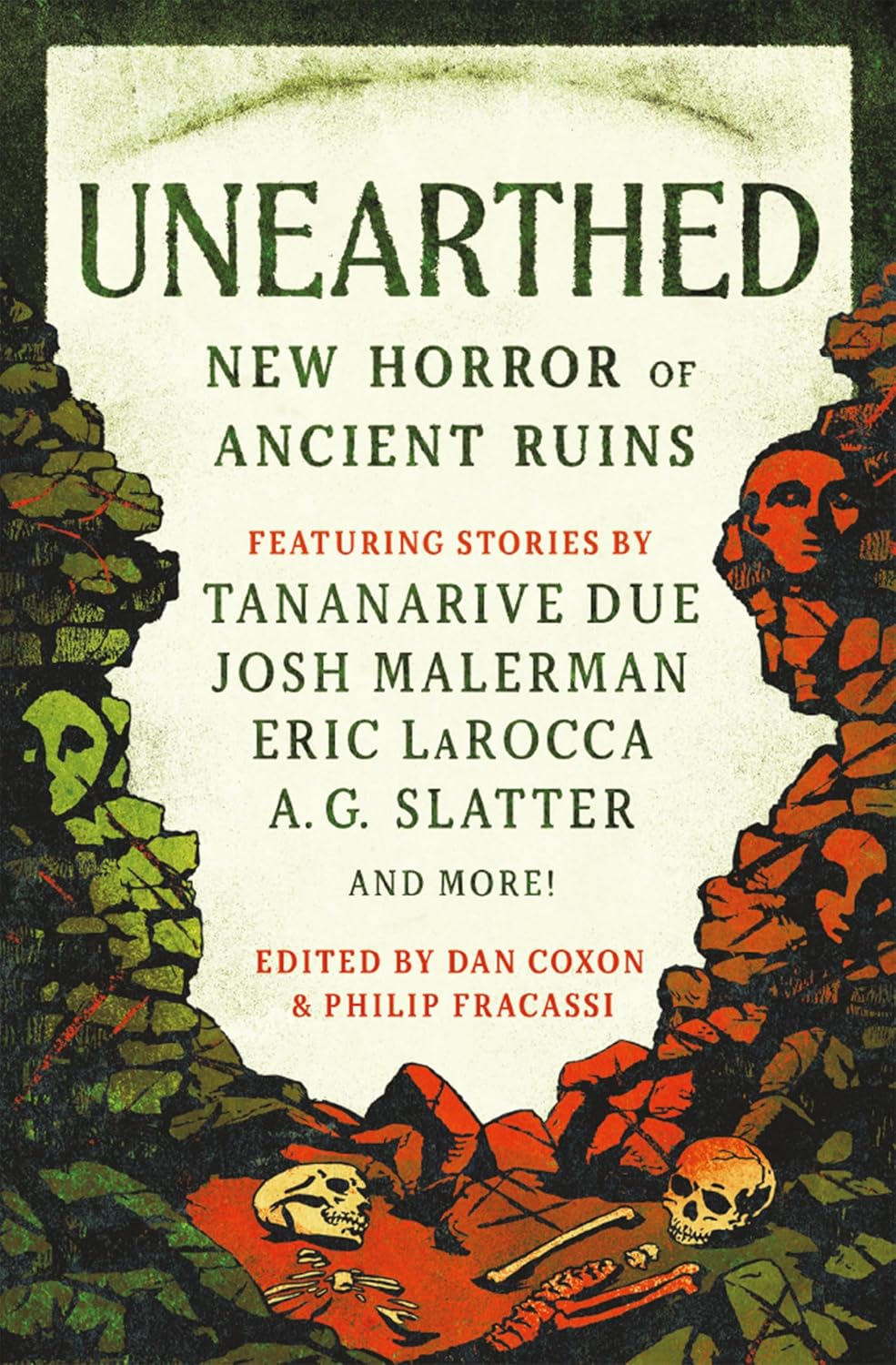
- Editors Dan Coxon and Philip Fracassi
- Publisher Titan Books
- Published 15 September 2026
- Pages 416
- Format Paperback, ebook
- ISBN 9781835413098
- Subgenre Archaeological horror anthology
- Reviewed by Jim McLeod
Nineteen new stories go down into tombs, caves, temples and stone circles, from Stonehenge to the terracotta army, to find out what the ancient world buried and why it should have stayed there.
Unearthed: New Horror of Ancient Ruins, edited by Dan Coxon and Philip Fracassi, brings together nineteen new stories set in tombs, temples, caves and stone circles. Titan has given the pair a cast list that runs from Tananarive Due and Christopher Golden to Ai Jiang and Hache Pueyo, and most of them have come ready to dig. I went in braced for a parade of mummies and curses. What I found was sharper than that: stories about who owns the past, who sells it, and what it costs to carry it home. One story will lose some readers, and I will come to it. First, though, the ground itself.
Unearthed is that rare themed anthology where the theme does the heavy lifting. Slatter, Castro and Jiang turn old stones into questions of greed and ownership, and only one story, which needed a warning it never got, keeps the book from full marks.
Unearthed Review: Who Owns the Ruins?
Every ruin is a quarrel about who gets to remember. Somebody built it. Somebody else knocked it down, or let it fall, or charged a fee to walk round it. Then, a few thousand years later, a man in a good coat turns up with a spade and a funding plan, and the quarrel starts all over again.
That, more than any curse, is what drives this book.
Coxon and Fracassi call it archaeological horror. That is their own label, not a shelf you will find in Waterstones. It fits. The old furniture is all here, the tombs and the monoliths and the dark below the dark, but the best stories in the book know that the dig is the haunted part. The trowel, the permit, the rich backer, the museum case. Horror has always loved a buried thing. Here it is far more interested in the hand that digs it up.
That is not new ground, quite. M.R. James was warning antiquarians to leave things where they lay a century ago, and Quatermass and the Pit taught a generation that London had something nasty under its Tube lines. What Unearthed adds is money. In story after story the past has been bought, branded or sold, and it wants paying back.
Coxon knows how to run a themed book. He edited Isolation for Titan in 2022, and his own folk horror collection, Come Sing for the Harrowing, showed a writer who likes his dread rooted in soil. Fracassi brings a novelist’s eye for pace; anyone who read Sarafina will know he is not squeamish about the body. Between them they have built a running order that moves from the slow and strange to the openly wild, with only one serious misstep along the way.
Themed anthologies are a hard trick. Pick a theme too tight and every story feels the same. Pick it too loose and you get a pile of good stories in a nice cover. Titan has done this well before, with New Fears and Bound in Blood, and Unearthed sits closer to those than to the pack. It reads best next to an Ellen Datlow book, where the theme is a door rather than a cage. The ruin gets you in. What you find down there is up to the writer. Most of the time, the writers here find something worth the climb.
Which Unearthed Stories Are the Best?
A.G. Slatter’s The Bridegroom of Cumae is the jewel, and it is also the most fun you will have in these pages. Cumae was home to the Sibyl, the prophet in her cave, and Slatter takes that old ground and runs a Holmes-flavoured mystery straight through it, complete with a colony of vampires.
It is a period piece told with total confidence, and it has the best people in the book. Slatter writes characters who can be a little bit infuriating, the sort who walk into danger because they cannot bear not to know. In a horror story that is not a flaw. It is the engine. Anyone who loved the witch lore of A Forest, Darkly will find the same steel here, set in older stone.
V. Castro’s AI Cathedral comes at the theme from the other end of time. A woman goes looking for what a murdered man found before the AI firm he worked for buried the evidence, and what she finds is far older than any server farm. It is the most timely story in the book. Castro has spent books like The Queen of the Cicadas pulling Mexican myth into the present and asking who it belongs to.
Here she points that question at the tech money that now funds half the world’s grand projects. The idea that a company would dig up a god and file it under research is chilling because it sounds so plausible. Castro blends lore and raw horror with no apology, and the story lands hard.
Ai Jiang’s The Empire Beneath His Feet goes to the terracotta army, which is a gift of a setting for horror. Thousands of clay soldiers, each with its own face, buried to serve one man after death. Jiang has always been good on labour and the cost of ambition, from Linghun to A Palace Near the Wind, and the emperor here is a demanding presence long after death.
The finds on the dig are wrong in ways the people digging do not want to see. It sits close to the heart of the whole book, because the terracotta army is the purest image of what a ruin really is: the work of many hands, raised for the glory of one.
Here the book starts to make an argument rather than just gather stories. Castro’s tech firm, Jiang’s emperor and Cavan Scott’s billionaire all want the past as property. Scott’s ReHistory is the cheekiest of the lot. A rich man buys Stonehenge and sets out to restore it to how it looked four thousand years ago, and the whole thing comes to us as the transcript of a BBC news report.
Look at how that form works, because it is the cleverest craft choice in the book. A transcript gives you no inner voice. You get the correspondent, the studio, the cutaways, the polite chatter of breakfast television, and you have to read the horror in the gaps. Every time the anchor steers back to a cheerful link, the dread grows, because you can feel how badly the people on screen are failing to grasp what they are standing on. Scott has said he had Quatermass and the old Doctor Who serial The Daemons in mind, and it shows in the best way. It is a story about how the news turns the end of the world into a segment.
Mark Chadbourn’s Lost Out Here in the Stars goes to Göbekli Tepe in the wake of the Syrian civil war, which gives the oldest site in the book the most present danger. Priya Sharma’s Okunoin takes its name from the vast temple cemetery on Mount Kōya, a setting made for her calm, exact style. A.M. Shine’s Live Forever, Hache Pueyo’s Son of the Earth and Tananarive Due’s Under Water all earn their places. Premee Mohamed’s None Went Out is the kind of story that sends you off to look up the author so you can find more.
Not every story clears the bar. Josh Malerman’s The Obsession of the Adversary is an odd choice to open with, too slight to stick, and it sets a slower pace than the book deserves. Benjamin Percy’s Burial Rights spends more time on a social climber than on the ground beneath him. And a handful of pieces feel as though the ruin was added late, a setting rather than a cause. In a nineteen-story book that is normal. It is also why I would tell anyone to keep reading past the first two.
Reading Unearthed is like walking a dig with a trowel in your hand. Most layers give up something worth keeping. A few give up only soil. And one turns up a thing you wish had stayed in the ground.
There is a lot of skill on show, and not much ego. No story tries to be the whole book. Each one picks a site, goes down, and comes back up changed, or does not come back at all. That is the shape of a good dig. It is the shape of a good anthology too.
Is Unearthed Too Dark? The Grasshopper Problem
Content note: this section names the subject of Eric LaRocca’s story, which includes child sexual abuse.
Eric LaRocca’s Grasshopper follows a girl on a family holiday. Her mother is dying back home. While she is away, she is sexually abused by another child. LaRocca has never been a writer who looks away. Things Have Gotten Worse Since We Last Spoke made his name on exactly that refusal. But this story is the one place in the book where the theme feels bolted on, the ruin a backdrop to a different and much darker story. When the link to the book’s premise is that thin, the abuse stops reading as part of a larger argument and starts reading as the point.
I do not think the story is beyond the pale for horror. Horror has to be allowed to go there. My problem is the framing. A theme anthology about ancient ruins sets a reader up for one kind of dark, and this is another kind entirely. A book that carries this story needed a content note at the front, and Unearthed has none.
It has also split readers more than anything else here, and I suspect it will cost the book some of them. That would be a shame. Skip it if you need to. The rest of the dig is worth it.
What stays with me, after the vampires of Cumae and the clay army and a billionaire playing god on Salisbury Plain, is how little of this book is about monsters at all. The monsters are real enough. But the true horror is the visitor’s badge, the sponsor’s logo, the urge to own what was never ours to hold. These ruins do not want to be seen. They want to be left.
Put the spade down. Read the book instead.
The Verdict: Is Unearthed Worth Reading?
The verdict
A themed anthology that turns its theme into an argument about greed and ownership, led by Slatter, Castro and Jiang, and held back only by one story that badly needed a warning.
Read it if: you like your horror with a sense of place and history, you grew up on Quatermass and M.R. James, or you want a sampler of the best names in the genre right now.
Skip it if: you want every story tied tightly to the theme, or you need clear warnings before material involving the abuse of children.
Keep reading on Ginger Nuts of Horror
 Fangs and Fury: How V. Castro’s Maria the Wanted Reinvents Vampire Horror
 Bound in Blood, edited by Johnny Mains, Book Review
 Women of the Weird West, edited by KC Grifant: The Frontier Reclaimed

About Ginger Nuts of Horror
Ginger Nuts of Horror is an independent horror review and culture site based in Edinburgh, Scotland. Edited by British Fantasy Award nominee Jim McLeod, it publishes horror book reviews, film reviews, author interviews, features and cover reveals. Ginger Nuts of Horror won Best Inclusive Film & Book Review Platform at the SME News UK Enterprise Awards 2026.