
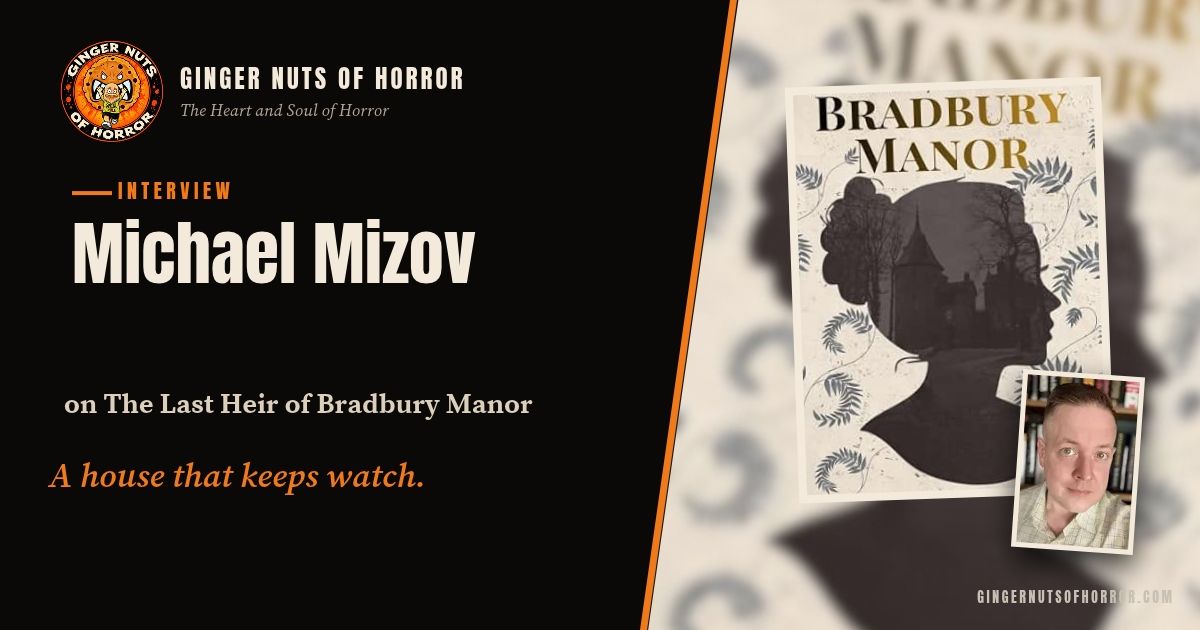
Michael Mizov on his debut gothic horror novel, a manor that watches back, a title that promised a romance, and the Pet Sematary paperback that started it all.
The Last Heir of Bradbury Manor | Michael Mizov | Three Dragons Press | 29 September 2026 |
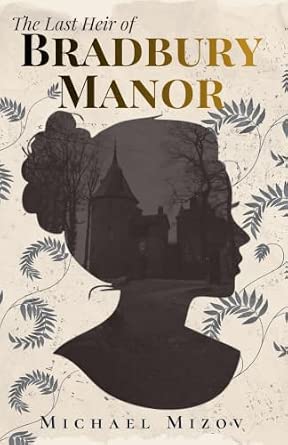
- Author Michael Mizov
- Publisher Three Dragons Press
- Published 29 September 2026
- Pages 347
- Format Hardback, paperback, ebook
- ISBN 9783912923018
- Subgenre Gothic horror
Yorkshire, 1919. After her brother dies in the Great War, Lottie Bradbury is called home to the family manor, where the gardener’s death and his son’s suspicions make her doubt everything she remembers.
Michael Mizov has made short films, a superhero send-up and an app company whose name needed explaining, and now he has written The Last Heir of Bradbury Manor, a gothic horror novel set in Yorkshire in 1919. It follows Lottie Bradbury, nineteen and called home after her brother dies in the Great War, to a manor she hoped never to see again. Then the gardener dies on the front steps, and his son arrives with a theory about the house.
In this Michael Mizov interview, the debut novelist talks about a 33,000-word outline, a title that promised a romance, and a childhood copy of Pet Sematary that made things much worse. He wanted the manor to feel watchful and hungry, which puts it in good company with the house in The Unhaunting. Like the best of our horror interviews, this one also gets to the root of what scares the writer most. Here he is, in his own words.
Mizov’s gothic debut trades jump scares for a slow erosion of certainty: a grieving heir who cannot trust her own memory, a manor that seems to watch and want, and a family where everyone believes they are doing the right thing, which he finds far more frightening than any monster in the dark.
Michael Mizov Interview
Let’s start at the very beginning. For our readers, please introduce yourself. Beyond the author bio, tell us a little about who you are when you’re not writing, what you love doing, what fascinates you, and what fuels your creativity.
I’ll give you the basics first. I’m Michael Mizov, I live in New Jersey, I’m married, and I have twin five-year-old girls. I’ve worked for an adhesives company in various roles for the past twenty years, most recently in market strategy. Basically the blueprint for “random middle-aged dude.
My entire life, though, I’ve had this competing urge to do strange, creative things while simultaneously staying on the “safe” path of the STEM degree, the 9-to-5, all of that. I started writing screenplays as a way to avoid classwork and wrote almost a dozen features before realizing that if I wasn’t going to live somewhere with the right connections, I needed to make my own. So I started producing short films under my little studio, Brain Salad Productions.
My first production was called Snubbing David Cross. This was back in 2004. I knew him from Mr. Show and his stand-up, and I had somehow run into the guy on three separate occasions. Every time, he completely refused to acknowledge my existence. So naturally I made a film about trying to find him, engineer a situation where he would finally say hello to me, and then snub him first. Comedy Central somehow got ahold of it and published a little blurb about how stupid it was, so that was cool.
After another half-dozen or so projects, including a mis-educational show that got me banned from streaming video on Amazon, I made my biggest project to date, Stuporhero. It was a send-up of the superhero genre that I finished in 2019, just in time for everyone to get tired of superhero movies and COVID to shut down every film festival on Earth. Whoops.
Around that time, my wife and I decided to have kids, and since it was COVID, apparently they were running a buy-one-get-one special, so we wound up with twins. Once I regained the ability to function as a human being, I started thinking about another film project. Then I realized sitting alone in the dark late at night writing was considerably cheaper than making movies, and eventually The Last Heir of Bradbury Manor was born.
Outside of all that, I’ve restored an 1885 Victorian house that probably should have been torn down and somehow still live in it. I also started an app company called Sinecure Industries and released things like How Am I Feeling?, Free Bad Advice, and Random Acts of Kindness. I spent considerably more time explaining to people what a sinecure was than I ever did pitching the actual apps, which may explain how that venture went.
So what fuels my creativity? Mostly, I just need somewhere for all the random stuff bouncing around in my head to go. My idea list is a mile long, and what I want more than anything is enough time to bring as many of those ideas to life as I can. I make things because I genuinely love making things. That’s really the fuel.
Although money would be nice, too.
In the early stages of a new project, what tends to come to you first: a compelling character voice, a central thematic question, or a vivid image/scenario? How does that initial spark then guide you in building the rest of the story?
First is always the scenario. What if blank happened? That’s the question, and then everything else starts spiraling outward from there.
For The Last Heir of Bradbury Manor, I had a very specific “what if?” question that I can’t actually write here because it would give away the entire novel. But if anyone reads the book, feel free to reach out afterward and hazard a guess as to what it was.
From that scenario comes the theme of the story. I’m a big proponent of the story structure Robert McKee outlines in Story. I went to one of his seminars when I was deep into screenwriting, and the tenets of his methodology apply far beyond film. If you want an idea of what the seminar was like, Brian Cox did a masterful job impersonating him in Adaptation. Needless to say, it stuck.
Once I have the question and the theme, I have to figure out who I want to put through all of it. In this case, that was Lottie Bradbury. To understand where Lottie needed to go, I first had to understand where she was starting, so I built her biography one characteristic at a time.
She loves to read. She’s a voracious reader. Okay, where did she do all that reading? At boarding school. Why was she there? Her mother died and her father didn’t want to deal with her. No, that wasn’t quite right. He couldn’t deal with her. Maybe he was afraid to. Why? Because she had an older brother. She was the second-born child and, in that world, not nearly as important.
So she’d been at boarding school for twelve years, since she was seven. She was completely disconnected from her home and her father, with most of her connection to the family coming through letters from her brother. Then the Great War happens. Her brother dies at the front.
Now she’s important again. Now she has to come home. Now she’s the heir. And that’s where the book begins.
I do that kind of biography for almost every major character and keep all of it in a gigantic Google Drive full of notes. I build histories for locations, maps, timelines, whatever I think I might need, because I’m a huge nerd for details.
Once that foundation is done, I build what I call my spine outline. That’s the broad architecture of the story: how many chapters belong to each arc, where Lottie is emotionally at each stage, and basic structural markers like “meet the mentor.”
Then I build the actual plot outline. The outline for Bradbury Manor was about 33,000 words, which eventually became a roughly 93,000-word novel. That outline contains essentially every action beat in every chapter, along with important lines of dialogue I already know I want somewhere and the occasional witticism I become far too attached to and eventually have to cut.
Having all of that worked out makes writing the prose much easier for me because I’m no longer wondering what happens next. I can focus on how the characters feel, what they say, what the room smells like, how the light falls, and all the little details that make the world feel real.
And yes, that includes long descriptions in my notes of Edwardian clothing. I researched it. You’re going to enjoy it.
Once I know where my characters are going and why, I can spend my time getting the reader into Lottie’s head and making the journey there feel alive.
Every book has its own unique set of problems to solve. What was the most difficult ‘puzzle’ you had to crack while writing this book? Was it a plot hole, a character’s motivation, the structure, or something else entirely?
My biggest problem to solve while writing this book was… me.
After I finished the first draft and my initial edit, the book had a couple of problems I was simply too close to see. The first was the title. For reasons that seemed perfectly sensible to me at the time, I had called it The Gardener’s Son, which sounds considerably more like a Harlequin romance than a gothic horror novel.
The gardener dies almost immediately. Shortly afterward, his son Arthur arrives, and he’s completely unlike anyone Lottie has ever known. He starts opening her eyes to things around the estate that his father had always considered… off. So now Lottie is dealing with an estranged father suddenly back in her life, a manor she would have preferred never to see again, and this handsome stranger essentially telling her, “I know things are already weird for you here, but I think your house killed my father.”
Arthur is a very important character. Apparently so important in my head that I named the entire book after him.
Then an agent wrote back with something along the lines of, “Interesting horror story, but I kept waiting for them to have sex and it never came together. Where’s the story that matches the title?” Big whoops.
That was incredibly useful feedback because she was completely right. The title was making a promise the book had no intention of keeping. More importantly, it made me realize I had centered Arthur in the title when this had always been Lottie’s story. So The Gardener’s Son became The Last Heir of Bradbury Manor, which is a much better representation of what the book actually is.
The second problem was chapter length. I was deliberately writing toward the rhythm of older gothic novels: lush description, mood, slow-building tension, and room for scenes to breathe. My original version had twenty-four chapters, with quite a few running somewhere between 3,500 and 5,000 words.
“Robust” would be the polite description.
Then the word every writer loves hearing came up: pacing.
The problem wasn’t that nothing happened. Plenty happened. But there weren’t enough natural places for the reader to stop, digest what had just happened, and then get that dangerous little thought: Well, I can read one more chapter.
When I went back through the manuscript, I realized that many of those long chapters already contained a natural midpoint climax followed by the beginning of the next movement of the story. So, mostly by splitting at those moments, I went from twenty-four chapters to forty-three while changing very little of the actual prose.
The average chapter is now around 2,200 words, with a handful of bridge chapters that come in at around 700. The story feels faster without actually becoming a different story.
Of course, then I got an ARC review saying the book moves incredibly fast, so apparently there is no correct answer.
But I like where it landed.
The journey from a finished manuscript to a book in a reader’s hands can be a surprising one. What was the most significant way your book evolved during the editing and publishing process, something you didn’t anticipate when you typed ‘The End’?
The biggest evolution was probably one of emphasis rather than story. The bones of the novel, its characters, mystery, and ending, were already there, but the editorial process helped me become much more deliberate about what Bradbury Manor itself represented and how strongly its presence should be felt throughout the book. I tightened certain scenes, clarified Lottie’s motivations, and made sure the house felt less like a setting and more like an active force shaping the people inside it. By the end, it was still very much the book I had originally written, but I think it became a more focused and confident version of itself.
Once a book is published, it no longer entirely belongs to the author; it belongs to the readers and their interpretations. Has a reader’s reaction or analysis ever revealed something about your own work that surprised you?
One reader said Bradbury Manor felt like a living entity and compared the experience of reading it to watching The Haunting of Hill House for the first time. That surprised me, not because I had never thought of the house that way, but because someone else felt exactly what I was trying to create while writing it. I wanted the manor to feel watchful, hungry, and almost conscious, something more than a backdrop for the story. Having a reader independently make that connection showed me that the atmosphere I had in my head had actually made it onto the page.
The book doesn’t rely heavily on gore or jump scares for its horror. I went full gothic with it. I wanted readers to feel as unsettled and off-balance as Lottie does, never entirely certain what can be trusted. So, when someone tells me they felt trapped there with her, or that the story stayed with them after they finished, that means a lot. This is my debut novel, so honestly, every reader’s reaction still feels like a revelation.
Writing is a demanding, often solitary pursuit. Beyond the apparent goal of ‘telling a story,’ what is the specific, personal fuel that keeps you going through the difficult stretches? Is it the joy of discovery, the need to understand something yourself, the connection with a future reader, or something else?
I write first and foremost to get the story out of my head. If I leave it bouncing around in there too long, it starts to drive me a little crazy. But I also love sharing what I’m working on and seeing how people react. I want to entertain people. I want them to laugh, get scared, feel uncomfortable, or feel some version of the emotion I felt while creating it. That may be a cliché answer, but it’s true.
I genuinely enjoy the solitary part of writing, too. People have called me an introverted extrovert. I’m great with people until my social battery runs out, and then that’s pretty much it until I recharge. Writing late at night while everyone in the house is asleep, with some strange classical music playing to set the mood, is my idea of a good time.
Oddly enough, the opposite is true when I’m on a movie set. Twelve hours, sixteen hours, it doesn’t matter. I never seem to run out of energy because I love the process so much. So if anyone ever wants to option The Last Heir of Bradbury Manor, fair warning: I’m going to want to be there for filming.
Is there an author, living or dead, whom you consider a ‘silent mentor’? Not necessarily someone you try to imitate, but whose approach to the craft made you feel permission to write in your own way?
Stephen King all the way. In the background of my author photo is part of my Stephen King collection, albeit out of focus. He’s never been afraid to try new things, be weird, change genres, and in one case, even throw himself into the story. On Writing is a formative book for any writer.
That being said, my love of Stephen King comes from a strange place. When I was 7 my parents rented Pet Sematary from the local video store. I about lost my mind. I had to leap to my bed from across the room for fear of getting my achilles sliced by the wendigo possessed toddler under the bed.
My mother’s solution, which was the most 80s parent solution I can possibly imagine, was to buy me the paperback to read to help me “sort out my feelings.” So, there I was, reading a book well beyond my years, so it was slow going, that was WORSE than the movie! A lot worse! And there was no looking back from there, I’ve been a horror junkie ever since. There’s no such thing as too dark. That’s the lesson.
Who was the first person to see your early drafts, and why did you trust them with your unpolished work? What is the most valuable piece of feedback they gave you?
My sister always gets first crack. She’s an engineer and she looks at it with a very objective lens. “This is dull,” “I don’t think this is possible,” “this is distracting.” Just very, very pragmatic observations on what I’ve written. She lets me argue back and forth about why something is the way it is but in the end she’s right, and I start my revising from there.
My wife also reads a lot of it, though she prefers a printed copy and ink is expensive these days. I also have a fellow writer friend that looks at just about every draft for me and I do the same for her. We’re both trying to “make it” so our conversations quickly move away from the prose to the idiosyncratic nature of the entire industry.
Horror is often most potent when it’s internal. Beyond external monsters, how do you explore the slow unravelling of a character’s sanity or the horror of their own mind?
That’s really the entirety of The Last Heir of Bradbury Manor. Lottie begins to question her own sanity as she digs deeper into the gardener’s death and what really happened to her mother. The more she learns, the less certain she becomes about what she’s seeing, hearing, and remembering.
A lot of the horror comes from that uncertainty. Is the manor actually doing these things to her, or are grief, isolation, and fear causing her to interpret everything through a darker lens? It becomes even worse because the people around her are withholding information, dismissing her concerns, or actively trying to steer her away from the truth, so she has very little external confirmation that what she’s experiencing is real.
I wanted the reader trapped in that same space with her. You should be questioning things when she does, doubting people when she does, and wondering whether she’s uncovering something supernatural or simply coming apart under the weight of everything that happened to her family. For me, that slow erosion of certainty is much more frightening than a monster stepping out of the dark.
Setting in horror is often described as a character in its own right. How do you approach transforming a location, whether a house, a town, or a landscape, into a source of active dread?
I received an ARC review that said, “Bradbury Manor itself is probably my favorite character,” and that meant a lot to me because I never wanted the house to feel like a backdrop. It needed to have a presence of its own. The way rooms feel, the sounds at night, the decay, the parts of the estate people avoid, all of that should create the sense that the manor is watching and reacting.
I also wanted the dread to come from accumulation rather than one obvious haunted-house moment. A door slams when no one is there. Footsteps move through an empty hallway. A room feels subtly different than it did before. The characters start changing their behavior because of the house before they fully understand why. From the beginning the setting asserts pressure on the story and has a direct influence on everything that comes after.
For me, that is where a horror setting becomes a character. It has wants, patterns, history, and an effect on everyone who enters it. In The Last Heir of Bradbury Manor, the house is tied so closely to the family that it becomes difficult to separate one from the other. By the end, I wanted the reader to feel that Bradbury Manor had been participating in the story the entire time.
Writing a terrifying buildup is one skill; delivering a satisfying payoff is another. How do you decide when to finally show the monster or reveal the source of the horror?
For me, the reveal has to come when the uncertainty has done all the work it can. In The Last Heir of Bradbury Manor, I wanted the reader to spend as much time as possible wondering whether the house is truly supernatural, whether Lottie can trust Arthur, whether her father is hiding something, or whether grief and isolation are distorting everything she experiences. The clues get larger and harder to rationalize, but I didn’t want to fully explain what was happening until the answer could reframe everything that came before it.
I think that is especially important in gothic horror. Once you name the monster and explain the rules, some of the fear inevitably disappears because the unknown has become something understandable. So I try to make the reveal do more than answer a question. It should uncover a worse question, deepen the character’s situation, or force them to confront something they can no longer escape.
With Bradbury Manor, the payoff was never just “here is what is haunting the house.” It was why this has been happening, how the family was involved, and what Lottie is willing to do once she finally understands the truth. That is the point where the mystery and the character arc have to collide.
The horror genre is rich with established tropes and archetypes. How do you engage with these familiar elements, the haunted house, the ancient curse, the final girl, in a way that feels fresh and surprising? Do you consciously seek to subvert a trope, or do you focus on executing it with such depth and authenticity that it becomes new again?
Gothic horror is practically built out of tropes, and I’m not interested in pretending otherwise. The crumbling estate, the family secret, the inherited curse, the isolated young woman, those are all part of the language of the genre.
Where I wanted to push against expectation was with Lottie. The traditional gothic heroine can sometimes feel trapped by the plot, reacting to things happening around her while everyone else controls the terms. Lottie is absolutely trapped in a seemingly unwinnable situation, but I wanted her to have agency inside it. She investigates, she questions people, she makes bad decisions, she makes brave ones, and eventually she starts forcing the story forward instead of simply enduring it.
That was important to me. Her strength doesn’t come from being fearless or somehow immune to the house. She is frightened, overwhelmed, and often unsure of herself, but she keeps choosing to act. So rather than subverting the haunted house or the curse, I think I was more interested in subverting the hapless gothic heroine and giving her the ability to fight back.
How do you approach writing scenes of intense terror or violence to make them feel physically impactful without tipping into gratuitousness?
For me, the impact comes from staying close to the character rather than trying to make the violence more elaborate. I’m much more interested in what Lottie feels, what she notices, and how her body reacts than in cataloguing every gruesome detail. A sharp image or one specific sensation can usually do more than a page of gore.
I also think violence has to change something. If a brutal scene exists only to shock the reader, it starts to feel decorative. But if it alters a relationship, reveals something about a character, or forces someone into a decision they cannot take back, then the violence has weight beyond the moment itself.
With The Last Heir of Bradbury Manor, I wanted the physical horror to feel invasive and immediate without turning the book into splatter horror. So when violence does happen, I try to make it count. The reader should feel the fear, pain, or loss of control, but the scene should still be serving the character and the story rather than competing with them.
Do you have a favourite line or passage from your work, and would you like to share it with us?
I have a lot of lines I’m attached to, but one of my favorites is probably, “The estate called, and she answered.” It’s only six words, but to me it contains the whole book. Lottie has spent twelve years away from Bradbury Manor trying to build a life disconnected from it and then circumstances drag her back. On the surface she’s answering her father’s summons, but as the story unfolds, you realize there may be something much older calling her home.
What is the specific, core truth you are trying to expose or explore through your horror?
Everyone is doing what they think is right.
That’s probably the core truth I keep coming back to. Most people don’t wake up believing they’re going to do something terrible. They justify it as love, duty, protection, survival, tradition, or doing what has to be done. The horror comes when those justifications collide and people keep pushing forward because they’re convinced their reasons are correct.
That runs throughout The Last Heir of Bradbury Manor. Characters hurt each other while trying to preserve a family, protect someone they love, uncover the truth, or hold onto something they believe should survive. Even the manor, in its own way, is trying to preserve what it considers important.
I find that much more frightening than an obviously evil character. If someone knows they’re a monster, at least there’s clarity. The dangerous person is often the one who can explain exactly why what they’re doing is not only necessary, but right.
You have precisely two minutes in a crowded bookstore to hook a reader who is sceptical of the entire horror genre. They look at your book’s cover and ask, ‘Convince me. Why should I read this? I don’t even like being scared.’
You should read it because I’m not really trying to scare you in the way you’re probably imagining.
The Last Heir of Bradbury Manor doesn’t rely on gore, jump scares, or monsters leaping out of closets. It’s gothic horror, so the fear comes from atmosphere, uncertainty, family secrets, and that slow realization that something is very wrong and nobody around you seems willing to admit it.
At the center of it is Lottie Bradbury, a nineteen-year-old woman who has been away from home for twelve years and is suddenly called back after her brother dies in the Great War. Her father tells her she needs to marry and preserve the family name. Then the gardener dies on the front steps, his son arrives claiming the manor itself killed him, and Lottie starts wondering whether the things she remembers about her mother’s death were ever true in the first place.
So yes, it’s horror, but it’s also a mystery, a family drama, and a story about a young woman trying to figure out who she is while everyone around her has already decided who she’s supposed to be.
If you don’t like being scared, that’s fine. I’m much more interested in making you uncomfortable.
I want you to finish a chapter, look at the dark hallway outside your room, and think, Well… that’s probably nothing.
That’s enough for me.
Get the book
The Last Heir of Bradbury Manor by Michael Mizov is out now from Three Dragons Press in hardback, paperback and ebook.

Keep reading on Ginger Nuts of Horror
 Max Doty Interview: Domestic Horror in The House That Eats the Dead
 Philip Fracassi’s Gothic: The Horror of Wanting Too Much
 The Raven by Susan McCauley: A Plague-Year Gothic Horror That Freezes You Slowly
About Ginger Nuts of Horror
Ginger Nuts of Horror is an independent horror review and culture site based in Edinburgh, Scotland. Edited by British Fantasy Award nominee Jim McLeod, it publishes horror book reviews, film reviews, author interviews, features and cover reveals. Ginger Nuts of Horror won Best Inclusive Film & Book Review Platform at the SME News UK Enterprise Awards 2026.