Thirteen for Halloween: Medusa and the Gorgons, Monsters Wronged | Thirteen for Halloween
Medusa and the Gorgons are the subject of the latest Thirteen for Halloween essay from George Daniel Lea. Few monsters have held on to him for longer. In his opening piece on horror monsters he promised a trip to the Gorgon’s isle, and here he makes good on it. The trail runs from an old Ladybird book in a shared childhood bedroom, through the darker Medusa myth in Ovid’s Metamorphoses, to Ray Harryhausen’s stop-motion terror in Clash of the Titans. As in his essay on Mr Hyde, Lea looks past the monster to the people who made it one. So follow him to the edge of the world, and mind where you look.
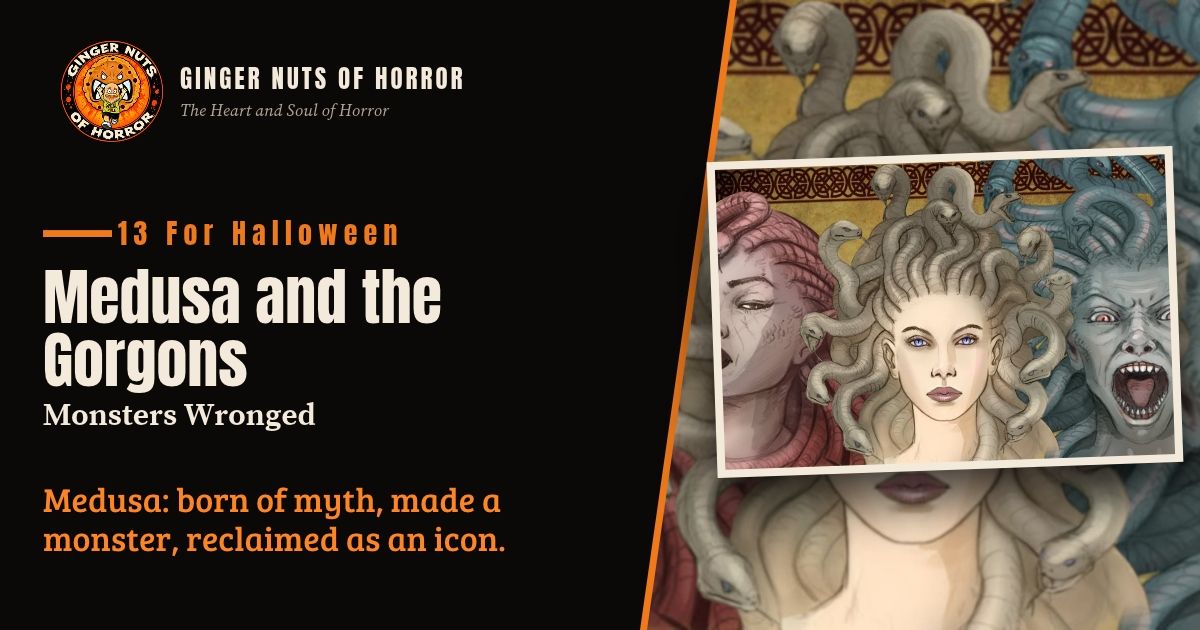
Medusa was made to terrify, yet the longer you sit with her story, the more she looks like a wronged woman. Punished for her own abuse, hunted in her own home and prized only as a weapon for men, the Gorgon becomes a figure of defiance, and her death the loss of a miracle.
Medusa and the Gorgons: From a Ladybird Book to Feminist Icon
Books of various folklore and mythology were ambient and readily available when I was a boy. The room my brother and I shared boasted a wardrobe stacked full of books, from illustrated studies on dinosaurs and pop-up books about insects to collections of Celtic, Norse and Ancient Greek folklore.
The latter always exercised particular fascination, with its wildly inventive gods and monsters, its epic yarns of semi-divine heroes, sorcerers and magic. Creatures such as The Chimera, Typhon, Echidna and Charybidis all had their moments as my particular favourites (usually inspired by the artwork that accompanied their stories). But few have maintained such lasting fascination as The Gorgons.
One of the many, many books from that collection was a rare and fairly old Ladybird book that provided bowdlerised accounts of two stories: Theseus and The Minotaur and Perseus and The Gorgons. These would be my earliest exposures to both creatures, and, from my first glimpse of them on the book’s cover, I was hooked.
Descriptions of The Gorgons alone were enough to enthral me: an immortal trio of creatures so hideous to behold, even a glimpse of them with the naked eye is enough to turn mortal men to stone. The exact nature and anatomies of The Gorgons varies from telling to telling, but they’re generally depicted as vaguely humanoid -a fact which lends them a liminal, uncanny quality-, with hideous, distorted faces, bronze hooves, wings, vicious talons and nests of snakes for hair.
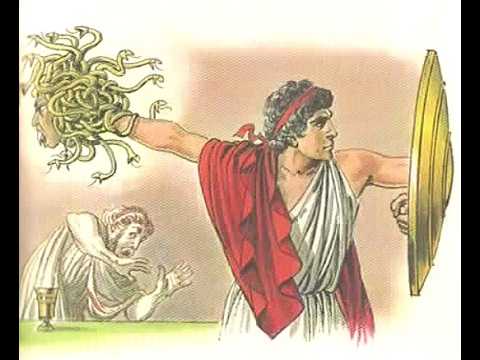
The artwork of them in the book, despite being aimed at children, did little to soften or skimp on their horror, the artist clearly taking pains to make them as terrifying and threatening as possible. For my part, I found myself obsessed by the strange contradictions of their anatomies, not to mention captivated by the ethos surrounding them (the story of Perseus frames them as ancient horrors from the edge of the world, creatures of elemental malevolence whose only delight is in the desecration of humanity).
Far from being scared of them, I found myself fascinated: I recall wondering to myself where they came from, why they were exiled as they were, and what had provoked their undying hatred of humanity.
Of course, this truncated version of the story didn’t go into detail of their background, but it did provide the imperative for me to read further: On the back of that initial exposure, I went on to read various different versions of their story -mostly in library books-, and realised the essential element of tragedy underpinning their monstrosity:
In one version of the story, they are the daughters of Phorcys and Ceto; deities of the depths and of sea monsters respectively. They thus have divine origins, very much akin to the man sent to slay them, and have no say or agency over their natures: they merely are as they were born to be (and form a strange fraternity with other creatures in the mythology).
However, Ovid presents another, more tragic origin in his Metamorphoses: Medusa specifically begins as a mortal, human woman, but is seduced by Neptune (the Roman equivalent of Poseidon) in the temple of Minerva (Athena). For this apparent blasphemy, Minerva twists Medusa into her monstrous, Gorgon form and exiles her to the ends of the Earth.
Both origins maintain a particular level of tragedy, but Ovid’s is the one that fascinates above and beyond:
Here, Medusa is symbolic of womanhood itself, and the inevitable abuses it incurs within Patriarchal systems: not only is she “seduced” -effectively raped- by an obsessive sea-deity, she is then punished for being the victim of that abuse by Minerva, an ostensibly female goddess but one who is a product of those very assumptions, and the tainted history that facilitates them. So, far from being an ally or instrument of vengeance against Patriarchy, Minerva embodies a conception of womanhood prescribed and bounded by that system, and thereby serves as its instrument (a vessel of internalised misogyny):
Medusa herself is blameless in this version of the story, but is cast as a monster nonetheless. Neptune/Poseidon suffers nothing for his part in the desecration (and certainly not for the rape), save for the loss of a favoured concubine; an object to be used and discarded as per his whim.
As a result of this version of the story -which I wouldn’t encounter until much, much later-, Medusa has become synonymous in Feminist writings and philosophy with Patriarchal injustice, the positioning of women and womanhood in our historical prescriptions, and a reclaimed symbol of female empowerment (not unlike other mythic archetypes such as Lilith, whom we’ll be discussing later in the series).
Interestingly, in Ovid’s telling of the tale, Medusa only ever has worth or potency when wielded as an instrument of male intentions: it’s from her blood that the iconic winged horse, Pegasus, erupts to bear Perseus away, and her severed head that grants him the means of saving the Princess Andromeda from being sacrificed to another iconic monster, The Kraken (he also uses the head’s petrifying gaze to turn the Titan, Atlas, to stone, thus relieving him of the burden of carrying the heavens on his shoulders.
Again, Medusa is cast as only having worth when she acts as an instrument of male intent, a salve to male suffering and burden. Her own woes are barely mentioned and no justice is pursued for them).
For my part, I was initially captivated by her strangeness and monstrosity; the nightmare-nature of her aesthetic. However, age and exposure to other ideas and incarnations of the character deepened that appreciation into something more abstract and resonant:
As in the writings of Feminist, Helen Cixous, I assimilated Medusa and her sisters as a symbol of monstrous liberation: her recruiting as something hideous and antithetical to men, far from the horror it’s meant to convey, became a species of defiance and power in my mind; a means by which a perpetually wronged and abused woman might reclaim agency (i.e. by defying the prescriptions and poetry Patriarchy imposes on her nature).
Another key version of the character I encountered very young was in Ray Harryhaussen’s seminal Clash of The Titans. Here, Medusa is reimagined as a singular entity (and more wholly monstrous: in place of legs, she boasts a slithering serpent tail with which she bears herself through her statue-littered domain).
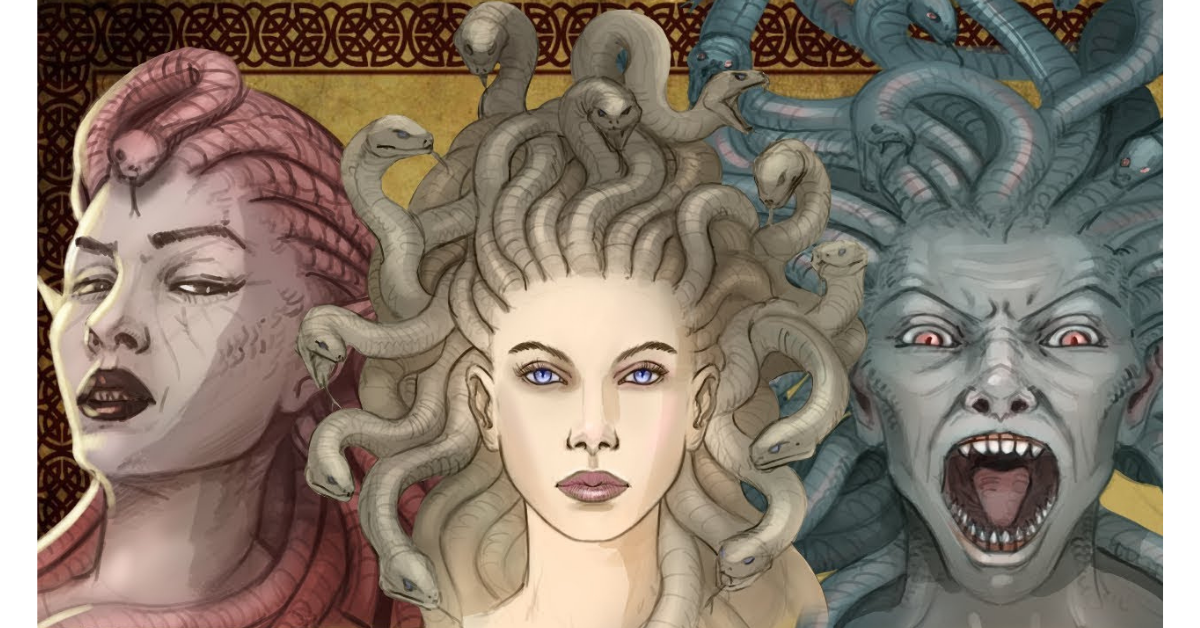
The design of the creature as a sculpted, movable figure is nothing short of breath-taking in its hideousness: Ostensibly still bearing features of womanhood, its face is the stuff of nightmares, the snakes crowning its head in perpetual, hissing motion. It’s an horrific and beautiful creature, but one whose presence and character is enhanced to the Nth degree by its framing:
In the film, Medusa occurs in a dimly lit, desolate temple, emerging partially wreathed in shadows. Her stop-motion nature already lends her an air of the uncanny, but the shadows, flickering light and the incredible sound design make her something torn directly from nightmares: Wherever she goes, she’s accompanied by the hissing of snakes, the threatening rattle of her tail and the scraping slide of her serpent body through the dust. Sound becomes all-important in the sequence, as it’s by this that hero Perseus tracks her movements (being unable to look at her directly without being turned to stone).
As for those members of Perseus’s party that stumble into her sight, a hideous, escalating chord plays as her eyes illuminate and her face twists into a hateful snarl. The stop-motion model conveys utter contempt for these men who’ve invaded her home and seek to do her harm. The sequence in which she stalks Perseus through the darkness, while he tracks her by sound and reflection in his mirrored shield, is nothing short of terrifying.
Even so, while the film certainly doesn’t intend it, there’s a note of ambiguous tragedy when Perseus eventually chops off her head: whilst this version of Medusa is unambiguously the most monstrous, the most terrifying in its framing, she’s also fundamentally a woman whose home has been invaded by men who intend violence. In herself, this “monster” was doing nothing but existing, waiting for the next have-a-go hero to try their luck. When she’s killed, there’s an unsettling, female cry of pain and despair, her serpentine body thrashing and coiling before it eventually spills its caustic blood onto the ground.
Ogden Nash once said: “Wherever there’s a monster, there’s a miracle.” Therefore, the death of a monster is also always the murder of miracles. The death of Medusa rings profoundly ambiguous; the murder of a woman by men who intend to use her as she’s been used and abused all her life, and the passing of something incredible from the world.
The Gorgons continue to fascinate and exercise an obsessive spell over me, and likely always will. They were among the earliest monsters whose stories I learned and that ignited my love of the monstrous. As my understanding of their mythic significance has expanded, so too has my appreciation of them deepened. Though intended as entities of mythological terror, they have ultimately become icons of Feminist commentary, their significance swollen far beyond the mere traditional.
George Daniel Lea, 14-10-26
Medusa and the Gorgons have outlasted every hero, poet and special effects budget thrown at them, and their hair still holds its shape better than ours on a wet Monday. The tour of monsters carries on, and the rest of Lea’s My Life in Horror essays will keep you company until the next one. Polish your shield in the meantime.
Keep reading on Ginger Nuts of Horror
 Frankenstein (Or The Modern Prometheus): The Horror Of Being: A My Life In Horror
 Nosferatu: The Feminist Gothic – My Life in Horror
 Alien – The Necessity of The Unknown, My Life in Horror
About Ginger Nuts of Horror
Ginger Nuts of Horror is an independent horror review and culture site based in Edinburgh, Scotland. Edited by British Fantasy Award nominee Jim McLeod, it publishes horror book reviews, film reviews, author interviews, features and cover reveals. Ginger Nuts of Horror won Best Inclusive Film & Book Review Platform at the SME News UK Enterprise Awards 2026.

George Lea is an unfixed oddity that can occasionally be sighted wandering around the UK Midlands. Queer as a very queer thing. Following the publication of his first short story collection, Strange Playgrounds and Essential Atrocities, he found a home amongst Perpetual Motion Machine Publications/Ghoulish Books stable of queer writers with his two-volume short-story collection, Born in Blood.
https://youtube.com/@ExaggeratedElegy


