
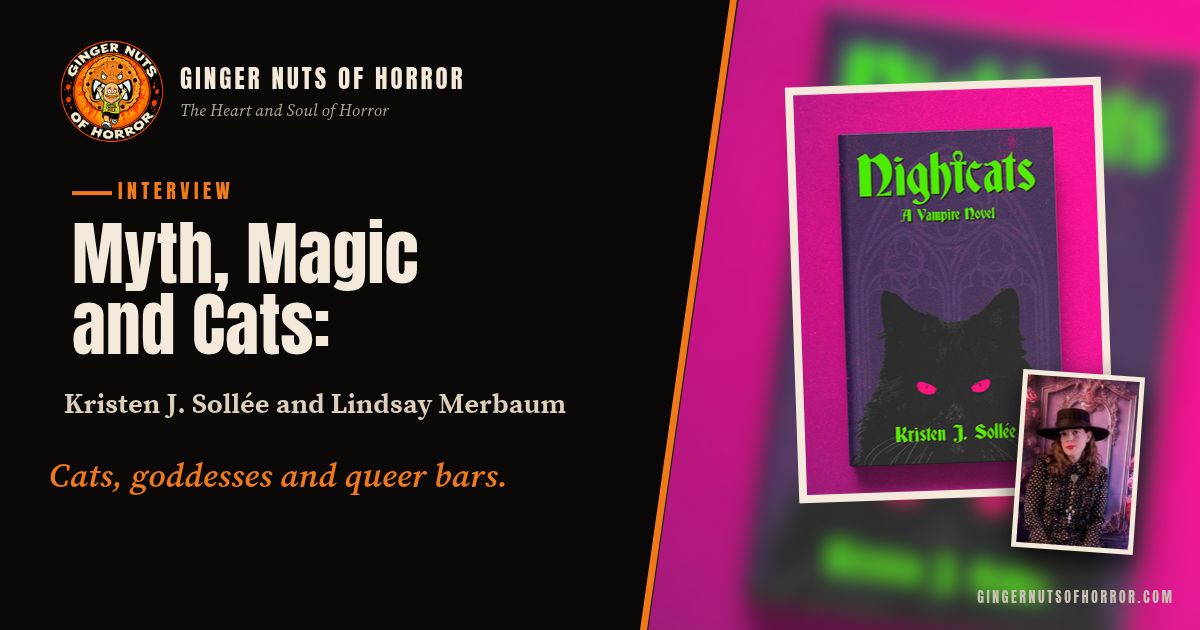
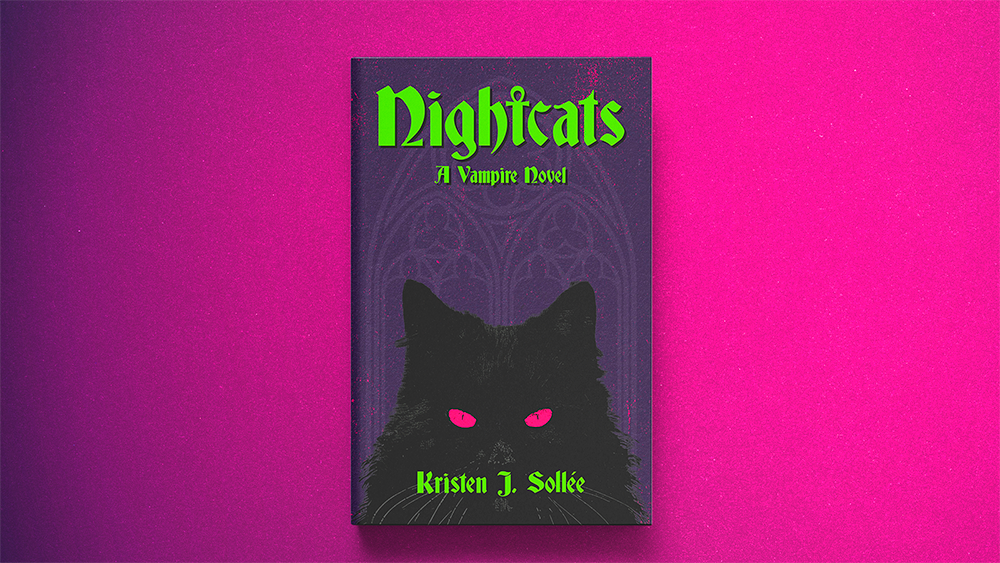
Nightcats | Kristen J. Sollée | Feral Eye | 26 October 2026
- Author Kristen J. Sollée
- Publisher Feral Eye
- Published 26 October 2026
- Pages 482 (paperback)
- Format Paperback, signed limited hardback, ebook, audiobook
- ISBN 978-1972637005
- Subgenre Occult horror, feminist vampire novel
New York, 2005. When goth waitress Vera Valcourt’s rescue cat Sammy goes missing, her search drags her into cat folklore, ruthless cults and the secrets of a deadly feline species with more than nine lives.
In Nightcats, Kristen Sollée turns centuries of cat lore into a feminist vampire novel about a goth waitress hunting for her missing cat in New York. This Kristen Sollée interview comes with a twist, because she is not facing our questions: she is trading them with Lindsay Merbaum, author of Witches of the Wheel. Merbaum’s novel follows Gold into The Wheel, a magical queer bar where ancient myth is never far from the surface.
Both books took years to build. Both reach back to fierce ancient goddesses, Sekhmet and Inanna, and both refuse to paint magic as simply good or evil. Kristen J. Sollée also set up her own press, Feral Eye, to bring Nightcats into the world, which we covered when Sollée opened Feral Eye earlier this year. Anyone who follows our horror interviews will find plenty to chew on here: divination, black cat history, playlists, queer spaces as places of worship, and an honest count of who owns how many cats. Over to the two of them.
Two novelists who practise the magic they write about trade notes on cats, fierce goddesses and queer bars, and arrive at the same place: magic is neither good nor evil, female monsters deserve the full spectrum, and ancient goddesses must be met on their own terms, never ours.
The Kristen Sollée Interview: Cats, Goddesses and The Wheel
LM: This is your first novel, I believe. What was it like making the switch to fiction?
KS: After writing three non-fiction books, it was terrifying and exhilarating to have so much narrative freedom. I still couldn’t resist including plenty of history in Nightcats, but there’s a big difference between writing to educate and writing to entertain. It feels so much more vulnerable, because you can’t fall back on facts to justify a book’s existence.
How was your writing process for Witches of the Wheel similar to or different from how you approached your other works?
LM: Every book has been different. Most of them have been a struggle and Witches of The Wheel was no exception. I had a really hard time translating the world of magic as I see and experience it into something a reader could comprehend and relate to. All in all, it took me almost a decade to piece it all together. That’s how I see a book—as a puzzle to be solved.
KS: Both of our books were years in the making. What was the original impetus for your story? What core aspects changed over time, and what aspects stayed the same from day one?
LM: The original impetus for this novel was the flash of an image that came to me, of a woman psychically trapped in a space that resembled her house, but wasn’t. She’d been put there by her husband. The original version(s) of this book included a second narrative narrated by this character, who still appears in the final version, but only towards the end.
Gold’s story and her basic arc did not change that much over the course of revisions, so much as her character grew and was enriched. But at a certain point, I realized I could not get the two voices to gel. I had to find another way of telling the story.
You have characters in different timelines–some centuries apart. Did you have a plan from the beginning re: how all the pieces would fit together? Or did you find answers as you went along?
KS: It took me over three years to piece all the timelines together through trial and error. I resorted to a lot of divination along the way. Bibliomancy and logomancy are my go-to methods. I don’t have a standard approach, but I put a question out there, and it never fails to astound me how many answers arrive within the texts I encounter throughout the day. I uncovered guidance in novels, sacred texts, audiobooks, junk mail, DMs, and text messages that arrived at just the right time.
LM: I love this quote in Nightcats, in reference to Medusa: “We won’t let our female monsters just be monsters.” As in, we have to humanize them with narrative. What does this mean to you as a writer and a feminist? Who are the true monsters in your novel?
KS: For millennia, women have been demonized just for being women, so you do run the risk of adding to that demonization when you create female monsters who aren’t humanized. But real representation means allowing the full spectrum of femininity, female characters, and female monsters to exist unapologetically in our art. So, in Nightcats, I created one mercurial feline deity to be the ‘true’ monster of the book. Her monstrosity isn’t unlike nature, though. Nature creates and destroys; there’s no moral valence to it. Is that really monstrous?
LM: We both wrote about scary ancient goddesses—Sekhmet and Inanna. Talk to me about the pull of the fierce goddess. What’s so enchanting about her? And how do we avoid appropriating her?
KS: To me, fierce, dark goddesses are so enchanting because female power of that magnitude is forbidden within mainstream American religious culture. As far as appropriation, I think the worst thing we can do is try to force our contemporary morality upon these deities. We need to understand them within their own contexts to respect—and, if we choose to, work with—them.
Many novels with occult themes cast magic and witchcraft as either good or evil, an oversimplified binary that contradicts how practitioners experience them in the real world. Was it important that you portray magic as morally neutral?
LM: In general, I’m more interested in morally complex characters than unflappable heroes and one-note villains. So in a book that’s so much about living with magic, exploring with nuance was key. In my experience, magic isn’t binary, so why should this representation be? It’s a kind of watering down to reduce magic to black and white.
KS: The Wheel is a magical queer bar like no other. But despite it being otherworldly and even frightening at times, it’s also incredibly, viscerally real and relatable. How have queer bars and clubs played a magical role in your life? Do you view queer bars as contemporary houses of worship for those who follow non-traditional spiritual paths?
LM: I remember being in high school–close to Gold’s age–and living in rural Connecticut and just losing my mind over any and all queer spaces, no matter how remote the queerness. There was a bookstore named Gertrude and Alice’s that also sold sandwiches and crystals and pride necklaces. I thought this was the coolest, most wonderful place in the world. If I saw a rainbow then, I was very excited.
There’s this tremendous sense of belonging, a yearning in all of us that queer people understand in a particular way because we are everywhere, across all other intersecting identities, but we can also be rendered invisible. Indeed there are forces working against our country right now that debate the validity of our very existence. So to step into a space–whether it’s a bar, or a meeting room, or a classroom—and find yourself surrounded by queer people fosters a sense of homecoming that can’t be fully put into words. But that also shouldn’t be underestimated. I channeled that feeling when writing The Wheel.
Our books take on some similar challenges: incorporating mythology, embodying the experience of the divine. How did you approach these elements of your story?
KS: I relied heavily on my own experiences with mythology and witchcraft, as well as historical sources. Attempting to embody different experiences of the divine in fiction did feel like its own kind of devotional act.
Sacrifice and devotion are central themes in your novel. Is creation a devotional act for you? What sacrifices have you made for your craft that have helped you develop as an artist and writer?
LM: Every book is an offering. It’s a privilege to make art. Even more so if you find a way to devote your life to the pursuit. That doesn’t make the work any easier, though. Everything about being a writer is hard, from the actual writing to every aspect of publishing. This takes a toll on your mental health.
Let’s talk about a cuter subject: writing cats. Vera’s cat Sammy provides the motivation for her character. As such, Sammy appears throughout. As does Cleo. How do you turn a non-speaking being into a character?
Cleo, Carmilla, Exene, Petunia—did you have fun naming them all?
KS: Cats have such outsized personalities. They may not speak our language, but they communicate in other ways. I had a blast not only naming the cats, but also working with feline vocalizing and body language to create unique temperaments for each cat in the story. As far as how many cats I have?
LM: Be honest, how many cats do you have at home?
KS: In my home: only one. But there are a dozen neighborhood ferals and strays that I feed sometimes when they come around.
Speaking of cats, I was so thrilled when a black cat appeared in your book. Did it feel inevitable that a witch book had to have a cat in it?
LM: Always! I love cats. I have three of my own. To me, Abzu is a character in her own right. She’s named for the Sumerian mythological abyss from which everything and nothing derive.
What is this connection between women and cats, especially women who are witches? Is it our feral natures?
KS: Definitely. That inability to be tamed, despite everyone doing their damnedest to tame them/us. And—shameless plug—a more historical answer can be found in my non-fiction book, Cat Call: Reclaiming the Feral Feminine. Cats have been associated with women and femininity since ancient times. So many ancient goddesses had feline attendants or feline features, and that connection got warped and twisted by Christianity, which leaves us with so much to untangle today.
LM: Indeed, Christianity has demonized cats. Nightcats begins with a dream about cats being killed in Belgium. Can we talk a bit about the history behind the persecution of cats, especially black cats?
KS: The demonization of black cats really began in medieval Europe, when certain heretical Christian groups (the Cathars, the Waldensians) were accused of worshipping Satan in the form of a black cat. In the early modern era, black cats were folded into the narrative of diabolical witchcraft, and there were countless public spectacles across the continent that included feline executions. But black cats were actually associated with bad luck as far back as the fifth century B.C. Aristophanes’ Ecclesiazusae includes a line about bad signs, such as earthquakes, lightning, and the sight of a black cat running across the street.
Getting into further research, I love a novel with a reading list! Were some of the books you included discovered during your research for Witches of the Wheel? Or were they mostly old favorites?
LM: The list really belongs to Gold, so it includes many of the books that were influential to her, as well as texts that I discovered that would be beneficial to her. Ultimately, my curiosity-turned-semi-obsession with Inanna and Sumerian mythology fueled the conception of this story more than anything and the reading list does reflect that.
KS: What are some of the songs you imagined they might play at The Wheel?
LM: I actually made a Witches of The Wheel playlist! I do that for all my projects. It includes Billie Eilish, Kate Bush, Qveen Herby, be steadwell, and many others.
Do you have a playlist of all the songs and bands referenced in this novel?
KS: The official Nightcats playlist is printed in the special edition hardback, which will be released by my new feminist occult press, Feral Eye. There are so many good cat songs—particularly goth and post-punk cat songs—that I had to include.
Get the book
Nightcats by Kristen J. Sollée is out now from Feral Eye in paperback, ebook and audiobook, with a signed, numbered collector’s hardback from Black Crow Books.
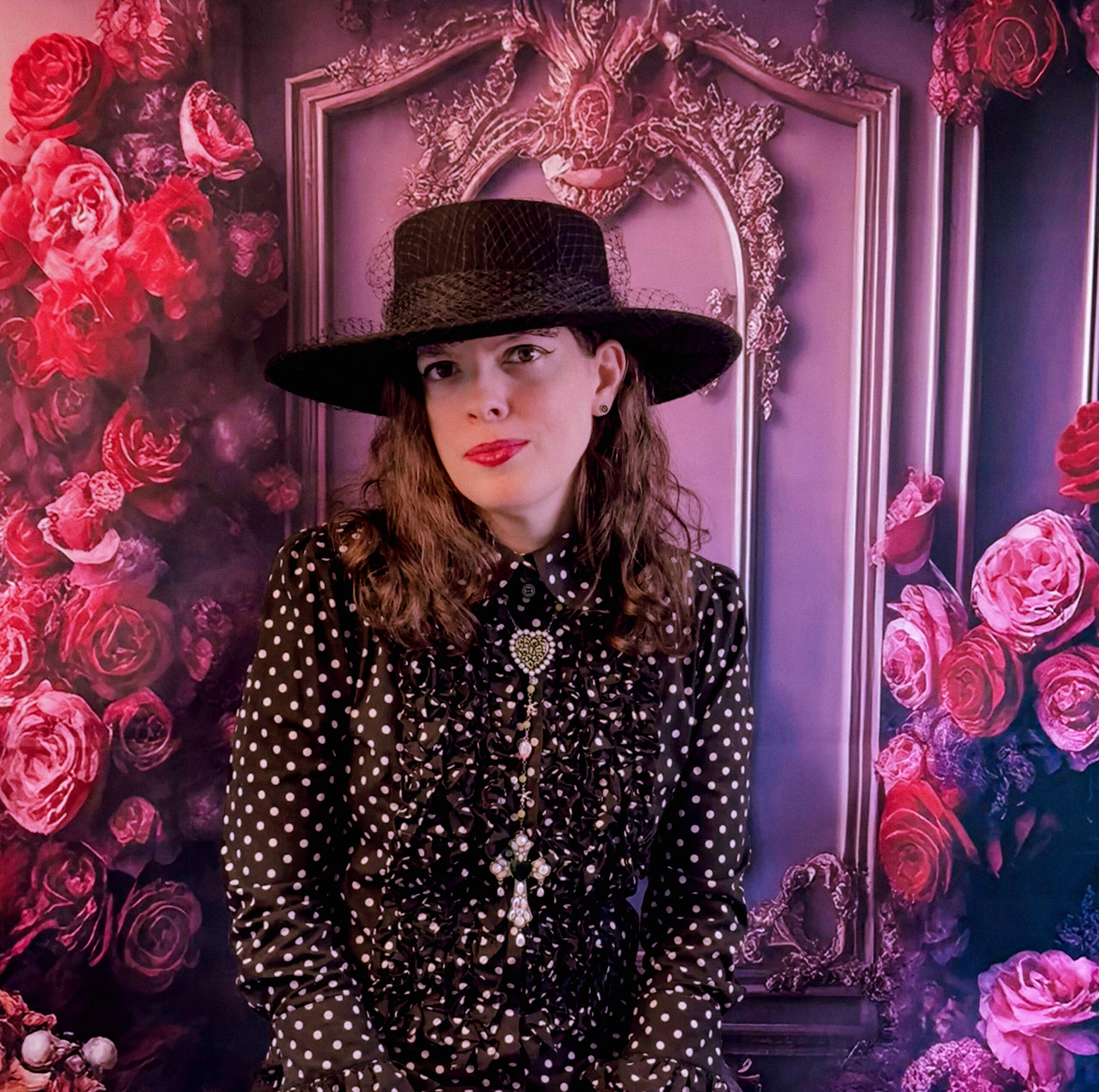
- Author Kristen J. Sollée
- Publisher Feral Eye
- Published 26 October 2026
- Pages 482 (paperback)
- Format Paperback, signed limited hardback, ebook, audiobook
- ISBN 978-1972637005
- Subgenre Occult horror, feminist vampire novel
New York, 2005. When goth waitress Vera Valcourt’s rescue cat Sammy goes missing, her search drags her into cat folklore, ruthless cults and the secrets of a deadly feline species with more than nine lives.
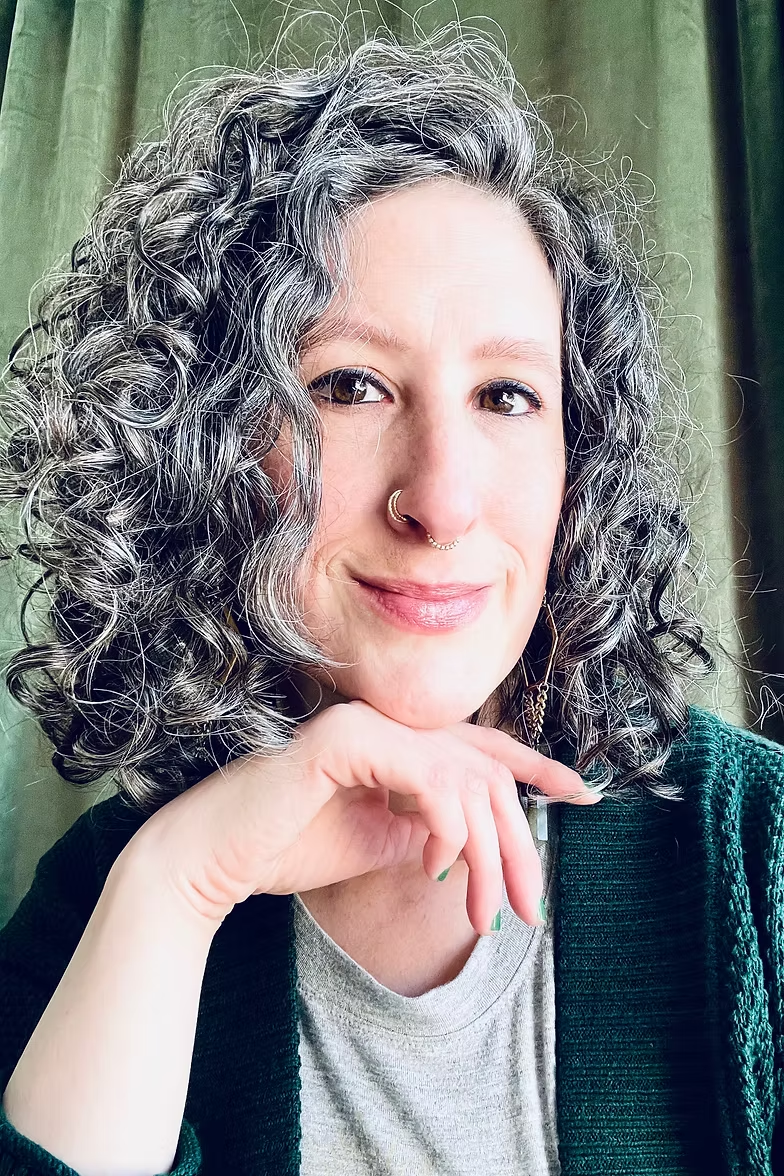
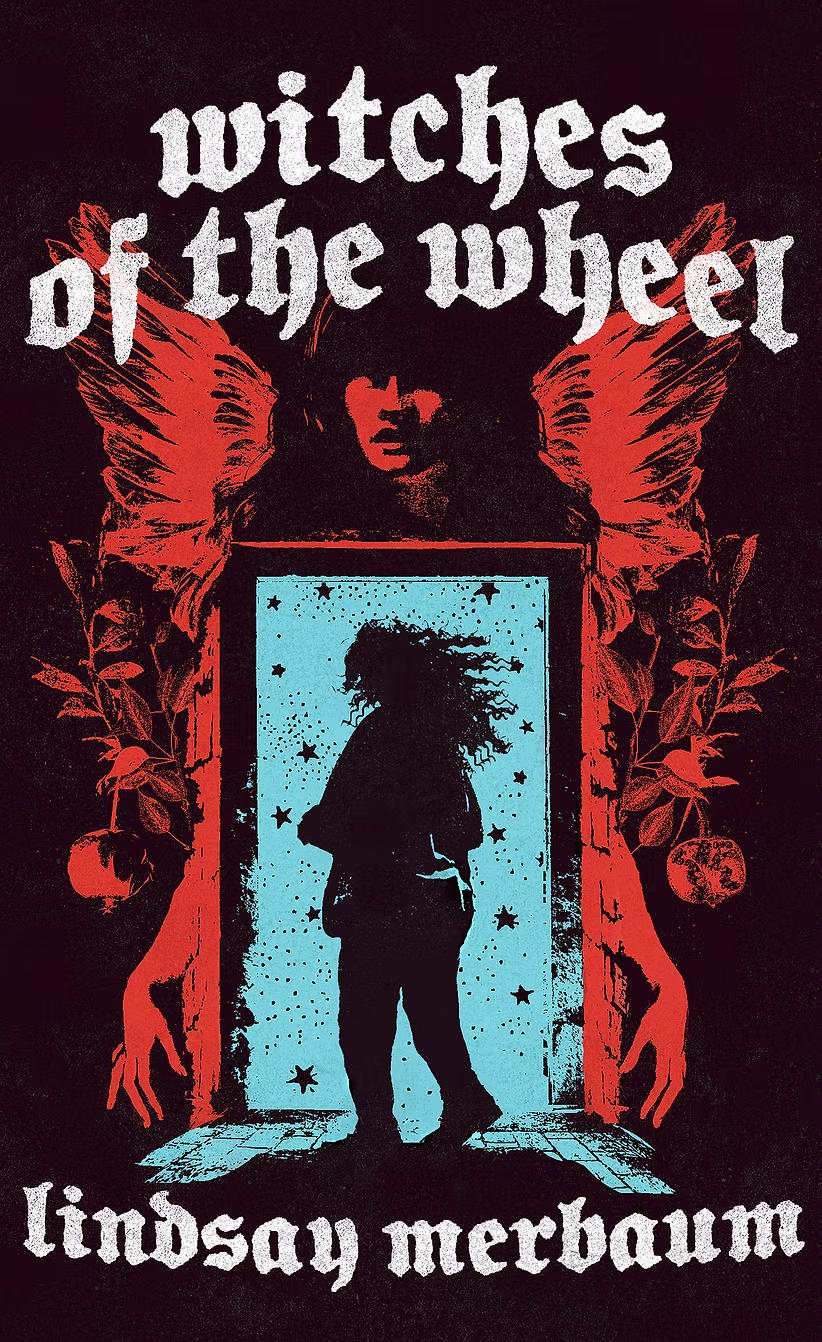
- Author Lindsay Merbaum
- Publisher Creature Publishing
- Published 22 September 2026
- Pages 264 (paperback)
- Format Paperback, ebook, audiobook
- ISBN 978-1951971540
- Subgenre Occult horror, queer metaphysical mystery
Gold stumbles into a job at The Wheel, an underground lesbian bar where a coven meets every Thursday, every entrance demands a painful sacrifice, and an ancient goddess takes a deadly interest in her.
One cat at home, a dozen ferals on the books and a novel crawling with vampiric felines: if this Kristen Sollée interview proves anything, it is that the cats have quietly taken over Ginger Nuts of Horror, and frankly they have earned the promotion.
Keep reading on Ginger Nuts of Horror
 Kristen J. Sollée Opens Feral Eye This Year – A Feminist Hybrid Publisher Devoted to Horror and the Dark Arts.
 Amy Jane Stewart Interview: Hex House and Feminist Horror
 Grady Hendrix on Witchcraft, Wayward Girls, and the Real Horror of 1970
About Ginger Nuts of Horror
Ginger Nuts of Horror is an independent horror review and culture site based in Edinburgh, Scotland. Edited by British Fantasy Award nominee Jim McLeod, it publishes horror book reviews, film reviews, author interviews, features and cover reveals. Ginger Nuts of Horror won Best Inclusive Film & Book Review Platform at the SME News UK Enterprise Awards 2026.