
Bloodborne Amygdala | Thirteen for Halloween |
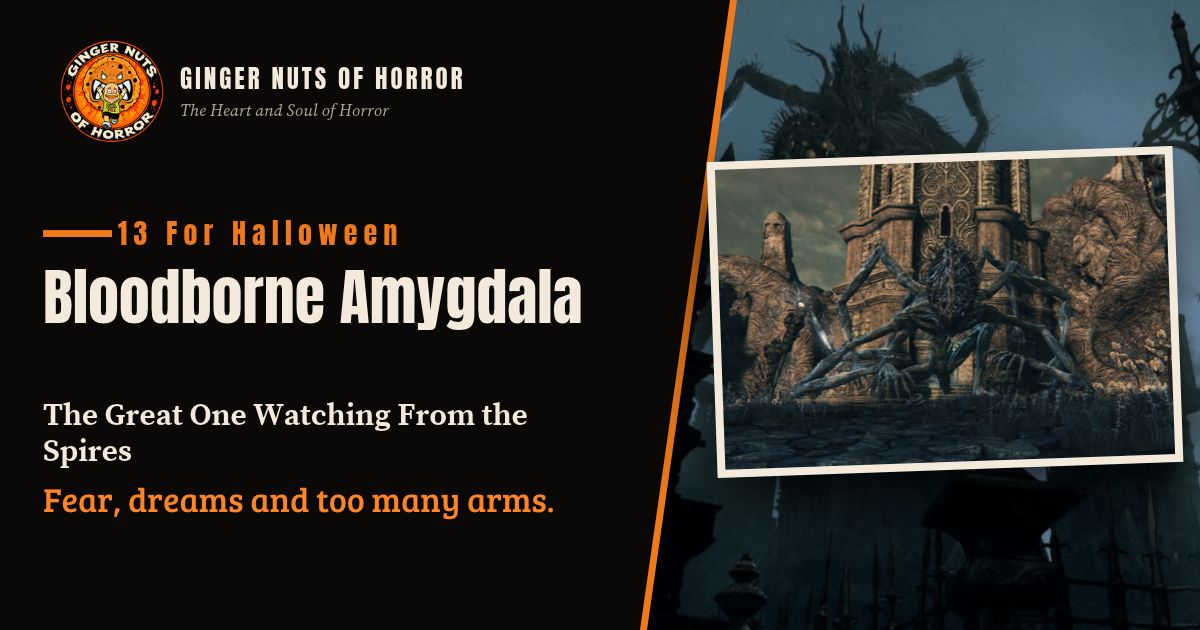
The Bloodborne Amygdala is the monster at the heart of George Daniel Lea’s latest Thirteen for Halloween entry. It is a FromSoftware Great One that clings to the spires of Yharnam long before most players can even see it. It is also one of the stranger beasts to crawl across the Ginger Nuts of Horror desk this Halloween, as it comes from a game rather than a book or a film. The creature takes its name from the part of the brain that handles fear and dreams, and that is no accident. In this addition to our horror features, Lea asks what it is, what it wants, and why the game will not tell us.
The Amygdala is Bloodborne’s horror at its most ambiguous: a many-armed Great One that watches from Yharnam’s spires, attacks, rewards and transforms without ever explaining itself. Named for the part of the brain that processes fear and dreams, it is less an obstacle to beat than a vessel of existential dread and strange beauty.
Bloodborne Amygdala: A Monster Built From Fear and Dreams
A shift towards the more contemporary for this entry, and a very different strain of monster, both in terms of style and presentation:
From Software’s video games, from Dark Souls to Elden Ring, are generally lauded not only for their superb monster designs, but the sense of atmosphere and implied storytelling surrounding them. Even the least encounters in these games is fraught with symbolism and environmental storytelling. Placement, positioning, pathways of movement and interaction, are all as important to the cultivation of character -and often, of horror- as the designs themselves.
And when it comes to the larger, more significant entities, the sense of weight and profundity can sometimes be overwhelming.
In the tradition of film-makers such as Ray Harryhaussen, Peter Jackson and Guillermo del Toro, From Software make “monsters” second and characters first and foremost. Every entity they include carries an ethos of weight and tragedy that is rare among the medium. Upon defeating them -which is often no mean feat-, victory is often tainted by a lingering melancholy, a sense that things could have been different, had circumstances not led to tragedy and abomination.
This is triply so in the company’s one and only dedicated horror title: the Lovecraftian, lycanthropic epic, Bloodborne, in which a seemingly straightforward tale of a city afflicted by a lycanthropic, blood-borne curse gives way to metaphysical horror complex and bizarre enough to make Lovecraft himself recoil.
What initially appears to be a literal space in the gothic, fantasy city of Yharnam, soon becomes revealed as just one level of an existential nightmare (of which there are numerous intermeshed, bleeding-through and forbidden strata, many of which are bizarre enough to drive any human mind to collapse). From these inimical layers of conflicting reality descend entities known as Great Ones; Lovecraftian beings that operate in spheres of reality human beings can barely glimpse or conceive of without losing themselves to abomination(not that it stops them trying, of course). For the most part, these entities are strangely passive and invisible, their effects on the world subtle (but ultimately catastrophic).
The entity -or maybe entities– known as Amygdala are among the more overt and active of the bunch: though their interest is obscure, they are actively present in much of the games key events (though whether merely as observers or active participants is difficult to discern).
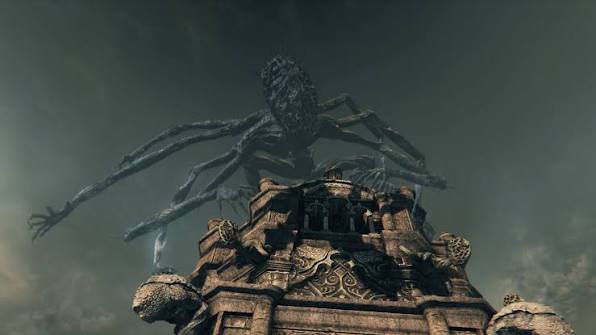
The Amygdala is a vaguely humanoid entity, its proportions distorted in the manner of a great lizard or spider. It boasts multiple, many-jointed arms, a withered frame not entirely unlike that of H.R. Giger’s Alien, and, perhaps its most remarkable feature: a head resembling the area of the human brain from which it derives its name (incidentally, the Amygdala in neurological terms is the area of the brain responsible for processing fear, but also dreams and imagination; an overlap that’s incarnated in the entity itself).
In classic, Lovecraftian style, it’s made clear to us that this inscrutable entity is incomprehensible to mortal understanding. Even the manifestation we ultimately see is only what we are capable of projecting upon it. Its true nature is vast, abstract and beyond any known sphere of existence or operation.
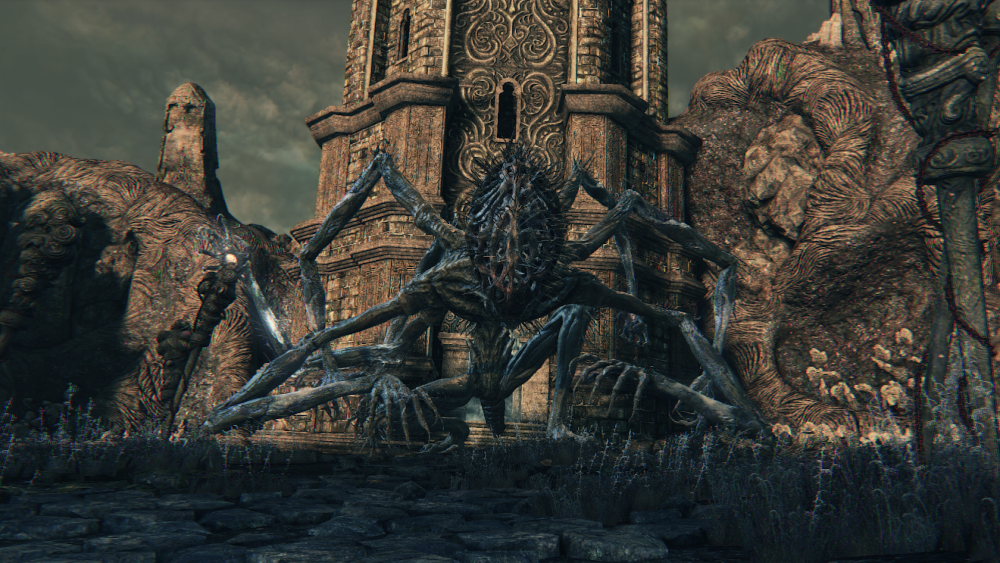
Unlike most Great Ones, Amygdala is distinct in that it takes an active interest in events within the city of Yharnam, and seems to either be drawn to or actively participate in them to some degree (later in the game, when a metaphysical veil is lifted from the city, specimens of the Amygdala can be found throughout, clinging to buildings and spires, observing what occurs in the streets below). Furthermore, the Amygdala will directly interact with the player and other characters, though its reasons for doing so remain obscure.
Its effects are, of course, profound and bizarre: if certain parameters are met, Amygdala can sweep the player away to other layers and levels of reality (including those “nightmare” regions that it either hails from or invades as it has invaded this one). It can also twist, transmute and alter those it comes into contact with (as evidenced in Patches, a character who seems to worship Amygdala and speaks of the entity in reverent, divine terms, whose human form has been twisted into that of a great spider as some species of “reward” or revelation).
The Amygdala itself is typical of Bloodborne’s horror, in that it’s sublimely ambiguous. At times, the entity appears antagonistic (such as when it attacks us with beams of metaphysical force from its perches in the spires, or when we actively confront the entity as a boss in the Nightmare Frontier).
Others, its conduct is less easily defined: it ultimately commits acts that benefit the player, but which may not seem like boons at the time (or at all, depending on how one interprets them). Even the entity’s nature is up for question: At times, we see multiple specimens of the Amygdala all existing at once, while at others, it’s referred to in the singular, as a specific, individual entity. The question thus arises: is The Amygdala a singular Great One or a species of them?
Of course, given the strange nature of their existence, their operation outside of physical law, there’s no reason both can’t be true and not true simultaneously: the apparently multiple Amygdala we see throughout Yharnam may, in fact, be the same entity existing at different points in time and space (we know from other examples that this is generally true of The Great Ones).
This adds a whole new level of disturbia to the monster: not only is it present and effecting events unseen, it also exists at various points in time and space and in seemingly contradictory conditions:
Most of the time, Amygdala appears relatively passive, content to witness events, but when we encounter the entity in The Nightmare Frontier, it is actively hostile (or seemingly so).
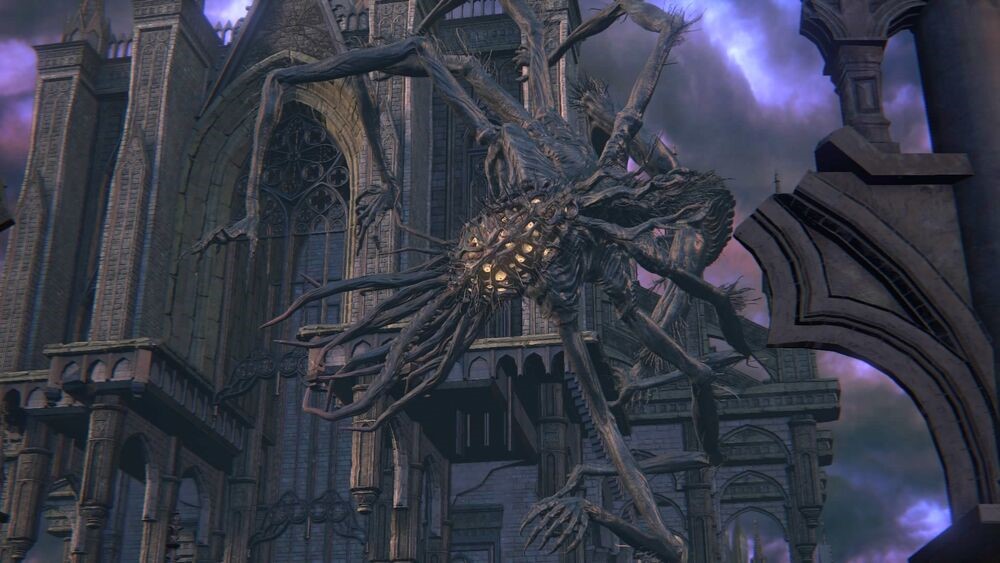
Furthermore, there are numerous seemingly dead specimens of the entity littered about different levels of reality (as though it has fallen from its own level like a bird from its nest). None of these are specifically explained: it simply is, a constant throughout reality and dreaming, never truly dead, never truly present. It’s a fantastic example of how Bloodborne treats its monsters: not as mere obstacles to overcome or even as enemies to thwart, but as powerfully ambiguous vessels of existential horror and strange, elaborate beauty.
During the game’s latter chapters, when the metaphysical veil is lifted and the divine infestation of Yharnam becomes apparent, it’s clear that The Amygdala are attracted to the plain of existence owing to particular, profane rites underway (i.e. The Ritual of Mensis). Exactly why and what part they play in those affairs is left deliberately vague: are they merely passive observers, attracted by the metaphysical atrocity of the ritual, or are they somehow guiding it to fruition for ends of their own? None of this is clearly answered in the game.
Instead, we’re left to infer our own interpretations. Being of The Nightmare Frontier (presumably, given certain context clues), is it the god of that particular state, and are all the myriad strange and surreal horrors we encounter there somehow its spawn? We know that certain arcane experiments conducted by the various colleges in the game inadvertently opened the way to the Nightmare. Did they also somehow cultivate or arouse The Amygdala, draw the entity to Yharnam and even give it form and license to interfere there?
Throughout the various environments, we encounter statues of the entity (or that are suspiciously redolent of it), suggesting that it exists in the collective, mythological consciousness of the city. Furthermore, there are strange fungal growths in areas whose shape is disturbingly redolent of the creature. Certain areas almost resemble gardens where young Amygdala have taken root and are slowly growing to maturity.
Both the design and framing of the entity are so very deliberate. They provide certain clues and suggestions as to its nature and origins, but nothing absolute. It is, like so much in the game, a creature of confusion, its disturbia exceeding any immediate or visceral horror and expanding into existential realms.
George Daniel Lea, 22-10-2026
Next time you feel watched from the cathedral roof, relax: it is only the Bloodborne Amygdala, and it has plenty of hands to wave with.
Keep reading on Ginger Nuts of Horror
 Bloodborne, Nine Years of The Hunt, My Life in Horror
 Weaveworld’s Magic: How Clive Barker’s Novel Fights Fascism and Celebrates Queer Identity: A My Life in Horror
 Horror Review Clichés Decoded: The Horror Reviewer’s Dictionary
About Ginger Nuts of Horror
Ginger Nuts of Horror is an independent horror review and culture site based in Edinburgh, Scotland. Edited by British Fantasy Award nominee Jim McLeod, it publishes horror book reviews, film reviews, author interviews, features and cover reveals. Ginger Nuts of Horror won Best Inclusive Film & Book Review Platform at the SME News UK Enterprise Awards 2026.