
- Casper and Molly’s Horror Watchlist: Horror Movies Where the Dog Lives
- The Horror of Tripadvisor: Horror Locations Given the Review
- Great British Bake Off Of Horror: Who Gets the Handshake?
- Horror Review Clichés Decoded: The Horror Reviewer’s Dictionary
Every horror review cliché, translated into what the reviewer actually meant.
Horror Review Clichés Decoded: The Horror Reviewer’s Dictionary | Features | Ginger Nuts of Horror
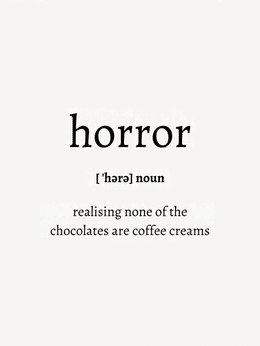
Horror review clichés are the secret language of horror criticism, and Ginger Nuts of Horror has been fluent in it for years, much to nobody’s credit. Slow burn horror, elevated horror, “not for everyone”, “a love letter to the genre”: every one of them means something, and it is almost never what it says. So for Halloween week we have done the decent thing and written the dictionary, giving the real meanings of the phrases horror book and film reviewers hide behind. There is some genuine history in here too, from the final girl to the bus that invented the jump scare. Consider it a public service. Or a confession.
Most horror review clichés became clichés because they were true first. Slow burn was a good description once, just far too often. Read with the code, most horror reviews are two reviews at once: one the author can live with and one the reader can use.
Horror Review Clichés Decoded
Slow burn means nothing happens for ninety minutes, and it is the first entry in a dictionary horror reviewers have spent years pretending not to own.
Every trade has its code. Estate agents say bijou when they mean you cannot swing a cat. Car dealers say a motor has character when they mean it has rust. Horror reviewers have gone further than either and built an entire language, carefully designed to tell you the truth while sounding like a compliment. Readers pick it up without being taught. Authors learn it the hard way, usually from a review of their own book, usually on a Tuesday.
How to use this dictionary: find the phrase in the review, look it up here, then decide whether you still want to read the book. Entries are grouped by what the reviewer was trying to hide.
A word of disclosure before we start. Search this site for “slow burn” and you will be scrolling until next Halloween. Nobody at GNoH is innocent here, least of all the person typing this.
Words for When Nothing Happens
Slow burn (adj.): Nothing happens for ninety minutes. In a book, nothing happens for two hundred pages, but beautifully. The fire, when it finally arrives, is in the last ten, and by then you have gone to put the kettle on. Used honestly, it can still carry weight. Our Bury the Devil review makes the fair point that some films earn the slow burn, while others let the fire go out before the end. Most reviewers do not make that distinction. Most reviewers have had a long week.
Atmospheric (adj.): Dark. Foggy. Someone spent the whole budget on a smoke machine and would like a round of applause for it.
Patient (adj.): See slow burn. Used by reviewers who want you to believe they enjoyed the wait, the way people claim to enjoy a queue.
Meditative (adj.): The reviewer fell asleep, woke up, and found the same shot still going.
Restrained (adj.): No gore. Said proudly by people who prefer it that way, and through gritted teeth by everyone who bought a ticket for the gore.
Ambiguous ending (n.): The film just stops. Nobody knows why, quite possibly including the director. The reviewer has a theory. It is four hundred words long, and you are about to read every one of them.
Words for When the Reviewer Didn’t Like It
Not for everyone (phr.): Not for me either. Or, frankly, for anyone I know.
Divisive (adj.): The reviewer hated it and is looking for someone to hate it with.
Ambitious (adj.): It failed. But it failed at something hard, the author is lovely, and they will definitely read this.
Uneven (adj.): There is one good chapter. It is chapter three. Enjoy chapter three.
It found its audience (phr.): Congratulations to its audience.
Pacing issues (n.): I skimmed. Heavily. From about page forty.
Interesting (adj.): The most dangerous word in the English language. It means nothing at all, and the author knows exactly what it means.
Brave (adj.): Nobody asked for this, and yet here we all are.
Unflinching (adj.): The reviewer flinched. Twice. Once at the eye scene.
Three stars (n.): Two stars with a guilty conscience, or four stars with a nervous one. From the outside, nobody will ever know which way it went. That is not a flaw in the system. That is the system.
Words From the Marketing Department
Elevated horror (n.): Horror that went to a good school and will not let you forget it. Usually involves grief, a lake and a jumper in a colour the paint charts call oat.
A love letter to the genre (n.): The author has seen a great many films and would very much like you to know. Expect a sheriff named after one director and a dog named after another.
For fans of Stephen King (phr.): Set in a small town. Contains a child with a secret.
Genre-bending (adj.): The publisher could not decide which shelf, so it went on all of them.
A twist you won’t see coming (phr.): You will see it coming. It is hinted at on the cover, in the title and on page one.
Grief horror (n.): The monster is grief. The monster is always grief. If a second monster turns up, that is grief as well.
Cult classic (n.): Nobody saw it at the time. Everybody now claims they were there.
Lovecraftian (adj.): Contains a tentacle, the word eldritch, or a narrator who faints at the sight of an odd angle. Sometimes all three on one page.
Folk horror (n.): Anything with a field in it. Also anything with a hedge, a straw hat or a villager who is suspiciously nice to you. Mark Gatiss brought the term into wide use in his 2010 BBC series A History of Horror, built around three British films: Witchfinder General, The Blood on Satan’s Claw and The Wicker Man. The field has been getting bigger ever since, and GNoH is still arguing about The Wicker Man half a century on.
Alternative – An absolute idiot goes to a town filled with really freaky people, ignores every warning, sees really freaky shit, then ends up either dead in a field or in the local school curry.
Liminal (adj.): An empty corridor. Also an empty school, car park or swimming pool. GNoH has made the case that liminal horror really lives in the back of the shop. In most reviews it now means any space with strip lights and no people in it, which covers a fair bit of Scotland on a Sunday night.
Cosy horror (n.): Horror with a cat on the cover. The cat lives. The cat always lives. Nobody else is promised anything.
Words From the Classroom and the Reviewer’s Desk
Final girl (n.): The film scholar Carol J. Clover coined the term in a 1987 essay and built on it in her 1992 book Men, Women, and Chain Saws. Clover meant something quite precise. In reviews it now mostly means the one who wasn’t daft, which in most slashers is a very short list.
Jump scare (n.): A loud noise where the plot should be. The film buff’s name for a fake one is the Lewton bus. In Cat People (1942), a woman walks alone at night, sure she is being followed, and a bus hisses into frame. Producer Val Lewton liked the trick so much that he kept using it. More than eighty years on, it still works, which is the single most annoying thing about it.
Found footage (n.): A film in which nobody, even at the moment of death, stops filming. The camera operator is the real final girl.
Body horror (n.): The reviewer put the book down, and then their lunch.
The house is a character (phr.): The reviewer cannot remember any of the people. To be fair, the house had better lines.
I need to sit with this (phr.): I have no idea what happened, and I would like a lie down.
Lingers (v.): The reviewer thought about it once more, on the bus, and then forgot.
Kept me up at night (phr.): The reviewer read it at night. They were going to be up anyway.
Not really horror (phr.): Nobody died, or somebody died very beautifully in a nightie.
ARC (n.): Advance reader copy. A book sent out months early so it can be read the night before the review is due.
TBR (n.): To be read. A pile. Load-bearing. Remove one book and the house comes down.
Why Horror Reviewers Talk in Code
A few of the best known words in the trade are missing from this dictionary. At GNoH they are banned outright, so they cannot appear here even to be mocked. You will spot the gaps anyway. There is the one that means the reviewer missed their stop on the train. There is the one borrowed from a gut surgeon. There is the one that means the film was still on the reviewer’s mind at breakfast. And there is the one that means I liked it and I am tired.
In fairness to the code, it works. A reader who sees slow burn knows exactly what is coming and can pack a flask. A review has a limited number of words to do its job, and shorthand saves room. Most of these phrases became clichés because they were true first. Slow burn was a good description once. It was just a good description far too often.
There is a kinder reason, too. Horror is a small scene. The reviewer and the author may share a bar at a convention, a thread online and quite possibly a publisher. The code lets a reviewer tell readers the truth while the author hears something they can live with. Read with the code, most horror reviews are two reviews at once: one the author can live with and one the reader can use.
Only one entry in the whole dictionary is completely honest.
DNF (v.): Did not finish. Three letters, and nobody has ever misread it.
Keep reading on Ginger Nuts of Horror
 Lost horrors: how the eerie telly of the 1970s birthed liminal dread
 The Devil’s Bath, Folk Horror Part 2: In Which We Restore Our Faith
 Exit 8 Review: Genki Kawamura’s Liminal Horror Finds Dread in Repetition
About Ginger Nuts of Horror
Ginger Nuts of Horror is an independent horror review and culture site based in Edinburgh, Scotland. Edited by British Fantasy Award nominee Jim McLeod, it publishes horror book reviews, film reviews, author interviews, features and cover reveals. Ginger Nuts of Horror won Best Inclusive Film & Book Review Platform at the SME News UK Enterprise Awards 2026.


