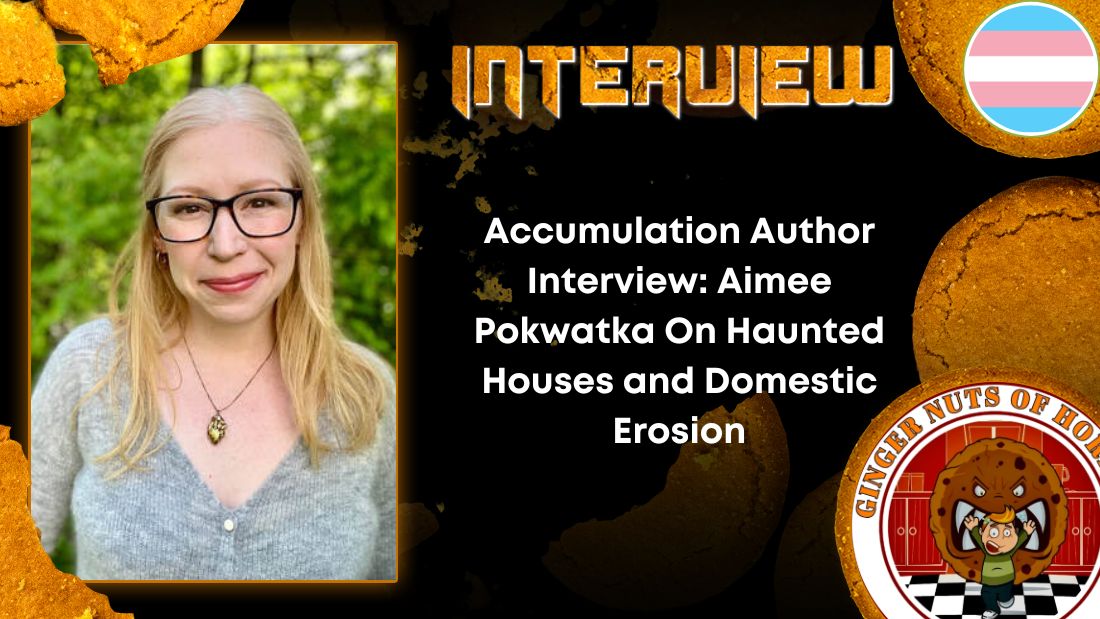
The doll shows up first. Then the tooth inside the floorboards. Then the faucet that runs without anyone near it. In Accumulation, the new novel from Aimee Pokwatka, the haunting does not announce itself with screams. It arrives through objects that should feel boring or safe. A family home becomes a trap. And the woman inside it helped build the trap herself.
This novel follows Tennessee Cherish, a former documentary filmmaker who traded her camera for diapers and dishwashers. She and her husband Ward move into an old house with their kids. They find a doll in the yard and start pranking each other with it. The game distracts them from what is really happening. The house has its own agenda. But the book is also about something quieter: the slow erosion of a woman who set aside her creative work for motherhood. The author describes domestic labor as repetitive and tedious, work that often falls disproportionately on women.
I recently spoke with the author about how Accumulation balances supernatural horror with the horror of daily compromise. We discussed the house itself, based on her own 1750s home, where she wrote the novel. We talked about the objects that function as a physical language for unspeakable tensions. And we explored why she refuses to offer a neat explanation, choosing instead to let multiple interpretations exist at once.
The author cites astrophysicist Katie Mack, who often answers with “I don’t know.” That acceptance of mystery runs through this conversation. What follows is an edited interview about silence, repetition, and the terror of waking up one day inside a life you do not like.
Accumulation Author Interview: Aimee Pokwatka On Haunted Houses and Domestic Erosion
Accumulation elegantly combines domestic drama with psychological horror, exploring the haunting of a house and a marriage. However, it also delves into the deeper theme of a woman’s struggle with the version of herself she abandoned. How did you balance the external horror of the haunting with the internal horror of Tenn’s eroded identity? Did one reflect the other during the drafting process?
In Accumulation, I started with a simple premise: a family moves into an old house and finds a creepy doll in the yard. Soon, they start pranking each other with said creepy doll, and in midst of this game, they fail notice the house is actually haunted. But the book is also about more than a simple haunting; it’s also about the heavy toll of the tedious and repetitive domestic labor that often falls disproportionately on women, particularly women whose creative work provide them with an essential outlet.
In the book, the house deteriorates, as does the mind of Tennessee Cherish, a woman who has set aside her filmmaking career for motherhood and all the domestic responsibilities that entails. The two unravel in parallel, because the house and what it represents haunts Tenn, but also because what haunts Tenn haunts the house, and the two become increasingly intertwined as the story unfolds.
The objects in Accumulation feel deliberate, almost talismanic: the creepy doll that migrates, the human tooth in the floorboards, the perpetually running faucet. These objects function almost as a physical language for the unspeakable tensions in the Cherish household. In what ways do these items act as “shadows” to the main argument of the book, serving as a more honest, tangible expression of the marital and maternal anxieties that the characters themselves cannot articulate?
Much of the drama between Tenn and her husband Ward is caused by their inability to say difficult things out loud. But the difficult things remain present, even if Ward and Tenn convince themselves that, because they’ve been together for so long, talking is not always necessary. Ignoring problems, however, doesn’t make them go away.
In some ways, the haunting is a physicalization of the emotional problems the characters. When Ward lies to his wife, his tooth cracks then falls out of his head. When Tenn represses her own desires and ambitions, words raise on her skin in welts. This physicalization continues through the house, as the walls and foundation literally crack and begin to crumble. The house and the objects within it insist on repair, something Tenn herself can’t face until the work of repair is thrust upon her.
A book about a haunted house runs the risk of being didactic, of making the supernatural a simple metaphor for a bad marriage. Accumulation resists that neat translation. Where did you find the balance between using the supernatural elements as a clear symbol and allowing the novel to maintain a sense of genuine, unsettling ambiguity? Was there a moment in the writing where you felt you had to pull back from explaining too much to preserve the novel’s philosophical core?
I think a lot about a podcast I heard years ago with astrophysicist Katie Mack, in which her answer to many of the interviewer’s was: I don’t know. I was really struck by the idea that it’s part of her job to accept the vastness of what we don’t know, of what we might never know, and to work within that reality.
The unknown, or the unknowable, is a theme that spans all my fiction, but this book in particular is rooted in it. The way you can be with someone forever and still not fully know them, the way the universe around us is full of mysteries—and there’s beauty in accepting that mystery rather than treating it as a problem to be solved.
I have a higher tolerance for ambiguity in writing than a lot of readers—in fact my favorite books are ones that resist neat explanations, that leave the reader with questions rather complete answers. So for me, the challenge was making sure the reader had enough explanation, to give readers what they need to prevent frustration, rather than overexplaining and then having to pull back. Practically, this meant that I was adding in “ghost logic” in the editing process, strategically filling in the gaps I’d left empty.
Tenn is a former documentary filmmaker, a person trained to observe and frame reality. This feels like a crucial narrative choice. How does Tenn’s professional background shape the novel’s unreliable narration? And where do you think a reader might misinterpret the novel’s philosophical core, perhaps by leaning too heavily on the supernatural explanation or, conversely, by dismissing it entirely, and why might that misinterpretation be a valid reading of the story?
In the course of investigating the strange phenomena in her house, Tenn sets up cameras to capture what’s really happening. She wants an objective view, a clear explanation that makes sense. Because Tenn herself is a lens that does not have the same objectivity as a camera, which she knows well from her professional experience. Tenn’s subjectivity makes her unreliable; we see her second-guessing what she observes with her own eyes.
Haunted house stories are full of women whose experiences are dismissed and doubted, because the reality for women is that we often are dismissed and doubted, even by ourselves. I think it’s possible to read this book as a straight haunted house story—the ghosts are there. But it’s also possible to let multiple interpretations exist at once. Haunting, as Kelly Link once said in an interview about vampires, is a “flexible metaphor,” and the haunting in the story happens at a variety of levels, so you can read it as literal, metaphorical, or—why not both?
In some ways, the haunting is a physicalization of the emotional problems the characters. When Ward lies to his wife, his tooth cracks then falls out of his head. When Tenn represses her own desires and ambitions, words raise on her skin in welts. This physicalization continues through the house, as the walls and foundation literally crack and begin to crumble. The house and the objects within it insist on repair, something Tenn herself can’t face until the work of repair is thrust upon her.
The novel’s title, Accumulation, is a brilliant and chilling word. It suggests a passive, gradual buildup. Your previous work, The Parliament, dealt with a sudden, violent siege. How did writing about a slow, creeping dread versus a sudden crisis change your approach to tension and pacing? And in what ways is the “accumulation” of everyday compromises more terrifying than a sudden, external threat?
Slow dread is actually much more natural for me to write than fast-paced violence, to a fault—the earliest drafts of this book were much longer, and I had to do a lot of cutting to keep things moving along. But what I’m trying to do in Accumulation is capture what it feels like to lose yourself to the daily grind of expectation and compromise that domestic life often requires.
And for many women, that’s not something that happens in one definitive, dramatic episode. It happens so gradually that we don’t notice until it’s too late, which is terrifying. It’s terrifying to wake up one day and realize you’re trapped inside a life you don’t like, and worse—that you’re complicit in your own unhappiness because you’ve made small compromise after small compromise without being able to see the way those compromises add up.
The house in Accumulation is more than a setting; it’s an active force. If I were to walk through it blindfolded, how would you describe the smell of the house when it’s “behaving” versus when it’s “acting up”? Is there a particular, unsettling scent, like the smell of the faucet water or the dust from the floorboards, that you used to ground yourself in Tenn’s disorientation while writing?
Accumulation is actually based on my own house, the main part of which was built in the 1750s. So I wrote this book largely inside the house it’s based on, and what grounded me was not unsettling scents or strangeness but the familiarity of the house and the many mundane tasks that accompany domestic life. Tenn’s life is full of repetitive labor—running the dishwasher, taking out the trash, feeding the kids. Domestic labor is typically seen as unthreatening, tasks so boring and rote they can lull us into a sense of safely. My goal in this book was to do the opposite—to take the boring and safe aspects of family life and weaponize them.
Sound design is critical in horror and Accumulation seems to use the acoustic landscape of a family home to great effect. Describe the acoustic landscape of a single, pivotal scene. Is it the oppressive silence of an empty house, the unsettling sound of the faucet running when no one is near it, or the specific pitch of a child’s outburst? How did you use these sounds to build a sense of wrongness?
I’ve been thinking a lot about sound since watching If I Had Legs I’d Kick You, Mary Bronstein’s blistering film about a mother who bends and bends until she finally breaks. The sound in the film is as overwhelming as the mother’s life, but in Accumulation, it’s actually the absence of sound that has the most impact.
There’s a scene late in the book where Tenn and her family have escaped the house and are crashing at a hotel. Tenn and her husband Ward are sitting side by side in a hotel bed in the same room as their sleeping children, so they have to be quiet, to avoid waking the kids. So instead of talking about their problems, about the decisions Tenn has made that Ward can’t understand, or Ward’s fears about Tenn’s mental health, they text.
While sitting directly next to each other. This failure to give voice—to their fears, their disappointments, their desires, their own love—is at the core of the book, and so it’s this silence that has more impact than sound itself.
Your previous novel, The Parliament, had a very specific, high-concept rule: if you leave the library, the owls will kill you. Accumulation deals with a more amorphous set of rules. How did you “test” the consistency of your supernatural or psychological system while writing? Were there rules you initially set for the haunting that you later broke, and what did that reveal about the story you were actually trying to tell?
Without giving too much away, the ghosts in Accumulation don’t work the way we’re used to seeing ghosts work in haunted house novels. So it was less about working with a set of rules and more about laying all the groundwork for the haunting in a way that wasn’t too obvious but that would make sense to the reader in retrospect, once the nature of the haunting is revealed.
There’s also an element of repetition in the hauntings, which was both fun and challenging to work with. I wanted the repetition to be subtle enough that the reader has the same experience as Tenn, of being unsure exactly what is happening, which is hard to gauge as the writer, when I do know exactly what is happening. I also made a rule for myself in the use of repetition, which was: No repetition without escalation.
This was all fun and games until I realized, in revision, that I had to apply the same rule to the family dog, who I very much did not want to put in danger. (Spoiler alert: I do not kill any dogs in this book.)
Accumulation is being marketed as horror and domestic suspense. But if you could secretly shelve it in a different genre section, one that better reflects its soul, where would you put it, and why?
All of my books are slippery, genre-wise. My second book, The Parliament, was largely marketed as fantasy and/or horror, but the first time I saw it in a bookstore, it was in the thriller section. Which delights me!
As someone who writes hard to classify books, I’ve come to really appreciate the role of booksellers in this equation. The reason my books may be on the mystery shelf in one store and the science fiction shelf in another is that a bookseller who knows their customers put it there. And really, that’s where I most want my book to be: on the shelf where a bookseller knows it will find its perfect reader.
The “haunted house” genre is filled with conventions, from the skeptical husband to the house with a dark history. Which trope did you deliberately weaponize to surprise the reader? For instance, did you want to use the trope of the husband who doesn’t believe his wife to highlight a deeper, more pervasive form of gaslighting rather than just a plot obstacle?
I play with a lot of haunted house tropes in this book, but I think the trope I was most interested in exploring was entrapment. Haunted house stories are often about women, because it’s women who traditionally inhabit the domestic sphere, and that space often becomes a kind of prison, as in “The Yellow Wallpaper.” The haunting is often not just a supernatural force, but also a manifestation of the woman’s mental illness or trauma.
In Accumulation, I’m certainly treading those familiar waters, but I wasn’t interested in either banishment of the haunting force or a continued imprisonment. My goal with this book was to show that just as it’s possible for women to build their own beautiful cages, it’s also possible for us to break out of them, using all of the skills and talents and intelligence that domestic life tends to diminish.
Conversely, what is one convention of domestic horror that you personally hate, and that you were determined to dismantle or subvert in Accumulation? Was it the trope of the “crazy” isolated woman, the idea that a mother’s love is inherently protective, or something else?
My least favorite convention is a story that gives the reader two options: either there’s something supernatural happening, or a woman is crazy, and we get all the way to the end to discover, yep! She’s just been crazy all along.
Tenn has a history of mental health issues, which is very deliberate choice. In this book, I wanted to create a woman who deals with mental illness, who doubts her own mind at times, but is still capable of being right, of being competent, of knowing when something is wrong.
Genre purists can be a passionate bunch. Was there one moment in Accumulation where you worried a reader who loves “traditional” haunted house stories might metaphorically “throw the book across the room”? Why did you keep that moment in despite that concern?
All of my books blend genres and play with them in ways that would probably dismay genre purists, so it’s lucky that I’ve never concerned myself with strictly following genre conventions. I’m much more interested in Ted Chiang’s definition of genre, from a 2019 interview in The Believer, in which he says genre is “a conversation between authors, between books, that extends over decades.” In Accumulation, I’m entering the conversation about haunted houses, but with my own vision and ideas about what it means for a woman, a mother, and an artist to be haunted. I love this definition of genre, because instead of imposing a restriction on the writer, it’s expansive, full of opportunity for innovation and play.
Looking at your bibliography, you move fluidly between different forms of speculative fiction. Self-Portrait With Nothing played with the idea of parallel universes, The Parliament was a locked-room survival story with fairy tales woven in. How does Accumulation represent an evolution in your approach to genre? Are you working against your own instincts as a writer here, or leaning further into them?
The clear trend in my writing is that I’ve been inching toward horror more and more with each new book. This is, I think, a sign of the times—the world feels, increasingly, oppressively horrifying, and horror feels like the correct lens through which to examine it. And I’m not sure I’d say it’s working against my own instincts as much as I’m navigating ways to write the horrific while also still being “me”—funny and particular and weird—all at the same time.
Now that the story is complete, is there an unanswered question about this world or its characters that you, the author, still enjoy pondering?
In the novel, the main character must learn how to dispel what haunts her. It’s a metaphor for making art—we all need a way to process the baggage we accumulate. For Tenn, that’s through film. In the book, she eventually finds a way to dispel her own ghosts, but there’s also no answer in the book about what happens next, after the dispelling. And that’s a question I could spend the rest of my life pondering!
Accumulation by Aimee Pokwatka
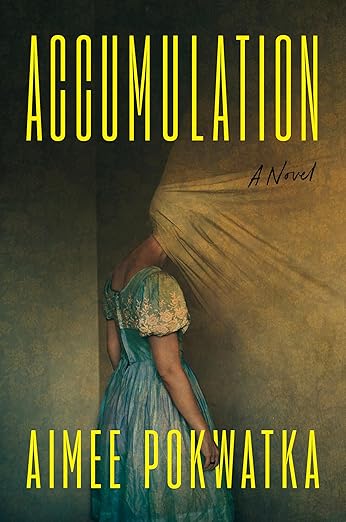
What do you do when the ghosts haunting your dream house are the least of your worries? When documentary filmmaker turned stay-at-home mom Tennessee Cherish moves into the dream house her husband bought for her, a brighter future seems to be on the horizon. Even if her husband is frustratingly absent due to his new high-paying job.
Even if their two young children begin acting out in strange ways. Even if she feels lonelier than ever. Distracted by the endless details that come with moving into a new town, a new house, and new schools, Tenn doesn’t notice when odd things begin happening at home. The faucet that runs at all hours. The creepy doll that seems to show up in every room. The human tooth was found in the floorboards.
As the kids’ outbursts and the strange events start to escalate, the family finds themselves increasingly caught in loops, repeating everyday actions with dangerous—and then devastating—effects. Tenn realizes she must find the source of what is haunting her family, before it kills them all. Taut and twisty, scary and searing, Aimee Pokwatka’s Accumulation lays bare the high price women pay for the promises of domesticity and motherhood, and the many ways in which families can be haunted.
Available May 5, 2026
You can preorder PERSONALIZED, SIGNED COPIES from my beloved local bookstore, Bedford Books.
Or find it at your local independent bookstore!
Penguin Random House / Bookshop.org / Barnes & Noble / Amazon / Libro.fm
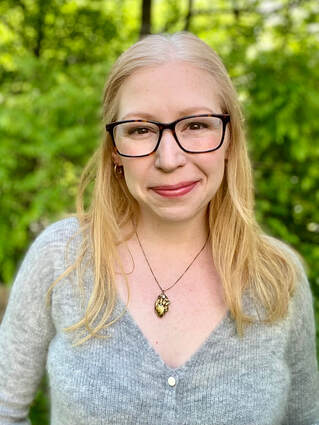
Aimee Pokwatka
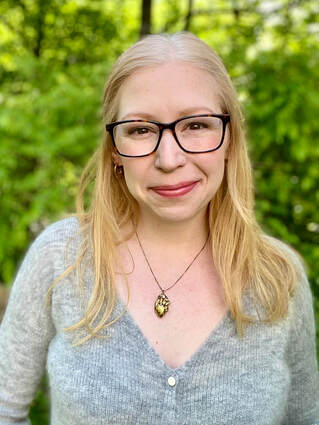
Aimee Pokwatka is the author of the genre-bending novels Self-Portrait with Nothing and The Parliament. Born and raised in Wheeling, West Virginia, she studied anthropology at the University of North Carolina at Greensboro, where she helped catalog a collection of archaic-period human skeletal remains. She received her MFA in creative writing from Syracuse University.
She has worked at Blockbuster Video, where she rewound and shrinkwrapped VHS tapes, and as a veterinary technician, where she expressed anal glands and once tended to a lion cub from the circus. She has also taught writers of all ages, and served as the editor of Salt Hill Journal and The Newtowner. She is an active member of Yellow Studio, a community for creative women and artists in Northern Westchester.
Her third novel, Accumulation, is forthcoming from Putnam Books in May 2026. She lives in a haunted house in New York with her family.