
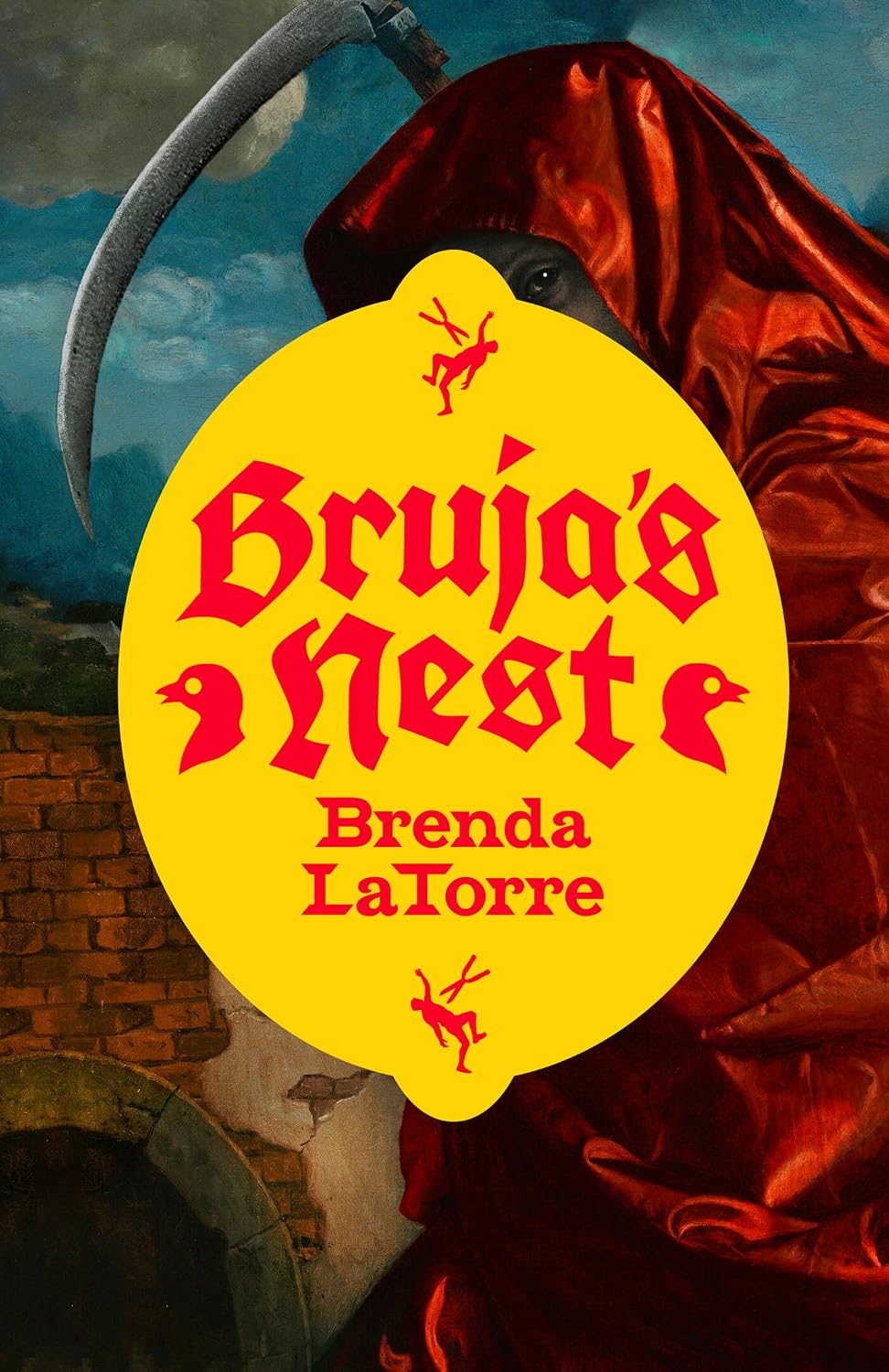
Bruja’s Nest | Brenda LaTorre | Creature Publishing | 6 October 2026 |
- Author Brenda LaTorre
- Publisher Creature Publishing
- Published 6 October 2026
- Pages 278
- Format Paperback, ebook, audiobook
- ISBN 9781951971571
- Subgenre Mexican folk horror, body horror
- Reviewed by Jim McLeod
Sent to work as a maid on a rich family’s hacienda, Yolanda pays the village bruja for a spell to trap the heir. The pregnancy that follows is not human, and neither is her love for what it brings.
Bruja’s Nest is the debut novel from Mexico City writer Brenda LaTorre, published by Creature Publishing. It mixes Mexican folk magic, class war and the kind of body horror that makes you hold the book a little further from your face. Its heroine is greedy, vain and hard to like. She is also the reason the whole thing works. What follows is spoiler-light, and the egg is on the back cover, so it does not count.
A wicked, gory, darkly funny debut that turns a maid’s fertility spell into a fierce study of class, faith and what mothers will do. Yolanda is hard to love and impossible to ignore, and only a hurried final act keeps Bruja’s Nest from full marks.
Bruja’s Nest Review: Folk Magic With a Telenovela Heart
In Mexican slang, to be bruja is to be broke. Skint. Out of pocket and out of luck. The word for witch doubles as the word for having nothing, and once you know that, a great deal of this novel falls into place. Poverty is its own kind of curse. The only question is what you will trade to lift it.
Brenda LaTorre’s Bruja’s Nest asks that question of Yolanda, a young woman raised on poverty, drink and abuse, and then shipped off by her own mother to work as a servant at Hacienda Cantera, the country estate of the wealthy Fernández De la Rosa family. Most heroines would want out. Yolanda wants in. She has watched enough telenovelas to know how the story goes: the poor girl catches the rich son’s eye, the family sneers, love wins, and the maid ends up mistress of the house. All she needs is a push. So she goes to the local bruja, pays for a fertility ritual, and lets the old magic do its work.
It does its work. That is the problem.
What grows inside Yolanda is not the heir she planned. Her body swells and festers, her few friends fall away, and she gives birth to a huge egg under the gaze of Santa Muerte, the bony folk saint of death. The rest of the book follows what hatches, and Yolanda’s furious, frightened, entirely sincere devotion to it, while the household around her decides her child is a monster.
That premise could have been played for pure shock. LaTorre plays it for something sharper. The key choice is Yolanda herself. She is not a victim waiting to be saved, and she is not a villain either. She is a schemer with a fantasy life, quick to lie and slow to see what is in front of her. She looks away from the truth again and again, because the truth would mean giving up the dream. You will wince at her. You will also understand her, which is worse.
This is where the book earns its stars. A lesser writer would have softened Yolanda so we could cheer. LaTorre keeps her prickly and lets us sit in her head as the plan curdles. The result is close to a dark comedy of manners, only the manners involve blood, feathers and infection. There is real humour here, much of it bleak. Yolanda’s certainty that this is all going to plan, while her own body is clearly saying otherwise, is the funniest and most awful thread in the book.
Is Bruja’s Nest Scary?
Not in the jump-scare sense. You will not find a creaking door or a face at the window. The fear here lives in the body. The ritual at the bruja’s house is the moment the novel shows its teeth, and the pregnancy that follows is a slow, wet dread that never quite lets up. If you have a weak stomach for gore, birth horror or harm to animals, take that seriously before you start. Bruja’s Nest does not look away, and it does not want you to.
What lingers longer than the gore is the way the women in the book treat one another. The rich family are vile, but they are not the only threat. The household is run on a pecking order, and the women at the bottom of it guard their small scraps of power with real spite. Alta, the stern housekeeper, has made her peace with a world where men call the shots and women compete for their favour. Yolanda wants to climb that same ladder, not kick it over. The cruelty comes from every rung. That is the true horror of the place, and it is a far colder thing than any spell.
I want to stay with that ritual for a moment, because it is the hinge of the whole book. I am paraphrasing here rather than quoting. To make the spell work, Yolanda’s flesh is pierced, and the heart of a rooster is placed inside her. Think about what a rooster is. It is the loudest bird in the yard, all strut and crow, a farmyard emblem of male pride.
Yolanda takes that swagger into her own body in order to get what men already have: land, a name, a place at the table. And what does the spell give back? An egg. Hen’s work. The bargain borrows a cockerel’s heart and returns a mother’s labour, and that neat, nasty reversal tells you everything about the deal she has struck. Even her magic is rigged by the world she is trying to beat.
Then there is the child. I won’t say much, because meeting him is half the fun. But the creature that hatches is not just a shock to gawp at. He is needy, odd and, in his own way, sweet. The family see a monster. Yolanda sees her son. LaTorre lets both views stand, and the gap between them is where the book does its best work. It is hard not to feel for him. It is harder still to decide who the real monster in that house is.
The title plays the same game. A bruja is a witch, a nest is where eggs are warmed, and the bruja’s home becomes the place where Yolanda’s future is laid and hatched. LaTorre does not underline any of this. She trusts you to notice, and the book is richer when you do.
How Bruja’s Nest Compares to Monstrilio
The publisher pitches the book as The Love Witch meets Monstrilio, and for once the comparison holds. From Anna Biller’s film it takes the heroine who treats romance as a spell to be cast and won. From Gerardo Sámano Córdova’s novel it takes the monstrous child and a parent’s love that will not bend to anyone else’s disgust. Our review of Monstrilio by Gerardo Sámano Córdova praised its tenderness, and that is where the two books part ways. Monstrilio grieves. Bruja’s Nest schemes. Where Córdova’s monster is wrapped in loss, LaTorre’s is wrapped in want, and that gives her book a meaner, more restless energy.
It also sits close to V Castro’s novel of Alejandra and La Llorona, another book that uses Mexican folklore to ask what motherhood costs a woman. Castro writes about a mother trying to escape a family curse. LaTorre writes about a woman who goes looking for one, because a curse is still better than nothing. Behind both stands Silvia Moreno-Garcia’s Mexican Gothic, with its rotten great house and its rich family feeding on the poor. Bruja’s Nest swaps the gothic fog for hard sunlight and dust, and it is all the better for it.
And then there is the telenovela, which is the book’s secret weapon. Yolanda is living out the classic plot of the poor beauty who claws her way into money, and LaTorre lets that soap opera logic run right alongside the folk horror. The two should clash. Instead they fit, because both are stories about women whose only route to power runs through a man and a marriage. The camp makes the horror funnier. The horror makes the camp cruel.
Reading LaTorre’s prose is like watching a candle lit for Santa Muerte. The wax is plain, the flame is small, and yet it throws a huge, shaking shadow up the wall. Her sentences are clean and quick, rarely showy, and the book moves fast. You could wish for lusher description here and there, but I think the plainness is a choice. Yolanda is not a poet. She is a girl who has learned to count, to watch and to want, and the prose sounds like her. When the gore comes, it lands harder for being stated flatly.
As a debut, it is striking. LaTorre has a background in short fiction, with stories in Pyre Magazine and several anthologies, and an MFA from the Stonecoast programme. In an essay for a Creature Publishing week on the RA for All Horror blog, she wrote about only giving her characters English names in her early work, until reading Gabino Iglesias’s The Devil Takes You Home changed her mind. Bruja’s Nest reads like a writer who has stopped asking permission. It is Mexican to the bone, unapologetic about it, and it fits right in on Creature Publishing’s list of feminist horror that likes to bite.
So where does it fall short? The final act. After two thirds of the book spent tightening the screws with real patience, the last stretch moves in a rush. Time jumps forward in sudden leaps, a few plot turns arrive faster than they can be felt, and some of the supporting cast, who had been building quietly, are left with less to do than they deserve. The ending itself is bold, and it fits the book’s themes, as Yolanda finally starts to see the cycle she has been caught in. I simply wanted more room for it. It is the one real flaw, and it is small, but it is the half star.
None of that undoes what came before. This is a debut with a strong voice, a wicked sense of humour and a clear eye for how class and gender grind people down. It knows its folklore, it knows its soap operas, and it knows exactly how much a body can take. Plenty of horror novels make you scared of the monster. Bruja’s Nest makes you scared of the woman who would do anything to keep it, and then, slowly, makes you understand that she was never given any other choice.
Some people are born with a silver spoon. Yolanda had to lay her own.
The Verdict: Is Bruja’s Nest Worth Reading?
4.5out of 5
The verdict
A wicked, gory and darkly funny debut that earns its egg, held back from top marks only by a rushed final act.
Read it if: you love a sharp anti-heroine, folk magic with real weight, body horror with a point, or Monstrilio and Mexican Gothic.
Skip it if: you need a lead you can root for, or graphic birth horror, sexual violence and animal harm are hard limits for you.
Content warnings: sexual violence, incest, child abuse, alcoholism, graphic body horror, pregnancy and birth horror, gore, animal death.

Keep reading on Ginger Nuts of Horror
 Pinfeathers by Christina Henry Review: A Mother’s Fear Grows Quills
 Mothersucker by Kim Bohyun Review: The Vampire Is the Least of It
 With Blood Upon His Teeth by Adam McOmber Review: The House That Hunger Built

About Ginger Nuts of Horror
Ginger Nuts of Horror is an independent horror review and culture site based in Edinburgh, Scotland. Edited by British Fantasy Award nominee Jim McLeod, it publishes horror book reviews, film reviews, author interviews, features and cover reveals. Ginger Nuts of Horror won Best Inclusive Film & Book Review Platform at the SME News UK Enterprise Awards 2026.