
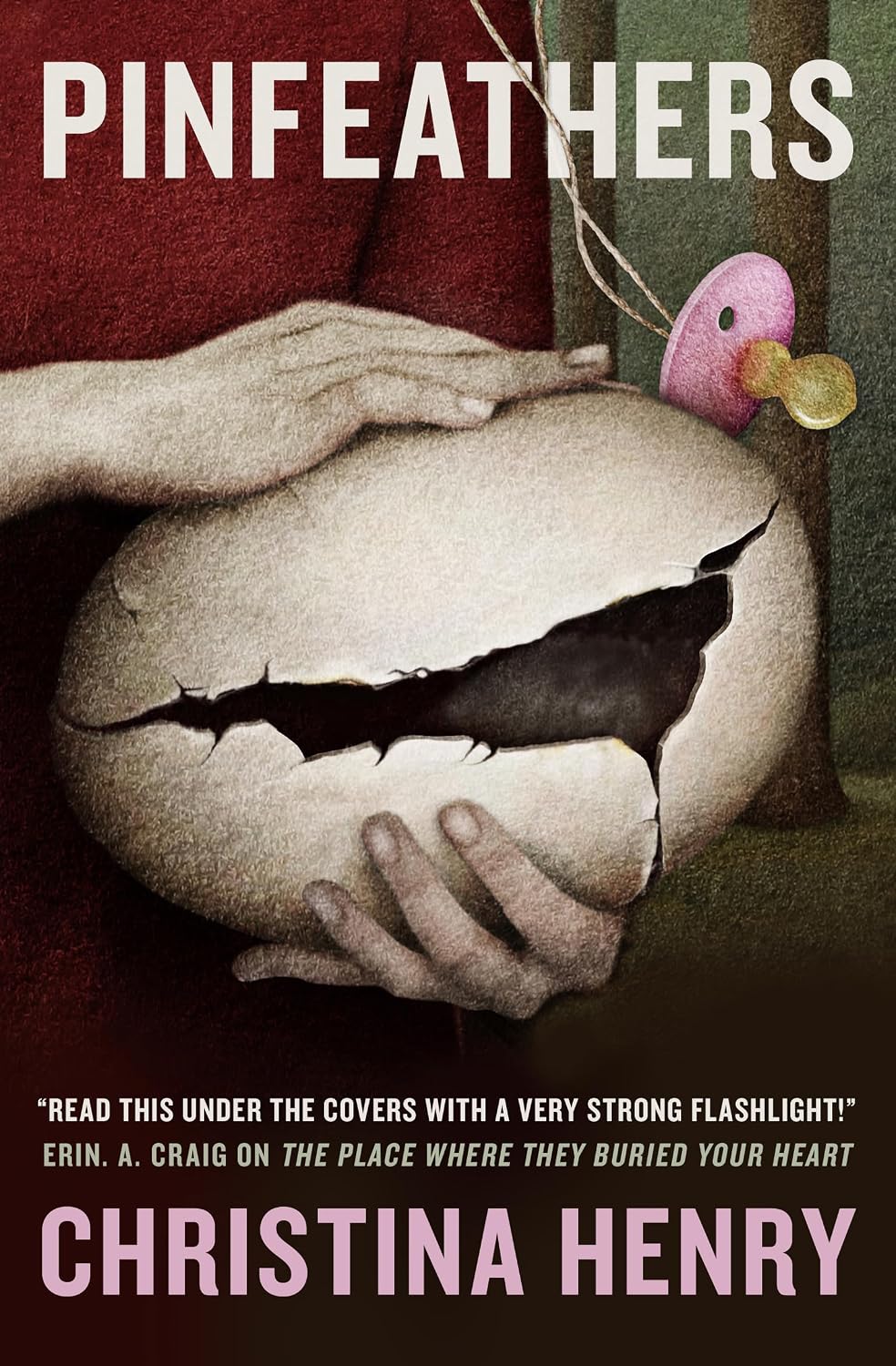
Pinfeathers | Christina Henry | Titan Books | 17 November 2026
- Author Christina Henry
- Publisher Titan Books
- Publishes 17 November 2026
- Pages 384
- Format Paperback, ebook
- ISBN 9781835412664
- Subgenre Maternal body horror
- Reviewed by Jim McLeod
A tired new mother finds dark quills pushing through her baby daughter’s skin. Her husband wants doctors. Her mother wants the child hidden. Nora has to decide who to trust before somebody else decides for her.
Pinfeathers by Christina Henry is her twentieth novel, a maternal body horror story about a baby girl who starts to grow feathers. In this Pinfeathers review I look at how Henry turns the plain, daily fear of new parenthood into something with quills, and why thin villains and late answers keep it just short of her best. It is out from Titan Books in the UK and Berkley in the US on 17 November 2026. Anyone who read my review of The Place Where They Buried Your Heart will know how well she has been writing lately. This one runs on the same fierce love, and it bites harder.
Pinfeathers takes the oldest fear a parent has, that something is wrong with the baby, and gives it quills. Christina Henry writes a mother’s panic with lean, fierce honesty, and Giulia is a gran worth the price alone. The villains are thin and the answers hurried, but the dread is the real thing.
Pinfeathers Review: Every Parent’s Worst Night, With Quills
Every new parent learns the same thing in the first few weeks. Nobody knows what they are doing, not really, and the books stacked by the cot are full of calm advice that falls apart at three in the morning. A rash is a rash until it isn’t. A cry is hunger until it goes on too long. The whole job is one long, quiet row between panic and common sense, and most nights common sense wins by a nose.
Christina Henry has set her new novel inside that row. Then she takes common sense away.
Nora Pacetti is at home with her baby daughter, Olivia, in a condo on Chicago’s North Side. She is tired. She is coping, more or less. She comes back from a morning run to a baby who will not stop screaming and a husband who is cross about it and heading off to work. Then she spots what looks like a splinter in Olivia’s arm. By the time the baby wakes from her nap there are more of them. Nora’s mother, Giulia, a woman who has watched far too many conspiracy videos, says out loud what nobody wants to hear. Those are pinfeathers. The baby is growing feathers.
It’s a premise that could tip into a joke very fast. Henry knows it. She has described the book herself as a little funny, a little sad and a lot unhinged, which is about right. What keeps it on the right side of silly is how hard she holds on to the fear underneath. She told the Chicago Sun-Times that the novel is really about the worry parents carry over illness and the things nobody warns you about. That worry is the engine. The feathers are just where it leaks out.
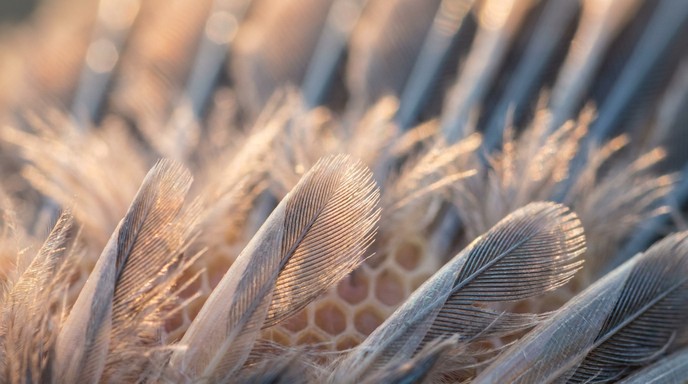
And Henry wastes no time. The quills arrive within a few pages. From there the book does not stop to catch its breath, and neither will you.
Who Gets Believed in Pinfeathers
Three adults stand round the cot, and each one is a different way of facing something you cannot fix.
Adam, Nora’s husband, wants tests, specialists, a hospital. That is the sensible answer, the one most of us would give. Giulia wants the child hidden, and Giulia is the family crank, the one with the YouTube habit and the theories. Nora is stuck in the middle, sure in her gut that the doctors are the danger, with nothing but her gut to go on.
This is the clever bit. Henry hands the most reasonable line to the man we would normally trust, then lets it sour. She gives the scariest idea to the woman we have been told not to believe, and slowly makes her right. So for a long stretch the question isn’t what is happening to Olivia. It’s what is happening to Nora. Is she a mother who simply knows, or a frightened, sleepless woman who has caught her own mother’s paranoia like a cold? The book holds that question open for a good while, and that is where it is strongest.
Adam is also where the cracks first show. He is the dismissive husband, short-tempered and out of the door, and that is a figure horror has leaned on a great deal lately. Henry gives him a job in the plot more than a life of his own. You can see why. The book is Nora’s, and it runs at a sprint. But a little more of Adam would have made the strain on the marriage cut deeper, and that strain is one of the most honest things here: two worn-out people pulling the same child in two directions.
Take the moment Nora gives in and lets the doctors look at Olivia. I’m describing the scene rather than quoting it, but the shape is the point. On paper it is the relief, the grown-up choice, the place where the story should calm down. Instead the doctors are far too interested. More tests. Another look.
Then a test goes wrong, and from that point nothing in Nora’s life is hers to steer. Henry turns the moment you ought to feel safe into the moment you ought to feel watched. All it takes is a doctor who is a little too keen. Anyone who has sat in a clinic while someone frowns at a chart knows that cold drop in the stomach. Henry reaches for it on purpose, and it works because it is so ordinary.
That’s the craft that runs through the whole book. Henry’s prose is lean. It takes no side trips and carries no fat, and the bodily changes are explained in a line or two rather than a lecture. There’s no gothic fog to hide in. The quills are described as calmly as a nappy change, which makes them worse. Reading Pinfeathers feels like worrying at a thorn under your thumbnail: small at first, then sore, then the only thing you can think about.
Spoiler warning: the next four paragraphs cover the middle of the book.
The condo doesn’t last. After a break-in goes badly wrong and Nora kills an intruder by accident, the family runs west before anyone official can ask about the body on the floor. Giulia, it turns out, has been ready for this for years: cash put by, cars bought, a cabin deep in the Minnesota woods. There is a dark joke in that. The woman everyone rolled their eyes at is the only one with a plan. And at the cabin there is another mother, hiding another child like Olivia, which tells Nora she is not alone and that the problem is far bigger than one cot.
Meanwhile Olivia keeps changing. The feathers are only the start; there is something hard and sharp in her throat now that snaps at food, and at fingers. Behind the family comes a doctor, Noel Cassidy, who believes a child like Olivia belongs in a secret lab, and men in uniform who may not be what they seem. Henry plays the body horror straight and close, never for gross-out, always through a mother trying to feed and soothe a baby she can no longer quite hold.
This is where Pinfeathers changes gear. It stops being a story about four walls and starts being a chase, with a shady programme behind it that owes more to The Island of Doctor Moreau and The X-Files than to any family drama. It would be easy to call the thriller side new ground for Henry. I’m not so sure. The Girl in Red was a woman on the run through hostile country, and Near the Bone was a woman trying to get off a mountain alive. Flight is home turf for her, and she handles the road well.
The shift will split readers. If you came for a slow, close study of one family coming apart, the second half may feel like it swaps that for a run of narrow escapes. For me it mostly works, because the chase never stops being about one mother keeping one baby fed, warm and out of sight. Where it slips is the people doing the chasing.
End of spoilers.
How Pinfeathers Compares to Christina Henry’s Earlier Novels
Henry made her name pulling old stories apart. Alice and Red Queen took Lewis Carroll somewhere very dark, Lost Boy told Peter Pan from Hook’s side, and The Mermaid, The Girl in Red and Horseman each picked up a familiar tale and gave it teeth. Before all that came the seven Black Wings books. Lately she has gone her own way, with The Ghost Tree, Near the Bone, Good Girls Don’t Die (which Valerie Lester covered in our Good Girls Don’t Die review), The House That Horror Built and The Place Where They Buried Your Heart.
Look at those last few and a thread shows. The House That Horror Built has a single mother trying to keep her son afloat. The Place Where They Buried Your Heart follows a girl who grows up to be a mother on the same street that swallowed her brother. Motherhood has been creeping towards the centre of Henry’s work for a while. In Pinfeathers it finally sits there, with nowhere else to look.
The weakness travels with her too, and it is the reason this is four stars rather than five. It comes in two parts.
The first is the enemy. The people hunting Olivia are glimpsed in flashes, a shadowy outfit with a lab and a lot of guns, and they never quite become people. They do cruel things, but you never feel the logic behind them, so they menace in the way a storm menaces rather than the way a person does. A villain you cannot understand is harder to fear for long. Henry keeps the wider picture deliberately out of focus, and for much of the book that adds to the panic. You know only what Nora knows, which is almost nothing.
The second is what happens when the picture does come into focus. The answers come very late, in a rush. They pull the book towards a wider story it had not been telling. After so long with one mother and one baby, the explanation feels added rather than grown. I had the same complaint about The Place Where They Buried Your Heart, where a late figure turned up to explain the house’s hunger and the ending came too fast. Twice in a row now the reveal has felt like a duty Henry had to do, not the payoff she was building to. She is superb at the long climb. The top of the hill is where she hurries.
Still, these are small faults in a strong book. You will not mind much while you read. And the last pages earn back a lot of ground. Henry lands the ending on Nora and Olivia, not on the conspiracy, and it is hopeful and quietly moving in a way the chase did not prepare you for. She also leaves the door open wide enough that a return to this world would not surprise me. That is the gap between four stars and five, and it is not a wide one.
So where does it sit on the shelf? The obvious ancestor is Rosemary’s Baby, the story of a mother and a child that powerful people want for their own ends. But Henry flips one key thing. Rosemary is the last to know. Nora knows first, and she runs.
It also makes a neat contrast with Rachel Yoder’s Nightbitch, the obvious modern touchstone. There, the mother is the one who changes. Here, the mother’s body is left alone, and the horror is in watching. That’s a crueller angle in some ways. You can’t fight what is happening to your child by changing yourself; you can only hold on, and hide, and hope.
The closest relative might be Gerardo Sámano Córdova’s Monstrilio, which Natalie Wall wrote about in our Monstrilio review: another mother raising a child the world would call a monster, another book that is tender first and violent second. And for anyone who saw Hanna Bergholm’s film Hatching, with its girl and her secret bird thing, Pinfeathers will feel like the grown-up, sleep-deprived version of the same nightmare.
None of those books has a gran like Giulia, though. Think of the most stubborn relative you have. Now make her a prepper, with a stash of cash, spare cars and a theory for every news story. She is loud and over the top, and she is also the book’s secret weapon. Much of the plot turns on what she knew and when, and finding that out is half the fun.
What Henry adds is the comedy of family. The friction between Giulia and Nora gives the horror room to breathe. It’s a story about love that has to take what it cannot grasp. It is about who gets believed when a mother says something is wrong. And it is about how far you will go once you have made up your mind.
Most horror about babies asks what is wrong with the child. Henry asks the harder question: what would you turn into to keep her safe?
The Verdict: Is Pinfeathers Worth Reading?
4out of 5
The verdict
A fast, fierce, funny tale of maternal body horror whose thin villains and hurried answers clip its wings, but only a little.
Read it if: you want body horror with a big heart, a mother you believe in, and a grandmother you will never forget.
Skip it if: you want slow, character-rich horror with villains you can understand, or stories of babies in danger are too close to home.
Content warnings: body horror involving a baby, an infant in pain and in danger, medical experimentation on children and animals, violence and death, gaslighting within a marriage, intense parental anxiety.
Keep reading on Ginger Nuts of Horror
 A Review of Kirsten Kaschock’s An Impossibility of Crows: Motherhood, Monsters, and the Crows of Letort
 What Kind of Mother by Clay McLeod Chapman
 Don’t Leave Her Alone by Desirée de Fez Review: A Family Love That Bleeds
About Ginger Nuts of Horror
Ginger Nuts of Horror is an independent horror review and culture site based in Edinburgh, Scotland. Edited by British Fantasy Award nominee Jim McLeod, it publishes horror book reviews, film reviews, author interviews, features and cover reveals. Ginger Nuts of Horror won Best Inclusive Film & Book Review Platform at the SME News UK Enterprise Awards 2026.


