Three women, one mall, two days to Christmas, and a love so tight it starts to cut.
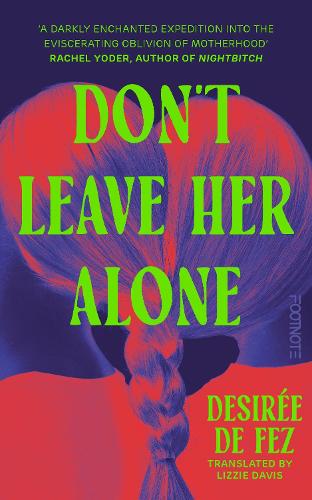
- Author Desirée de Fez, translated by Lizzie Davis
- Publisher Footnote Press
- Published 15 October 2026
- Pages 240
- Format Hardback, ebook, audiobook
- ISBN 9781804443361
- Subgenre Literary body horror
- Reviewed by Jim McLeod
A Barcelona mother and her two grown daughters can barely stand a day apart. Then, on Christmas Eve, the youngest goes missing inside a shopping centre, and all three bodies start to give way.
Don’t Leave Her Alone is the first novel from Desirée de Fez, the Barcelona film critic, and it reaches English readers in a translation by Lizzie Davis. It follows a mother and her two grown daughters through the last days before Christmas, when a trip to the mall goes badly wrong. In this Don’t Leave Her Alone review I look at how de Fez turns a family that can’t bear to be apart into a Spanish body horror novel with real teeth. It is also a book that has left some readers scratching their heads. So here is why I think it earns every one of its five stars, starting with the phone that never stops ringing.
De Fez takes a family that cannot stand to be apart and splits it open under shopping-centre light. The plain prose is the trap, the lurch into body horror is the point, and the result is a rare debut that knows exactly what it wants to frighten you with.
Blood in the Food Court: De Fez Turns Family Love Into Body Horror
Some families never hang up. The call ends, but the line stays open. It hums in the pocket, in the kitchen, in the back of the skull. Nobody says goodbye, because nobody ever really leaves.
Desirée de Fez has built her first novel inside that hum. Don’t Leave Her Alone, translated from the Spanish by Lizzie Davis, is set in the quiet suburbs of Barcelona in the run-up to Christmas. It is about three women who love each other so hard that the love has started to leave marks. By the end, the marks are real.
Alba is the younger sister. She has a husband, three kids, a car and a mortgage, and she cannot be on her own. Not for a day. Not for an hour. She spends long stretches on the phone to her mother and her sister. Her mother, Carmen, goes with her most days to a huge shopping centre, where the two of them kill time until the school bell. Alba books the summer holiday in January. She buys the Christmas presents in July. Her eyes are raw with worry.
That detail about the diary is the key to her, I think. A life planned a year ahead has no gaps, and a gap is where you would find yourself alone. Every booking is a door shut on the quiet. De Fez never needs to spell this out. The calendar does the talking for her.
Diana, the elder sister, has two kids, a job and a head full of small disasters. Did she leave the iron on? Is a cigarette still burning in an ashtray somewhere? She juggles work and motherhood, and she cannot recall the last time Carmen looked after her. Most families have one child who gets the leftovers of a mother’s care. Diana knows which child she is.
Carmen sits in the middle of it all. She does what women of her age were told to do: everything, for everyone, for ever. Duty is her job. Sacrifice is her pension.
Nothing I describe from here goes past the jacket copy, so read on without fear of spoilers. Two days before Christmas, Alba drags Carmen to the mall. A pair of women known as the widows come up to Alba and put the evil eye on her. Her nose starts to bleed. On Christmas Eve, Alba vanishes, shut inside the shopping centre after everyone else has gone home. She wakes soaked in blood, with no phone and only scraps of memory. Outside, Diana and Carmen fold over in pain as their bellies split open.
Look hard at that nosebleed, because the whole book lives in it. The publisher’s summary, which I’m paraphrasing, puts it in one flat beat: the nose bleeds, and that is how Alba knows. Not how she guesses. How she knows. The knowledge comes through the body, not the mind. The evil eye is the stuff of grandmothers and kitchen lore all over Spain, and de Fez drops it into the least magical place on earth, a mall at Christmas, under the tinsel and the tannoy. Alba does not reason her way to fear. Her blood tells her first, and she trusts it.
That is the move de Fez makes again and again. These women know things in their bodies that they will not say out loud. So the body says it for them, a little louder each time, until it tears.
And here is the part that lands hardest. The horror is less the wound than the shrug that comes after it. The women try to play down what is happening to them, to keep the day on track, to get the gifts wrapped. Anyone who has said “I’m fine” while plainly not being fine will feel a cold hand on the back of the neck.
Is Don’t Leave Her Alone Scary?
Yes, though not the way a jump scare is scary. This is dread that builds in the gut before it breaks the skin.
The American publisher’s copy talks openly about tentacles living inside these women, so I will too. Are they real? Are they guilt, or grief, or a mother’s grip made flesh? De Fez won’t settle it, and she is right not to. They bind these women to each other the way an old phone cord binds a caller to the wall. You can pace the room. You can’t leave it.
De Fez has spent her working life in the dark of the cinema, and it shows. She has said, more or less, that the book could be a chat between her own mother and David Cronenberg. That tells you most of what you need to know. The clear ancestor is The Brood, Cronenberg’s 1979 film in which a mother’s buried rage grows a body of its own. Don’t Leave Her Alone takes that idea out of the clinic and puts it on the family phone line and in the Christmas food court.
The book behaves like two novels stitched together at the navel. The first is plain family realism: school runs, work stress, shopping lists, long talks that circle the thing nobody will name. The second is the nightmare that was waiting under the first all along. Some readers will find the join too sudden. A few will call the back half nonsense and wonder what they just read. I understand the reaction, but I think it misses the design. The lurch is the point. It is the moment the family story can no longer be told in the kitchen voice, because the kitchen voice was lying from the start.
If there is a quibble, and it is a small one, the final image asks a lot of you. Readers who need every metaphor paid off in hard cash will close the book with questions. Gore hounds may also find the talky opening slow to catch. Neither point dents the book. Both are simply the price of a writer who trusts you.
Then there is the prose, which is plain. That is a choice, and a clever one. Much of the first half runs on dialogue, the kind of talk families use to avoid saying anything at all. Reading it is like standing under shopping-centre lights: flat, bright and even, with no shadows anywhere. Then something moves, and because the light hides nothing, you see all of it at once. A fancier stylist would have given the horror places to hide. De Fez gives it none.
There is dark humour too, the everyday sort that comes from seeing your own family on the page. It knows how absurd it is to hunt for the right present while your insides come apart. Davis, whose past work includes Juan Cárdenas’s The Devil of the Provinces, looks a smart match for a writer this direct.
From Film Critic to Novelist: Where De Fez Fits
This is a debut novel, but de Fez is no newcomer to horror. She is a Barcelona critic who has written about the genre for years, works with the Sitges film festival and hosts the horror podcast Marea Nocturna. Her earlier books are all about film: Películas clave del cine de terror moderno in 2007, a book on J.A. Bayona’s The Impossible in 2012, and, in 2020, Reina del grito, a personal journey through women’s fears by way of the horror films that shaped her.
That last book matters most here. Reina del grito dealt with the fear of walking alone at night, of the body, of motherhood. Don’t Leave Her Alone reads like those same fears given flesh and a shopping list. For years the critic explained what horror does to women. Now the novelist simply does it.
The book arrives with some noise behind it. Blackie Books published it in Spain earlier this year as No la dejes sola, and the foreign rights went to auction at Frankfurt. On the shelf it sits beside Rachel Yoder’s Nightbitch, Samanta Schweblin’s Fever Dream and the work of Mariana Enriquez, with a nod to Bora Chung’s Cursed Bunny in the way it lets the real world simply crack. There is plenty of Almodóvar in its women and their kitchens, too. The UK edition pitches it at fans of The Substance, and the link holds. Both are about women’s bodies breaking under the demand to keep smiling.
It also sits well beside some recent horror covered on this site. Samantha Josephs’ Carrying turns motherhood into flesh and gore. Jessica Hamilton’s The Woods finds domestic horror in ageing and family. On screen, Hanna Bergholm’s Nightborn takes on a mother who cannot love her baby. Those stories mostly look at one woman. De Fez draws a triangle instead: the mother, the clinging daughter and the overlooked one. Each of them is a mother, each of them is a daughter, and the care only ever seems to flow one way down the line.
That triangle is where the book’s real idea lives. Care and control are twins here, and you can’t always tell which one is talking. Even the title works both ways. Read it once and it is a plea: look after her, keep her safe. Read it again and it is a sentence: she will never be allowed a moment to herself. Alba fears being alone. The book suggests she has never once been given the chance.
Christmas is the perfect stage for this. It is the season when families perform being close with the most effort, and the mall is its cathedral. De Fez strips the lights off both and shows you the wiring.
This December, when the family phone lights up for the fifth time before lunch, you’ll think of Alba alone in a dark mall, bleeding and, for once, alone. Pick this book up before the tree goes up, then see if you can bring yourself to let the call ring out.
The Verdict: Is Don’t Leave Her Alone Worth Reading?
The verdict
A fierce, darkly funny debut that turns the family you can’t escape into body horror you won’t shake off.
Read it if: you loved Nightbitch, Fever Dream or Mariana Enriquez, and you like your horror rooted in the kitchen and the family phone call.
Skip it if: you need every monster explained, or you want gore from the very first page.
Jim "The Don" McLeod has been reading horror for over 35 years and reviewing it for more than 16. He's the editor of Ginger Nuts of Horror, Europe's largest independent horror review and culture site, and a British Fantasy Award nominee for his work in the genre. When he's not busy inflicting his opinions on the horror community, he can be found annoying his family or getting thoroughly outwitted by his two dogs, Casper and Molly.