
Jessica Hamilton on why a kind homecoming can be horror’s cruellest trick.
Jessica Hamilton on The Woods: | Interview
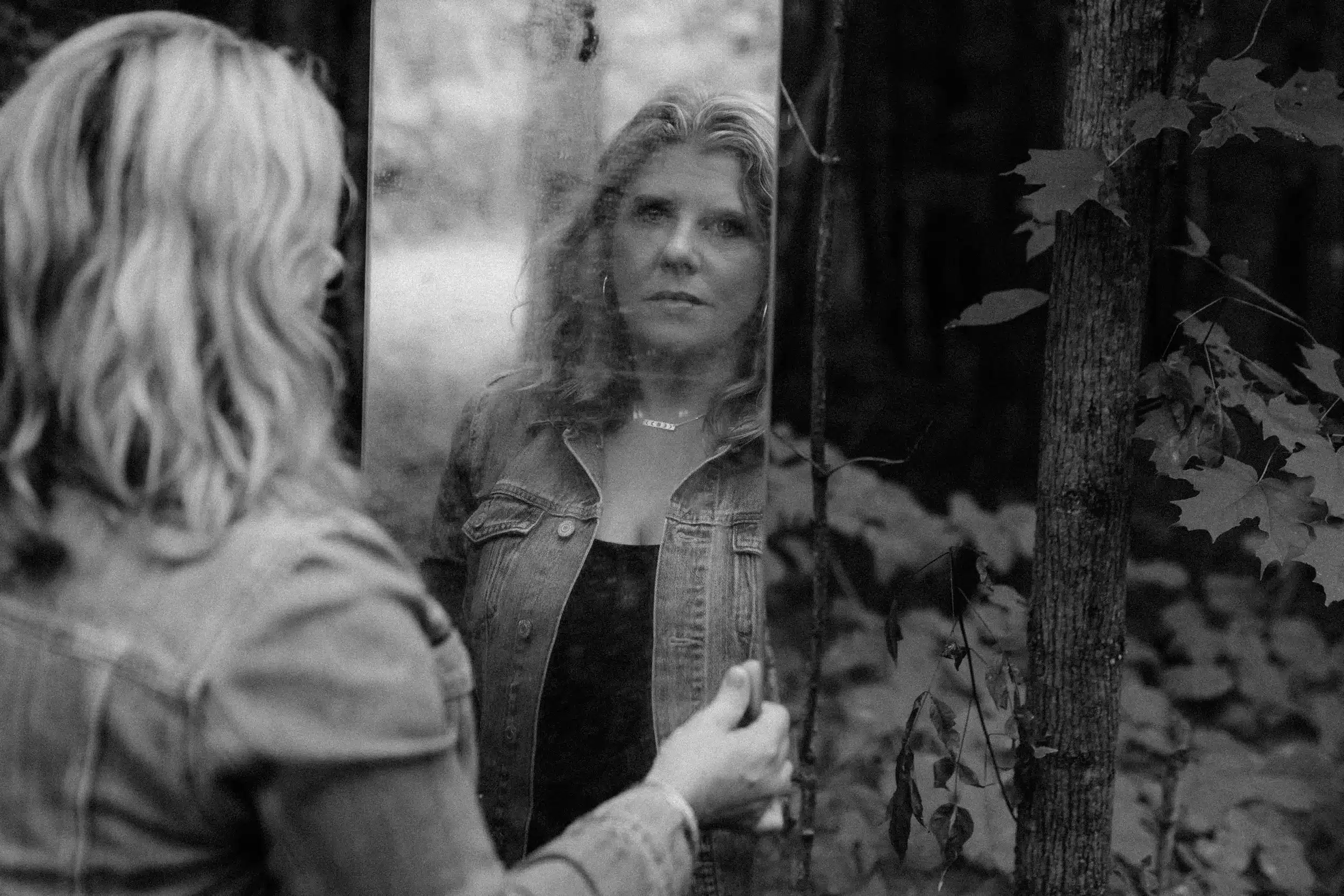
Jessica Hamilton writes among the birds. She lives an hour and a half north of Toronto on a heavily wooded property she calls Raven House, where she takes forest walks and works with the trees pressing in on every side. Knowing that, her horror debut reads a little like a confession. The Woods, out from Simon & Schuster on 25 August, drops a grieving family into a secluded house ringed by ancient forest, then lets that forest do something no exorcism could undo: it lifts their pain, and hands back smiling, hollowed-out copies of the people they were.
Hamilton arrived here by an unusual road. Her debut, What You Never Knew, was a thriller narrated partly by the dead; her second, Don’t You Dare, a suspense novel about a woman losing herself inside a marriage. The Woods is where she stops circling the supernatural and walks straight into it. It is also a book about grief, motherhood, and the particular horror of being a woman nobody believes. I wanted to know how she built it, and what it cost to write a forest that turns on the family living in its clearing.
Jessica Hamilton on The Woods: And The Monster We Are Scared to Talk About
You have said that Don’t You Dare grew out of a dream, a couple passing notes back and forth. The Woods carries a stranger origin in its bones, a premise where the trees give a family exactly what they ask for and take something unspeakable in return. What was the first image or idea that told you this was a horror novel and not another thriller?
When my agent read the first draft of my debut novel, What You Never Knew, her main comment was, there are a lot of ghosts in this story, is it a thriller or a ghost story, pick a lane. I got rid of all but one ghost and went with the thriller genre. Only after the release of my second thriller novel, Don’t You Dare, did I realize that I wasn’t as enthusiastic about the thriller genre as I was the horror genre, as both a reader and a writer.
I decided that in my next novel I would embrace the paranormal elements, which I love, and that there would be no more cutting the ghosts. I knew before even starting The Woods that it would be a horror novel and after how easily it came to me and how much fun I had writing it I now know that there will be no going back, horror is the genre for me.
The book opens not with Alice but with a true-crime podcast, Cleo Watson walking her listeners through Justine Gordon, the woman who murdered her family in that same house and insisted to the end that the woods had replaced them with imposters. You hand the reader the ending before the story starts. What did opening on that frame let you do to the dread that a cold open never could?
I think that when you identify right out of the gate what may be the threatening, ominous thing in a horror novel it means the reader gets to be suspicious or even fully afraid of that thing for the entire duration of the book, which is good horror value. I also want my reader asking questions and trying to figure things out from the beginning and feeling a sense of unease and dread the entire time that they’re reading.
Your reborn characters come back kind. Geoff steps out of the trees without a scratch, grinning, saying he feels amazing; Quinn softens; Beverley loses her edges. You resist the obvious move of making the returned monstrous. In what way did making them pleasant, even improved, sharpen the horror for you as you were writing it?
I very consciously wanted to play with a more nuanced depiction of the paranormal rather than something that was simply good versus evil. When something appears good on the surface but feels wrong in your gut, that is scarier to me than a clearly defined enemy. What’s in the woods believes that they are doing good while those on the outside, unchanged, are living in terror of it. This kind of dichotomy can be seen throughout history, and I find it to be a very unsettling one.
Alice is the only one who sees what is happening, and the novel keeps stepping out of her head into Beverley, Polly, Quinn and Geoff. Fracturing the perspective away from your one clear-eyed witness is a risk, because it lets the reader breathe. What did the shifting point of view give you that staying locked to Alice would have denied?
One element that was important to me to show in this book is how divided a family can be, despite living in the same house, having the same experiences and being blood related. Having the shifting POVs allowed me to show each family members’ perspective, how they contrasted and the low-lying tension that flowed between them. It also gave me the opportunity to include more varied experiences with the woods coming from five different perspectives therefore showing the creep factor of the woods from multiple angles and for multiple reasons.
Every person Alice turns to reaches for the same explanation: stress, trauma, hormones, menopause. The supernatural in this book is real, but the disbelief that surrounds it is entirely ordinary. How deliberately were you building the menopause motif as a second horror running alongside the first?
It’s very deliberate. For a long-time society didn’t even acknowledge menopause and what women went through with it. What I’ve noticed now, as a middle-aged woman myself, is that the pendulum has swung the opposite way, which on the one hand is great because that stage in life for women is no longer hidden away and full of shame and people are talking about it and so many more resources are available because of this.
But at the same time, because it has become so much more well known and understood, it’s being used to diagnose and explain away everything a woman in her forties and fifties is experiencing. Individual, authentic experiences and feelings that a woman of that age are having lose credibility when blamed on hormones which is a horror in itself as, seen with Alice in the book.
There is a choice at the centre of the book that mirrors Justine Gordon’s, and Alice arrives at it from the opposite direction. Without giving it away, the question underneath seems to be whether a mother should accept a counterfeit peace if it frees the people she loves from their grief. When did you know that this, and not the question of escape or survival, was the real spine of the novel?
As a mother myself, I’ve always used my writing to explore ideas and themes of motherhood. One that I often come back to is what a mother is willing to sacrifice for her children and the lengths she will go to protect them. I’m amazed at what some mothers will hold for their children, what they will deny for themselves in the name of their children, what they will endure.
It was only as I wrote the ending of the novel that I decided what kind of Mother Alice was in the face of the woods. Up until that point, I had no idea what she would actually do. I had to learn her as a mother through the writing of the novel to know what kind of mother she would be when given the choice that she was at the end of the book.
What You Never Knew was narrated in part by someone already dead, and here you return to the dead who will not stay gone, but you invert it: now they come back into the living world. What did writing that first novel, with its voice from beyond, teach you that you drew on directly for The Woods?
One thing I’ve learned from my own experiences with the paranormal is that there isn’t really a divide between the living and those who have passed—more of a co-existing. What You Never Knew was my first attempt at writing about this understanding and seeing if I could portray that sense on the page. I got a good response about my ghost POV, and I think that gave me the confidence to explore it further in The Woods.
You have talked about Don’t You Dare as a book about a woman losing her identity when her whole job becomes taking care of other people. The Woods pushes that self-erasure to a supernatural extreme, a mother who ends up carrying everyone’s pain so they need not feel it. In what way do you see these two books as part of the same preoccupation, and where does the horror take that idea somewhere the thriller could not?
It is definitely the same preoccupation, as mentioned in my previous answer, and one I often return to. In my thriller novel the loss of identity was my protagonist’s motivation and justification to do bad things, to escape the reality of having lost herself.
In my horror novel my protagonist, Alice, is pretty much willing to do anything to fix her family, including sacrificing herself to do it. I think coupling that desperation with a paranormal force, that she views as a threat to her family, creates a very unsettling tension. What I hoped was that the reader would feel as desperate as Alice is to save her family and that they would fear the woods as much as she does.
Your first two novels were published by Crooked Lane and sold as thrillers with a chill running through them. The Woods is your first book billed outright as horror, with a major house behind it. What did committing fully to the genre free you to do on the page that you had been holding back?
Ever since I was a kid I’ve been fascinated by the paranormal and by the horror genre in both books and movies. I started with thrillers because I thought they had a wider appeal but to be honest, I never really felt like I belonged in that genre. Committing to horror has felt like finally accepting who I really am as a writer.
When I wrote THE WOODS, I wasn’t worrying whether or not readers would believe in my ghosts or the unexplained elements of the story. I just had fun with it, and it was the easiest book I’ve written yet. I think that’s why I was able to get a major house behind it. I stopped trying to tailor my voice to the thriller genre and let my inner horror voice free and authenticity always makes for better writing.
Horror right now is full of women’s rage and women’s bodies, the wave some are calling femgore, and The Woods sits close to books like Marcus Kliewer’s We Used to Live Here in the way it turns a house and a family into a slow trap. Where do you see this corner of the genre heading, and what is it giving women writers that the domestic thriller could not?
I always say that if a woman gave a visceral description of the many physical things her body has put her through over the years, or what the world has put her through, it would sound like it was right out of a horror novel. The horror genre gives women a place to express the horror that is being a woman in this world, as well as the opportunity in some cases to direct the anger that comes with it and create a social commentary.
Often in domestic thrillers women are victims of their circumstances. I find in the horror genre women can be the one causing the horror, or the one combatting it but are rarely its victim. I think the genre is only going to grow and gain in popularity.
Setting your own reading aside from your writing for a moment, what is a horror novel by another author that genuinely unsettled you, the kind that followed you out of the book and into the house, and what was it doing to you that you still think about?
The Caretaker by Marcus Kliewer. I found it hard to read but couldn’t stop at the same time. I have OCD and his novel essentially turns common OCD loops and compulsions into things that if not carried out will destroy the world, for real, and not just something that’s all in the head. The way he described the physical sensations of those loops was so well known to me, but I’d never seen it described outside of my body and in a way that helped me understand it better but was also so unsettling because the thought of it all was horrifying. I think about that book often.
The dread in The Woods lives at the level of the sentence. Geoff’s return is written as broken little full stops, “I feel. Well. I feel. Amazing.” The wrongness in the family shows up as a flicker of black sliding across the eyes. When you are trying to make a reader feel that something is off without naming it, what are you actually doing to the prose?
Metaphorically speaking you’re having a door creak open on its own without showing what’s behind it until much further into the story. You describe the unsettling sensations of the door opening on its own, you have everyone feel creeped out by it but then come up with logical explanations to assuage the fear. You delay describing the scary thing in full, only parceling out bits of it at a time which means your prose is restrained, very intentional, and, on a need, to know basis.
The driving force of the book is Alice noticing, raising the alarm, being dismissed, then doubting herself, over and over. That loop is the point, the rhythm of a woman disbelieved, but sustaining tension across a repeating beat is one of the hardest problems in a slow-burn novel. How did you keep that cycle taut rather than letting it settle into a pattern the reader could predict?
I honestly wasn’t sure that I did so it’s wonderful to hear that I was in fact successful. I think I just kept each incident varied enough so that it wasn’t the same thing that Alice was encountering each time and then being disbelieved about. It was markings on the trees one day, then bodies in the woods another and it wasn’t always the same person disbelieving her either. Often, she didn’t even believe herself.
You live inside the thing you wrote about. You walk in the woods most days, with the birds and the trees you clearly love. What is it like to spend a year making your own forest sinister on the page, and then step outside into it? Has writing this book changed the way the trees at Raven House feel to you?
I do love the woods that I live amongst but from the very first day we moved into the house I felt like something was out there looking back at me. It wasn’t necessarily sinister, but it wasn’t totally comfortable either.
My property has an otherworldly feeling which is what attracted me to it in the first place, and it was that feeling that inspired the novel. I will say though that while writing the novel the feeling did intensify, and my sister, who did an early read of the book, will no longer stay in our guest cabin which sits at the edge of those woods, but that only made me know I’d done my job as a horror writer.
At its heart The Woods asks whether you would take a version of someone you lost that came back happy and whole but not quite them, or whether love is precisely the refusal of that bargain, the insistence on keeping the grief because the grief is the last true thing you have of them. If the woods made you the offer, and no one would ever know which you chose, what do you think you would do?
Based on the grief and loss that I’ve experienced in my life I would take the offer of the woods because a lot of my grief comes from what was done to me and I wouldn’t mind forgetting about those hurts in my life.
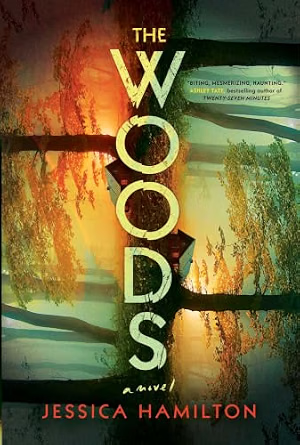
The Woods by Jessica Hamilton
We Used to Live Here meets The Amityville Horror in this haunting novel about Alice, a frustrated wife and grieving mother whose life is turned upside down when she moves her family into a secluded house sheltered by ancient woods.
After the devastating death of her teenage daughter Lucy, Alice and her family need a fresh start. Their home in the city is full of painful reminders of what they’ve lost, and Alice is worried about the mental health of her other two children, Quinn and Polly, and the state of her marriage.
So when she accidentally discovers a gorgeous, renovated bungalow nestled in the shadow of lovely old woods with a FOR SALE sign at the curb, Alice immediately emails the estate agent for a viewing. She can’t believe the list price—until the agent discloses the history of the house.
Years earlier, a woman named Justine Gordon murdered her family there, claiming they were imposters and that her real family had been taken by the woods. Undeterred by the sad story, Alice makes an executive decision as the chief breadwinner.
Though neither of her kids are happy to leave their friends behind, her mother Beverley thinks the granny flat in the backyard is cramped, and her husband Geoff, a failed novelist, can’t put down the bourbon long enough to help the family unpack, Alice prevails. As her family reluctantly settles in, the cracks in their relationships become more pronounced.
And when inexplicable things start happening, including sightings of strange figures in the yard, and Geoff vanishing into the woods one night and returning hours later wearing different clothes and remembering nothing, Alice must confront the possibility that her refuge may be her undoing. Is her menopausal mind playing tricks on her, or is there something ancient and malevolent in the woods?
Jessica Hamilton is the author of two atmospheric thriller novels, What You Never Knew and Don’t You Dare. Her debut horror novel, The Woods, is set for publication in Fall 2026 with Simon and Schuster. Jessica was born in Australia but grew up in Canada. She has lived and worked in the Czech Republic, Taiwan, India and Japan.
She studied writing at the Humber School for Writers as well as George Brown College and spent several years volunteering for the Canadian Authors Association. She lives with her family an hour and a half north of Toronto, Canada, on a heavily wooded, property called Raven House where she enjoys writing, forest walks and spending time with the birds.
Jim "The Don" McLeod has been reading horror for over 35 years and reviewing it for more than 16. He's the editor of Ginger Nuts of Horror, Europe's largest independent horror review and culture site, and a British Fantasy Award nominee for his work in the genre. When he's not busy inflicting his opinions on the horror community, he can be found annoying his family or getting thoroughly outwitted by his two dogs, Casper and Molly.
Ginger Nuts of Horror: The Heart and Soul of Horror Reviews
Every feature is built to sell your work. We include backlinks to your website or Amazon author page, a full synopsis, and a universal purchasing link that sends readers straight to their local store. Add a large, engaged social following and an 18-year archive of trusted horror coverage, and you have a platform genuinely built to grow your readership.
Whether you’re an established author, an indie filmmaker, or a debut voice in indie horror, there’s a way for us to help you reach more fans. Explore our horror book reviews and horror movie reviews, then get your horror book or film featured today.