A blue-collar Houston summer, a love that dare not speak its name, and a dark red GTX idling at the edge of the frame.
Lost Boys | Dean Cade | Slashic Horror Press | 15 May 2026 |
Houston, the summer of 1973. In the blue-collar Heights, a closeted teenager called Lane Bowden pumps gas and dreams of riding off with a boy named James, with no idea that the man the neighbourhood will call the Candyman is already circling.
Dean Cade builds his Summer 1973 trilogy on the real Houston Mass Murders, the crimes of Dean Corll and his teenage accomplices, and Lost Boys, the middle volume from Slashic Horror Press, is a rare kind of true-crime horror. It refuses the killer his starring role and hands the story back to the frightened, hopeful young people living in his shadow. Queer romance and creeping dread, braided tight.
“Cade refuses the killer his close-up and gives the summer back to the boys history reduced to a body count. Lost Boys aches as much as it dreads, and it earns every beat of both.”
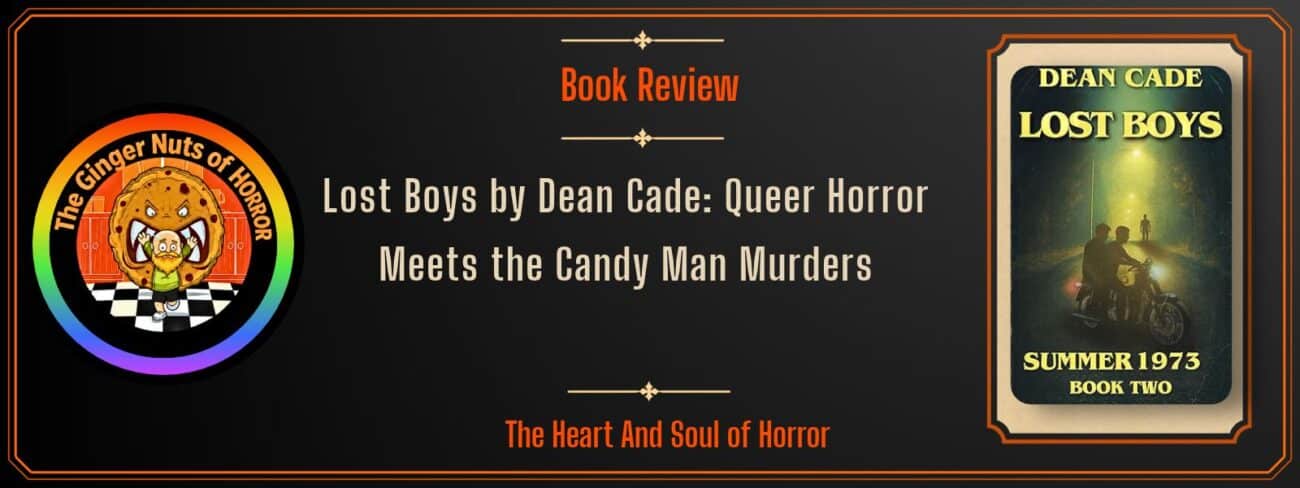
Lost Boys by Dean Cade: Queer Horror Meets the Candy Man Murders
History has a tidy, cruel habit with its victims. It files them under a case number, a body count, a lurid nickname for the man who took them, and the boys themselves shrink to footnotes in his legend. What goes missing is the summer they were still living in when it happened. The jobs. The crushes. The burgers and the milkshakes and the ordinary, aching want of a better life somewhere past the county line. Dean Cade has gone looking for that lost summer, and the second book of his Summer 1973 trilogy is what he came back with.
For readers who need the ugly scaffolding underneath, it is worth naming it plainly, because Cade never hides it. Between 1970 and 1973, Dean Corll, a Houston man his family’s candy business had nicknamed the Candy Man, murdered more than two dozen teenage boys, most of them plucked from the Heights, with the help of two teenagers, Elmer Wayne Henley and David Brooks. Jack Olsen’s The Man with the Candy remains the definitive account of the horror itself. Cade is after something Olsen never tried for. He wants the texture of the days before the headlines, the interior weather of the boys who were still just boys.
Lane is his way in. A gas jockey at Ben’s failing Mobil station, sweating in his third pair of coveralls, in love with James and unable to say so out loud in a Texas that would break him for it. In the space of a morning Cade has him fired by the tired old owner who cannot afford him, sent to a bank that tells him the joint account holds sixty-eight dollars and change, and drawn back again and again to the thing he cannot stop thinking about, which is not the dark red Plymouth GTX that keeps sliding past at the edge of his vision but the boy waiting for him back at apartment nineteen.
We know what the Heights meant in the summer of 1973. Lane does not. Every tender, mundane thing he does, we watch through a pane of dread he cannot see.
The genius of the approach shows clearest in the scenes Cade gives to the men in the GTX. Rather than a masked bogeyman, we get two teenagers bickering in a smoky muscle car while Uriah Heep’s “Easy Livin'” rattles out of the radio. One is scruffy and wound tight, hoping to catch Lane’s eye through the window. The other, blond and bespectacled, taps the brakes and counsels patience.
They talk about letting somebody called Billy get closer. They talk, glancingly, about things that could get one of them “handcuffed to the torture board again.” And in that single dropped clause the whole architecture of the real case rears up, the plywood board with its restraints, the accomplices who were themselves lured and coerced before they turned recruiter. “Separate lives. Separate worlds,” the driver says, nodding to the beat, and the scruffy one answers that one day it will all be worth it and he will get out.
These are not monsters relishing the hunt. They are frightened, trapped kids doing a monstrous thing, and Cade lets the horror arrive not through gore but through the appalling ordinariness of a joint passed hand to hand while a boy is marked for death two blocks ahead. It is the Texas Chain Saw trick, terror in the banal, and he pulls it off without a drop of blood on the page.
Read that scene beside the one that opens the excerpt I have, Lane waking in James’s bed with a mouth like sandpaper, a bruise on his abdomen he cannot account for, and the nagging refrain, Shouldn’t I remember this?, and you see how carefully Cade has calibrated the two registers. The bedroom is warmth and want and a locked door keeping the world out for one more hour.
The car is the world getting in. He runs them on the same frequency of not-quite-remembering, the blackout haze of a stoned summer, so that pleasure and threat share the same fog. When Lane later walks past the Henley house and feels “the gaze of a stranger’s eyes on him emanating from the blinded windows,” the paranoia reads as of a piece with the hangover, and that is precisely the point. The boy cannot tell his dread from his high. The reader can, and can do nothing with the knowing.
Watch the same trick work in daylight, in the safest rooms Cade can find. At the Yale Street diner, the waitress Tammy teases Lane about the boy he has plainly met, slides him a burger and a shake on the house, and never notices the thing Cade plants in the last line, Lane leaving his two quarters and heading for the door without clocking the dark red GTX that cruises past outside the window.
The comfort and the threat share a single sentence. Later, at Heights Hospital, he sits with his dying mother Ellen in room 407, holding her hand while she frets about the yard and asks whether he has a girlfriend, and the four-storey building looms over him “like an ancient citadel harboring the threat of pain and suffering behind its high walls.” Cade will not grant Lane one unhaunted hour. Grief, poverty, first love and stalking terror all breathe the same cranked-up air conditioning, and the reader is never let off the hook, because Lane, blessed and cursed with not knowing, always is.
The prose itself runs like a well-tuned muscle car idling at a kerb. Nothing showy in the bodywork, plain declaratives, period-perfect detail, a waitress blowing a gum bubble, a Pegasus sign whirring overhead “like a metallic whinny,” but you feel the engine turning over the whole time, and you never lose the sense it could drop into gear without warning.
Cade scores his menace to the era with a collector’s ear, the flying red horse of the Mobil sign, a ’70 Cadillac DeVille “haloed in red,” the Apes movie at the drive-in, and he trusts his images to do the lifting. He even risks a literary wink, sending Lane’s dying mother into the care of a Doctor Benway, a name lifted straight from Burroughs, a small dark joke about which sicknesses actually get treated in this city.
The one place the writing shows its seams is a certain repetition in Lane’s inner monologue, the same worried loop circled a touch too often, though on the page it doubles as character, the mind of a stoned nineteen-year-old genuinely does snag and repeat, so even the flaw earns a little of its keep.
Summer 1973 is Cade’s debut, and it is instructive to set Lost Boys against what Cruising set up before it. The first book had the harder job, introducing Lane and James, lighting the romance, planting the threat. This one has the freedom to deepen.
The love story stops being a promise and starts being a stake, something the machine of the plot is visibly sharpening its teeth on, and Lane’s world contracts around him, the job gone, the money gone, the mother in room 407 slipping away, until the only exit left is the motorbike and the boy and the dream of California. Cade has also written a punk memoir, No Future, and you can feel the same autobiographical heat here, the lived knowledge of running wild and poor and unseen in a Texas that had no use for you.
Because the theme underneath it all is being unseen. Lane is invisible twice over, closeted in a world that would punish the truth of him, and poor in a Heights that is boarding up its shops and burning down its cinema. The real crimes are remembered partly because so many of the boys went unidentified for so long, one of them known for decades only by a catalogue number, and Cade has said it was the pauper’s burial of one such victim that started him writing.
That grief runs right through Lost Boys. Lane’s deepest fear, older than any GTX, is that he might be no one, that he might vanish and leave no mark. To restore his interiority, his desire, his bad jokes and his bruised heart, is a quietly radical act of remembrance. It is the book giving a name back to a number.
The only caveat worth naming is a minor one, and it is the caveat of every middle chapter. This is a bridge, and it reads best as one. Come to it cold, without Cruising behind you, and some of its threads will feel deliberately unfinished, because they are. Start at the start, and this is where the trilogy tightens the noose.
Cade has taken the most picked-over crime in his city’s history and found the one thing everybody else left on the cutting-room floor. Not the killer. The kids. And he has written them with such tenderness that when the GTX finally slides into gear, you will want to reach into the page and pull Lane off the kerb yourself.
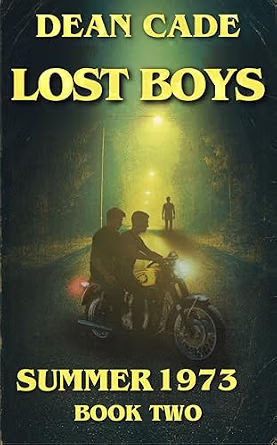
Lost Boys by Dean Cade
In Lost Boys, Lane and James dream of running away. Hiding their secret, they stumble into one of the most horrific crimes in the annals of American history.
Hanging out at swimming pools and dive bars, riding a BSA Lightning motorcycle, partying, muscle cars, and rock music define the summer of ’73. Through it all, Lane revels in his connection to James, someone different like him—gay in a time when it is not cool.
In the blue-collar neighborhood of the Heights, an eerie, dark red ’68 Plymouth GTX prowls the streets, a man with burning eyes watches from a dirty white Econoline van, and teenage boys disappear.
Held back by a lack of money, Lane deals with his dying mother while James distracts him from his ominous feelings of someone following him. Ignoring the warning signs, they are unaware of the danger of a serial killer and his teenage accomplices stalking them with the help of one of their friends.
The Candyman is coming, and in his dark house the torture board awaits.

Jim "The Don" McLeod has been reading horror for over 35 years and reviewing it for more than 16. He's the editor of Ginger Nuts of Horror, Europe's largest independent horror review and culture site, and a British Fantasy Award nominee for his work in the genre. When he's not busy inflicting his opinions on the horror community, he can be found annoying his family or getting thoroughly outwitted by his two dogs, Casper and Molly.
Ginger Nuts of Horror: The Heart and Soul of Horror Reviews
Every feature is built to sell your work. We include backlinks to your website or Amazon author page, a full synopsis, and a universal purchasing link that sends readers straight to their local store. Add a large, engaged social following and an 18-year archive of trusted horror coverage, and you have a platform genuinely built to grow your readership.
Whether you’re an established author, an indie filmmaker, or a debut voice in indie horror, there’s a way for us to help you reach more fans. Explore our horror book reviews and horror movie reviews, then get your horror book or film featured today.