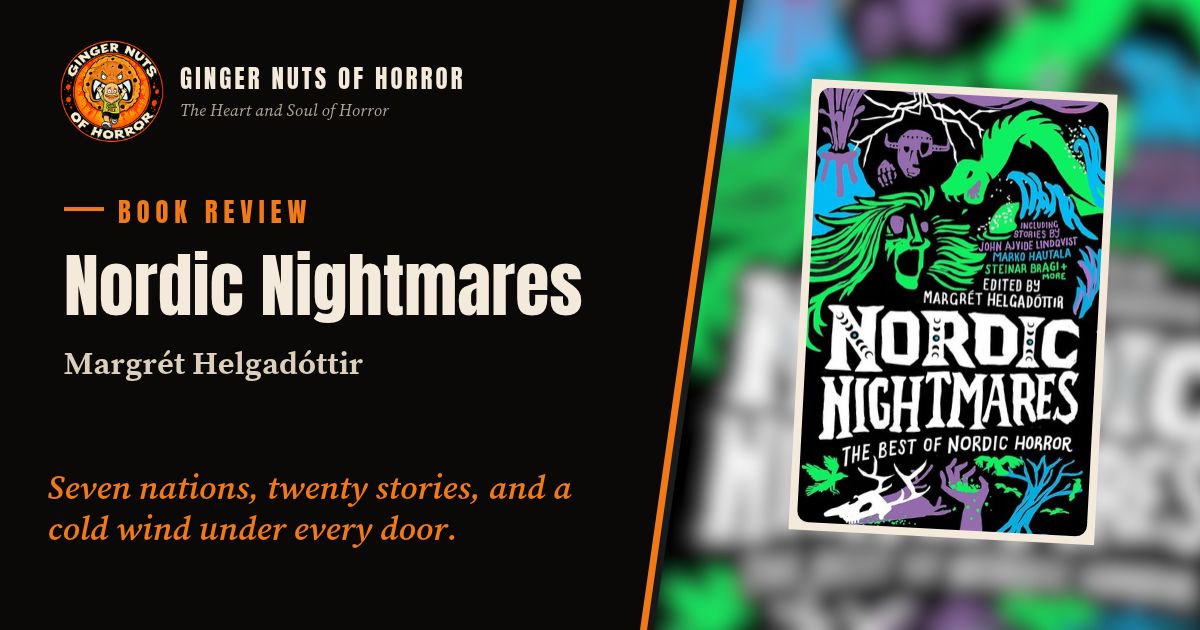
Seven nations, twenty stories, and a cold wind under every door.
Nordic Nightmares | Margrét Helgadóttir | Solaris | 22 October 2026 |
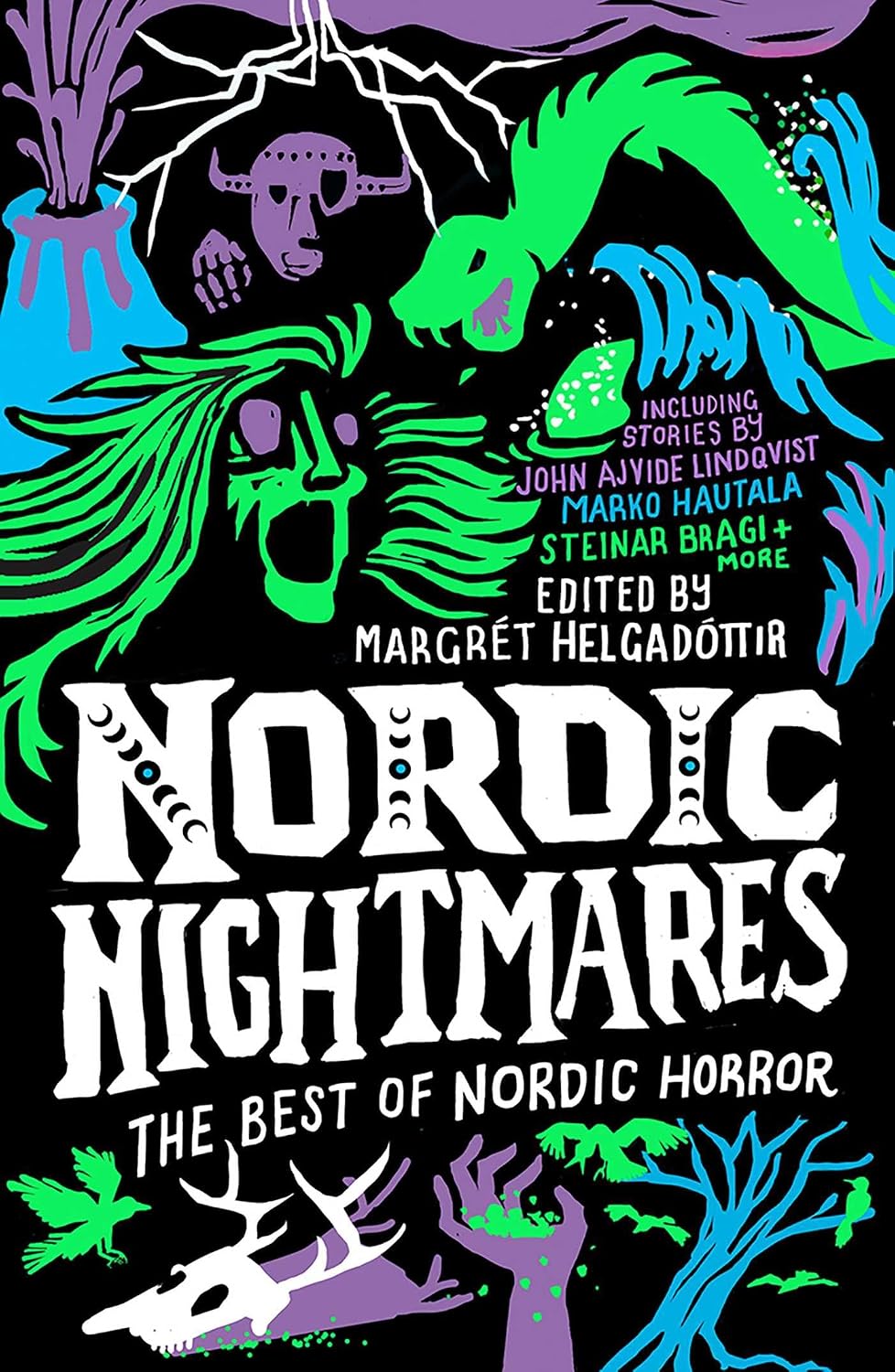
- Editor Margrét Helgadóttir
- Publisher Solaris
- Published 22 October 2026
- Pages 352
- Format Paperback
- ISBN 9781837868575
- Subgenre Nordic horror, translated fiction, anthology
- Reviewed by Jim McLeod
Twenty horror stories from seven Nordic nations, most of them in English for the first time. Folk monsters, failing hearts, bad weather and worse neighbours, from Finland to Greenland and back to Sweden.
Nordic Nightmares: The Best of Nordic Horror, edited by Margrét Helgadóttir, gathers twenty stories from Finland, Denmark, Greenland, Iceland, the Faroe Islands, Norway and Sweden. Most have never been in English before. That alone makes it worth a look. In this Nordic Nightmares review I weigh up whether the book does more than fill a gap on the shelf. It sits beside her earlier Nordic Visions, and it leans harder into fear. Big names like John Ajvide Lindqvist and Johanna Sinisalo share the pages with writers who are new to English readers.
A cold, wide and welcome tour of Nordic dread. Too many of its twenty stories see their own endings coming, and the Greenland pair never match the folklore behind them, but the best of Nordic Nightmares are among the strongest horror stories of the year.
Nordic Nightmares Review: Twenty Doors Into the Cold
Horror travels badly. A ghost that chills one country can look like a damp sheet in the next. So much of what scares us is local. It is the road we know, the weather we grew up with, the tale our gran told to keep us off the ice. Take away that soil and you are often left with a plot and not much else.
So an anthology that tries to carry the fears of seven nations into English is taking a real risk. Margrét Helgadóttir knows this. In her introduction she says horror sits nearer the edges of Nordic publishing than it does in Britain or America. You can feel that in the book. A few of these stories were found in odd places. Pasi Ilmari Jääskeläinen’s “Angela’s Artworks” first ran in a Finnish anthology for language and literature teachers, where writers were asked to revisit a classic tale. His classic was Poe’s “The Masque of the Red Death”. Most of us would not look for horror there. That is rather the point.
The book is laid out as a tour, country by country, from Finland in the east to Sweden at the close. That shape helps. You get a feel for each place before you move on, and you start to notice what each one is afraid of.
Finland is afraid of things that wait. Denmark is afraid of what arrives in the post or moves in next door. Greenland reaches for its monsters. Iceland, fittingly, keeps glancing at the ground under its feet. Sweden, the most settled horror culture of the lot, simply gets on with being frightening.
What works: the quiet ones
The stories that hit hardest here are rarely the ones with monsters in them. They are the ones where something small goes wrong and keeps going wrong.
Take Mikkel Harris Carlsen’s “Mr Schaday”, translated from the Danish by Olivia Lasky. A fussy, careful lodger in an unnamed city gets a new neighbour. That is the setup. What follows is a slow tightening, like a screw turned a quarter at a time. It has the feel of Poe, but it never reads like a copy. All the way through, the world seems about to tip over into something new. It is the best kind of short horror: a closed room, a nervous mind, and a door you would really rather stayed shut.
Then there is “The Storm” by Boel Bermann, translated from the Swedish by Heather Jonasson. A man whose daughter died in a chemical spill takes a job with Sweden’s civil contingencies agency. He buries himself in planning for disaster, partly to cope and partly to avoid his wife. Then a real storm comes. The weather outside starts to match the weather inside him. The story lets neither of them off lightly. It is grief written with its sleeves rolled up. The details feel lived in, not borrowed, and the ending does not flinch.
Nanna Árnadóttir’s “You See Me, Don’t You?” is the one I would hand to anyone who thinks they have seen every trick. A woman is trying to work out where she is and what has happened to her, with a volcanic eruption somewhere in the frame. I will say no more than that, because the less you know the better it works. It gets under the skin without a single stock horror move. That is rare.
Two very short pieces prove the anthology knows the value of brevity. Tor Åge Bringsværd’s “All the Friendly People”, another Lasky translation, is a tired man on a train and a run of strangers who are a touch too warm. It is only a few pages long, and it is gloriously odd. Bringsværd helped found Norwegian science fiction. He has since died, and almost none of his adult fiction is in English. This small, strange story makes that feel like a loss.
And the book closes on John Ajvide Lindqvist. “My Christmas Holiday”, translated by his long-time translator Marlaine Delargy, is a little girl’s account of her Christmas Eve. You may guess where it is going. It does not matter. The child’s voice does the work, and it lands with a weight out of all proportion to its length. If you came to Lindqvist through Let the Right One In, you know how well he writes children who see more than they say.
A close look at “The Rat”
If I had to pick one story to show what this book does at its best, it would be Sólrún Michelsen’s “The Rat”, from the Faroe Islands, translated by Matthew Landrum.
Here is the premise, which I am paraphrasing rather than quoting. A man’s heart has been damaged so badly that he cannot bear to keep it in the house. So every winter he buries it in the ground. That is how the story opens, flat and plain, as though it were a chore like clearing the gutters.
What makes this work is the tone. Michelsen does not wink at us. The heart is real, the soil is real, and the man treats both as facts of life. That deadpan delivery is the trick. A writer reaching for effect would underline the metaphor. Michelsen just lets it lie there in the cold earth and trusts us to feel the chill. When the rat arrives, and the man starts to form a bond with it, the story begins to dig up what hurt his heart in the first place. It turns from an odd fable into something much darker.
Some readers have found the turn too sudden. I can see why. But the jolt suits a man who has spent years refusing to look at his own wound. When the truth comes, it would come all at once.
Reading the best of this book is like walking on a frozen lake at night. The surface looks calm and solid, and the stories are mostly told in plain, clean prose. Then you hear the crack.
Where Nordic Nightmares Falls Short
Now the honest part. Twenty stories is a lot, and not all of them pull their weight.
The biggest problem is predictability. Too many of the middle-ranking stories show their hand early. Marko Hautala’s “The Silence of the Host” has a boy home alone at night with a radio phone-in. One caller says their child is possessed. It builds a neat sense of dread, then goes just where you expect. Aleksander Brun’s “Wrecked”, from Norway, has a grieving man realising why his family has not come home, and you will likely realise it some pages before he does. Jon Ewo’s “Smoke and Shadows”, about an executed killer whose evil does not stay dead, has a fresh angle and a very familiar road. These are solid, well-made stories. They are not surprising ones.
The Greenland pair are a real let-down, and the reason is frustrating. Gertrud-Marie Kreutzmann’s “The Qivittoq” and Pivinnguaq Mørch’s “The Tupilak” both draw on rich Inuit folklore. A qivittoq is a person who has walked away from people into the wild. A tupilak is a made thing, built to do harm. Those are wonderful seeds for horror. But “The Qivittoq” never quite gets going, and “The Tupilak” spends most of its length describing its creature rather than making us fear for the person facing it. In both cases the legend is more frightening than the tale. That is a shame, as Greenlandic horror is almost never seen in English.
Endings are a wider issue. Johanna Sinisalo’s “The Joys of the Table” is told by a table. It is one of the boldest ideas here, both lovely and unsettling. Then it hurries to a close that feels generic. “Angela’s Artworks”, in which a painter is asked to put the missing children back into her old pictures, has a fine slow build and an ending that does not quite pay off. AR Frederiksen’s “A Pretty Parcel for a Pretty Price” has a cracking sci-fi tinged idea about an unexpected package, and prose that some will find choppy.
And then there is Rakel Helmsdal’s “When the Angels Came”. This is the one that will start arguments. It is the diary of a woman living under a near-future surveillance state. It piles up turn after turn in a short space. Some readers will find it bold and packed with ideas. Others will find it shrill, a string of provocations with nowhere to go. I can see both books in it. What I will say is that it is the story most likely to split a reading group down the middle, and an anthology should have at least one of those.
The translators deserve a bow
It would be wrong to review this book without naming the people who carried it across. Olivia Lasky handles five stories from the Danish and Norwegian, including “Mr Schaday” and “All the Friendly People”. Her work is smooth and quietly sure of itself. Heather Jonasson’s “The Storm” and Marlaine Delargy’s Lindqvist are just as fine. Where a story stumbles, it is more often the plot than the English. That is no small feat across this many voices.
Where this sits in the genre
Helgadóttir has done this before. Her Nordic Visions, from 2023, mapped speculative fiction across the same seven nations. Before that came Winter Tales and the seven Fox Spirit Books of Monsters, which roamed the world one continent at a time. Her own debut, The Stars Seem So Far Away, was shortlisted for a British Fantasy Award. She has a clear eye for range, and this new book pushes that eye towards fear.
Next to Nordic Visions, this one is tighter in theme and leans more on new work. It feels like a bigger effort. There are more stories, more translations and more writers from further afield. As an introduction to Nordic horror in English, it sits comfortably beside something like The Valancourt Book of World Horror Stories, though it goes much deeper into one region.
It also offers a useful map for readers who want to go further. Hildur Knútsdóttir’s “The Shape of Stones”, a journal of a woman hunting for ancient sacrificial stones, is a good taster for anyone who enjoyed her novel The Night Guest. Sinisalo and Jääskeläinen both have novels in English for those who want more Finnish strangeness. And several of the best writers here, Carlsen, Bermann and Árnadóttir among them, have little or nothing else in English yet. This book is a strong case for changing that.
The Verdict: Is Nordic Nightmares Worth Reading?
Yes. It is uneven, as most big anthologies are. A handful of stories give away their endings too soon, and two never live up to their folklore. But the high points are high. “Mr Schaday”, “The Storm”, “You See Me, Don’t You?”, “The Rat” and that final Lindqvist would earn a place in any year’s best list. The rest is a well-curated tour with a clear sense of place, and a real chance to hear voices that English horror has been missing.
Read it with the lights low and the window open a crack. Some of these stories only work when you can feel the draught.
The verdict
An uneven but welcome tour of Nordic dread, carried by a clutch of stories that rank with the best horror of the year.
Read it if: you want horror in translation, love slow, strange short fiction, or have wondered what scares Finland, Iceland and the Faroes.
Skip it if: you want every story to land, or prefer your monsters loud and your plots full of surprises.
Keep reading on Ginger Nuts of Horror
 Cthulhu Cymraeg: The Night Country by Mark Howard Jones Review: Lovecraft, Welsh Style
 Don’t Leave Her Alone by Desirée de Fez Review: A Family Love That Bleeds
 Death in Its Many Forms by S.H. Cooper Review: The Dead Take Back Their Story
About Ginger Nuts of Horror
Ginger Nuts of Horror is an independent horror review and culture site based in Edinburgh, Scotland. Edited by British Fantasy Award nominee Jim McLeod, it publishes horror book reviews, film reviews, author interviews, features and cover reveals. Ginger Nuts of Horror won Best Inclusive Film & Book Review Platform at the SME News UK Enterprise Awards 2026.

Jim "The Don" McLeod has been reading horror for over 35 years and reviewing it for more than 16. He's the editor of Ginger Nuts of Horror, Europe's largest independent horror review and culture site, and a British Fantasy Award nominee for his work in the genre. When he's not busy inflicting his opinions on the horror community, he can be found annoying his family or getting thoroughly outwitted by his two dogs, Casper and Molly.