
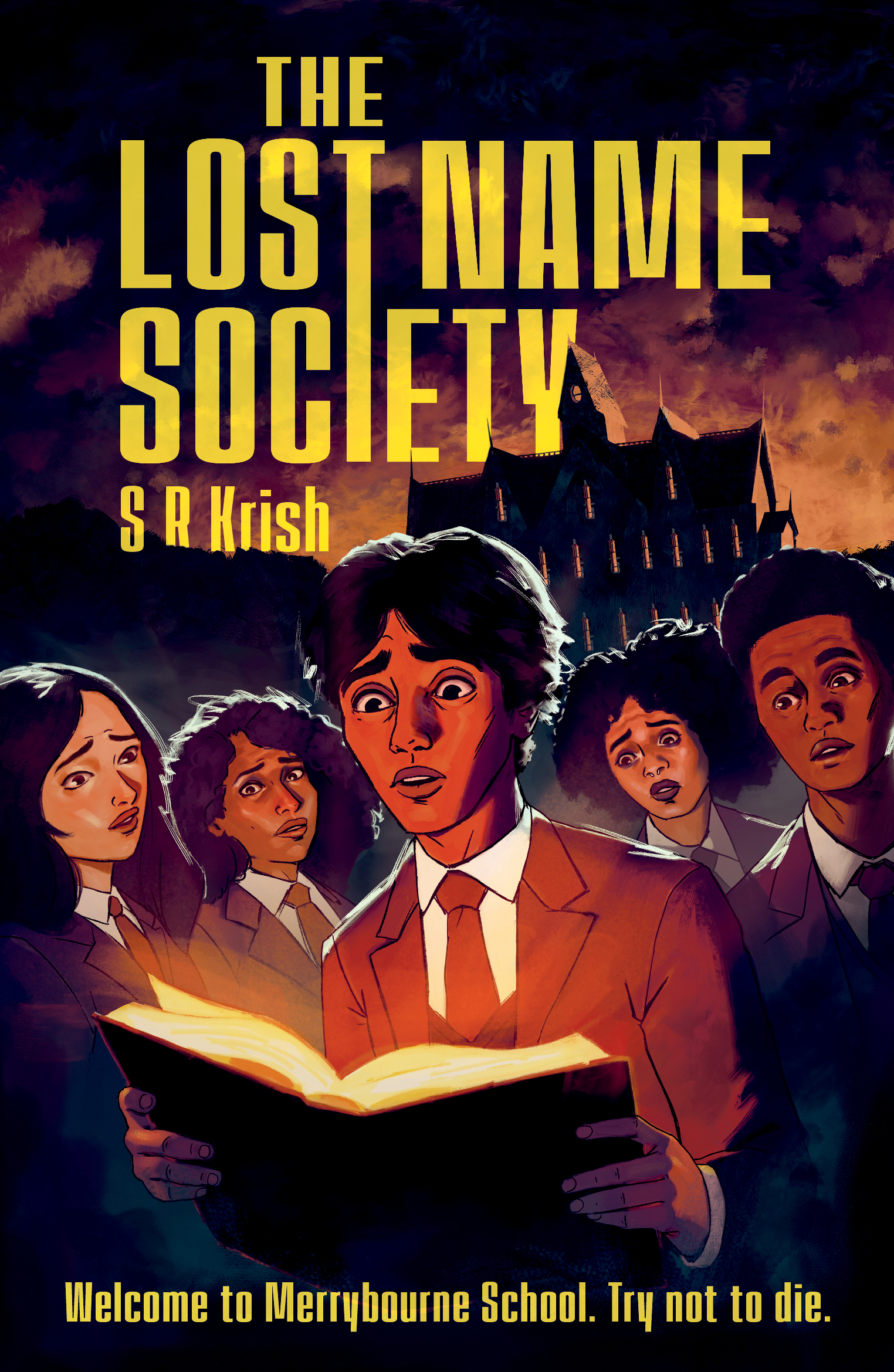
The Lost Name Society | S R Krish | Fox & Ink Books | 3 September 2026 |
- Author S R Krish
- Publisher Fox & Ink Books
- Published 3 September 2026
- Pages 256
- Format Paperback
- ISBN 978-1-917894-24-1
- Subgenre YA folk horror, dark academia
Five teenagers start induction week at Merrybourne, a gothic boarding school in the Cotswolds, only to be forced into a competition of deadly games devised by an ancient evil, where your name makes you a target.
Savita Kalhan made her name with YA thrillers such as The Long Weekend, a book she says scared the adults who read it more than the teens. This Savita Kalhan interview finds her on darker, stranger ground with The Lost Name Society, a YA folk horror novel written under the pen name S R Krish. Five teenagers arrive at Merrybourne, a gothic boarding school ringed by woodland and watched over by gargoyles.
Soon they are forced to play a series of deadly games set by an ancient evil. At the heart of it all sits a question of names: who changes them, who loses them, and what power a real name still holds. Kalhan talks about the typesetting slip that nearly made a puzzle unsolvable, the chapter cut before publication, her childhood fear of the woods and why The Night of the Hunter deserves your evening.
Anyone who enjoyed our look at folk horror and The Wicker Man, or who raids the teen shelves of The Young Blood Library, will find plenty here. It is one of the more surprising horror interviews we have run this year, stick fighting and book smuggling included. Here she is in her own words.
Savita Kalhan builds The Lost Name Society on a simple, dangerous idea: a name changed to fit in, or because a teacher cannot say it, is a name lost, and getting it back carries real power. Add a gothic school, gargoyles and puzzles that must work or everyone dies, and the stakes are plain.
— GINGER NUTS OF HORROR
The Savita Kalhan Interview: Lost Names, Deadly Puzzles and Gargoyles
Let’s start at the very beginning. Beyond the official bio, who are you when you’re not writing? What do you love, what fascinates you, and what would surprise readers to learn about you?
That’s a tough question! Like any writer, reading is my first love and continues to be what I spend the most time on. Stories are fascinating and as a reader of many different genres there is so much variety and breadth of stories to indulge in. Beyond reading, I’m an allotmenteer, and just like writing, it’s all about growing and nurturing and tending to get the results you want, but it’s never foolproof and doesn’t always go to plan!
I love travelling and exploring and this feeds my imagination. I lived abroad for several years in the 1990s and I ended up being a book smuggler, but that’s another story! I also did Ju jitsu, and escrima – stick fighting, which I loved and which people always find surprising!
When a new project starts to take shape, what arrives first: a voice, a question, or an image you can’t shake? How does that first spark shape everything that follows?
The voice of the main character has always arrived first for me when I embark on a new book. Images and atmosphere follow quickly behind as the story begins to fall into place. I tend to work organically in that I may have a story idea and themes I want to explore, but I like to see where the character takes me and the story. I’m on this journey as much as my main character is! So the MC’s voice, their thoughts and fears, hopes and desires, definitely spark and as well as shape the story, giving it body and depth, leading it to the final page of the story.
What piece of writing advice were you given early on that you now think is wrong, or that you’ve happily ignored?
Not really, but one piece of advice that I was given I would happily pass on. I was told to develop a thick skin, rhino-level, by my agent! I think it was the best advice I’ve ever been given. It’s not always been easy to follow the advice, but I would definitely pass this on to any newbie or pre-published writer. A thick skin is needed when your work is critiqued, for the inevitable rejections, and in order to carry on and not be demoralised by the vagaries of publishing industry.
What horror book, film or story deserves far more attention than it gets, and what would you say to convince someone to seek it out?
The Night of the Hunter. The film and the book, by Davis Grubb, were inspired by the true story of Harry Powers who was hanged for the murder of two widows and three children. There is a quote from the beginning of the book that I really wanted to use for my book The Long Weekend, it would also have been apt for my new book The Lost Name Society. Both The Long Weekend and The Night of the Hunter shared a similar theme. In both, two children were trying to escape the clutches of a remorseless predator hell-bent on killing them. In the film, Robert Mitchum plays the role of the creepy predator, and the quote is
“When you’re little, you have more endurance than God is ever to grant you again.”
Spoken by Rachel Cooper in The Night of the Hunter, played by Shelley Winters.
The Night of the Hunter is a chilling, haunting story, with a nightmarish quality and it’s very visual even though it’s shot in stark black and white, which lends it a surrealness. The film will stay with you long after the ending. I hope that’s convincing enough for you to seek it out!
What’s the strangest research rabbit hole you’ve fallen down for a book? Did any of it make it onto the page, or was some of it too disturbing, or too unbelievable, to use?
I’m forever going down rabbit holes – what writer doesn’t! I did lots of research on gothic architecture because that’s the setting for The Lost Name Society, but what I really found fascinating were gargoyles. Most of them, across the world, are macabre, hideous, and always perched on rooftops or entrances. Gargoyles usually have water spouts, and the ones that don’t are called Grotesques or Chimera – and these have already sparked an idea for another story…
Throughout the ages, gargoyles/grotesques/chimera abound in folk tales, explaining their symbolism. There are stories of fire-breathing dragons where because their heads would not burn they were placed on a roof as a warning. Lots and lots of interesting stories, and I’m away down the rabbit hole again…
And yes, gargoyles do feature in The Lost Name Society.
What’s the first thing that truly frightened you as a child, and can you still find traces of it in your writing?
Being in the woods at night, lost and alone, was always a frightening thought for me as a child. Especially as the woods I walked back from school through had a cemetery. I wasn’t always alone, but even with a friend beside me, I felt alone. It was cold, it was deathly quiet, and with my vivid imagination, it became a place to fear. The woods definitely feature in a few of my books, but strangely more as a place to hide from a predator, as in The Long Weekend, and The Lost Name Society, rather than as place that is full of lurking evil. The terrors follow the kids into the woods…
Perhaps that’s my way of dealing with something that I once found so terrifying.
Every book has its own problems to solve. What was the hardest puzzle you had to crack with this one: a plot hole, a character’s motivation, the structure, or something else entirely?
The Lost Name Society has lots of puzzles the teens in the book must solve – or die trying! So whilst it was so much fun devising all the different types of puzzles, I had to make sure they all worked. In fact I checked them countless times – even at the proofing stage where luckily I spotted a mistake made during the typesetting, which made one of the puzzles unsolvable. And if its unsolvable, everyone dies! So high stakes for the characters, but also for the reader.
What was the biggest change your book went through between typing “The End” and holding the finished copy? Was there anything you fought to keep, or were glad to lose?
The biggest change was the ending of the book. There was another chapter before the current ending and it made me very sad when it was decided that it was best to remove it. The cut chapter led the way into what might have been a book two as it left one of the characters slightly, ambiguously compromised.
I remember when I wrote The Long Weekend, my agent asked for an extra chapter at the end of the book, so several months after writing The End, I went back and wrote ‘6 Years Later’, and I was so glad that my agent had suggested it as it really finishes off the book in a far more hopeful way. But with The Lost Name Society, I actually wanted an intriguing teaser of a chapter to end the book. Although, it can very easily go into a book two should I ever be commissioned to write it…
Once a book is out in the world, it belongs partly to its readers. Has a reader or reviewer ever shown you something in your own work that you hadn’t seen yourself?
I think of The Lost Name Society as a gothic folk horror for teens /YA, where one the main themes of the book is lost names. The characters in the book have all changed their names – either to fit in and assimilate or because a teacher can’t pronounce it, whatever the reason their real name is lost. But your name has power – as we see in many fantasy epics such as the Earthsea series by Ursula LeGuin, and The Name of the Wind by Patrick Rothfuss.
There is a power in your real name and in revealing it to others, we find exactly what that power is in the book.
Writing is demanding and often lonely. When a draft is fighting you, what keeps you at the desk: the thrill of discovery, the need to work something out, the thought of a future reader, or something less noble?
I think for me it’s the main character. It’s impossible to leave him/her hanging for too long without trying to get them out of the predicament they find themselves in a particular scene. I do step away from the writing for a moment to let ideas percolate in the background. I have a view of the woods where I write and it’s perfect for running through various plot scenarios with a cup of tea in my hands. Deadlines also provide a pretty good impetus to finish a draft!
What scares you that you’ve never managed to put on the page, whether because it’s too personal, too hard to capture, or you’re not ready yet?
Over the years I think I’ve tackled most of my fears and they’re present in most of my books. From the personal to the general. But it hasn’t been easy, that’s for sure. The books that have taken the longest to write, gone through the most drafts, caused the most internal agonies, are those where the more personal fears/themes have scared or frightened me the most.
Building dread is one skill; delivering the payoff is another. How do you decide when to show the monster, and have you ever got that timing wrong?
This is probably a question for the reader of my books! I love building dread, and tension and atmosphere in a book. But whether I show the monster too early? I’m not sure, but I don’t think I do. Within a chapter or two I hope the reader is unable to put the book down and wants to read on.
I may have got the timing a little wrong in one of my books, but once I put the draft away for a month and read it again with fresh eyes it usually becomes very clear where changes need to be made to keep the tension and dread ramped up and to keep the reader onboard and committed to the book.
Pick one horror trope you love and one you’re tired of. What would it take to make the tired one feel fresh again?
The clown! I think it’s because it’s supposed to be a figure of fun and mirth that it has provided writers with a character/antagonist that is anything but full of fun and comedy. It’s a character archetype that has been explored many times. It’s also one that can still instil a lot of fear when used by the right hands.
One of the other tropes is the haunted house setting. It’s usually an abandoned house, or an isolated house where all the horror lies in waiting.
Some of the well-known tropes are also the best tropes, and often readers can’t get enough of them. Each writer takes a different approach when using these tropes and I think it can keep them almost fresh. I would like to see the haunted house be the place that becomes the safe refuge from the terrors lurking outside it rather than within its walls…
How do you write terror or violence so that it hits hard without tipping into the gratuitous? Where is your line, and has it moved over time?
In The Long Weekend I was conscious that the book was aimed at teenagers, so I decided to leave much of the terror in the book unwritten. It’s hinted at, written more sparely, and the rest is left to the reader’s imagination. What happened was that it made the book all the more terrifying – particularly for the adults who read it more than the teens who read it.
Over the years my line hasn’t moved that much as my main readership remains teens/YA. In my new book, The Lost Name Society, the terror lies in a more supernatural monster rather than a real human monster, so I allowed myself a little more license. And who knows, if I write a horror specifically aimed at the adult reader, how far I might go with the terror and the violence…probably not a million miles away I imagine. Some of the best horror writers don’t overstep into gratuitous violence, yet they never lose the reader.
You have two minutes in a crowded bookshop with a reader who doesn’t trust the whole genre. They pick up your book and say, “Convince me. I don’t even like being scared.” What do you tell them?
I would say, ‘Same! But not all horror is about jump-out-scary moments and within the genre there is so much variety and choice! The Lost Name Society for example is so much more- it’s dark academia and folk horror and the main horror is in the situation the teens find themselves in. Yes, there is a monster, but there are also games, there is friendship and camaraderie. So this book is more akin to Hunger Games meets Stranger Things meets Squid Game meets Wednesday all rolled into one.’
If one of your characters could sit you down and interview you, which one would it be, and what’s the question you’d least want them to ask?
It would be Murk. She’s an amazing character – sassy, brave, warrior with all the MMA skills, and loyal to the bone. I would not want her ask me – what’s your deepest fear, and how much space does it occupy in your mind?
Get the book
The Lost Name Society by S R Krish, the pen name of Savita Kalhan, is out now in paperback from Fox & Ink Books.
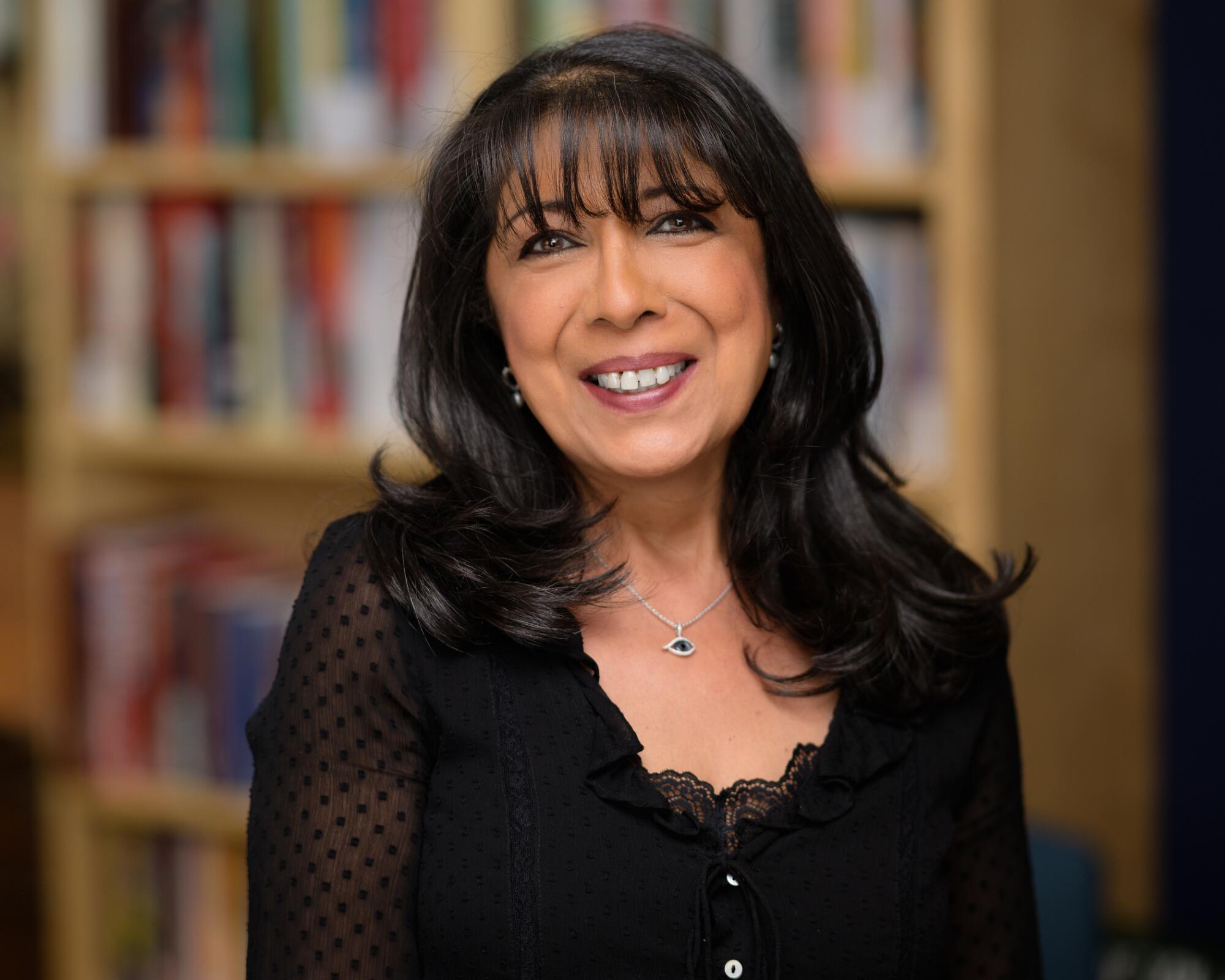
That wraps up our Savita Kalhan interview. If you changed your name to get past a teacher’s register, now might be the time to change it back, ideally before the gargoyles notice.
Keep reading on Ginger Nuts of Horror
 YA and Middle Grade Horror March & April 2026: The Best New Scary Books for Teens
 The 2025 YA Bram Stoker Award Preliminary Ballot: Every Book Ranked and Reviewed
 YA Science Fiction Horror Books: Top Picks for Teens
About Ginger Nuts of Horror
Ginger Nuts of Horror is an independent horror review and culture site based in Edinburgh, Scotland. Edited by British Fantasy Award nominee Jim McLeod, it publishes horror book reviews, film reviews, author interviews, features and cover reveals. Ginger Nuts of Horror won Best Inclusive Film & Book Review Platform at the SME News UK Enterprise Awards 2026.