
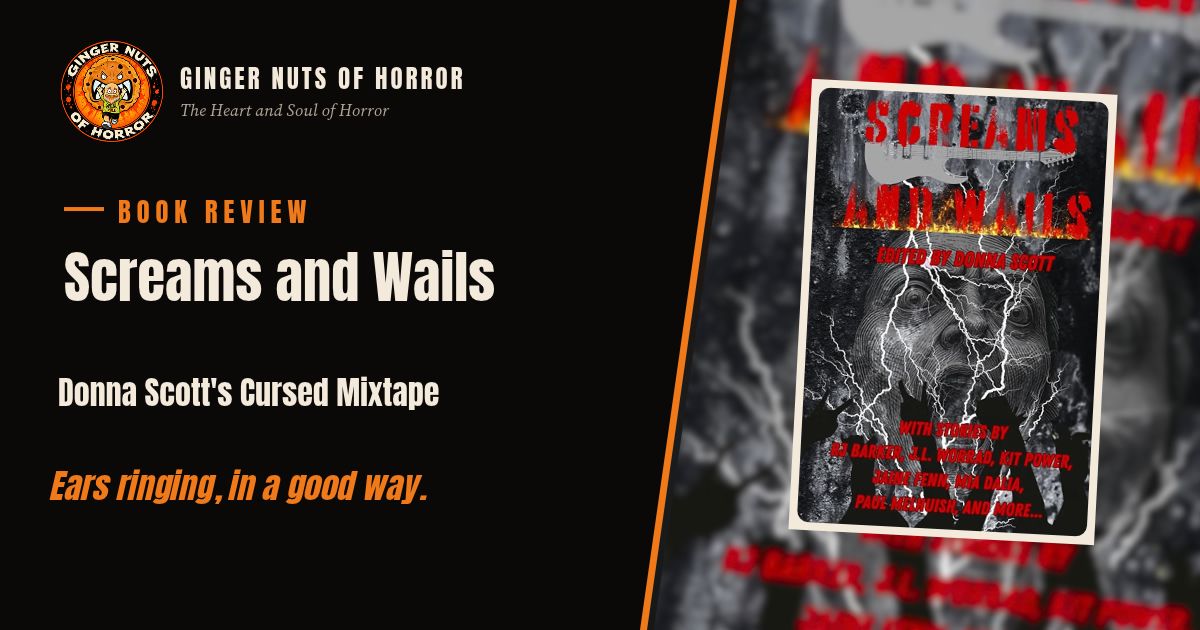
Screams and Wails | Donna Scott | The Slab Press | November 2026 |
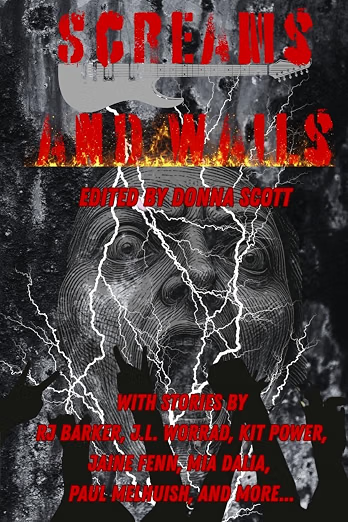
- Editor Donna Scott
- Publisher The Slab Press
- Published November 2026
- Pages 399
- Format Paperback, ebook
- ISBN 978-1-0669883-0-3
- Subgenre Music horror
- Reviewed by Jim McLeod
Eighteen original horror stories about the music that plays forever, the noise that will not stop and the price of being heard, from cursed records to ringing ears.
This Screams and Wails review looks at the new anthology edited by Donna Scott for The Slab Press. It gathers 18 original horror stories about music, from metal and emo to riot grrl, Bowie and dub. RJ Barker, Kit Power, Jaine Fenn and fifteen other writers each take a track. Some stories shout, some whisper, and a few leave your ears ringing. The book is sequenced with care and loaded with ideas, but it is also long, and a handful of its bargains with the devil start to blur together. Here is what the setlist gets right, and where it overstays its welcome.
Eighteen stories, one loud idea, and most of them land. Donna Scott sequences the book like a setlist, with Feedback and Orlando Road as the peaks. The fame-for-a-price bargain turns up too often and the back half runs long, but the best stories here leave a ringing in your ears.
Screams and Wails Review: A Mixtape With Teeth
A good gig ends twice. The first ending is the house lights coming up. The second comes on the walk home. The world sounds like it has been wrapped in a duvet, and you work out what the night has cost you. Donna Scott’s book lives in that second ending.
Scott has dressed the book as a record. There is a Track List instead of contents. There is an Intro, an Outro, and Sleeve Notes where the author bios sit. It starts as a small joke and turns into a real idea, because every story arrives as a track with its own volume, tempo and bad habits.
In her introduction she calls the book her mixtape, and she means it. She wants fans of metal and fans of horror in one room, with no pandering to the purists on either side. Her list runs from prog and doom to shock rock, punk and nu metal. It ends with a plea to keep small venues alive and to buy the music, not stream it for a fraction of a penny. It is a tidy manifesto. The stories mostly keep their side of the deal.
RJ Barker opens with the best idea in the book. In Feedback, a guitarist called Ricky is soundchecking in London in 1990. His band, The Craven Souls, is supporting a bigger act, and a high, whining shriek keeps wrecking the sound. The engineer explains it calmly. Feedback is a loop, and you stop a loop by shutting down every source.
Barker then builds the whole story as a loop. Present day Rick lives with his mother in a rented house. He works in a call centre and takes the same bus each morning. The band years keep cutting in. Each return wears the lines a little thinner. Barker is better known for fantasy, such as The Bone Ships, so this swerve into short horror is a welcome one.
J.L. Worrad’s Orlando Road is built as a song. Its sections are labelled Verse, Chorus, Bridge and Outro, and the form does real work. In the verses, a woman named Chloe visits an old friend at a streaming giant that owns everything you can hear or watch. She has come to say that the memory treatment has failed. It was meant to wipe out what a rock star did to her. In the choruses she is fourteen and calls herself Xen, dancing in her bedroom to the band she loves.
Screams and Wails Track by Track
Feedback by RJ Barker
A guitarist called Ricky is soundchecking in London in 1990, and a high shriek keeps wrecking the sound. The engineer says feedback is a loop, and Barker builds the whole story as one. Present day Rick lives with his mother and works in a call centre, while the band years keep cutting back in. The scenes repeat, a little thinner each time, and the same ordinary line about overcooked potatoes returns with its ending eaten by noise. It is a clever idea, and it works because the sadness is real. A band that never quite made it, and a man who never quite left.
Orlando Road by J.L. Worrad
Worrad writes the story as a song. It is split into Verse, Chorus, Bridge and Outro, and the form does real work. In the verses, a woman named Chloe visits an old friend at a streaming giant that owns everything we hear. In the choruses she is fourteen and dancing in her bedroom. The bridge is the part of the song she cannot remember, and Worrad lets that gap carry the dread. The satire of a firm that owns all our music hits harder for being so carefully built. The Outro is the best short stretch in the book.
The Judas Cradle by Kit Power
Kit Power has written My Life in Horror essays for this site for years, and his story begins with Mitchell, who has painted the mascot of the metal band Judas Cradle for twenty years. Now he is back in Barnstaple, two weeks late on a cover, and his touch has gone. A dream sends him back to a winter night in 1997 with his best friend Rachel on the town’s Tower Mound.
Power starts in midlife flatness and ends somewhere loud, rude and joyfully over the top. The sex and the carnage are both graphic. The tone swings from tender to gleeful, and the last line is a gag you will groan at and grin at. It is great fun if you like your metal with a sense of humour.
Stitched Lip Symphony by Tom Johnstone
The narrator is Matt, a guitarist and gardener who joined the riot grrl band Grendel’s Mother after their singer’s Alsatian bit him. The singer, Ms Begotten, has a body that does impossible things, and her father was a preacher who called her a monster. Johnstone cuts the memoir with lyrics, a nasty magazine review from 1993 and a blog report of the comeback gig. The review is full of slurs, and it is meant to be. The story is angry and funny, and Matt’s passive decency is the real target. His final decision is quiet and unsettling.
Summer Riff by Mia Dalia
Josh is fifteen. His mother has died, his father drinks, and they have moved to a neat suburb that feels like a trap. He sees a band called The Tytans at the May Fair and decides to learn guitar. His one friend is Noah, who wears hearing aids and loves the same band. A free guitar arrives from a basement full of cursed objects. Dalia is best on the house itself, with its cobwebs, its heat and its blaring TV. Grief is the real horror here, and the guitar only tilts it. The final page is brutal.
Psithurism by Caitlin Duffy
It is 2008, and the emo band Grave Mistakes goes into the woods to film a video. Kim writes the songs and loves the singer, Lucas. When they play, the forest plays the song back, and it is better than their version. Duffy cuts between Kim’s first person narration and transcripts from a TV chat show, where the band keeps getting paler and smilier. Trees start growing in apartments. It is folk horror with eyeliner, and the band-as-cult idea has a real bite. The title means the sound of wind in leaves.
Ashes to Ashes by Jaine Fenn
Mike is a BT engineer who has bought the Eventide Harmonizer used on Bowie’s Scary Monsters. He believes it traps the entity that made Bowie great. His brother Keith bullies him, and his late partner Charles is never far from his mind. Fenn gives Mike a rueful, funny voice, and her Bowie detail rings true. The summoning is practical and awkward, and what Mike asks of the demon is the story’s sharpest idea. It is a quiet apocalypse, with a turntable playing. Read it next to Scott’s introduction, which worries about streaming and AI.
Feeding the Beast by David Cartwright
Cartwright opens by calling music a predator. His narrator fronts a young band mixing kawaii with nu metal, and they have been signed in record time. They do not drink and they do not do drugs, which is the point. Their roadies are old hands who like to talk about the business, and one of them keeps looking at fans in the wrong way. The sleaze arrives with the price of fame, and the final third is as bloody as anything in the book. It is the anthology’s plainest version of the old bargain, told at the pace of a horror film.
Dani Gets a Backstage Pass by Tiffani Angus
Dani is dead. She is queuing with other dead teenagers to watch Bal Starling play the same songs for ever. Her best friend Lila is still alive, and Dani has been sent back to talk her out of following. Angus moves between the afterlife theatre, a bus stop in eighth grade and a bedroom, and it is tender work. The fan devotion that comforts the dead also holds them. It is a gentle ghost story about suicide and self-harm, with real warmth in it. It may be the most humane story in the book.
Siren, or Killing Hamish by Teika Marija Smits
Soraya follows her guitarist lover Hamish around the world. She hates him and she carries a kitchen knife. Every time she nears the point of leaving, he plays, and the music melts her resolve. Smits opens with an epigraph on sirens in Greek art, then runs a cold, sharp story about a muse who wants to be a star. The plan Soraya hatches is not the one you expect, and her motives are less noble than she believes. The last scene is bitter and exact. It is a sly reversal of the “talented man and his muse” story.
Lost In Music by Andrew Hook
A mediocre Midlands metal band is told to cover Sister Sledge for a hit. They are sent to a Cotswolds barn to record with a well-known producer, Eva Lubchinsky. By night she drives them to their best playing. By morning she wipes the tapes and mixes the songs into dub. The explanation, when it comes, is a dybbuk, and the cure involves ram’s horns in the boot of a Vauxhall Viva. Hook’s dry British comedy is the funniest in the book. The narrator’s regret is real, and the last line has a very good dub joke.
Tip of the Tongue by Robert Bagnall
Joe is an ageing rock star who wakes in a private hospital after an overdose. His manager chirps about cruise ships. Joe wants only to hear the song he half-remembers from Hamburg, when a woman in a vermilion dress told him the Devil has the best tunes. Bagnall stays in one room and one head, and it is the tightest story in the book. The voice is bitter, funny and hungry. It is also about a man who thinks only death will let him hear the music. The final request sounds small, and it is not.
Shadowplay by Paul Crosby
Ravi and Lydia are hunting the alley on the cover of Brian Xenon’s last album, using a phone photo and Ravi’s dad’s old A-Z of London. Crosby gives them banter you would believe, and the geeky detail has real fun with record collectors. The photo shows a blurred figure leaping. The alley will not fit the picture. When they try to recreate the shot, it goes wrong. This is a found-photograph ghost story, and the maths of the angle is its best trick. The ending is short, and it leaves Lydia alone with the screen.
She Sings Your Doom by Kev Rooney
Erika Stein looks mid-twenties and is far older. She is on a UK tour in a £1,500 van with a pushy manager and a “content creator” she did not ask for. Rooney cuts between this and a prehistoric family around a fire, where a Traveller sings to keep a sound like sliding shale at bay. That sound runs through the whole story. It is the longest piece in the book at 38 pages, and it earns most of them. The final stretch is the most graphic in the anthology. The close is horrible, and the last word is an order.
The Immortal Roadie by CJ Hooper
Abel Jones is a Bermondsey lad who made a deal in a theatre dressing room in the 1920s. He would carry for a jazz singer, and listen to her for ever. A century later he has carried for rock gods, and watched them die in his arms. The voice is warm and a bit weary, like a story told at a bar. When a clean-living young songwriter turns up, Abel has something to lose. The King of the deal is a good villain, and the ending is gentle and sad. It is a love letter to the people who carry the amps.
The Pale Gospel by Benedict J Jones
Two friends flick through charity shop crates and find a test pressing with no label. The sound of fingers on cardboard opens the story and returns to close it. When Andy plays the record, something goes wrong, and his friend Will follows the trail back to the band that made it. This is the book’s most traditional piece, a cursed record passed from hand to hand. It is also very gory. The structure is neat, and the cruelty of the loop is what stays with you.
State of Sin by Gregory Lawrence
The narrator is a sheltered student from a theocratic “Free-State Federation of God-Fearing Peoples”, now at a women’s university in New Deserette. Her friends take her on a city bus to a “thing” downtown. Lawrence gives her an earnest, old-fashioned voice, full of “gosh” and “no siree”, and lets her mistake a metal gig for a church service. The mosh pit, the wall of death and the “pit” in the floor all get a theological gloss. It is broad satire of both religion and gig culture. The last scene is a communion, and it is chilling.
It Took the Night to Believe by Paul Melhuish
World peace breaks out in a week. Wars end, the World Cup is cancelled, and the pubs serve only tap water. The narrator, a software rep with a hangover, realises everyone around him has been taken over, and giant chrome mushrooms are growing in the fields. Melhuish plays it for laughs, and it is the lightest story in the book. What saves the world is a CD of drone metal and a ghetto blaster. The opening pages name real leaders, so it may date faster than its neighbours. It closes the record with a wink.
Is Screams and Wails Scary?
Mostly it is unsettling rather than frightening, which suits music. The best dread here is quiet. It is the creeping loss of hearing in Feedback and the memory you cannot reach in Orlando Road. Some stories do go loud, though. She Sings Your Doom is the longest in the book, and its final stretch has earned a place on the splatter shelf. A few others play for dark laughs, and the closer leaves the room on a shrug and a wink.
How Screams and Wails Compares to Other Music Horror Anthologies
A themed anthology lives or dies on variety. Women of the Weird West, which we reviewed this summer, packs in twenty-five women-led tales of frontier folklore. Screams and Wails gets its variety another way. It has 18 stories and a theme loose enough to hold them all. Music and horror have shared a tour bus for a long time. Rock & Roll Nightmares, edited by Staci Layne Wilson, filled three volumes with stories titled after classic songs. Axes of Evil and Heavy Metal Nightmares aim squarely at the metalhead. Dethfest Confessions pins every story to one fictional festival. Scott’s book has no such fence.
Its bands are mostly invented. Its settings roam from a Barnstaple hotel to a motorway services. Its taste runs from Bowie to emo to dub. That makes it feel less like a genre exercise and more like somebody’s real record collection.
On the novel side, Zachary Ashford’s Polyphemus argued that life in a band is horrifying before anything supernatural turns up. Scott’s best stories take the same view, then add the supernatural anyway.
Scott’s own track record helps. Her press already has Hiding Under the Leaves (review to follow), Vivid Worlds, Laughs in Space and Dark Horses on its shelf. She also edits the Best of British Science Fiction series for NewCon Press. You can feel that experience in the running order. It swings between tones without ever stalling on one.
Read it first. Then go and stand in a sweaty room with strangers and a wall of amps, and wear the earplugs. Feedback will tell you why.
The Verdict: Is Screams and Wails Worth Reading?
4.5out of 5
The verdict
A loud, inventive anthology whose best stories stay in your ears, and whose few repeated chords barely dent the record.
Read it if: you like your horror with a soundtrack, from metal and emo to riot grrl and Bowie, and enjoy an anthology that swings between tones.
Skip it if: you want straight-down-the-middle heavy metal gore, or an anthology that keeps one steady mood from start to finish.
Content warnings: abuse, addiction, suicide and self-harm, domestic violence, bullying, graphic violence and gore, sexual content, grief.

Keep reading on Ginger Nuts of Horror
 Women of the Weird West, edited by KC Grifant: The Frontier Reclaimed
 Polyphemus by Zachary Ashford
 With Blood Upon His Teeth by Adam McOmber Review: The House That Hunger Built
About Ginger Nuts of Horror
Ginger Nuts of Horror is an independent horror review and culture site based in Edinburgh, Scotland. Edited by British Fantasy Award nominee Jim McLeod, it publishes horror book reviews, film reviews, author interviews, features and cover reveals. Ginger Nuts of Horror won Best Inclusive Film & Book Review Platform at the SME News UK Enterprise Awards 2026.