
The night the dead walked, and the only defence was a story.
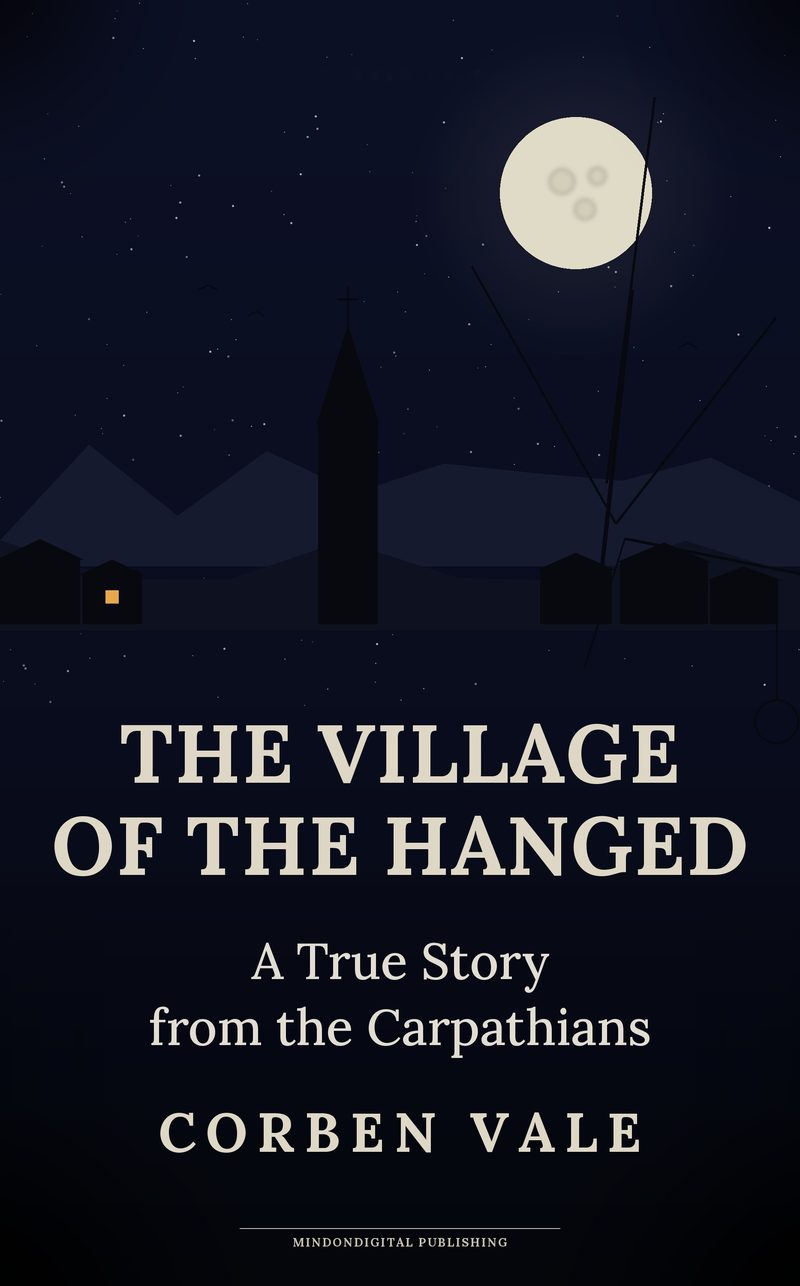
The Village of the Hanged | Corben Vale | MindOnDigital Publishing | 15 October 2026 |
- Author Corben Vale
- Publisher MindOnDigital Publishing
- Publishes 15 October 2026
- Format Ebook
- ISBN 9783693500545
- Series The Carpathian Chronicles, Book 1
- Subgenre Folk horror
A man falls for Lena, a Romanian woman, and follows her to a Carpathian village the locals call the village of the hanged, where strange events lead him to a curse more than a century old.
St Andrew’s Eve falls on 29 November, and in Romanian folklore it is the night the strigoi begin to walk. Garlic goes on the window panes. The wolf goes unnamed. Nothing is lent out of the house. Corben Vale writes the Carpathian Chronicles, horror novels grounded in that belief, and he travels every year to his wife’s home village in Romania. In this guest feature for Ginger Nuts of Horror, he turns to the one rule of the night that most accounts leave out. It sits well beside our other horror features on folk belief, but it asks a sharper question. Why, on this one night, was the best defence against the dead a story?
Of all the defences on St Andrew’s Eve, only one works on the people rather than on the dark. Storytelling keeps nothing out. It keeps a household awake, lit and together until the cock crows, and that may be the oldest written account of what horror is for.
The Night You Had to Keep Talking
St Andrew’s Eve in the Carpathians, and the defence that was a story
There is a line in the ethnographic record on Romanian vampire belief that ought to be better known among people who write horror. It concerns the night of 29 November, and it does not recommend a stake, a crucifix or a priest. It recommends that you stay awake and tell stories.
Agnes Murgoci collected it for Folklore in 1926, among a great deal of material about what the dead were thought to do on that night. Her phrasing is plain to the point of flatness: “If you are telling stories, vampires cannot approach.”
Not prayer. Not silence. Narration.
The night in question
The Romanian farming calendar does not begin winter on the solstice. It begins it at cap de iarnă — the head of winter — and that falls on St Andrew’s Day, 30 November. From that point the nights are long enough that whatever moves in them no longer has to wait for morning.
Andrew himself is not an incidental saint here. Tradition has him preaching in Dobruja, on the Black Sea coast; he counts as the apostle of the Romanians, and since 2012 his feast has been a public holiday. In folk belief he picked up duties no church ever assigned him. He keeps the boundary between the house and whatever is outside it. He is also, quite separately, the lord of the wolves.
On his eve, the records agree more than records usually do: the strigoi begin to walk.
What was expected to be out there
The strigoi is the returning dead — the corpse that will not stay where it was put. But the belief has a second and stranger half. The strigoi vii, the living strigoi, are people alive and asleep in their own beds whose souls leave the body at night without their knowledge. They are not villains. They are usually not even aware of it.
Both kinds were thought to meet at the hotar, the field boundary, where they settled whatever there was to settle among themselves. Murgoci records that the women among them left the house by the chimney — women who had just given birth included — and came back worn out and in rags.
Consider what that means inside a village. Some of the people at the boundary were your neighbours, and they did not know they had been there. In the morning nobody could be pointed at. The belief does not give you a monster to drive out of town. It gives you a room in which anyone, including you, might be implicated.
Anglophone horror has spent a century turning the strigoi into a vampire and losing this. The loss is not a small one.
The defences were cheap, and that is the point
Everything done against that night could be done by a household with no money at all.
You took a cut clove of garlic and drew a cross on the window panes. You rubbed the doorpost with it, and the latch, and the rim of the chimney — every place a thing could get in. You rubbed your own shoulders and chest. In the byre you rubbed the udders of the cows, because the milk was held to be the first thing to go.
Murgoci lists the same actions for St Andrew’s Eve and for St George’s Eve in spring: the two hinges the farming year turns on, one closing the dark half and one opening the light. What holds on the night of 23 April holds again on 30 November, in the other direction.
Then the prohibitions, and these are the same everywhere the custom was written down: no spinning, no sewing, no sweeping, and nothing lent out of the house. Whoever lent something that night was understood to have lent the protection with it.
The party inside the fear
Here is the detail that rarely survives the trip into English, and it is the one that changes the shape of the whole thing.
The same night has a custom called păzitul usturoiului — the guarding of the garlic. The girls of a village brought their garlic bulbs together, marked with coloured thread so each knew her own, and laid them in one room. An older woman sat watch over them until morning.
Next door there was food: pumpkin, unleavened cakes, beetroot pies, forest mushrooms, wine. Later the young men arrived and there was dancing. In the morning each girl took her own garlic home again, and for the rest of the year it counted as medicine — against fever, against pain, against whatever could not be explained. The night it had been guarded had made it strong.
So the night the dead walk is also the night half the village sits up together and dances. Both things are true at once, and neither is a rationalisation of the other. Tell only the horror and you have told half of it.
The name you did not say
The wolves belong to the same night. On 30 November, it was said, the wolf can turn its neck — an animal that otherwise looks stiffly ahead becomes supple that day, and therefore dangerous.
So the name was not spoken. To say lup was to call it. If it had to be named at all, people said the one out there. In southern Moldavia and around Galați, where the belief is most densely recorded, a turta lupului, a wolf’s cake, was baked and put outside the house.
There is a whole theory of language buried in that. The word is not a label for the thing. The word is a way of reaching the thing, and the reaching goes both directions.
Why the storytelling rule is the good one
Back to Murgoci’s line. Everything else in the night’s repertoire is apotropaic in the ordinary sense: a substance, a mark, a threshold, a prohibition. Garlic keeps the thing out. The unswept floor keeps the thing out.
Storytelling keeps nothing out. It has no material and no formula. What it does is guarantee that the household is awake, lit, talking, and together until the cock crows — that for one night nobody is alone in the dark and nobody drifts off into the state in which a soul is said to go wandering without its owner.
It is the only defence in the whole night that works on the people rather than on the dark.
Which is, if you want it, a complete account of what the genre is for. The oldest recorded professional advantage of the horror writer is not that we can frighten people. It is that people who are being told a story are demonstrably still here, still listening, and still in company — and that in at least one place, on at least one night of the year, somebody wrote that down as a survival technique.
A note for anyone reaching for this
Romanian St Andrew’s Eve now travels through the press as “the Romanian Halloween”. It isn’t. The comparison is a recent label; what the two share is a date near the edge of winter and nothing else. The garlic, the unnamed wolf, the guarded bulbs, the stories until dawn — none of that is Halloween furniture, and it does not need the borrowed costume.
Folk horror, at its best, is not about a creature. It is about a custom you are standing inside before you understand it. This night has more of that per hour than anything a screenwriter has yet invented, and it is all in the record, waiting.
On St Andrew’s Night: https://www.corbenvale.com/en/st-andrews-night-romania/
Sources: Agnes Murgoci, “The Vampire in Roumania”, Folklore 37 (1926); Tudor Pamfile, Sărbătorile la români (1914); the calendar-custom work of Ion Ghinoiu.
Get the book
The Village of the Hanged by Corben Vale, book one of the Carpathian Chronicles, is out as an ebook on 15 October 2026, alongside book two, Stafii.
So this St Andrew’s Eve, rub garlic on the latch, call the wolf the one out there, and on no account lend next door your hoover. Then keep talking until the cock crows. If you run dry, we have plenty of stories going spare.
Keep reading on Ginger Nuts of Horror
 The Vourdalak: A Darkly Comic Vampire Tale
 If You Loved Fawn by C.N. Vair, Read These 10 Folk Horror Books Next
 Modern Folk Horror Explored: Tony’s Top Tips

About Ginger Nuts of Horror
Ginger Nuts of Horror is an independent horror review and culture site based in Edinburgh, Scotland. Edited by British Fantasy Award nominee Jim McLeod, it publishes horror book reviews, film reviews, author interviews, features and cover reveals. Ginger Nuts of Horror won Best Inclusive Film & Book Review Platform at the SME News UK Enterprise Awards 2026.