- Philip Fracassi’s Gothic: The Horror of Wanting Too Much
- Sarafina by Philip Fracassi Review: Where Civil War Brutality Meets Body Horror
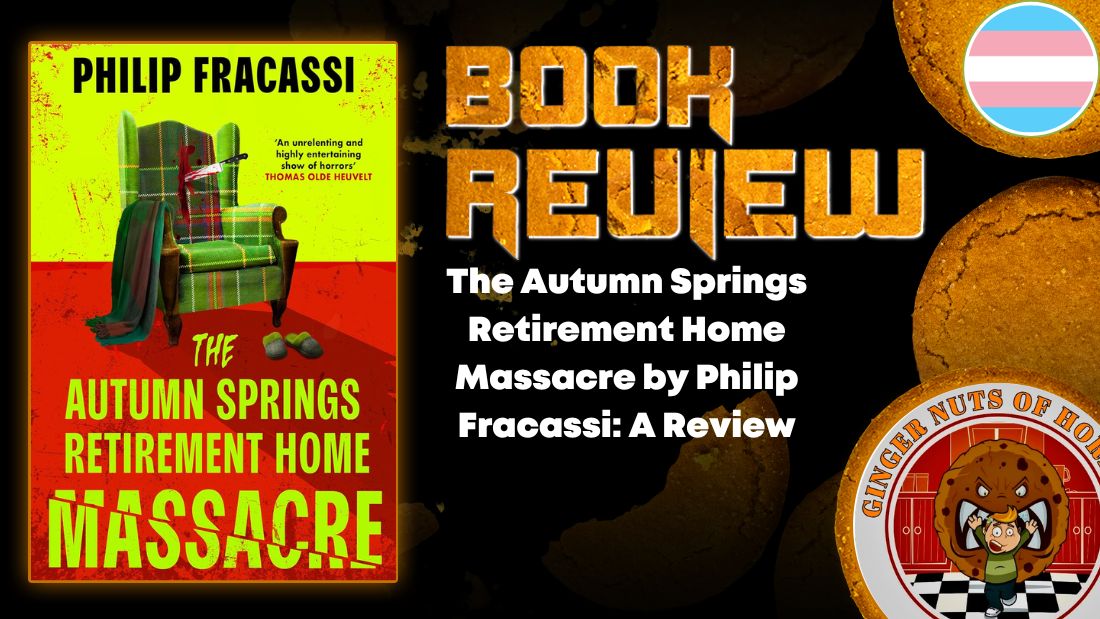
- The Autumn Springs Retirement Home Massacre by Philip Fracassi: A Review
- Boys in the Valley by Philip Fracassi
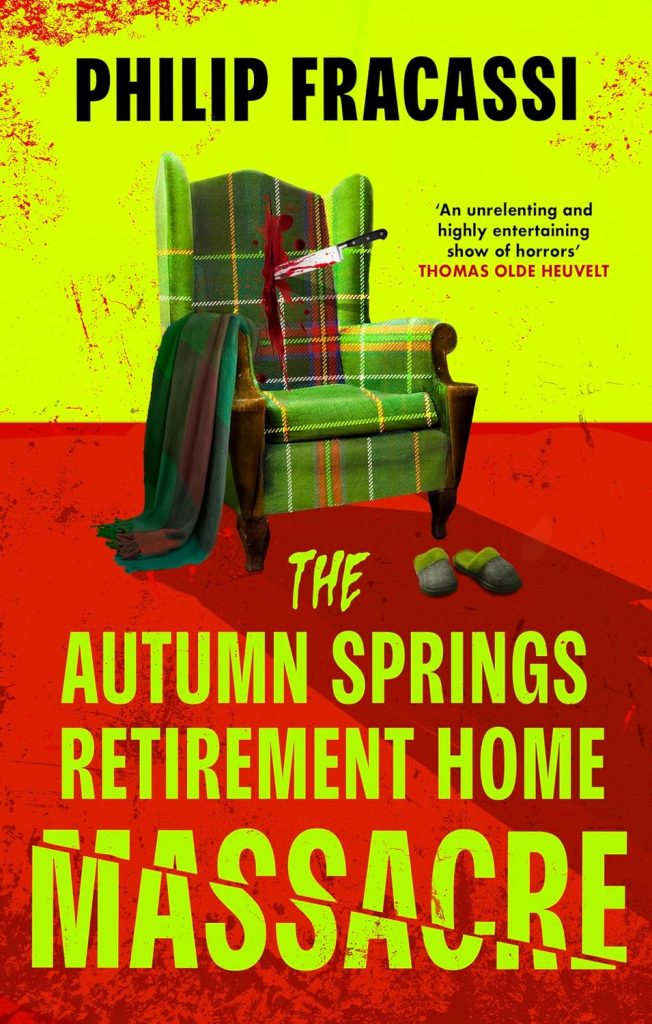
You have to wonder at what point a suspicious death stops being a byproduct of old age and starts being a statistic. The line is blurrier than you think, especially when you’re pushing eighty and living in a place specifically designed for people to quietly expire. looks at that blurry line, grins, and then proceeds to drag a bloody machete right through it. His latest, The Autumn Springs Retirement Home Massacre, takes the slasher genre, strips it of its spandex and teenage angst, and redresses it in cardigans and adult diapers. And here’s the thing. It works. It really, really works.
This isn’t just a gimmick. Fracassi isn’t here to mock the elderly. He’s here to arm them.
We meet Rose DuBois, our protagonist, not as she’s running from a maniac, but as she’s navigating the mundane indignities of communal living. She’s sharp, independent, and harboring a quiet trauma from a marriage that left more than just memories.
She has a suitor, the gentle and bookish Miller, whose affection she politely deflects. She has friends: a trio of sisters suspected of being witches, a film buff named Gopi, and Tatum Bird, a man lost to dementia who sits by the pond waiting for a dog that died a decade ago. Fracassi builds this world with the patience of a literary novelist. He introduces us to the rhythm of the home, the small politics, the way the residents cling to their agency. You get comfortable.
Then the falls start happening. Then the heart attacks.
One of the smartest choices Fracassi makes is in the killer’s methodology. Early on, the deaths look natural. An accident on the stairs. A bad reaction to medication. And because the victims are old, no one looks too hard. The administrators see paperwork. The overworked nurse sees a free bed. There’s a horrible, cynical logic to it that Fracassi uses to fuel the novel’s quiet rage. It’s a rage against a society that looks at the elderly and sees a problem to be managed rather than people to be cherished. The book asks a deeply uncomfortable question: if an old person is murdered, does anyone care enough to call it a crime?
Structurally, Fracassi is playing a slightly different game than usual. If you strip away the plot, you find a meditation on value. Who has it? Who decides? Rose and her friends are fighting for their lives, yes, but they’re also fighting for the right to be considered worth the effort. There’s a chapter late in the book where residents, sensing danger, try to call their children to come get them.
The excuses they get—the busy schedules, the lack of space, the polite refusals—are more brutal than any of the killer’s handiwork. It’s a moment of such profound, quiet sadness that it anchors the entire bloody spectacle in reality. You can compare this to something like Stephen King’s Gerald’s Game, which used a trapped woman to explore childhood trauma, or even something like John Ajvide Lindqvist’s Handling the Undead, which deals with the horror of the flesh failing. But Fracassi’s focus is less on the supernatural and more on the social. The real horror isn’t just the monster in the hallway; it’s the fact that no one hears the screams.
When the slasher elements finally take center stage, they hit hard. Fracassi has a background in screenwriting, and it shows in the set-pieces. The violence is sudden, physical, and mean. He doesn’t romanticize it. But because we’ve spent so much time with these people, every kill lands like a gut punch. We aren’t watching nameless teens get picked off; we’re watching beloved characters we’ve come to admire get snuffed out. It raises the stakes immeasurably.
If you’ve read Fracassi’s earlier work, like the stunning collection Behold the Void or the relentless Boys in the Valley, you know he has always had a knack for dropping ordinary people into extraordinary, often cosmic, hellscapes . His prose in those books was like watching someone paint with acid—corrosive, brilliant, and likely to leave a scar. Here, that voice has matured. The acid has cooled, but it hasn’t lost its potency.
It’s now a tool for etching fine details rather than just burning through the page. He’s traded some of the cosmic dread for a more terrestrial, human grief. The writing is cleaner, more direct. He lets the silence between the screams do the work. There’s a new confidence here, the feeling of a writer who knows he doesn’t have to prove how scary he can be, so he focuses on making us care first.
If I have a minor quibble—and it’s a small one—it’s that the book occasionally flirts with the idea of a supernatural explanation. A few chapters from the killer’s perspective are thrown in, and while they build tension, they lack the interiority of Rose’s sections. They feel like genre obligations rather than essential pieces of the puzzle. The killer, when revealed, is ultimately just a person. A broken, hateful person, but a person nonetheless. That’s scarier, honestly. Evil with a badge and a key card is far more terrifying than a ghost.
Reading this prose is like watching someone carve a detailed scene into a fine piece of wood with a whittling knife. At first, you just see the block—the retirement home, the premise. Then, with careful, deliberate strokes, the faces emerge. Rose’s stubborn chin. Miller’s worried eyes. Tatum’s vacant stare. And just when you’re admiring the craftsmanship, the artist snaps the blade and uses the jagged edge to tear the whole thing apart. The result is a mess of splinters and beauty.
The Autumn Springs Retirement Home Massacre isn’t just a horror novel. It’s a eulogy for the forgotten, a thriller for the invisible, and a slasher for anyone who’s ever feared that the world has stopped seeing them. Fracassi has written a book that bleeds from a place deeper than the jugular.
You don’t stop being a final girl just because you need a hip replacement. You become one because you refuse to stop fighting.
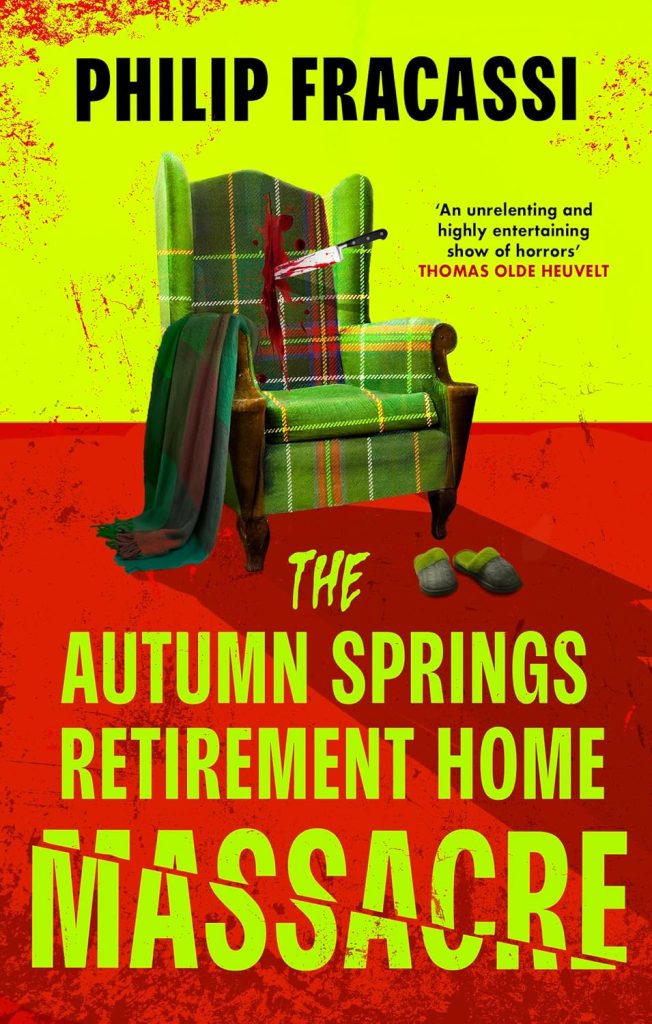
The Autumn Springs Retirement Home Massacre
‘DIABOLICALLY DELIGHTFUL‘ Tananarive Due, author of The Reformatory
‘OLD-SCHOOL HORROR’ Stephen King on Boys in the Valley
Burgeoning with dark humour, violence and mystery, The Autumn Springs Retirement Home Massacre is a blood-soaked slasher sure to keep readers flinching, laughing, and guessing until the very last page.
Rose DuBois is not your average final girl.
Rose is in her late 70s, living out her golden years at the Autumn Springs Retirement Home.
When one of her friends dies alone in her apartment, Rose isn’t too concerned. Accidents happen, especially at this age!
Then another resident drops dead. And another. With bodies stacking up, Rose can’t help but wonder: are these accidents? Old age? Or something far more sinister?
Together with her best friend Miller, Rose begins to investigate. The further she digs, the more convinced she becomes: there’s a killer on the loose at Autumn Springs, and if she isn’t careful, Rose may be their next victim.
‘Fracassi blends the true-life horror of aging and society’s scorn for the elderly with an original slasher premise and reimagined Final Girl. The question isn’t who will die at the Autumn Springs Retirement Home – but who will survive? Diabolically delightful‘ Tananarive Due, author of The Reformatory
‘Rose isn’t your average final girl. She’s a woman and a survivor who you’ll cheer for every step of the way in this smart, fast-paced slasher’ Erika T. Wurth, author of White Horse and The Haunting of Room 904
‘A wholly original slasher novel with a uniquely strong and vulnerable heroine…Fans of the genre should put this on their must-read list’ Christina Henry, author of Alice and The Place Where They Buried Your Heart
Horror Book Reviews: Ginger Nuts of Horror, Your Premier Horror Website for 17 Years
For every horror enthusiast searching for authoritative horror book reviews and a definitive horror website, your journey ends at Ginger Nuts of Horror. As a trusted pillar of the dark fiction community, we have spent over 17 years building a reputation for the most passionate, insightful, and credible coverage in the genre.
Our dedicated team of reviewers lives and breathes horror. Our collective expertise, forged over nearly two decades, ensures every review is a deep, critical analysis. We don’t just summarise plots; we dissect the terror, explore the thematic depths, and connect you with the very emotional core that makes horror books so compelling.
Why Ginger Nuts of Horror is the #1 Resource for Horror Fans
Unmatched Depth & Legacy in Horror Book
Reviews: With 17 years of reviewing horror, we offer an unparalleled perspective. Our reviews expertly guide you from mainstream bestsellers to under-the-radar indie gems, helping you find your perfect, terrifying read.
Exclusive Access to Horror Authors: Go behind the scenes with in-depth interviews that reveal the minds behind the madness. We connect you with both legendary and emerging horror authors, exploring their inspirations and creative processes.
Award-Nominated Authority & Community: Founded by Jim McLeod, Ginger Nuts of Horror has evolved from a passion project into an award-nominated, essential horror website. We are a global hub for readers who celebrate horror literature in all its forms, from classic ghost stories to the most cutting-edge dark fiction.
Experience the Difference of a Genre-Dedicated Team
What truly sets us apart is our dedicated team of reviewers. Their combined knowledge and authentic enthusiasm ensure that our coverage is both intelligent and infectious. We are committed to pushing the genre forward, consistently highlighting innovative and boundary-pushing work that defines the future of horror.
Ready to dive deeper?
For horror book reviews you can trust, a horror website that champions the genre, and a community that shares your passion, Ginger Nuts of Horror is your ultimate destination. Explore our vast archive today and discover why we’ve been the top choice for horror fans for over 17 years.