
A formidable, flawed epic of grief, war and the century’s raised dead.
The Rouse by China Miéville Review: A Vast, But Slightly Flawed Reveille
The Rouse is China Miéville’s new novel, and it is a monster. It runs to 1,264 pages. It took twenty years to write. It is his first solo novel in fourteen years. If you know Miéville from The City & The City, or from the Bas-Lag books, take a breath. This one is bigger and stranger than any of them. The story braids two lives. Maur Towns is a mother, and she has lost her soldier son. Stallo is an old soldier too, and he has a dark, private gift. He can raise the dead. The twentieth century has left him plenty to work with.
Their paths cross. The book becomes a family saga, a Cold War thriller and a ghost story, all at once, marched across the bloodiest years of the last century. It is wildly ambitious. It is deeply felt. It is unlike anything else you will read this year. It is also very long, and the ghosts are rationed. So is The Rouse worth the climb? In this review I weigh the grief, the war and the necromancy against the sheer size of the thing.
Miéville’s first solo novel in fourteen years is a formidable, grief-stricken feat of the weird, a ghost story that turns the twentieth century into one long battlefield. It circles and grinds where a sharper book would cut, and it will test your stamina. But the reader who keeps marching is handed something no one else alive could have built.
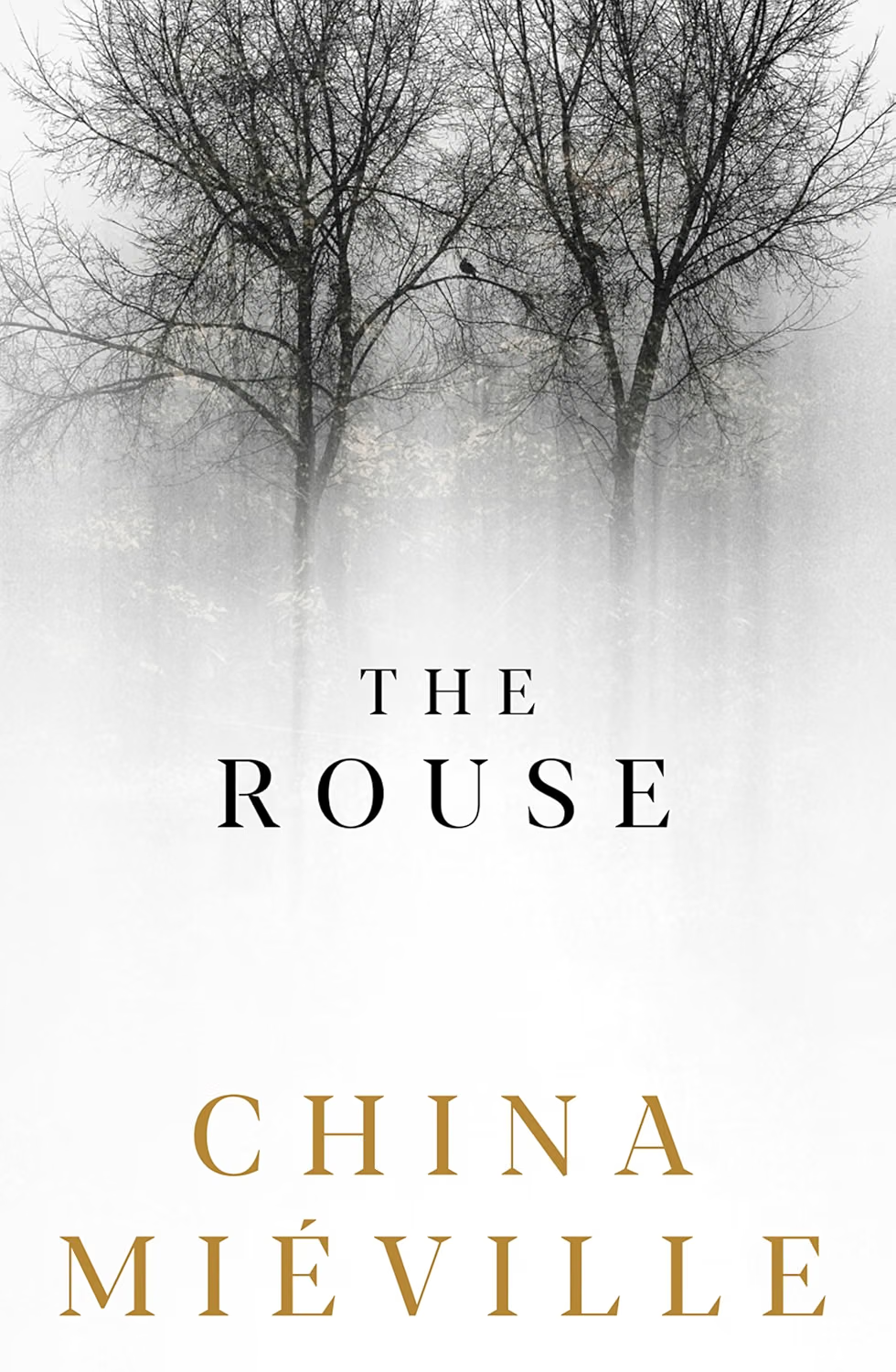
The Rouse | China Miéville:| Picador | 17 Sept. 2026
At the Cenotaph, once the two minutes of silence are done, a bugler lifts the horn and plays a second call. It is not the Last Post. That one puts the dead to bed. This one is shorter and brighter, three notes off a single line of brass, and it is meant to wake them. Soldiers knew it as the order to get up and get on with the day. After the First World War someone slid a quieter meaning underneath it, a promise that one day the living and the dead might rise together. Most of us have heard it a hundred times on a cold November morning and never once learned its name.
It is called the Rouse. China Miéville has spent twenty years building a novel around that idea, all 1,264 pages of it, and he has named the book after the bugle.
The setup is deceptively small. Maur Towns is a woman whose whole life bends around one loss. She was an art student in 1970s London, young and broke, a mother by accident and then a mother in full. Her son Ewan grows up quiet in a way that worries her, a boy who fills his sketchbooks with tanks and guns and aeroplanes and then, to her horror, enlists.
It does not end well. A grown child, a soldier, dead. That is the whole of it, and Miéville states it early with a flatness that lands like a slammed door. There was a person. She had a baby. The baby grew up. The baby died. Then the book spends a thousand pages refusing to let that be the end.
Because a second story runs braided through the first, and it belongs to a soldier called Allardyce, who later goes by Stallo. He is old, hard, and very good at killing. He can also do one thing no drill sergeant ever taught him. He can raise the dead. Not as a metaphor. As a trade. The century’s battlefields become his recruiting ground, and the men he brings back are the men nobody wanted to lose. Something is hunting him for it. Maur, chasing the truth about her boy, walks straight into his path.
For about the first hundred pages we sit with Maur alone. Then Miéville opens the second channel, and the book starts to alternate, Maur and Stallo, back and forth, in short chapters that change how they look as they change what they say. Different fonts. Different coloured pages. Dialogue set down without a single quotation mark, so you learn to feel the seam between speech and thought rather than see it. On paper it sounds like a gimmick. It reads, by all accounts, like a system, a way of making the page itself hold two kinds of time at once.
What Miéville is really writing here is a grief novel wearing the coat of a war novel wearing the coat of a ghost story. The grief comes first, and it is the truest thing in the book. Maur is not a symbol. She is a specific woman with a specific hole in her, and the early chapters hold that hole open without flinching, and without tipping over into misery for its own sake. That is a hard trick to keep up across a thousand pages. Where the book keeps its nerve, it is very good indeed.
The politics run underneath all of it, the way they always do with this writer. Stallo’s raised army is more than an eerie image. It is an argument about who the century used up and threw in a ditch, about the soldiers and the workers and the beaten left, the people history buried and then told to stay buried. The ghosts here are the defeated. Miéville has spent his whole career insisting that the dead have a claim on the living, and in this book he takes that idea, makes it literal, and marches it across the world in boots.
Take the decision to strip out the quotation marks, the kind of choice that makes a lot of readers groan on principle. Here it earns its keep. A ghost story lives on one question. What is real, and what is only heard? Whose voice was that? Did the dead speak, or did you just want them to? Pull out the little hooks that tell you speech from thought, and the reader is dropped into exactly Maur’s spot, straining to know who is talking and whether to believe it. The form carries the dread, so the plot does not have to keep announcing it. That is control, not showing off.
And that flat statement of the death, the one that reads like a door swinging shut on hope, is the whole book in miniature. It lays the loss down as final. Complete. Nothing left to say. Then it goes and says more for another 1,200 pages. The novel is shaped like the service it is named for. Last Post, then silence, then the Rouse, the call that will not let the dead simply lie there.
The prose is a strange animal. It is huge and curt at the same time, able to run a long sentence right across a decade and then land a three-word jab that stops you dead. Miéville has always loved a rare word, and the rare words are here, but they sit next to plain squaddie speech and army slang without a bump. The rhythm is a route march. Left, right, steady, the same footfall landing in the same place on purpose, until the repetition stops feeling like a fault and starts to feel like the point, the way a drumbeat is the point.
It helps to know where this sits in the career. Miéville turned up at the start of the century as the loud new engine of the New Weird. The Bas-Lag books came first, Perdido Street Station in 2000, then The Scar and Iron Council, vast invented cities dripping with biology and revolt. He won just about everything worth winning with The City & The City in 2009, a detective story about two towns sharing one map and the trained habit of not-seeing.
Then Kraken, then Embassytown, then Railsea in 2012. And after that, for the length of a whole childhood, no solo novel at all. There were novellas. There was a stack of non-fiction, a history of the Russian Revolution, a book-length row with the Communist Manifesto. There was the odd, fun swerve of writing a novel with Keanu Reeves. Fourteen years is a long silence for a man people once called prolific. The Rouse is what the silence was for.
Where does it sit on the shelf? Somewhere between the doorstop historical fantasy of Susanna Clarke’s Jonathan Strange & Mr Norrell and the braided, time-hopping strangeness of David Mitchell at his most ambitious, with the cold English dread of Hilary Mantel’s Beyond Black threaded through the middle. The nearest cousin in spirit is M. John Harrison, Miéville’s old fellow-traveller in the weird, another writer who treats genre as a thing to prise open rather than tick off. The Rouse is not out to send up the ghost story. It wants to take the ghost story seriously enough to make it bear the weight of an entire century. That is a bolder move, and a riskier one.
The theme that lingers is the one the title keeps ringing. Can the dead be roused, and should they be? Lincoln in the Bardo put its ghosts in a graveyard and let them natter because they did not know they were gone. This book puts its ghosts in uniform, and they know exactly what they are, which is the century’s unpaid bill. Grief here is not a private matter. It is historical. Every family loss sits on top of a mass grave, and Miéville will not let you keep the two apart.
Somewhere inside these 1,264 pages there is a devastating 800-page novel trying to get its boots on. The supernatural, too, is rationed harder than a lot of readers will want. Come for the necromancy and you will spend long stretches waiting out in the cold for it. Miéville cut this down from something far larger, and you can admire the discipline while still wishing the knife had gone in a little deeper. Endurance is part of the deal here. Go in knowing that.
None of it sinks the book. Twenty years is an absurd slice of a life to pour into one book. On the evidence, Miéville knew that, and did it anyway, and what he has made is flawed and enormous and unlike anything else you will pick up this year. It will wake you at three in the morning and keep you up. That, in the end, is what a rouse is for. Clear your autumn.
At 1,264 pages, The Rouse is less a novel than a piece of home gym equipment. China Miéville spent twenty years on it, and you will spend a fair slice of autumn carrying it about like kit on a route march. Worth the effort.
The Rouse by China Miéville
‘Completely without parallel’ – Michael Moorcock, author of The Dancers at the End of Time
‘A magisterial wonder’ – Paul Tremblay, author of The Cabin at the End of the World
‘An extraordinary tour de force’ – Adrian Tchaikovsky, author of Children of Time
‘Every page feels alive’ – Xiaolu Guo, author of Call Me Ishmaelle
‘A monster of a book in every sense’ – Francis Spufford, author of Golden Hill
From the bestselling, award-winning master of uncanny fiction comes a defining work, twenty years in the making – a deeply moving, decade- and continent-spanning epic of grief, global tumult, and grim conspiracy.
Maur’s life has been shaped by an unbearable loss. But in the aftermath of what is an apparently ordinary tragedy, deeper, stranger questions arise . . . Their answers may lie within the dark heart and darker history of an old soldier who shares Maur’s obsessions – and is violently pursued by the same unknown, unquiet forces.
So begins The Rouse, a masterpiece unlike any other: at once a sprawling saga of the bloody twentieth century, and the intimate story of two lives, their loves, regrets and secrets – and a terrifying journey into infinite mystery.
Praise for China Miéville, The Rouse:
‘[An] incredibly ambitious combination of history and the supernatural . . . fans will not be disappointed’ – Publishers Weekly
‘Miéville has been allowed full, free rein in this new work of eldritch dead and haunting dread’ – Booklist
‘A smartly imagined, genre-bending story that readers may find all too real’ – Kirkus Reviews
‘Miéville is back . . . you never want it to end: you want it never to end’ – Boston Review
Jim "The Don" McLeod has been reading horror for over 35 years and reviewing it for more than 16. He's the editor of Ginger Nuts of Horror, Europe's largest independent horror review and culture site, and a British Fantasy Award nominee for his work in the genre. When he's not busy inflicting his opinions on the horror community, he can be found annoying his family or getting thoroughly outwitted by his two dogs, Casper and Molly.
Ginger Nuts of Horror: The Heart and Soul of Horror Reviews
Every feature is built to sell your work. We include backlinks to your website or Amazon author page, a full synopsis, and a universal purchasing link that sends readers straight to their local store. Add a large, engaged social following and an 18-year archive of trusted horror coverage, and you have a platform genuinely built to grow your readership.
Whether you’re an established author, an indie filmmaker, or a debut voice in indie horror, there’s a way for us to help you reach more fans. Explore our horror book reviews and horror movie reviews, then get your horror book or film featured today.