
- Author Gareth Wood
- Publisher Stairwell Books
- Published 15 June 2026
- Format Paperback
- ISBN 978-1-917334-30-3
- Subgenre Urban folk horror
- Reviewed by Jim McLeod
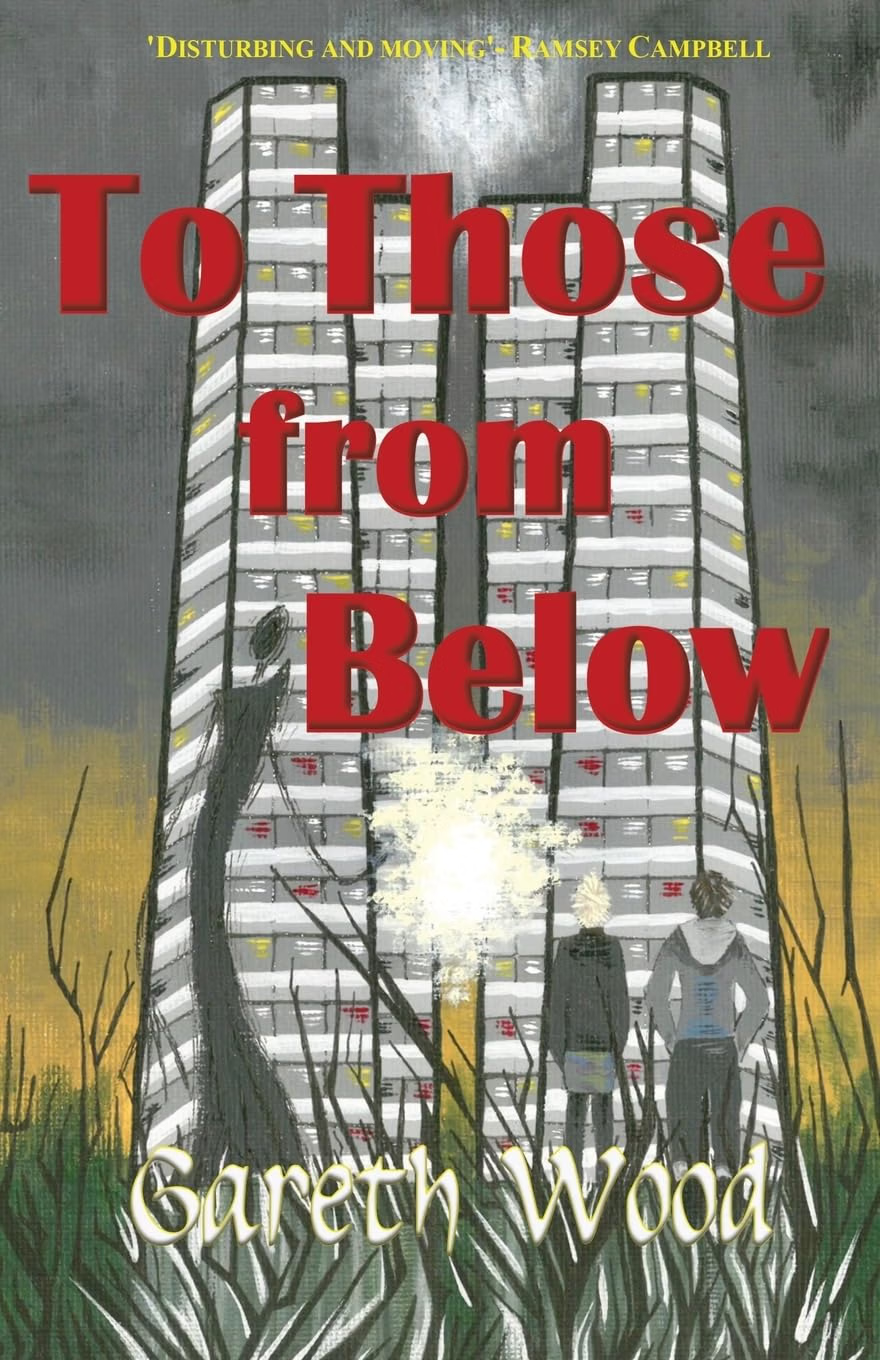
In 1995 a bookish schoolboy and a punk girl swap monster stories about a Birmingham tower estate. Twenty years on, one of them needs the other to keep a promise and go back inside.
This To Those from Below review looks at Gareth Wood’s new novel from Stairwell Books, a working-class horror story set on a Birmingham estate that the council has already given up on. Mick and Liz meet at school in 1995, when she shows him a diary full of monsters. Twenty years later she asks him to keep an old promise. I found a book with a loud voice, creatures that deserve their own fan club and a surprising amount of tenderness underneath. It has flaws, and I will name them, because the score needs earning. Few horror novels feel this rooted in a place, and here is why it lands at four and a half stars.
Wood turns a doomed Birmingham estate into a creature feature with a conscience, and the monsters are the best thing in it. Mick’s swearing, simile-stacked narration sometimes piles on, and one long speech slows the middle, but the heart under all that grime is real.
— GINGER NUTS OF HORROR
To Those from Below Review: Four Towers and One Appetite
A tower block doesn’t empty overnight. First the lifts break. Then the repairs stop coming. Then anyone who can leave does. Whoever stays becomes a story other people tell about the estate, usually with a shudder and a locked car door.
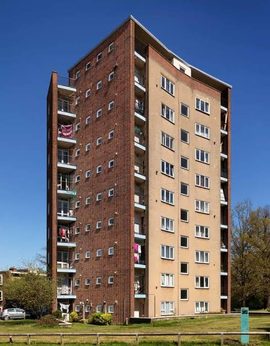
Wood’s novel begins at the far end of that process. The four towers of Wallows Heath are fenced off and marked for demolition. Mick, who tells the story, has decided the place isn’t finished with him. He writes it all down while his pens last, and he opens with an apology to Liz.
Then the book rewinds to two fourteen-year-olds. Mick is the bookish, bullied boy from the cul-de-sacs who landed at Rookwood High, the school his parents dreaded. Liz is a mixed-race punk in an oversized biker jacket who reads Fangoria by the smokers’ wall. Her mother, Wilma Pennyfeather, keeps a diary of the things said to live on the Wallows estate.
Mick calls secondary school an abattoir, and the first stretch of the book earns the comparison. It is funny, filthy and cruel about being a teenager. It also sets up the novel’s real argument early. A place can become a bogeyman long before anything supernatural turns up. Mick’s parents treat the estate as a warning to their own son, a living example of how badly life can go. When the monsters finally arrive, they find the ground already prepared.
That argument gets sharper when Wood turns to Wilma. She came to Britain as a toddler from St Kitts, part of the tail end of the Windrush generation, and Mick reads her diary partly through that history. The towers went up on top of older streets, and the people who lived there were simply moved into them. Nobody asked what had been sitting under the old ground. Wood never lectures about housing policy. He lets the layout of the estate make the point for him.
And what monsters. Wood gives them names a child would whisper at the back of a bus. The Lantern Man. The Shambling Granddad. Moss Jack, Beryl Twilight, Slug Nan Tubby, Norris Teeth, the Leech-lipped Lovers of the Old Arcade. Then he gives them bodies no child would have invented. Moss Jack turns up with a head like a poisoned garden and a mouth of rusted teeth.
The diary itself is a fine object. Its pages are yellowed and ripped at the edges. The biro fades, and the lettering shrinks down the page until it is almost impossible to read. Liz keeps it close and rarely turns it round, so Mick only glimpses the rough sketches of the creatures. He never meets Wilma in the usual way, yet he says that thumbing through her notes felt more personal than any meeting. That is smart. The monsters reach us as hand-me-down stories first, scribbled by a tired woman, and only later as things with teeth.
Take the diary entry on Uncle Rat Jacket. Liz reads it aloud on the common while Mick watches the bracken behind them. At first it describes a stocky bloke in a polished biker jacket, with long hair and thin legs, loitering on the benches behind North Tower. Then the jacket moves. The leather is a heap of fat black rats, bound together by their own gristle. The legs are bone stilts. The face folds back into a box of snapping teeth.
That is a good monster on its own. What lifts it is one small detail: it plays drunk. It hangs about where a drunk would hang about, hoping someone will take it for an easy mark. The creature has learned what outsiders think of the estate and turned it into bait.
Wood closes the entry with the estate as a belly that is never full, one that “rumbles in sirens and screams.” To my ear, that is the whole book in a sentence. Sirens are the soundtrack of a neighbourhood the authorities only notice when something goes wrong. Here the sound of neglect becomes the sound of being eaten.
The voice carries all of it, and it will not suit everyone. Mick narrates in a rush of swearing, similes and self-disgust. It is a lot. His insomnia arrives as “a head full of hammers and maggots” and a heart “beating like bad jazz.” Reading Wood’s prose is like pulling a supermarket trolley out of the brook on the common. It is bent, rusted and loaded with everything anyone has chucked in it, and somehow it is still the thing you want to push down the road. It is not subtle. It is alive.
The framing helps. Mick writes from a bad place, sleepless for days, drawn night after night to a landfill site where lorries queue to tip yesterday’s belongings into a quarry. He starts to feel like litter waiting its turn. That image is doing quiet work. A book about people who get thrown away begins with a narrator watching the bins, and it never lets you forget what the estate has been treated as.
Humour keeps the dread honest. When Mick and Liz gear up to go back, he packs a carving knife and a bread knife, and Liz points out that the bread knife will take a while to get through anything. It is a small joke, and it tells you that these two have known each other for a very long time. Liz is the book’s best creation. She is fierce, funny and stubborn, and she fights whatever the odds. When Wood lets her talk, the novel sparks.
Is To Those from Below Scary?
Yes, though it frightens through accumulation more than through jolts. Wood loves a long dark approach: the underpasses, the stairwells, the lifts that smell of meat gone bad, the sense that the estate is listening. When a creature does show up, the book doesn’t flinch from the detail. There is real gore here, and some of it is cruel.
The bleakest passages are the ordinary ones, though. A mother who stops getting dressed. Parents who decide a school place has ruined their son’s future. A council that leaves a brook full of dead cats and trolleys and calls it green space. Those scenes are why the monsters feel as if they belong there.
The three-part structure helps too. Each part has its own title, from the funeral flowers of the first to the damned family of the last, and each one narrows the world a little further. By the final stretch the book has stopped being about a place and become about two people in the dark.
My one real quarrel is with the prose habits that pull against the pacing. Wood stacks images. Where one simile would land, three arrive. The swearing is so constant that it sometimes flattens its own effect. The middle of the book shows it most.
Bhu, a man who has made a home in one of the emptied towers, gets a long speech explaining what the place is and what lives beneath it. The book notices the performance itself, describing Bhu as if a single spotlight had found him. It is a strong idea. It comes as a lecture, though, and the story stops to hear it. Some nights in the towers also rhyme too closely with one another.
I would have trimmed the middle without losing anything that matters. That is a real limit, though a modest one. It never turns the book from a recommendation into a hedge.
Where Gareth Wood Fits in British Urban Horror
Wood doesn’t hide his influences. Mick himself names Clive Barker’s Cabal and Ramsey Campbell’s Ancient Images as the books that blew his young mind, the ones full of folkloric monsters and underworlds of old passages. Campbell has endorsed this novel, and so has Catherine Cavendish, so the lineage is acknowledged from both directions.
What Wood adds is the postcode. Adam Nevill’s working-class chillers, Cunning Folk and The Vessel among them, bring old horrors into ordinary households. Glen James Brown’s Ironopolis finds the urban wyrd in estate life. Wood’s estate is the source of the horror, and the class system that built it keeps coming up.
If you enjoyed the British texture of Dan Coxon’s Come Sing for the Harrowing, this belongs on the same shelf, with more swearing and more rats. You can find more of that sort of thing in our horror book reviews.
His previous Stairwell novel, At Night, White Bracken, planted folk horror on a run-down estate. In the acknowledgements here, Wood says he expected this follow-up to push the loneliness and alienation of that book further, perhaps towards something nihilistic. He found love at the centre instead. I believe him, because the best pages are the ones between Mick and Liz.
That is the real surprise. Under the rats and the rust, this is a friendship story. Mick has carried a childhood failure for twenty years. The book cares as much about whether that can be forgiven as it does about whether the monsters can be stopped.
Mild spoiler ahead, because the next line gives away what the book thinks the creatures are. Liz explains it early in their return to the estate:
Maybe the world makes monsters from the people it forgets the fastest.
It is the most useful line in the novel. It turns the creatures from threats into casualties. It makes every empty flat in those towers feel like a grave that nobody has marked. Wood says in his afterword that he wrote much of the book through a year of loss, and that love belongs in horror as much as in kisses. The book is gentler with its ghosts than the swearing suggests.
The towers will come down eventually. Wood makes sure you know what won’t.
The Verdict: Is To Those from Below Worth Reading?
4.5out of 5
The verdict
A fierce, filthy and surprisingly tender urban horror whose monsters outshine its occasional excess.
Read it if: you like British folk horror with council-estate grit, inventive creatures and characters you end up caring about.
Skip it if: constant swearing, stacked similes and long stretches of dread without release wear you out, or you want a lean, restrained read.
Content warnings: gore and body horror, violence including violence against children, child disappearance, suicide, bereavement, bullying, racism and racist language, police violence, institutionalisation, drug use, sexual references, animal death, strong language throughout.

Keep reading on Ginger Nuts of Horror
 Gorse by Sam K. Horton Review: Where the Old Gods Grow Through Stone
 Home Sick by Rhiannon Grist Review: Folk Horror That Gets Under Your Skin
 We Call Them Witches by India-Rose Bower: You Will Never Look at Anything the Same Way After This Novel
About Ginger Nuts of Horror
Ginger Nuts of Horror is an independent horror review and culture site based in Edinburgh, Scotland. Edited by British Fantasy Award nominee Jim McLeod, it publishes horror book reviews, film reviews, author interviews, features and cover reveals. Ginger Nuts of Horror won Best Inclusive Film & Book Review Platform at the SME News UK Enterprise Awards 2026.