Mathilda Zeller on It Looks Like You in the Dark: Borrowed Faces | Interview |
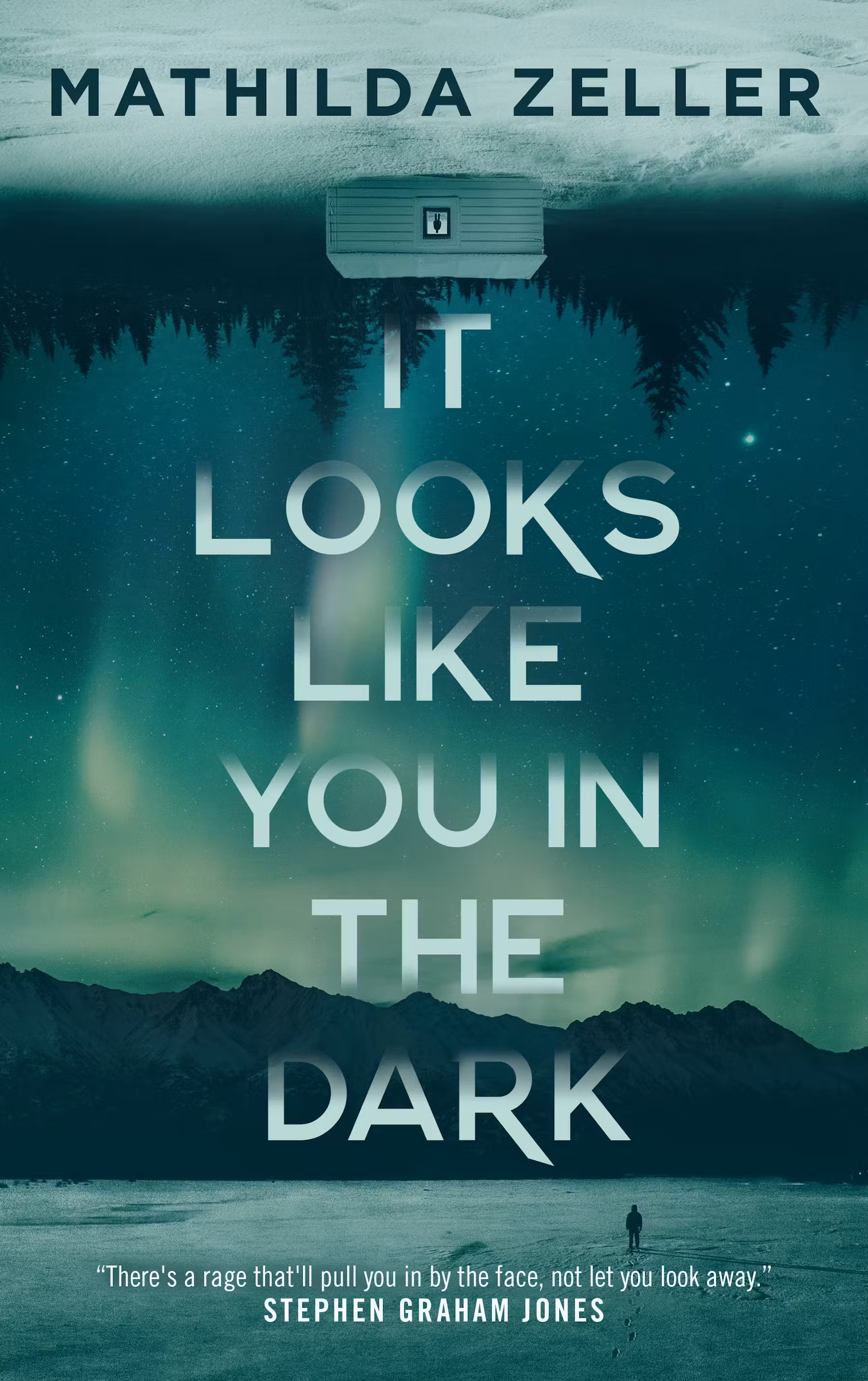
- Author Mathilda Zeller
- Publisher Tor Nightfire
- Published 13 October 2026
- Format Hardcover, paperback, ebook, audiobook
- ISBN 9781250402035
- Subgenre Indigenous horror
In the Inupiat village of Chukchi, fish plant worker Tapeesa searches for her missing sister Esther while a rare earths mine reshapes the land, and a creature that wears the faces of loved ones waits in the dark.
The kushtuka does not invent a face. It borrows one you already love, then waits to see if you will follow it into the dark anyway. That mechanism sits at the centre of Mathilda Zeller’s short story “Kushtuka,” which opened the anthology Never Whistle at Night in 2023 and became one of its most talked about entries, a creature that turns intimacy itself into the trap.
Three years on, Zeller has expanded that premise into IT LOOKS LIKE YOU IN THE DARK, her debut novel from Tor Nightfire. Tapeesa, the fish plant worker who narrated the original story, returns to a Chukchi altered by the arrival of a rare earths mine and the disappearance of her sister Esther. The kushtuka is still shapeshifting through the narrative, but the ground it walks on has widened considerably, from a single household to an entire village under extraction. Zeller writes as someone raised inside this folklore, not borrowing it from outside, and that distinction runs through everything that follows. Here is where the expansion actually started.
Mathilda Zeller writes the kushtuka from inside the stories her grandfather told her, not from a folklore handbook. Her debut carries generations of family experience of Arctic mining, a craft built on payoffs that open fresh questions, and a quiet confidence that Indigenous stories are too varied for any trend to flatten into one.
Expanding Kushtuka Into a Debut Novel
“Kushtuka” unfolded across a single night in one household, the dinner party where the creature interrupts a very specific arrangement of power. IT LOOKS LIKE YOU IN THE DARK moves that same monster through fish processing plants, mining infrastructure and an entire village’s worth of relationships. What proved hardest about stretching a story built for one claustrophobic room into a structure that has to sustain a whole community?
It was actually a relief to be able to expand it. As I wrote the original, there was so much more I wanted to include, and the more I wrote the novel, the more I wanted to tell; in some ways, there was very little I made up, having grown up on my mother’s and uncle’s recollections of growing up in the region, and having visited myself. There was a lot of story to tell, and I’m glad I got to tell more of it here.
Esther’s disappearance gives Tapeesa a concrete person to chase, something the short story’s one night structure never needed. What made you decide the novel needed a missing sister driving the plot, rather than keeping Tapeesa alone with the kushtuka the way she was in the original story?
In the original story, Tapeesa’s mother threatens to send Esther to help with the party if she refuses to–so in both stories protecting her sister is what pushes things forward. Her feelings about her sister are a foundational driver of the plot in both stories.
Rare Earths Mining and Stories Handed Down
The mine at the centre of the novel is a rare earths operation, a very current flashpoint given how aggressively those deposits are being pursued across the Arctic right now. How much of the mining detail in the book came from research into actual rare earths extraction, and where did you draw the line between real industry practice and what the story needed?
I have had multiple generations of family members who have interacted with the Arctic mining industries in some way or another, so I’ve been painfully aware of the humanitarian and environmental dangers for a while. On the level of plot, I needed something that had a faster poisoning effect than, say, lead would, and rare earth elements made sense.
Tapeesa’s Ahna is the one who hands her the kushtuka legend, which means the novel has to carry oral transmission on the page without turning it into a lecture for readers who have never heard the story before. What did you have to strip out or rework to keep that inherited knowledge feeling spoken rather than explained?
It felt fairly intuitive to tell it that way. I lived with my Inupiaq grandfather in elementary school and high school during some of the more difficult parts of my life, and one of the primary ways he helped me during that time was to tell me stories from the region. Aana responding to Tapeesa in the same way just seemed right.
Craft, Stamina and Why Water Frightens Her Most
A creature that wears the face of someone you love only works as horror if the reader starts doubting people who are supposed to be safe. A short story can spring that once; a novel has to sustain the doubt for hundreds of pages. How did you keep that suspicion alive across the full length of the book without it curdling into a gimmick or tipping its hand too early?
I guess it will be mostly up to each reader to determine whether I pulled it off or not, but I like to think of horror (and novel writing more broadly) in terms of set ups (or creating tension with unanswered questions) and payoffs (answering those questions). Question/answers or set ups/ payoffs can be short term (asked and answered in a chapter or scene) or longer term (set up at the beginning of the book, paid off at the end). The important thing, I think, is to make sure that there are always new set ups happening amid the payoffs–and my personal favorite is when a payoff/ answer also serves as a new set up/ question.
“Kushtuka” arrived in 2023, two years after your short story “The Incident at Veniaminov” appeared in Mermaids Monthly. What had shifted in your process between those two stories that let “Kushtuka” land the way it did?
Writers have very little control over how things land, I think.
The only things a writer controls are how much they write, read, study the craft of writing, and submit their work. I’ve been writing roughly a novel a year since 2008. Some of them are decent, some of them aren’t, and the goal is to just keep going, try to improve with every attempt, and hopefully find the readers who appreciate what you’re doing along the way.
Your bibliography keeps circling back to water, from that 2021 mermaid story through to the qalupalik novel you have coming next, even while “Kushtuka” and this current book are rooted in land and ice. How do you think about water as a threat in your fiction differently from the way you think about the cold and the dark?
If you’re surrounded in darkness, you can light a match, or (unless it’s the dead of winter at the poles) wait till sunrise. If you’re very cold, you can move around, hold a loved one, put on more clothes, light a fire. If you’re surrounded by water, there’s quite a bit less you can do, other than hope you’ve got great endurance as a swimmer or water treader. Also, everything is in the water, from the remains of countless humans, to creatures we can only imagine. Getting out of a serious water situation is generally much more complicated than escaping the cold or the dark.
A 288 page novel asks for a different kind of stamina than anything on your short fiction list. What did you have to unlearn from writing short stories in order to sustain a plot and a cast across a full novel?
Nothing; I’ve been writing a novel a year since 2008, and in a lot of ways novels are easier for me to write than short fiction, because you don’t have the tight word count limitation and you can let the ideas and characters develop a little more.
Indigenous Horror, Labels and the Publishing Wave
Never Whistle at Night was marketed as “Indigenous dark fiction” in 2023. Its sequel this past August carries the harder label “Indigenous horror,” with more violence and a wider range of registers. Where does your own novel sit between those two labels, and did the label change how you approached writing something for the same readership three years on?
On the Macmillan site, IT LOOKS LIKE YOU IN THE DARK is listed as a thriller. On the Tor Nightfire site, it’s listed as horror. I just wrote the story I wanted to tell, and let my agents and publisher decide on the rest.
Indigenous horror is currently being talked about in publishing as a wave, with your two book deal arriving in the middle of it. What is your view on the risk of that momentum flattening individual books into a single trend, and how do you try to write against that while still being part of it?
The thing about literary trends is that even if they’re temporary, they establish audiences that are longer term; I’m deeply grateful that more attention and support are being given to Indigenous authors now, and whatever discourse or commentary arises about the flattening of our collective work.
I believe that 1) that, too, will be temporary, 2) our stories and cultures are so varied and diverse that anyone who is actually reading and paying attention will have a difficult time rounding us out into a monolith, and 3) a core readership will stay with us no matter how in or out of vogue we may be in the future. I’m less concerned with writing against anything as I am with telling stories I feel need to be told while uplifting other writers’ equally necessary stories.
Writing Dread in the Alaskan Dark
Most horror leans on shadow and half light for its dread. An Alaskan autumn heading into winter offers something closer to sustained darkness. What did writing dread inside near total dark, rather than shifting shadow, change about your pacing or your sentence rhythm?
I like to let form follow function in my writing, and allow things to occur organically. There are constructions from the line level to the story level that are deliberate, but a lot of them happen subconsciously, and I find them while revising and figure out how to lean into them (or pull back from them, the case depending). I wrote the first draft of this story in the dead of winter in Detroit, which was very helpful to set the mood.
You have now spent years writing a creature whose entire threat depends on wearing a face you already trust. After all that time with the kushtuka, whose face would you least want to see it wearing?
My husband’s. I’ve been happily married for over 20 years, and that would be horrifying.
Get the book
It Looks Like You in the Dark by Mathilda Zeller is out from Tor Nightfire on 13 October 2026, in hardcover, paperback, ebook and audiobook.
If this Mathilda Zeller interview has you squinting at your loved ones over dinner, ask them where they left the car keys. A kushtuka would know. A real spouse never does.
About the author
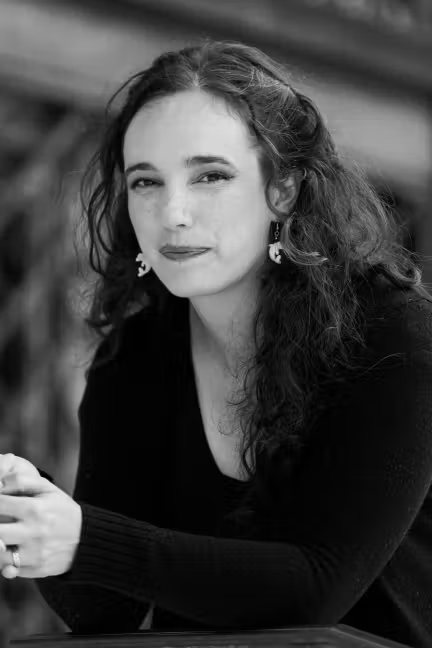
Mathilda Zeller writes horror. She is the author of It Looks Like You in the Dark as well as several short stories. Her pen name was inspired by her Iñupiaq and Ashkenazi great grandmothers. She currently lives in the Midwest with her family.
Keep reading on Ginger Nuts of Horror
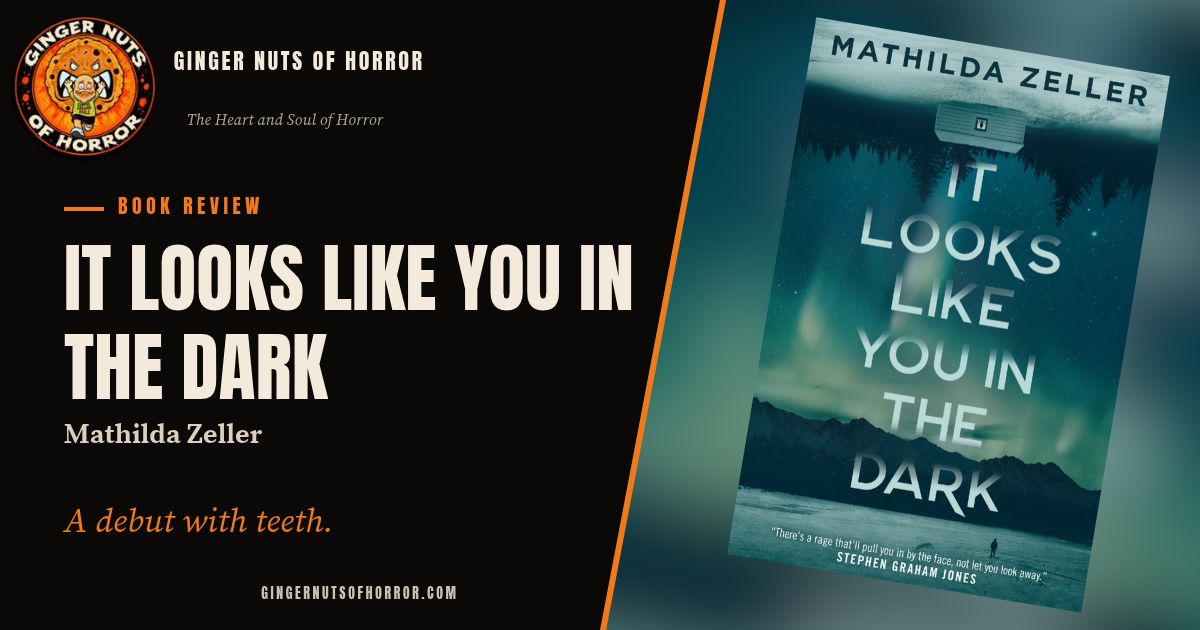 It Looks Like You in the Dark by Mathilda Zeller Review: A Debut With Teeth
 Blood Memory: Stephen Graham Jones Reimagines the Vampire in The Buffalo Hunter Hunter
 If the Dead Belong Here by Carson Faust A Tapestry of Ghosts: Weaving Generational Trauma
About Ginger Nuts of Horror
Ginger Nuts of Horror is an independent horror review and culture site based in Edinburgh, Scotland. Edited by British Fantasy Award nominee Jim McLeod, it publishes horror book reviews, film reviews, author interviews, features and cover reveals. Ginger Nuts of Horror won Best Inclusive Film & Book Review Platform at the SME News UK Enterprise Awards 2026.


