
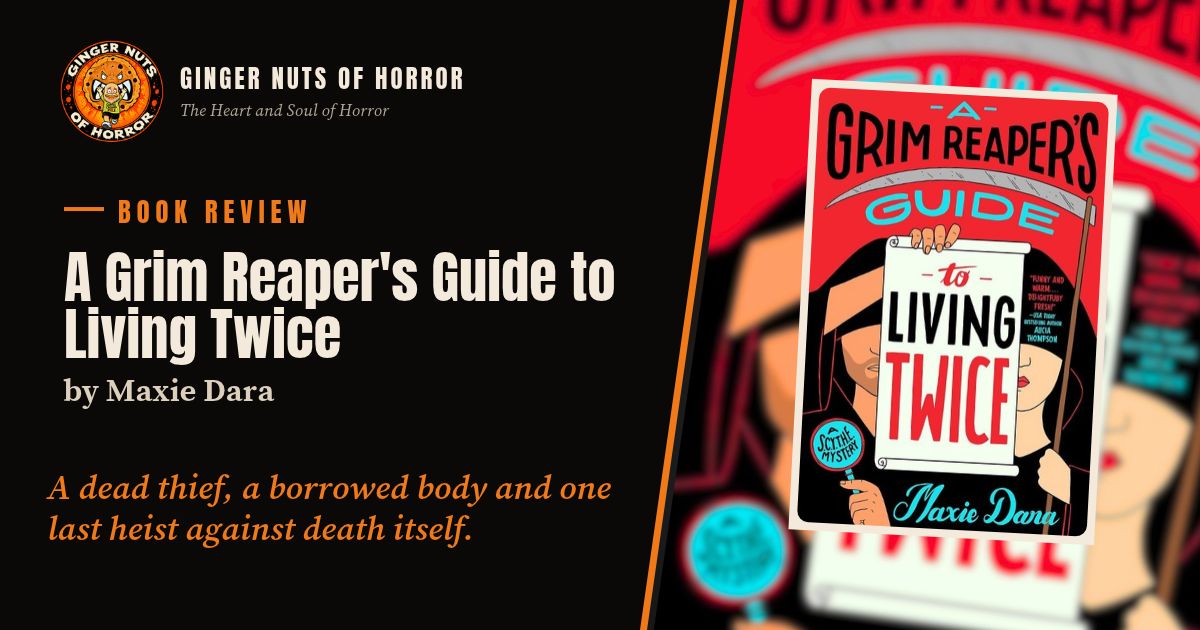
A Grim Reaper’s Guide to Living Twice | Maxie Dara | Berkley | 3 November 2026 |
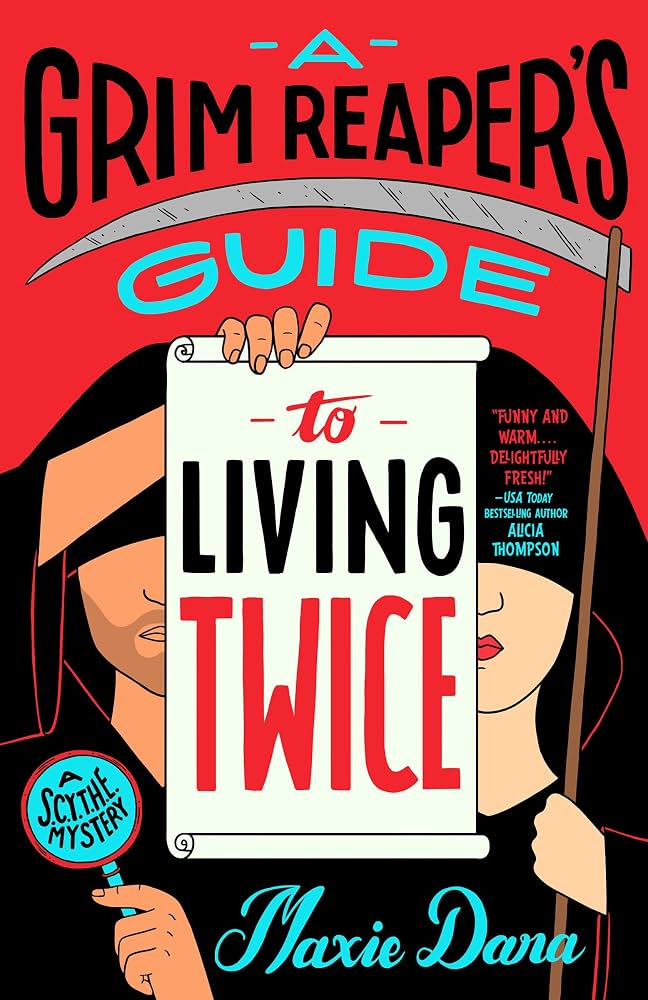
- Author Maxie Dara
- Publisher Berkley
- Published 3 November 2026
- Pages 336
- Format Paperback, ebook, audiobook
- ISBN 9798217187454
- Series S.C.Y.T.H.E. Mystery, Book 3
- Subgenre Paranormal cosy mystery
- Reviewed by Jim McLeod
A dead con man hides inside the body of an elderly grim reaper. When he is sent to collect an old friend’s soul, his past drags him into one last heist against the company that employs death.
A Grim Reaper’s Guide to Living Twice is Maxie Dara’s third trip inside the afterlife’s least glamorous employer, and this time she hands the keys to a dead thief. This A Grim Reaper’s Guide to Living Twice review comes from a horror reader, so a word of warning first: the book is a cosy paranormal caper from Berkley, not a horror novel. Jack McCoy has stolen an old woman’s body and has to plan a heist from inside it. There is plenty to like. It is funny, warm and smarter about death than the jacket lets on.
Maxie Dara turns a dead con man into an elderly grim reaper and gets real comedy and real grief out of the swap. The middle sags under too many flashbacks and too big a crew, but the heart of this caper beats loud enough to carry it home.
A Grim Reaper’s Guide to Living Twice Review: The Long Con of a Borrowed Body
Every con needs a costume. A good grifter knows the suit and the bored face do half the work, because people see what they expect and then stop looking. Jack McCoy has pushed that rule further than any man should. He is dead, and the costume he wears is another person.
That person is Margaret Chen. She is in her eighties, and she ferries souls for S.C.Y.T.H.E., the company that runs death in Maxie Dara’s books. Here the Grim Reaper wears business casual and keeps office hours. Jack was a thief and a liar in life. Now he has slipped into Margaret’s body and set up home there while his own corpse lies in the ground. Possession is not supposed to be possible in this world. Jack did it anyway.
That is the joke. It is also the problem.
And the book is at its best when it lets you feel both at once.
The plot is a caper with a ghost at the wheel. Jack has to keep up the act at work, which means doing Margaret’s job well enough that nobody asks questions. Then S.C.Y.T.H.E. sends him to collect the soul of Dale, an old friend from his criminal past. One knock on the door and the past comes in with it. Before long Jack is pulling together the gang of misfits he grew up with, and they are planning to rob the company itself. The prize is a list of souls worth more than anything they ever lifted as kids. The woman Jack loves needs that list. Someone else wants it too, and that someone keeps getting there first.
It is a good engine. Dara knows it, and she runs it hard.
How Living Twice Compares to Catching a Killer
Dara has built this series in an unusual way. Each book picks up a different worker at S.C.Y.T.H.E. and treats the company as the one constant. A Grim Reaper’s Guide to Catching a Killer, the 2024 debut, gave us Kathy Valence. She was forty-two, halfway through a divorce, pregnant by the man she was divorcing, and assigned to Natural Causes, the dullest desk in the building. Then a seventeen-year-old called Conner insisted he had been murdered, and she had forty-five days to prove it before his soul was stuck on earth for good.
A Grim Reaper’s Guide to Cheating Death followed in 2025 and swapped Kathy for Nora Bird, an office worker who took a job in death because she is scared stiff of it. When her twin brother’s name lands on her desk, she runs. Dara pitched that one as a family road trip crossed with Final Destination, with a talking parrot along for the ride, which tells you plenty about her sense of humour.
Both books had a heart that worked better than their mysteries. That was the common gripe, and it was fair. Catching a Killer in particular rushed its ending. The answer arrived late and felt thinner than the friendships around it.
Living Twice is the boldest of the three. Its hero is not a reaper who meets the dead. He is one of the dead, and he has cheated the system the other books took for granted. That shift changes the series from the inside. Up to now, S.C.Y.T.H.E. has been a workplace, a bit absurd, a bit cruel, mostly harmless. Seen through Jack, it is a vault. Every rule is a lock, and every lock is a dare.
Dara writes plays as well as novels. She won Best of Fringe at the 2017 Hamilton Fringe Festival with a musical comedy, and it shows. Her prose works like a stage farce with a revolving door: someone is always coming in dressed as someone else, and the timing matters far more than the wallpaper. She is not a writer of fine sentences. She is a writer of entrances, exits and the half second when a lie nearly slips. In a heist novel that is the right gift to have.
Take the central set-up and look at how it is built. Jack is a con man who now has to play one role all day, every day, with no chance to step out of it. For a grifter that is the dream and the nightmare. The comedy comes from the gap between who he is and the body he has taken, a career crook stuck with an old woman’s aches, wardrobe and bunions. A cheaper book would milk that for slapstick.
Dara keeps it gentler than the premise suggests, and she leans on old-age gags far less than you might brace for. That restraint is wise, because the body Jack is wearing is not his to mock. The book seems to know that. Under the laughs there is a small, cold question. Where is Margaret while Jack is wearing her?
That question is where the horror lives, if you go looking for it. Possession has always been the genre’s purest theft, and you can find it played dead straight in The Devil in I by Angel R. Sánchez Review: Possession Turned Inward. Dara turns the same idea into a crime caper and lets the unease sit in the corner of the room. She never makes it the point. But it never quite leaves.
The book also runs on two clocks. One timeline follows the gang as children, pulling their first scams. The other follows the adult heist. The early cons echo the late ones, so each memory adds a little weight to the job in hand. When it works, the effect is lovely. You watch a group of kids learn to trust each other, and then you watch the grown-ups test whether that trust survived.
Where the Heist Loses Its Footing
The two clocks do not always keep time. For a long stretch in the middle, the flashbacks and the present day stop feeding each other and start fighting for room. Just as the heist builds speed, the book cuts back to childhood. Just as the childhood thread finds its feet, it cuts back to the plan. Neither gets the run it needs. The opening is slow to warm up, and the middle drifts, and a caper cannot afford to drift. Heists live on momentum. This one stalls.
The crew is part of the trouble. A gang of old friends is a lovely idea for a story about second chances, but there are more of them than the book can light. Dale matters, and Jack matters, and a few others come into focus. The rest blur. In a good heist film every member of the crew gets one moment that tells you who they are, and Living Twice does not always find those moments.
Jack himself is a mixed bag. He starts out hard to like, selfish and quick to blame, and that is clearly the plan. His growth across the book is the emotional spine, and by the end he has earned some warmth. Yet he is billed as a slick operator, and on the job he often seems a step behind. Being outplayed is part of the plot, of course. Still, a con man story needs at least one scene where the con man is brilliant, and Jack does not get enough of them.
None of this sinks the book. The last third pulls the threads together with real snap, and the ending sets up whatever comes next with a hook that should keep readers keen.
Horror readers should go in with clear eyes. This is a cosy mystery with a supernatural frame, not a dark book wearing a funny hat. If you want death played for filth and laughs, try Deadbeat by Maxim Volk, A Choose Your Own Queer Adventure Horror at Its Nastiest instead. Dara is aiming at a kinder target.
Her family tree is easy to sketch. Terry Pratchett gave Death a job and a sense of duty in Mort and Reaper Man. Christopher Moore made the death trade a comic day job in A Dirty Job. The TV series Dead Like Me put reapers in office jobs with a boss and a schedule. Dara takes that bureaucratic afterlife and drops a heist plot into it, Ocean’s Eleven by way of The Goonies, with the cast of The Thursday Murder Club in spirit if not in fact. An old woman’s body pulling off a robbery is a very Richard Osman joke, and it works for the same reason his books do. Nobody suspects the pensioner.
What lifts Dara above most of the cosy paranormal pack is that she takes death seriously even while she jokes about it. She has written about using humour to shrink her own fear of dying, and that purpose runs right through these books. The bureaucracy is funny, but the grief is real. Living Twice is a book about second chances, and it knows that a second chance stolen from someone else comes with a bill.
The themes stack up neatly. Found family, the old gang pulled back together. Fear, and what you do with it. The red tape of the afterlife, which is a gag and a quiet satire of every workplace that treats people as files. Under it all sits the theft of a body, a life lived in somebody else’s shoes, which is about as close to a horror idea as a cosy book can get without changing shelves.
Most people get one life and spend it badly. Jack McCoy got two, stole the second, and Dara still makes you want him to spend it well.
The Verdict: Is A Grim Reaper’s Guide to Living Twice Worth Reading?
4out of 5
The verdict
A warm, funny caper about a dead thief in a borrowed body, held back by a baggy middle but well worth the ride.
Read it if: you enjoyed the first two S.C.Y.T.H.E. books, or you want a cosy paranormal heist that takes grief as seriously as its jokes.
Skip it if: you want horror with teeth, or a slow middle stretch tests your patience.

Keep reading on Ginger Nuts of Horror
 Short Story, Heaven Is Hungry by Michael Botur: A Hellish Vision of the Afterlife
 A Parade of Horribles Review: Matt Dinniman’s Dungeon Crawler Carl Book 8
 Headlights by CJ Leede Review: Horror at Its Most Devastating
About Ginger Nuts of Horror
Ginger Nuts of Horror is an independent horror review and culture site based in Edinburgh, Scotland. Edited by British Fantasy Award nominee Jim McLeod, it publishes horror book reviews, film reviews, author interviews, features and cover reveals. Ginger Nuts of Horror won Best Inclusive Film & Book Review Platform at the SME News UK Enterprise Awards 2026.


