Privilege has teeth in Jennifer Thorne’s savage, funny country-house werewolf novel.
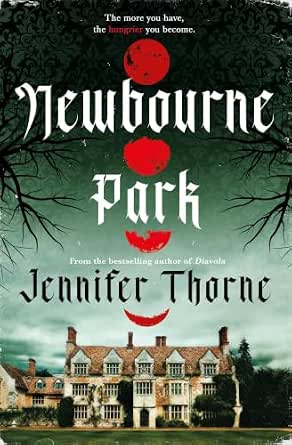
- Author Jennifer Thorne
- Publisher Titan Books
- Published 29 September 2026
- Pages 368
- Format Paperback
- ISBN 9781835415887
- Subgenre Werewolf horror, class horror
- Reviewed by Jim McLeod
Worn out by grief, Martha Shaw joins her brother and two friends for a secret weekend in an empty country mansion. Then its titled owner comes home early with guests, and the night turns savage.
Newbourne Park by Jennifer Thorne is a werewolf horror novel about class, grief and hunger, set on a vast English country estate. Martha Shaw, a young carer worn thin by loss, sneaks in with her brother and two friends while the owners are away.
Then the owners come home. In this Newbourne Park review I look at how Thorne builds dread inside a stately home, why the book changes shape after its first act, and how it grows out of her earlier novels Lute and Diavola. It is the book where everything she does well comes together, and here is why it earns full marks.
Newbourne Park opens as a siege and turns into a seduction, and the change is the whole point. Jennifer Thorne writes like a butler with blood on his cuffs, all perfect manners and dreadful secrets. This is her angriest, funniest and best novel, a werewolf story where the rich do the biting.
Who Gets to Eat at Newbourne Park
Every stately home in England has a rope across a doorway, and every visitor has leaned over it to peer at the room they are not allowed to enter. That rope is the whole class system in one length of red cord. You can look. You can buy the tea towel. You cannot sit on the chair.
Martha Shaw grew up on the wrong side of that rope. Her mum spent money she did not have on National Trust passes, and hauled Martha and her brother Ian round other people’s gardens for damp picnics in other people’s orchards. It is a small detail, dropped early in Jennifer Thorne’s new novel, and it tells you nearly everything. This is a book about looking. Then about taking. Then about what it costs to be let in.
Martha is twenty-six and feels twice that. She spent eight years caring for her mother, and six months after the funeral she still cannot face clearing out the cottage in Bintley. She cleans other people’s homes for a living. So when Ian and his girlfriend Lucy talk her into a weekend at the country estate where their old school friend Tommy has just started work as a live-in footman, she says yes. A round of Drambuie does most of the talking. The owners are away. The staff are gone. The cameras are off. Tommy has the code for the gate.
What follows is one of the best first acts I have read in a werewolf novel. The cover gives the game away and the publisher has not been shy about the wolf, so I will not pretend it is a secret. The family comes home early. They do not come alone. And the night turns red.
Each chapter is headed as a sin. The first is Trespassing, the second Covetousness, and the list only gets darker from there. It is a clever frame. Martha is not so much telling us a story as making a confession, and there is an edge of pride in it. She knows how this ends. She wants you to know that she knows.
Look at how Thorne handles the arrival. As the car rolls through the gates, Martha does what any sane person does in a strange place. She marks the exits. The gate locked behind them. The drystone walls. The outbuildings dotted round the park. For a paragraph she is pure survival instinct. Then she sees the house, and every thought of escape falls clean out of her head. It is so old and so huge that she feels less important to it than a germ on the back of a whale. The front door, in the morning light, looks to her like a tongue.
That is the novel in miniature. The fear is right, and the appetite wins anyway. A few lines earlier Martha owns up to the real reason she came: “I wanted to break something, if only a law.” It is a perfect line for her, wry and sad at once, and it hides a promise the book keeps with some relish. By the end she has broken a great deal more than a law.
Thorne plants her wolves in plain sight, too. Among the statues perched on the roof, next to the eagles and wyverns and stags, there are wolves. Martha lists them and moves on. So do we. Tommy boasts that the fridges are full of the cook’s leftovers and that it is all fair game, and Lucy sniffs that she has no interest in scraps. In a book about who eats and who gets eaten, nothing on the table is there by chance.
The prose deserves a word of its own. Thorne writes like a butler with blood on his cuffs. The manners are flawless. The sentences are clean, the jokes land quietly, and there is always something just out of frame that you know better than to ask about. Martha’s voice corrects itself as it goes. She stops to admit a fib, then carries on. It feels like being spoken to rather than written at, and that is rarer than it should be.
Is Newbourne Park Scary?
Yes. It is scary in two quite different ways, and that is where the book will split its readers.
The first third is a siege. Thorne builds dread out of small wrong notes: the horses gone from the stables, the grooms sent away, a poison garden fenced off near the house, paintings that loom over every room. When the house fills up at dusk, the violence is fast and loud and very wet, and she does not look away from any of it. Some of it is darkly funny. Most of it is not.
Spoiler warning: the next two paragraphs describe how the middle of the book is built, though not how it ends.
Martha gets away from Newbourne, but not clean. She has been bitten, and she has been noticed. The second movement draws her back into the orbit of Lady Olivia Lambert and her circle, and the siege becomes a seduction. The pace drops. The body count drops with it. If you came for a creature feature from start to finish, you may feel the air go out of the tyre for a while.
I think this is the best thing about the book, and I think it is wholly on purpose. The horror of the first act is teeth. The horror of the second is comfort. Being hunted is frightening, but being welcomed by people who own the land, the local police and half the village is worse, because part of you wants to stay.
Thorne slows down so we feel the pull that Martha feels: the clean sheets, the good food, the thrill of being chosen at last after eight years of being nobody at all. A faster book would have told us that power is tempting. This one makes us sit by the fire and enjoy it, and then asks what we would do to keep our seat.
Lady Lambert is the book’s great creation. She never needs to raise her voice. Her cruelty arrives as a compliment with a hook in it, or an invitation you cannot turn down, and she is far more frightening in a drawing room than any beast is on the lawn. Martha, for her part, grows harder to like as the pages turn.
She is petty. She keeps score. Every slight she has swallowed from well-connected people like her old friend Laura sits in the book like a debt waiting to be collected. She wants things, badly, and she is not sorry. I found her magnetic. Thorne never asks us to approve of her, only to see how easy it would be to become her.
If I have a quibble, it is a small one. Martha’s habit of hinting at what is to come now and then tips from menace into coyness, one knowing wink too many. It is a minor tax on a voice that pays its way everywhere else.
Newbourne Park is Thorne’s third horror novel for adults, and you can trace a clear line through all three. Lute, in 2022, set an American bride, Nina Treadway, among the island gentry she had married into, on an island where seven people die every seventh summer. Diavola, in 2024, sent Anna and the rest of the Pace family on a holiday to an Italian villa with ideas of its own, and turned family spite into something far nastier.
Diavola has become a touchstone for the new wave of social horror, and it came up as a point of comparison in our review of The Sea Hides Its Dead. Thorne was born in the United States and now lives in the west of England, and it shows in the best way. She writes about the English class system with an outsider’s clear eye and an insider’s ear for the small cruelties. Lute watched the gentry from beside them. Diavola watched a family eat itself. Newbourne Park goes below stairs and asks what happens when the help gets hungry. Titan Books published Diavola here too. This is her angriest book, her funniest and her best.
How Newbourne Park Compares to Other Werewolf Novels
The werewolf has always been a story about blood, and in England blood has always been a story about class. Titles pass down the family line. So does the bite. Thorne sees that the old gentry and the pack run on the same rules: loyalty, rank, and a firm sense of who counts as prey.
Most recent werewolf fiction has used the wolf to talk about the body. Rachel Harrison’s Such Sharp Teeth made it about trauma and change. Sam Beckbessinger’s Femme Feral turned it into a howl of female rage. Tom O’Donnell’s Moonsick bit a rich girl and showed her the gilded cage she had been living in. Newbourne Park flips that last idea on its head. Here the rich do the biting. The wolf is not a curse that falls on the lucky few. The wolf is the luck.
For the house itself, the family tree runs further back. There is a lot of Rebecca in the way Newbourne dwarfs the young woman who walks into it, and a lot of Brideshead in the way it wins her over. Fans of the class-war carnage of Ready or Not, or the country-house hunger of Saltburn, will feel right at home, though Thorne has more on her mind than either. And somewhere behind it all stands Angela Carter’s The Company of Wolves, with its sly sense that the wolf is not always the villain of the tale.
What lifts the book above clever genre play is grief. Under the satire sits a young woman who gave her twenties to a dying parent and came out with nothing: no real job, no friends, no clear sense of who she is. Thorne writes the carer’s fatigue with real tenderness. Martha still keeps her mother’s clothes. She cannot recall the last time she slept through the night. When hunger arrives, it is the first thing she has truly wanted in years. The book never pretends that is healthy. It just refuses to pretend it is hard to understand.
That is the trick at the heart of it. The Lamberts are monsters, but so is a world that grinds a woman like Martha down to nothing while one family owns two hundred acres and the silence of a whole village. Thorne lets no one off. Not the rich, not the village, not the help, and least of all her narrator.
Read it, then go to your next stately home and look up at the roof. Count the wolves.
The Verdict: Is Newbourne Park Worth Reading?
The verdict
A savage, funny and quietly heartbroken werewolf novel that turns the English class system into a hunting ground, and Jennifer Thorne’s finest book yet.
Read it if: you like your horror angry and funny, enjoy a narrator who is hard to love, or always felt Saltburn needed more teeth.
Skip it if: you want creature carnage on every page, or need a hero you can cheer without a flicker of doubt.
Ginger Nuts of Horror: The Heart and Soul of Horror Reviews

Jim "The Don" McLeod has been reading horror for over 35 years and reviewing it for more than 16. He's the editor of Ginger Nuts of Horror, Europe's largest independent horror review and culture site, and a British Fantasy Award nominee for his work in the genre. When he's not busy inflicting his opinions on the horror community, he can be found annoying his family or getting thoroughly outwitted by his two dogs, Casper and Molly.