
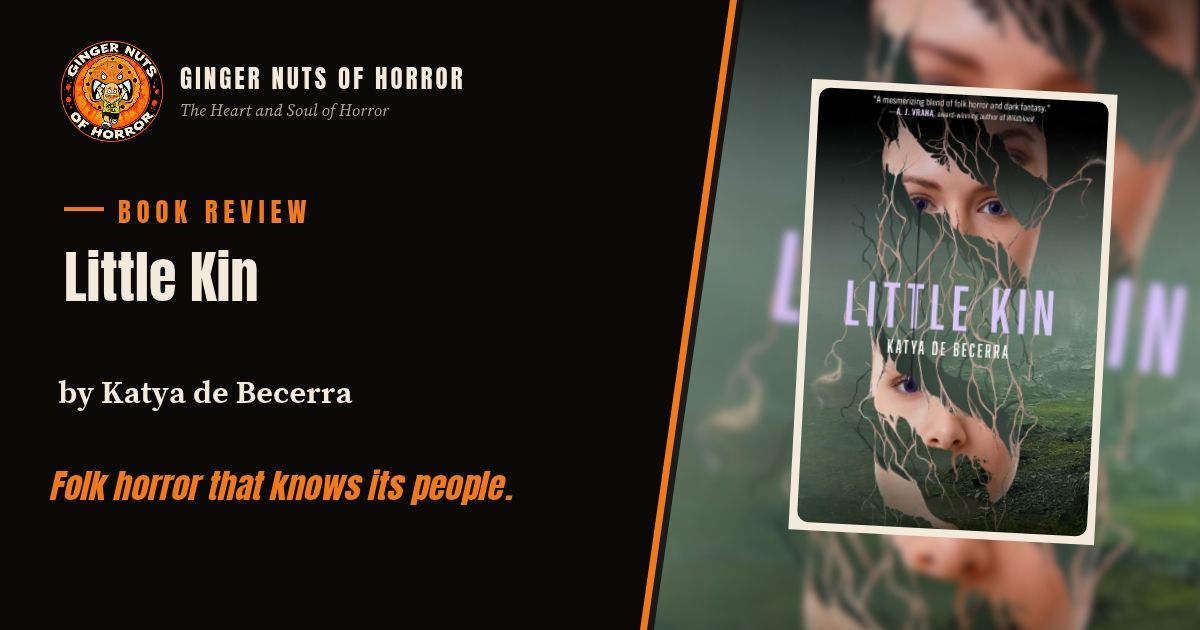
Little Kin | Katya de Becerra | Blackstone Publishing | 22 September 2026 |
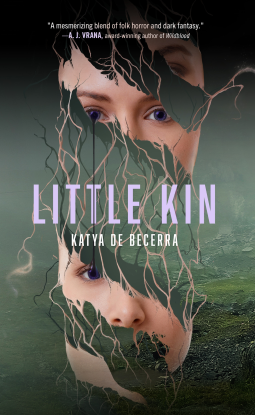
- Author Katya de Becerra
- Publisher Blackstone Publishing
- Published 22 September 2026
- Pages 320
- Format Hardback, paperback, ebook, audiobook
- ISBN 9798228682054
- Subgenre Folk horror
- Reviewed by Jim McLeod
An adopted anthropologist inherits a house on a cold, secretive island near the Arctic Circle. The locals live by old rules, small watchers live under the ground, and a pact older than anyone is starting to fray.
Little Kin is the first novel for adults from Katya de Becerra, an award winner best known for her YA horror. This Little Kin review looks at what happens when a writer with a PhD in anthropology turns that training on folk horror, and builds an island whose rites make sense from the inside. It is a book of old pacts, small watchers and a house left by an aunt nobody mentioned. It has one real flaw, and I will get to it. But first, a word about what it costs to come home.
Little Kin is folk horror built by someone who knows how real communities work. Its rites have logic, its creatures have weight, and its island has a will of its own. A hurried romance is the one real stumble in a strange, assured adult debut.
Little Kin Review: The Price of Belonging
Nobody tells you that a home can cost more than the rent.
Some places want your time. Some want your pride. A few, the old ones, the ones at the edge of the map where the ferry comes when it feels like it, want something you cannot get back, and they never write the price down because everyone who lives there already knows it.
That is the bill Katya de Becerra hands her heroine. Cass was adopted as a baby and raised in Ithaca, New York, by two academics who once studied a remote island near the Arctic Circle. The island is called Rothagisht. To Cass it was always just her parents’ old field site, a name on a box of notes. Then an aunt she never knew she had dies and leaves her a crumbling house there.
Cass is an anthropologist too. So she goes for two reasons that do not sit well together. She wants a fresh start, a place to belong. She also wants the work, because an island that keeps strangers out is the kind of place a scholar dreams about at three in the morning.
The island has rules. Never go out after dark. Never open the door to a knock.
Sit with those for a moment, because they do a lot of lifting. They are the oldest rules in the book, the ones we all know from fairy tales and from Grandma’s warnings. And they land on a woman whose whole job is to open doors. She is trained to ask why. She is trained to watch the rite, write it down and stay calm. De Becerra builds the novel on that clash: the scholar who wants a polite distance, and the blood in her veins that will not grant it.
That is a smart engine for folk horror. In most of the classics, the outsider is the fool. Think of the policeman on Summerisle, who sees a pagan island and reaches for his rulebook. Cass is not that. She arrives with the right tools to understand Rothagisht, and the book’s real menace is that understanding does not protect her. If anything, it pulls her in faster.
Paperwork as horror
The scene I keep coming back to is a quiet one, and it sits near the start. It is in the excerpt the Horror Writers Association ran, so I can point to it with care, though I am paraphrasing rather than quoting. The law firm handling the will sends Cass her original birth certificate. It lists her birth parents as Paralah and Volak, both recorded as island residents. It says she was born on the mainland, at a small hospital in Alaska that no longer exists. And it gives her a name she has never heard: SyffBrigra.
Look at what that does. There is no creature, no knock, no dark. Just a form. Yet it is the first true scare in the book, because a name is the first gift a family gives you, and hers turns up decades late, in a tongue she cannot speak, from a place that does not want guests. The detail about the hospital is the cruel little twist of the knife. Even the record of where she began sits on ground that has gone.
The prose here is plain, almost clerical, and that is the right call. Elsewhere that plainness can tip into bluntness, and a few lines of dialogue land with a thud. But in this scene the flat voice of a legal letter is the horror. De Becerra trusts the facts to be strange on their own, and they are.
An island that thinks
Rothagisht is the star, and it earns the billing. It is cold and volcanic, a rock with heat in its belly, and its people are oddly, suspiciously healthy. That last touch is a fine one. In most horror the sick village is the warning sign. Here it is the glowing skin and clear eyes that should worry you.
Then there are the things that share the island. The Movoi, known as the little kin, live below. The Garathin are creatures of fire and stone that rise from the hot depths when the old pact stirs. There is a tiny door in the aunt’s house, and the title has already told you who it is for. And looming over all of it is the Festival of Giving and Receiving, a name so mild it can only mean trouble.
What lifts this above stock folklore is the thinking behind it. De Becerra has said she built the island’s creatures by asking what sort of society would live beside them and rely on them. You can feel that on the page. The rites are odd, sometimes bizarre, but none of them is random. Each one reads like an answer to a problem the islanders have had for centuries. That is the anthropologist at work, and it is why the place feels lived in rather than dressed up. These are not borrowed Norse props on a shelf. They feel like a culture that grew there, in the steam and the dark.
Reading de Becerra on landscape is like watching someone sketch in charcoal on a frosted window: a few quick, rough strokes, and the cold fills in the rest.
The islanders, too, refuse to sort into heroes and villains. People do hard things for reasons that hold up. That moral murk is a gift in folk horror, where the easy move is to make the locals sinister and the visitor pure. De Becerra is more honest than that. Everyone is paying something.
The one real stumble
Now the flaw, and it deserves a straight answer rather than a mumble.
Cass is given a guide, a tall islander tasked with showing her the ropes, and the pull between them comes on fast. He does a lot of the explaining, so much that at times he feels less like a man and more like a walking glossary with good shoulders. In those scenes the voice shifts. The cadence of the YA books creeps back in: the quick spark, the sidelong looks, the heat that arrives before the trust. It is not bad writing. It is just younger writing than the rest of the novel, and it sits oddly next to a book this sharp about custom, kinship and what we owe the people who take us in.
It costs the book half a star. It does not cost it more, because the romance never takes the wheel. The island does.
Is Little Kin Scary?
Yes, in the slow way. Less so in the loud way.
If you come for jump scares, you may find this lighter than you hoped. Little Kin leans hard into dark fantasy, and there are stretches, later on, that play out more like a fight in a fable than a night in a horror novel. There is body horror, and some of it is nasty, but it never takes over. Readers who loved the dread of de Becerra’s earlier work may find that book has more raw fright per page.
But the fear here is of a different grain. It is the fear of a rule you do not understand and must obey anyway. It is the knock you are not allowed to answer, heard from a bed in a house that may not want you. The first half moves at the pace of a careful field study, with Cass gathering scraps from people who answer every question with a riddle. That takes patience, and it pays. By the time the island shows its hand, you know enough to be scared of the right things. The final third also goes somewhere I suspect few readers will see coming, and I will say no more than that.
From YA to the long dark
This is de Becerra’s fifth novel. Her debut, What the Woods Keep, set the pattern: a young woman, a family secret, a place that knows more than it says. Oasis took that into the desert. When Ghosts Call Us Home, her most decorated book, won the Aurealis Award for Best Young Adult Novel and the Shadows Award, and its narrator runs on anger and nerve. They Watch From Below moved to a university campus for a turn at dark academia. Along the way she co-edited This Fresh Hell, an anthology built to twist horror tropes.
Little Kin keeps the same core. Families with locked rooms. Places with long memories. Heroines who will not stop digging. What changes is the scale and the patience. The adult frame lets her slow down, let a custom breathe for a chapter, and leave the reader with questions rather than a bow on top. For the most part, it suits her very well.
Where it sits in folk horror
The obvious names are The Wicker Man and Midsommar, and the book invites them: an outsider, a closed community, a festival you just know will end badly. Our own long piece on Lord of Misrule, folk horror, and why we’re still arguing about The Wicker Man makes the point that the best folk horror is less about evil locals than about the gap between how a culture sees itself and how a stranger sees it. Little Kin lives in that gap. It just puts its stranger halfway across it from the start.
The closer cousin, to my mind, is Heather Fawcett’s Emily Wilde books, with their scholar on a cold northern island cataloguing the folk who live there. Little Kin is that idea with the cosiness drained out and the teeth left in. The frequent T. Kingfisher comparison is looser than it looks. There is little of Kingfisher’s wry humour here. This is a colder, stranger book, nearer to the eerie pull of Adam Nevill’s The Ritual than to anything that makes you laugh. If you want a map of the wider field, Tony’s guide, Modern Folk Horror Explored: Tony’s Top Tips, is a good place to see where this one fits.
Belonging, and what it costs
Under the creatures and the rites, this is a book about migration. De Becerra was born in Russia, studied in California and made her home in Australia, and she has written about how belonging is something you bargain for rather than something you are handed. Cass carries that idea like a stone in her pocket. She has the blood to claim Rothagisht. The island lets her stay. But blood is not the same as being wanted, and being wanted is not the same as being free.
That is the question the book leaves ticking. What if you finally find the place that is yours, and it asks you for something you cannot spare? Most of us, if we are honest, would pay. That is the scary part.
The island says never open the door to a knock. Open this one anyway.
The Verdict: Is Little Kin Worth Reading?
4.5out of 5
The verdict
A clever, strange folk horror novel whose island feels truly lived in, held back only by a hurried romance.
Read it if: you love folk horror built on customs that make sense, cold island settings and dark fantasy creatures with real weight.
Skip it if: you want nonstop scares, or a fast spark between strangers makes you roll your eyes.
Content warnings: body horror, gore, violence, sexual content.
/cu
Keep reading on Ginger Nuts of Horror
 Home Sick by Rhiannon Grist Review: Folk Horror That Gets Under Your Skin
 Gorse by Sam K. Horton Review: Where the Old Gods Grow Through Stone
 The Devil’s Bath, Folk Horror Part 2: In Which We Restore Our Faith
About Ginger Nuts of Horror
Ginger Nuts of Horror is an independent horror review and culture site based in Edinburgh, Scotland. Edited by British Fantasy Award nominee Jim McLeod, it publishes horror book reviews, film reviews, author interviews, features and cover reveals. Ginger Nuts of Horror won Best Inclusive Film & Book Review Platform at the SME News UK Enterprise Awards 2026.