
Books of Blood Volume 3 | Clive Barker | Sphere | 1984
- Author Clive Barker
- Publisher Sphere
- Published 1984 (this ebook edition 26 October 2015)
- Pages 248
- Format Ebook, paperback
- ISBN 9780751564044
- Series Books of Blood, Volume 3
- Subgenre Body horror
Barker’s third Books of Blood volume opens with Son of Celluloid, in which a wounded fugitive dies behind a cinema screen and the cancer inside him wakes up in love with the films.
Clive Barker’s Son of Celluloid opens the third Books of Blood volume with one of horror’s strangest monsters: a cancer that comes to life behind a cinema and falls in love with the films. In this Son of Celluloid essay, George Daniel Lea takes the creature apart cell by cell. He made the case for monsters over heroes in the opening Thirteen for Halloween essay, and he has already told us how Barker’s Weaveworld changed him. Here he goes back to the younger, poorer Barker of Thatcher’s Britain. What he finds is a parasite fed on borrowed dreams, a cynical satire of the film business, and an unlikely heroine who sees straight through it.
Barker’s Son of Celluloid is a living cancer that adores the films it was born from, and that is the satire. It can copy every screen idol and cowboy but never create anything, and once its glamours are pierced it stands exposed as cinema’s pathetic, parasitic rot.
Son of Celluloid: Barker’s Monster in Love with the Movies
Clive Barker has an uncanny knack for finding the ambiguity in the monstrous. Even when his horrors are of the most loathsome nature imaginable -as this specimen, from the short story that bears its name, absolutely is-, he manages to flourish the entity with wit, character and depth that very few contemporaries achieve. Eschewing moral binaries, Barker tends to make his creatures things of their own nature, not necessarily removed from humanity, but an echo or unflattering reflection of it.
The eponymous Son of Celluloid is, in many respects, a bizarre child of our species; comprised of the very best and worst of us simultaneously. Essentially, it’s a living cancer, a creature born of our rebellious cells, suffused with disease and morbidity by its inalienable nature. However, this =as Seth Brundle will express in Cronenberg’s The Fly- is a disease with purpose, even poetry: its host, a criminal of no particular import, seeks sanctuary in the abandoned spaces behind a popular cinema while wounded and on the run from the law. Secreted there, he dies unknown, unfound, suppurating and saturating in a bombardment of passions as audiences surrender to the waking dreams of the cinema screen.
It’s this factor that ultimately brings the cancer to life and consciousness, that defines its power and purpose: it, like us, becomes a thing in love with cinematic fictions, the dream-life of our species. But its love is as tainted as its nature; it vampirically needs those fantasies, those vicarious emotions, to sustain itself (not to mention the stolen glamours that shroud what it truly is).
Its need isn’t a passive or harmless one; it doesn’t merely bask in ambient emotion: it seduces, it enraptures, then it invades, undoes and consumes in the most intimate, revolting manner possible (the sequences in which the Son takes its victims have more than an echo of rape imagery, the creature seeking out orifices to invade and thereby devour the material stuff of its victim’s from the inside out. Even the rhythms and cadences of the process are analogous to those of sex scenes, with the Son growing priapic with borrowed passion before luridly bursting from its paramour’s eye sockets).
It’s a peculiar, literally hallucinatory entity that can alter human perception and the nature of reality, bringing to full and vivid life Spaghetti Western cowboy fantasies, celebrity sex-symbols (even those long dead); anything and everything ever recorded to film, as a means of enrapturing its prey. But the fantasies it evokes aren’t merely tools to an end: it loves them, it lives them; they are its religion, its ideology, its cell-deep nature. Humanity’s unthinking adoration of them brought it to borrowed and wretched life.
It therefore recreates them lucidly and lovingly, but can only ever provide imitations of other’s work (in echo of its original nature as simply DNA gone awry, it cannot create, only emulate, however perfect that emulation might be).
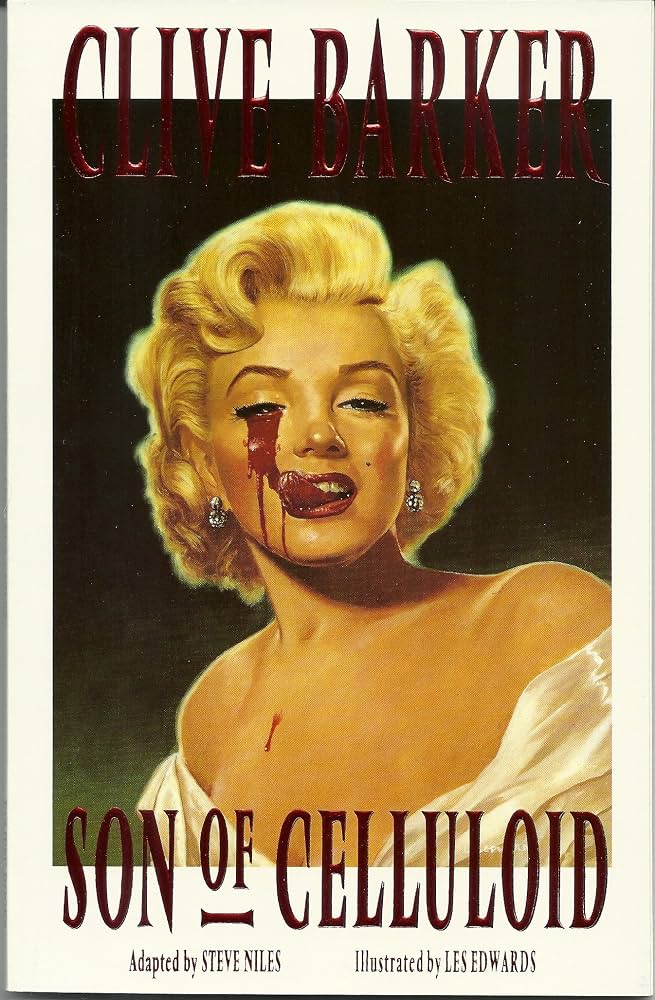
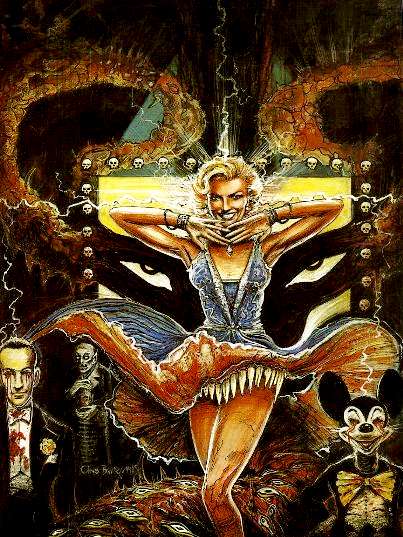
In aesthetic terms, the monster is a typically Barkerian -if such a thing can be said to exist- juxtaposition of the alluring and repellent: the glamours and masks it wears are universally pristine, to the point that their intended subjects can’t discern them from reality. But, like the films they derive from, they are ultimately nothing but pretty lies, confections made to hide something rancid, wretched and corrosive.
When the creature is revealed, it’s described in various terms as something obscene; seeping, slug-like, having the texture of raw and rotten liver. It is everything our animal selves are conditioned to reject and revile: living rot, animate disease. Combined with its parasitic and rapine nature, it’s easily among Barker’s most disturbing creations (this thing is a vandal not only of the body, but the human imagination: it takes what we love and find meaning in and turns it against us for predatory purposes).
Metaphorically, the Son of Celluloid is, like many entities in Barker’s Books of Blood, complex and densely layered: there’s a satire innate to its nature (a conspicuous strain of which runs throughout the story). It is emblematic of the bleaker side of cinema. While Barker has always extolled its virtues as a medium, he’s far from blind to the myriad ills and evils seething throughout the industry that sustains it:
The Son is the hideous expression of those evils given shape and animus, the rot and parasitism that lurks behind every moment of contrived virtue and manipulative sentiment or sanctimony. Through the monster, Barker satirises our willingness to surrender ourselves, to invest factors as precious as our emotion and imagination on what is, ultimately, consumptive, corporate enterprise. The living cancer is the fantasy life that consumes rather than enriches; blithe, banal and vapid comfort, wish-fulfilment, masturbatory exercise in place of sincere experience. It’s a very particular type and quality of cinema that Barker is attacking here; that species designed to gull and manipulate rather than communicating something essential.
Not only is the Son parasitic and predatory, it’s also profoundly impotent, a thing that can only mindlessly sustain its own lamentable condition. It can’t create or imagine better, can’t even grow or evolve beyond what it is. It is symbolic of art that exists to console and reinforce in one’s assumptions rather than challenging, a creature for whom art is fodder; material to be consumed and digested rather than used as a means of self-transcendence.
In that, it is the diseased and conciliatory side of our imaginations; that part of us that rationalises, diverts and justifies rather than assessing or exercising insight. The emotion that brought the thing to life might be sincere, but it’s also ephemeral, vapid, pop-corn. It has no lasting weight or worth (and nor does the Son itself).
While ostensibly horrific, the monster is revealed as utterly pathetic and impotent when its shams and glamours are pierced. The unlikely heroine of the piece is, quite deliberately, the antithesis of those we find in popular horror cinema of the era: she isn’t particularly beautiful, smart or resourceful, but exercises a certain cynical pragmatism that defies the cinematic gloss of the creature, allowing her to see through to the truth of it. Ultimately, she uses her own weight to crush the stolen, unnatural animus from the beast, its squealing protests rendering it a pathetic specimen. She requires no especial knowledge or agency, no magical rite or aid.
Just her own disgust at the creature, the genuine and sincere reality of her own body. In this, Barker presents a somewhat cynical satire on what mainstream, Capitalist culture has made of our collective imaginations (a condition which would’ve been at its excremental height at the time of writing, in Thatcher’s Britain of the 1980s). Here, we have a woman of extremely bleak reality set against a creature of dreams and fantasies, a creature that can be any beauty or sex symbol it or its victims desire, and that is aware of what we yearn for on a fundamental level.
A woman immune to its charms and whiles, whose instinct for self-preservation and piercing through manipulative bullshit is so earnest, she manages to see and survive, whereas others fall happily prey.
When examining The Son of Celluloid, we must bear in mind: this Clive Barker is a very different writer from the one who would go on to write metaphysical epics such as Weaveworld or Imajica: younger, underclass, practically homeless, he would be in a position to see the cancerous corruption of our society from its diseased entrails out, those parts of the beast most of us never witness first-hand.
The Son, along with so many entities from The Books of Blood, is an expression of that well-earned and righteous cynicism. In Hollywood, in popular cinema in general, our most sacred and intimate qualities, our very dreams and imaginations, are rendered down into fodder for Capitalist engines. They are made materialist, consumptive and thereby cancerous, antithetical to the genuine and sincere fantasies that can so move and transform us.
The Son of Celluloid is that phenomena made manifest in the most grotesquely literal way imaginable, an unambiguous stab at the moribund nature of popular culture of its era, and uniquely resonant for that -barely veiled- subtext.
George Lea 31-10-2026
Get the book
Books of Blood Volume 3 by Clive Barker, first published by Sphere in 1984, is available from Sphere as an ebook and in paperback.
So if a film ever leaves you feeling oddly drained, have a look behind the screen. The Son of Celluloid only ever copies what someone else made, which, now we think about it, is a worrying thing to have in common with a film critic. More monsters are queuing up in My Life in Horror as Thirteen for Halloween carries on.
Keep reading on Ginger Nuts of Horror
 Thirteen for Halloween: Mr Hyde, the Monster Repression Made
 How do you make a Hellraiser? The secret ingredient is love. No, really.
 Frankenstein (Or The Modern Prometheus): The Horror Of Being: A My Life In Horror
About Ginger Nuts of Horror
Ginger Nuts of Horror is an independent horror review and culture site based in Edinburgh, Scotland. Edited by British Fantasy Award nominee Jim McLeod, it publishes horror book reviews, film reviews, author interviews, features and cover reveals. Ginger Nuts of Horror won Best Inclusive Film & Book Review Platform at the SME News UK Enterprise Awards 2026.


