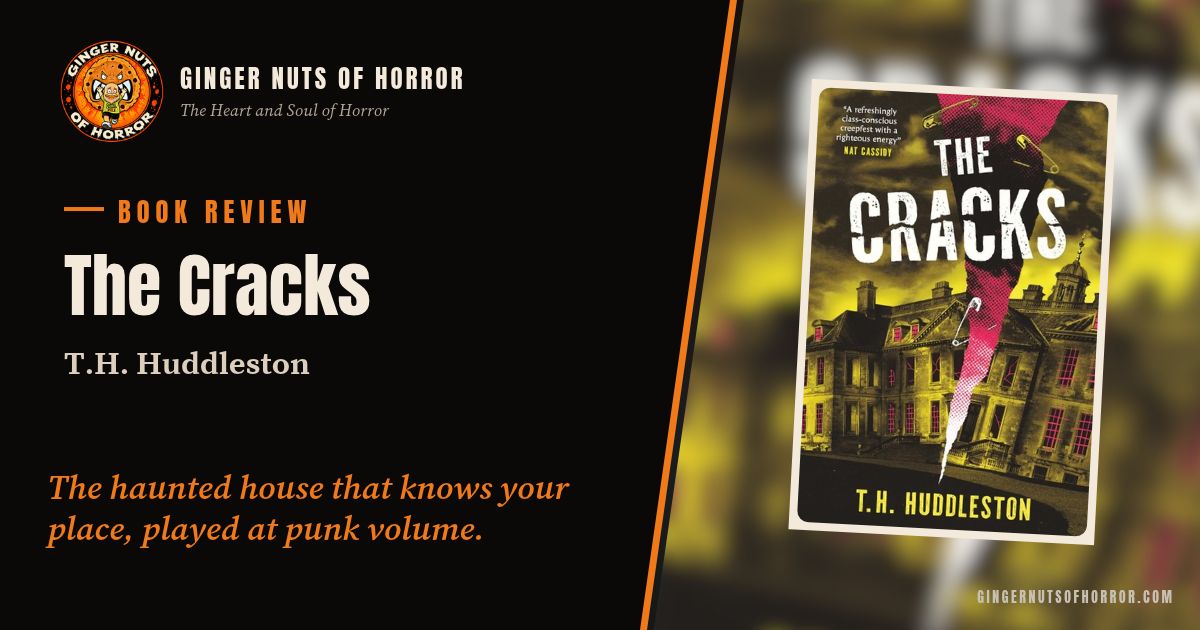
The Cracks | T.H. Huddleston | Titan Books | 6 October 2026 |
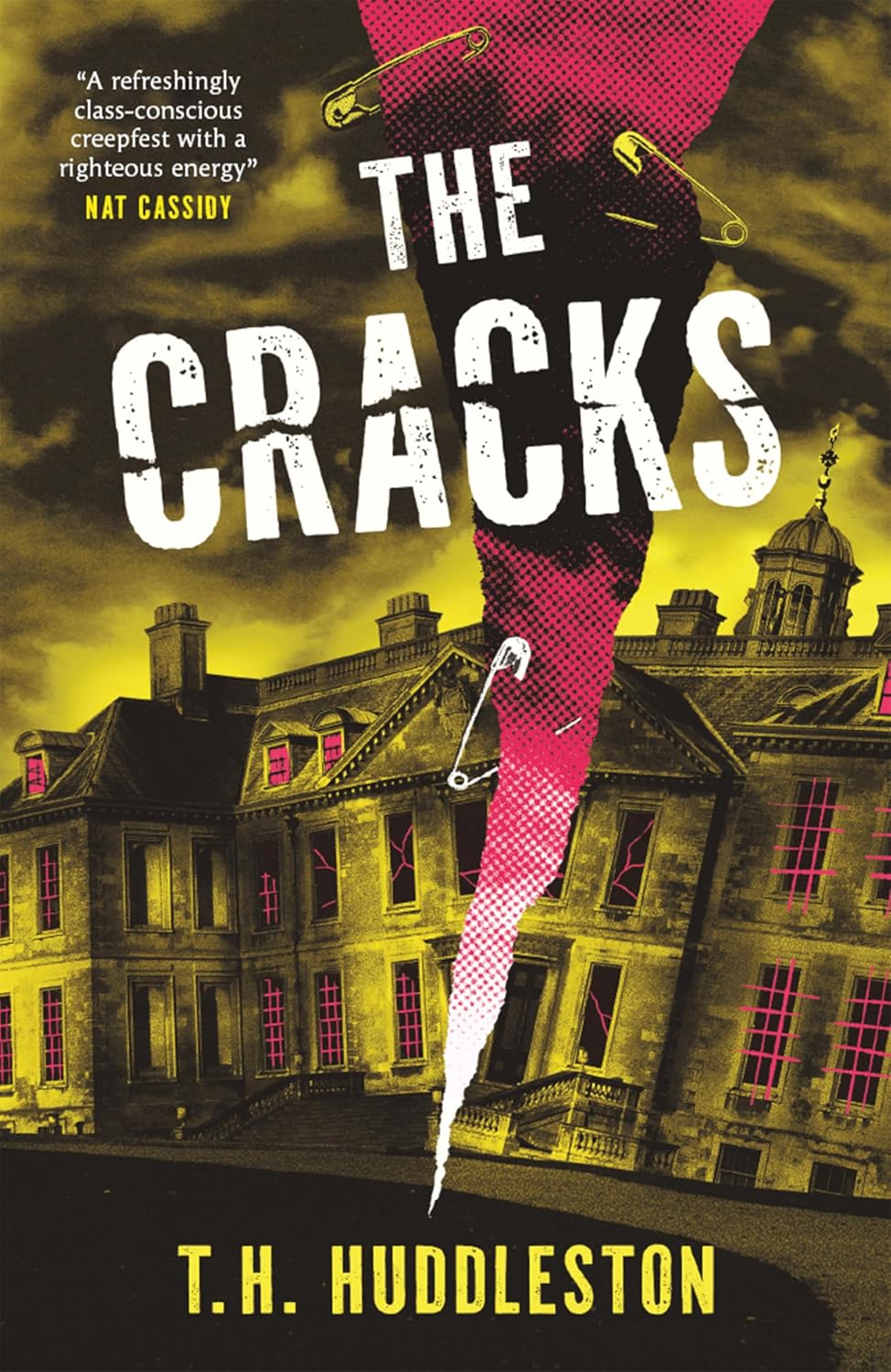
- Author T.H. Huddleston
- Publisher Titan Books
- Published 6 October 2026
- Pages 368
- Format Paperback, ebook
- ISBN 9781835413036
- Subgenre Gothic haunted house, class satire
- Reviewed by Jim McLeod
Widowed, broke and out of work, chef Sandra Riley takes up an old friend’s offer to stay at his wife’s crumbling family seat. Hautmond Hall has its own ideas about where she belongs.
The Cracks by T.H. Huddleston is a punk rock Gothic about grief, debt and a stately home that knows where everyone belongs. Out now from Titan Books, it is the first novel for adults from Tom Huddleston, the film writer behind the FloodWorld trilogy. A widowed chef takes refuge with an old university friend at Hautmond Hall, and the house starts handing out parts to play. It is a haunted house novel with the volume turned all the way up. The Cracks review below explains why it earns five stars from me, and why its bluntness is the whole point.
Every Gothic trick is here, the hidden room, the figures in the mirrors, the cursed old family, but Huddleston plays them like a punk band covering a hymn: faster, louder and with a sneer. The Cracks is a haunted house novel about who uses the side door, and it kicks in the front one.
The Cracks Review: The House Wants Staff, Not Guests
Every big English country house has two doors. One is at the front, for the family. The other is round the side, by the bins, and it is for everyone else.
That second door is where this novel lives. It is a haunted house book, and a very good one. But the ghost it cares about most is the one we still call class. It is the ghost that tells you which door to use. And it never really left.
Sandra Riley has lost almost everything. Her husband, Vin, has died after a long illness, and she spent his last months caring for him. She is a trained chef with no job. The bank wants her home. Then, by chance, she runs into Gerry McManus, an old friend from university, and once, for a short while, a bit more than a friend. Gerry has done well for himself. His wife, Joy, has just come into her family’s crumbling pile in the country, Hautmond Hall. Come and stay, says Gerry. Clear your head. We will sort out the house.
It is a kind offer. That is the trap.
Huddleston knows the shape of this story, and he knows that you know it too. Grief, a big old house, a host who is a touch too keen. Bad dreams. Strange accidents for anyone who visits. A secret room deep in a pitch-black cellar. Dim figures at the far end of the mirrors. The Gothic toolkit is laid out on the bench, every piece polished. What makes the book stand out is what he builds with it.
Hautmond does not want Sandra dead. Not at first. It wants her useful. It wants her in the kitchen, grateful and quiet, below stairs. It wants Gerry and Sandra to play their parts in a country life the house has written for them. Joy and Gerry came to do the place up and sell it on, but that plan fades. The lawyer friend who was going to save Sandra’s home never seems to turn up. The roles settle on everyone like dust sheets.
That is a fresh idea for an old form, and a cruel one. Plenty of houses in fiction want the living out. This one wants them in, and in their place.
Now read the title twice. Cracks in the plaster, yes. But also the cracks people fall through, when a job goes and a partner dies and the bank letters pile up on the mat. Sandra has fallen through one. Hautmond is waiting at the bottom with an apron.
Is The Cracks Scary?
Yes, and it gets worse the longer you sit with it. Huddleston tells the story from above, with a wide, roving eye that can drift from Sandra’s room to the long past of the house and back again. That choice matters. A tight voice in Sandra’s head would make this the tale of one woman losing her grip. The wide view makes it the tale of a building that has done this many times before. The dread is not in one big jump. It is in the pattern.
The early scares are the old ones, and they still work. Bad dreams. A guest hurt. A shape where no shape should be. Then the history starts to come up through the floor, as the people working on the house begin to learn what went on there down the years, and the book turns from creepy to nasty. By the last act, the blood runs freely. This is not a polite ghost story, and the ending will make you look back at Hautmond in a very different light.
Spoiler warning: the next three paragraphs cover a turn from the middle of the book.
The best scene to study is not a scare at all. Sandra, feeling the gap between her life and her hosts’, goes looking for work of her own. She lands a job as a chef at the local pub. The staff are rough and ready, and they play in a punk band. For a while she finds her people again, the people she was before grief and debt wore her down. She has a way out.
Then the pub burns down.
Look at how that works. Huddleston never has the house reach out and grab her. He does not need to. He takes away the one other place she could stand, and gravity does the rest. Sandra goes back up the drive, back into the kitchen, back to fetch and carry for people who once called her a friend. Is the fire the house’s work? Maybe. It is also how class works in real life. Nobody locks you in. Your other options just keep burning down. I can’t think of a cleaner picture of how a system keeps people where it wants them.
That is the novel’s great trick. Each Gothic beat has a twin in the real world. The room in the cellar might be read as the history a family hides. The figures in the mirrors as the staff nobody ever looks at. The house’s hunger as that old belief that some people are born to serve.
Why The Cracks Plays It Loud
Some readers have found the book too blunt. The family history is wicked to the point of cartoon, they say, and you can see the end coming. I see why. I just think they have heard the volume as a mistake. This is a punk novel. Punk was never meant to be subtle. It was about saying the thing out loud, fast, in three chords, while the people in charge winced.
Huddleston writes the way a punk band covers a hymn. Every note of the old tune is there: the stately home, the hidden room, the long line of bad lords. It is just played faster, louder, and with a sneer you can hear from the back of the hall. The gentry here are monstrous because the book wants you to stop squinting at them. Easy to guess? Only in the way a falling piano is easy to guess. You can see where it will land. You still flinch.
And the punk is not set dressing. Sandra and Vin were punks. The band at the pub are punks. At the heart of the book sits a punk song, made up for the story, and it carries the novel’s anger like a banner. Huddleston has even put together a playlist of songs the book mentions. The music stands for all that Hautmond wants to scrub out: the noise, the cheek, the refusal to say thank you, sir. When it comes to who Sandra can trust, the answer comes from an unlikely place, and I will leave it there.
There is real feeling under the noise, too. Sandra’s grief is not a plot device. She nursed Vin for months, and the book knows how that kind of loss leaves you raw and broke at the same time. Grief makes you easy to place. Being skint makes you easy to keep. Hautmond knows both.
Her bond with Gerry is the sharpest thing here. He is not a villain. He asked her to stay because he cared. But he cannot see what the house is doing, because it is doing it for him. Every perk lands in his lap. It is a fine study of a decent man who has moved up in the world and stopped noticing who carries the trays.
T.H. Huddleston is Tom Huddleston, and The Cracks is his first novel for adults. Most readers will know him from the younger shelves. His FloodWorld trilogy, made up of FloodWorld, DustRoad and StormTide, sent two kids through a drowned London and across a desert America. He has written Star Wars: Adventures in Wild Space books and Warhammer Adventures novels for young readers. He spent a decade on the film desk at Time Out, and his non-fiction includes David Lynch: His Work, His World, The Worlds of George RR Martin and The Worlds of Dune.
You can see the thread. FloodWorld was already about who gets the high ground when the water rises. Years of writing about film show in how this book frames its scenes, wide and patient, letting the house fill the shot. What is new is the anger. The children’s books kept hope at the end of the tunnel. This one keeps a middle finger.
Where does it sit on the shelf? Close to Richard Matheson’s Hell House, for a house as a hungry thing with a long memory. Close to Sarah Waters’s The Little Stranger, for the slow rot of a family seat and a guest who does not quite belong. It shares some blood with Saltburn, though it is far less in love with the rich. Adam Nevill’s No One Gets Out Alive paired the haunted house with being poor to brutal effect. Huddleston brings the same rage but swaps the bedsit for the ballroom.
Titan pitches it at fans of Grady Hendrix and Rachel Harrison, and that fits the tone, if not the setting. Hendrix put a haunted house through the wringer of family grief in How to Sell a Haunted House. Huddleston puts one through the wringer of the class system. For a wider map of how the form got here, Joshua Chaplinsky’s A Brief History of the Haunted House Novel is a fine guide. And if you want another recent house with money and class buried under the floor, Max Doty’s The House That Eats the Dead makes a good second helping.
What sets The Cracks apart from all of them is the sound. I can’t name another haunted house novel that plays this loud.
Hautmond Hall has stood for centuries on the idea that some people are born to use the side door. The Cracks kicks in the front one. Play it loud.
The Verdict: Is The Cracks Worth Reading?
The verdict
A loud, angry, clever Gothic that turns the haunted house into a machine for keeping people in their place.
Read it if: you like your Gothic political, your gentry monstrous and your horror with the volume up.
Skip it if: you want quiet ambiguity and a mystery that keeps its cards hidden; this book shouts on purpose.
Keep reading on Ginger Nuts of Horror
 The Unhaunting by Micaiah Johnson Review: The House That Wants Ghosts
 Accumulation by Aimee Pokwatka Review: A Haunted House Novel That Knows the Real Horror Is Domesticity
 Hollow Folk by Andrew K. Clark Review: Love and Terror in a Frozen Hotel
About Ginger Nuts of Horror
Ginger Nuts of Horror is an independent horror review and culture site based in Edinburgh, Scotland. Edited by British Fantasy Award nominee Jim McLeod, it publishes horror book reviews, film reviews, author interviews, features and cover reveals. Ginger Nuts of Horror won Best Inclusive Film & Book Review Platform at the SME News UK Enterprise Awards 2026.

Jim "The Don" McLeod has been reading horror for over 35 years and reviewing it for more than 16. He's the editor of Ginger Nuts of Horror, Europe's largest independent horror review and culture site, and a British Fantasy Award nominee for his work in the genre. When he's not busy inflicting his opinions on the horror community, he can be found annoying his family or getting thoroughly outwitted by his two dogs, Casper and Molly.