
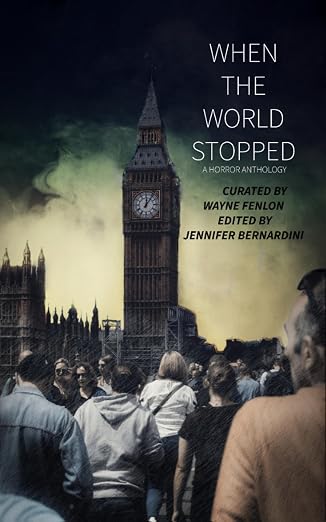
- Curated by Wayne Fenlon
- Edited by Jennifer Bernardini
- Publisher Exploding Head Fiction
- Published 13 October 2026
- Pages 512 (hardback)
- Format Hardback, paperback, ebook
- ISBN 9798178179574
- Subgenre Apocalyptic horror anthology
- Reviewed by Jim McLeod
Thirty-one horror writers take on the end of the world, but most of them shrink it down to one house, one family or one terrible night, where the collapse is personal and the damage is close enough to touch.
When the World Stopped is a new horror anthology from Exploding Head Fiction, curated by Wayne Fenlon and edited by Jennifer Bernardini. In this When the World Stopped review, I look at a lot of thirty-one stories. The theme is the apocalypse, but the writers keep turning it inward. A hangman runs out of people to hang. A train runs out of coal. A mother runs out of memory. The book is long, and it is not flawless. It is, though, one of the best themed anthologies I have read this year, and here is why.
Thirty-one writers end the world in kitchens, cellars, classrooms and on dark country roads, and most of them prove that small disasters cut deeper than big ones. One or two stories drift, and the book is long, but at its best this is as good as small press horror gets.
— GINGER NUTS OF HORROR
When the World Stopped Review: Wayne Fenlon Ends the World One House at a Time
Nobody lives through the end of the world. They live through the end of their own world, and that is a smaller and worse thing. The news can tell you a city has gone. It cannot tell you what it is like to be the one person left on the hill.
That is the idea that holds this book together. The foreword says it plainly: the truest apocalypses are intimate. Wayne Fenlon has gathered writers who take that brief seriously. There are bombs and plagues here, and a rapture, and a tornado. But the camera keeps pulling in. It finds a man on a sofa, a woman in a barn, a teacher with a box of rocks by a classroom door.
The book is split into three parts: Friends, Families and Survivors. It is a neat bit of shape. The first part is about the people we choose. The second is about the people we are stuck with. The third is about who is left when the rest have gone.
The Families section is where the book draws the most blood. Ross Jeffery’s “Sundowning” is the hardest of my nineteen to sit through. Dafydd goes home to his mother, Angharad, who has dementia and has grown huge and strange. The house is full of soil. She keeps calling him by his father’s name. Jeffery writes the shame of that with no mercy at all. Then the story turns, and the garden starts to give up what it has been keeping. It is grief horror with a knife in its sleeve, and it ends on a choice that will sit with you for days.
Craig Wallwork’s “What Rots the Flesh of Fruit” is the most elegant thing here. It is 1947, and a boy in Mytholmroyd has polio. His father buys him an old Victorian wheelchair from an antique shop. You can guess some of what follows, and Wallwork knows you can. What you will not guess is the second half, told by the boy’s mother, who goes looking for the man who made the chair. The prose is calm and period-perfect. The last scene, at a dinner table with a wooden bowl, is one of the quietest and cruellest endings in the book.
Then there is Phil Sloman. “When There’s No One Left to Hang” follows Grigore, a hangman like his father before him. A blight has killed the crops. The preachers sent him sinners for a while. Now nobody comes up the hill at all.
What Grigore does to keep his purpose alive is grim, and I will not spoil it. It is also, horribly, logical. His collection No Happily Ever After was a British Fantasy Award finalist, and on this evidence the next one should be too.
Jeremy Hepler’s “The Shaken and the Unshaken” is more of a genre piece, and a good one. A tornado drives Jesse and his autistic sister Jane into the storm cellar. Then their father comes down the steps. Then their father comes down the steps again. One of them is hurt and frightened. The other is calm. Hepler writes Jane with real care, and the test of which father is real is a lovely, sad bit of writing, built from the private names their late mother used. The ending reads like the first chapter of a longer book. I would read that book.
Cindy O’Quinn’s “Tailbone Teratoma” is the strangest story in this section. Ellen had a twin she absorbed in the womb. The tumour was cut out at birth, but Maura, the twin, still talks to her. She lives in a fleck of amber in Ellen’s right eye. O’Quinn writes it in short, sung lines that loop back on themselves, close to a chant. It can feel airless, which is the point. The final image is small and it is perfect.
Douglas Hackle’s “Wyler’s Mom (Has Got It Goin’ On)” is the book’s wild card. Most of the world has turned into mannequins. Our narrator gets letters from someone called Wyler, telling him not to turn round. Those letters are frightening. Then he is invited to Wyler’s birthday party, and the story turns into a deadpan comedy about a man who will not stop asking a stranger to read his poems. Some of it is very funny. Some of it, the shouty capital letters in particular, runs on too long. It will split readers. I found I was glad of it, placed where it is, like a joke at a wake.
Is When the World Stopped Scary?
Yes, though rarely in the jump-scare sense. The fear in this book is the slow kind. It is the fear of being the one who has to decide.
Katherine Silva’s “The Last Train to Willow Outpost” is the clearest case. An old steam engine is running for its life across a hostile land, with monsters behind it and a skeleton crew on board. The narrator is the engineer. His job is to keep the fire fed. The coal runs low, and the captain keeps barking the same order over the radio. Silva lets the horror build through what goes into the firebox next. By the time the engineer thinks “Hold on. Feed the engine. Use the bodies,” the words have become one thought. The ending is a refusal, and it is the bravest ending in the book.
Holly Rae Garcia’s “Diamond, Pearl, and the Squirrel” is told as a diary kept in a psychiatric ward. A mother writes, badly and angrily, about her husband, her nurses, a woman called Josie, and the daughter who will not visit. Something happened at a snowed-in cabin. One twin came home. One did not. Garcia makes you do the work, and she trusts you to. The narrator is rude, sly and very human, and the last entry lands like a slammed door. It is the story I most want to press into other people’s hands.
Laurel Hightower’s “Harbinger” takes a local legend, the Woman in White who appears on a dark Kentucky road before a crash. Dale saw her as a boy, the night his father died. Now he goes back, night after night, to ask her why she did not save him. Hightower is very good on grief that has curdled into blame. When the Woman finally turns round, the description is a genuine shock. Like her novella Crossroads, it turns a stretch of roadside into a place grief will not leave.
Stephanie Ellis’s “Bloodmeal” is folk horror for a drowned world. The valleys are under water. Eleri is pregnant again after three losses, and her husband Rhys is desperate to make their hillside grow. An old neighbour, Otis, has a recipe from the almanacs. You can see roughly where it is going. Ellis still makes it hurt, because she keeps her eyes on Eleri, and Eleri is the one nobody told. The story fits neatly beside her novel The Barricade.
Steve Stred’s “Demarcation” is short and sharp. Mikey volunteers for a search and rescue team in the woods. Five hours into a search for a lost hiker, his partner finds a symbol hacked into a hemlock. Stred has always been at home in the woods, in novels like Churn the Soil and Mastodon, and the robed figure here is a fine creation, a ten-foot thing of moss and rot. The best part is a vision of Mikey’s own body being taken back by the forest floor, piece by piece. The return to normal at the end is a little too tidy, but the last lines leave the door ajar.
Anton Cancre’s “None of Us Are Ever Prepared” is not supernatural at all, and it may be the most frightening story here. A special needs teacher is half way through a test with a pupil when the shooting starts in the corridor. Cancre writes it as a rush of thought: anger at a colleague, worry about a fly near a pencil, a panic attack, then the clear, fierce need to protect these kids. It is furious, funny and heartbreaking in under four thousand words. It reads like it was written by someone who has done the job.
How When the World Stopped Compares to Other Apocalypse Anthologies
The big end of the world books, John Joseph Adams’s Wastelands for one, tend to go wide. They want the map of the ruins. This book wants the floor plan of one ruined house. That is what makes it feel new. It sits closer to the grief horror boom of the last few years than to the old zombie and bomb stories.
Some stories still go wide, and they mostly work. Ronald Kelly’s “The End Times: A Sinner’s Diary” is a rapture story told by the man left behind, a hard-drinking Tennessee sinner. His voice is the joy of it:
Kelly is very funny, and then he is not, and then he finds a strange grace at the end that I did not see coming. He has written Southern-fried horror for forty years, and the voice here is as easy as an old porch chair.
John Boden’s “One Hand Clapping” is a junkyard after a great flash. Devon, a crooked scrap dealer, lives behind walls of crushed cars and watches a creature called the Sumpworm drink from a pit of poison. Boden’s prose is thick and sour, like rust you can taste. It is more a mood than a plot. But the closing line is the saddest joke in the book:
Funny thing: Boden and Jeffery both have characters who keep jars of children’s teeth. Ellis, McCarthy and Wallwork all use fruit as a gift, and you are never sure what it costs. I do not think that is planned. I think it is what happens when you ask thirty-one writers to imagine the worst, and it gives the book an odd, pleasing echo, like hearing the same bird in three different woods.
Every house has a candle in the window, and every room is lit by its own small disaster.
The Friends section has its own gems. Kev Harrison’s “Husk and Hearth” is a tender, gruesome story about grief. After his husband’s funeral, David is turning himself, on purpose, into something that will last. His friend Luke arrives too late to stop it, and maybe just in time to help. Harrison handles it with real warmth.
Yolanda Sfetsos’s “A Perfect Day?” puts a lonely data clerk, Cyra, into a meadow she can only reach by staring at the office clock. Her crush on Aden from another department gives the story a soft heart. The radio line about the doomsday clock repeats a few times too often, but the last scene is lovely. Red Lagoe’s “Real Human Art” is a sharp satire about AI and art theft, set at a secret gallery show. It is a bit on the nose, and the final line is more gag than horror. It still bites.
Catherine McCarthy’s “Return of the Green Man” has the most beautiful writing of the stories I read. A group of cavers climb out after a great storm to find the dead hung in the trees. One by one, the group go missing in the mist. McCarthy’s prose is rich and full of smell and texture. When the Green Man himself arrives, he talks a little too long, and the climate message is spelled out where it could have been felt. Even so, the first half is superb.
Which brings me to the one real stumble among the nineteen. Don Gillette’s “Neither World, Netherworld” is about boys, a boundary stone and a ghost child on an autumn hill. The idea is fine. The writing keeps hedging. The ground is “almost covered, almost blanketed,” and that half step back runs right through the story.
The two modern boys are never named, so it is hard to care about them. The ghost child turns up to explain the danger and then fades, which takes the threat away just as it starts. And it ends by telling us the boys “never spoke of that day,” rather than letting us feel why. In a book this sharp, it reads like a sketch for a story rather than the story itself.
That is the book’s one true flaw, and it is a small one. At 512 pages, you will find a dud or two. The rest ranged from good to outstanding. Anyone who has followed the horror book reviews on this site will know how rarely an anthology this long keeps its standard this high. It belongs on the same shelf as Anthony Ryan’s The Feeding, the human scale to its wide screen.
Fenlon promised the end of the world. He delivers it again and again, and nearly every time it leaves a mark.
The Verdict: Is When the World Stopped Worth Reading?
4.5out of 5
The verdict
A long, generous anthology that shrinks the apocalypse down to human size, with Sloman, Silva, Garcia and Jeffery at the top of a very strong field.
Read it if: you like your end of the world stories personal, grief-soaked and told by some of the best names in independent horror.
Skip it if: you want big action and wide wasteland maps, or you struggle with stories about children coming to harm.
Content warnings: child death, child abuse, suicide, self-harm, pregnancy loss, dementia, cannibalism, a school shooting, unwanted sexual contact, animal death, gore.
Keep reading on Ginger Nuts of Horror
 Eat the Light by Andrew Najberg, Review, A Post-Apocalyptic Cosmic Horror Masterwork
 Dark Bloom by Molly Macabre – Book Review
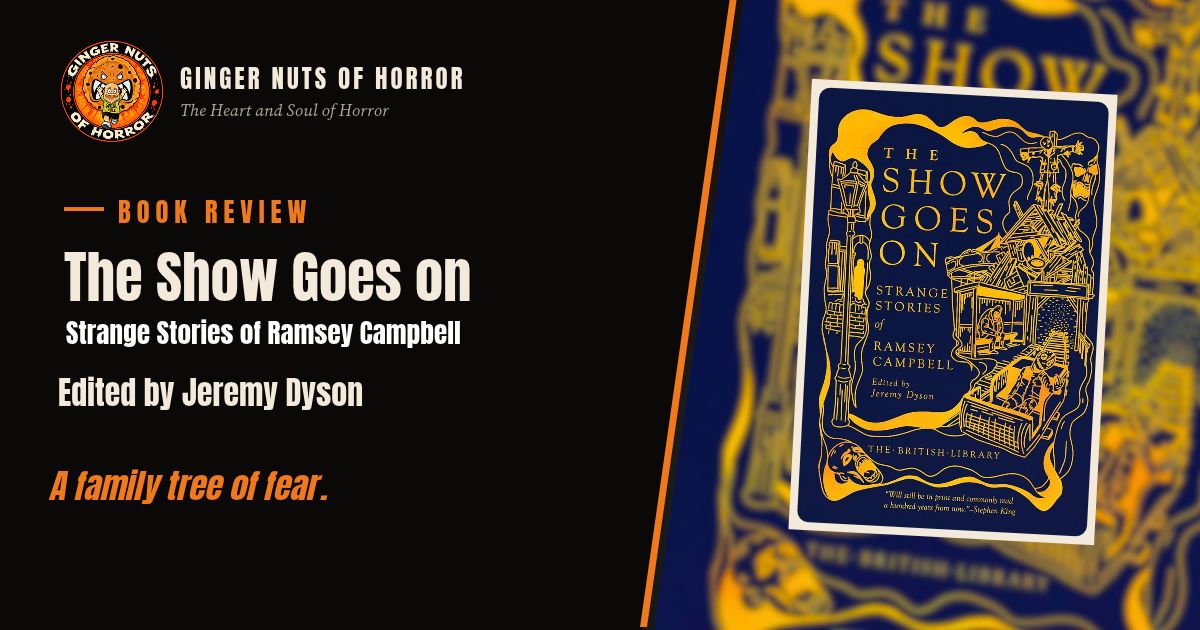 The Show Goes On by Ramsey Campbell Review: Jeremy Dyson’s Perfect Ode
About Ginger Nuts of Horror
Ginger Nuts of Horror is an independent horror review and culture site based in Edinburgh, Scotland. Edited by British Fantasy Award nominee Jim McLeod, it publishes horror book reviews, film reviews, author interviews, features and cover reveals. Ginger Nuts of Horror won Best Inclusive Film & Book Review Platform at the SME News UK Enterprise Awards 2026.