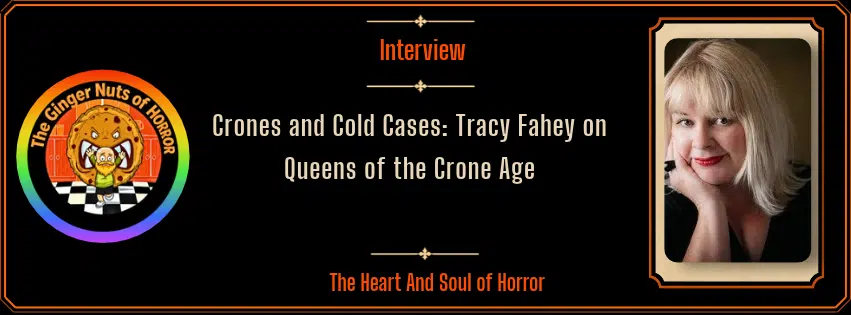
Tracy Fahey on crones, case files and the past that refuses to leave.
Tracy Fahey published two books this year that could not be less alike, except in the ways that matter. Queens of the Crone Age sends the Cailleach of Irish myth back into the modern world to listen to women’s stories left at her altar. Down We Go Together, her first collection of crime and noir fiction, sends ordinary people down into missing persons files, cold cases and holes in the ground. One is myth reclaimed as feminist reckoning; the other is procedural dressed as ghost story. Both, in Fahey’s own words, are drawn to “the persistence of the past in the present”, and both refuse their characters a clean resolution.
Nine books in, an Irish academic with a PhD on the Gothic in visual arts, Fahey has spent a career turning the female body, the haunted house and now the case file into the same instrument: something that will not stay buried. With a Rubery International Book Award, a Paul Cave Prize and two very different 2026 collections behind her, this felt like the right point to ask her to look back across the whole shape of that work, not only the newest piece of it.
Tracy Fahey writes crime and myth from the same obsessions: memory, repression, and a female body that keeps surprising its owner. She rewrote one ending to take the answer away, because life leaves losses open, and she built her Hag as a wounded healer who must be healed herself.
Crime, Folk Horror and Unreliable Narrators in Down We Go Together
The title story splits into fragments divided only by a stray tilde, and Dee’s dystonia keeps interrupting her own narration mid-scene, so the reader loses her exactly when she loses herself. How did that structural fracture take shape: was it there from the first draft, or did it arrive once you had decided how unreliable her grip on London and on time needed to be?

I’ve always been powerfully attracted to the notion of the unreliable narrator, ever since Alan Clarke’s Angel Heart. For a long time, I toyed with writing about a father’s search for his daughter, disguised as a police procedural, but was deterred by the fridging trope (where the main, male character’s narrative arc is propelled onwards by the passive, usually dead presence of a woman).
But once I gender-flipped the roles, this story took flight. I’m fascinated by psychopathology, by the way that the brain can work against itself, obscure information. And couching the story in first person brought an added degree of challenge – how much information does the reader need to navigate? – how can I structure a story so the truth gradually starts to bleed through the narrative? I never over-plot a story – this one started with the back-story, some research on dystonia, and I began with the image that opens it; a woman in a rainy café in Soho, case files spread over a table – it grew organically from there.
In ‘Listen To My Skin’ the dead narrator offers a real ethical knot: a woman who leads us through her story, which may or may not be the whole truth. How far were you willing to let a victim narrator go before she stopped being purely sympathetic?
I’m always interested in how we subconsciously expect female narrators to be ‘sympathetic’ in a way we seldom expect from male characters. I really admire Gillian Flynn who writes dark, unapologetic female characters like Camille Preaker in Sharp Objects or Libby Day in Dark Places. And in this story, my object was to awaken empathy with the story of the protagonist’s life, to the point that we feel morally ambiguous about her actions – that we feel we understand them, if not condone them.
‘Monsters’ never tells us who took Emily, and it ends with her mother climbing into the same wardrobe her daughter hid in, as if grief and guilt and the abductor have all become interchangeable. What made you decide to withhold that answer completely, rather than giving the reader even a partial resolution?
‘Monsters’ asks a lot of questions – what if the worst happened? And what if that horrific situation was resolved? And what if that resolution wasn’t satisfactory? I guess my point is that life is messy, often unresolved, and full of ambiguous, open-ended losses. Trauma always leaves its mark. In writing this, I was fascinated i with the idea of parental love and guilt. I wrote this story originally with quite a clear-cut resolution, but it didn’t sit right – so I rewrote the ending to make it deliberately unclear.
‘The Day of the Straws’ sets a real Irish wedding tradition, the Strawboys, against Direct Provision protestors and a crowd that closes ranks around an outsider. Folk horror often uses old rituals to say something about a community’s present anxieties. What came first here, the research into Strawboy traditions, or the instinct to write about how a country treats the people arriving in it now?
True horror, for me, always lies close to home, and hits hardest when there is an underlying truth behind it. The Strawboy element of the story came first – I was driving across Ireland with a writer friend when we chanced on a rather magical straw festival. The Strawboys are creatures from a living nightmare, invading weddings, forcing the bride to dance with them.
But I also wrote this story while vile, racist rhetoric was making headlines in Ireland, and so it became the perfect portal for exploring how an obsession with folklore and a desire to preserve lore in amber can turn into something infinitely uglier and increasingly hostile towards those among us perceived as Other. Folklore is an ever-evolving conversation with a culture, and that culture is always changing – something that those interested in notions of racial purity often conveniently ‘forget.’
‘Attic Storey’ closes the collection with story from inside the tent: a Garda recruit unearths more than he expects during a routine task, and this starts to blur the boundaries between story and teller. What made ending on ‘Attic Storey’ feel right, leaving readers with the collection’s most compromised narrative rather than is most resolved one?
I started (as I often do) with the ending of ‘Attic Storey.’ I only had the vaguest idea of how I was going to get there, but as I started writing a real gift arrived – the characters came to life and started to inhabit the pages in a forceful way, directing the action. Crime is one of the most disruptive traumas; it marks everyone involved, victim, investigator, perpetrator.
Like many of the stories in Down We Go Together, ‘Attic Storey’ offers no clear path through murky situations, readers are dependent on how much the narrator allows them in – or is able to allow them in. As in other stories, like ‘Down We Go Together’ and ‘Trypophobia’, the battle fought here is largely internal, somewhere between repression and the desire to remember.
How Queens of the Crone Age Reimagines the Cailleach

In Queens of the Crone Age, the Cailleach does not simply collect the stories left at her altar, she is wounded by listening to them, which makes her as much a character in crisis as any of the women bringing offerings. What was the appeal of giving a mythic frame narrator an arc of her own, instead of keeping her as a fixed presence the stories orbit?
The inspiration for this collection started with reading stories of the Hag herself, so the Cailleach’s own story was always important to me. This book was always about healing, and I realized that this process was not just part of the stories, but vital to the Hag’s metanarrative – the wounded healer who herself must be healed. I’m so indebted to Priya Sharma and Penny Jones for beta-reading an early draft, and Priya for suggesting it would be nice to hear more of the Hag’s own story.
On the final residency during the writing of this book, in Cove Park in Argyll & Bute, I wrote the entire structure of stories and the Hag’s story on Post-It notes, read it over, paced around and then wrote a more developed arc of the Cailleach’s story around it. In doing this I became interested not only in singular narratives, but in the idea of a global restoration of harmony. To heal the Hag is to heal the land, after all.
‘What Happens At The End,’ the novella that won you the Paul Cave Prize, centres on a young doctor who inherits a patient nobody else wants to treat. Doctor and patient stories usually put the reader on the doctor’s side by default. How much of that unsettling of the reader’s sympathy was intentional from the start, and how much did the patient’s own voice force onto the page as you wrote her?
This story was a gift. I wrote it over a three-day span, it came to me, fast and urgent, after a visit to Eyeries in Cork, where the famous bean feasa (wise woman) Máire Ní Mhurchú had lived. She was a woman who had the ability to appear in two places at once, to travel around the world at magical speed, possessed of incredible healing powers. I was so pleased when this won an award, as it was an experiment in writing a different type of narrative.
In a lot of my fiction, doctors frequently appear as dark or unsympathetic characters, caught up in the Western bio-medical idea of treating diseases and not patients. Part of that, I acknowledge, stems from my own experience in the medical system as someone with a chronic illness. But in this story, I liked all my characters, they were all striving, in their different ways, to do good. I loved writing Charlotte the doctor and the magical Máire as her patient – and really enjoyed fleshing out the relationship between them.
‘Witchwalking’ made Ellen Datlow’s Recommended Reading List for a story about a pregnant woman drawn into a fertility cult, a premise that sits close to a fair amount of pregnancy horror already out there. What did you want this story to do that a more familiar cult horror setup would not have let you do?
I started out simply wanting to write a story about a síle-na-gig stone sculpture – there are so many theories about what they are, what purposes they served. They’re so interesting to look at – not only do they unexpectedly bare their genitalia, but they have the appearance of old women, lined faces, protruding rib-bones.
I’m fascinated by cults – one of my favourite movies is Ari Aster’s Midsommar and the emotional isomorphism of the Hårga, where the whole community shares in Dani’s emotional trauma. So, I guess that was what impelled it, a curiosity to write about a sect that may be malign or that may be benevolent. It was first published by Nosetouch Press in Fiends In The Furrows II, and DT Neal wrote to me to say they wanted to include it as it spoke to dangers around contemporary female autonomy and reproductive rights. It sounds naïve, but I hadn’t thought about that aspect – a tribute to the insights readers always bring to the page.
‘The Women In The Water’ gives a domestic abuse survivor refuge in water rather than danger in it, reversing how water usually works in this kind of story. How did that reversal enter the story, as the seed it grew from, or as something you discovered once you knew who this woman was?
The reversal was actually a natural act – like so many women of my age, I’ve found delight and community in sea-swimming. Throughout folklore there’s been a long and strong association with women and water in the form of selkies, mermaids, and other sea-spirits. But I was also interested in the mythological history of water in Ireland, and how often it is populated by stories of drowned women like Scéine – a marginal figure that both myself and dancer/writer Shebana Coelho bonded over when we met in Kerry.
Each story in the collection is unlocked by a devotional talisman left at the Cailleach’s altar, so the reader is handed an object before they are handed a story. How did you decide what physical object could carry a whole narrative’s weight, and which story changed the most once its talisman was chosen?
I thought about this a lot, but in choosing the object I was also influenced by visiting the real-life rock at Beara, said to be the Hag herself, calcified into stone. When you go there today the ridges of the stone are laden with all sorts of votive offerings.
But I wrote this book in so many stages – I sketched out the whole, and then the stories came together with part of the Cailleach’s story, then I chose the symbols, and then there was the difficult – no, mammoth – task of piecing it all together. It’s the most difficult jigsaw puzzle I’ve ever made. One of my favourite parts of the book illustrations by artist Jacob Stack were his evocations of these different tokens which start each story. He’s a beautiful artist, and really captured the magical atmosphere I was trying to conjure.
Female Body Horror From I Spit Myself Out to They Shut Me Up
I Spit Myself Out described the Gothic body as something that holds illness, trauma and memory the way a set of Russian dolls holds smaller versions of itself, and that exact image resurfaces in ‘Down We Go Together’ when Dee pictures her son as a series of Russian dolls, baby to teenager, finally nested inside a stranger’s body. How much of that image doubling back across two different books, years apart, was a conscious echo, versus simply how your imagination keeps returning to the same shape?
I have several recurring obsessions, twins, doubles, trauma, memory, repression, lore – they keep circling back. The root of this was my interest in the uncanny Gothic body which I first wrote about in The Unhemlich Manoeuvre and this interest really blossomed in I Spit Myself Out. It stemmed from my own experience of illness; how you can suddenly wake up and be in possession of a different body, stripped of able-bodied privilege. Our bodies are endlessly capable of surprising us, equally in terms of damage and resilience – a fleshy echo of how we, on a broader level, keep evolving and changing but always carrying the same roots within us. Like Russian dolls.
They Shut Me Up grew out of visits to Leamaneh Castle and the stories that cling to Máire Rua, and it already had you writing about the menopausal body before Queens of the Crone Age turned that interest into an entire mythology. Looking back, how did the concerns you were working through in They Shut Me Up grow into the conviction that the Cailleach needed a whole book of her own?
I describe They Shut Me Up as a prelude to Queens of the Crone Age. I always tend to write from my own lived experience, and the experience of inhabiting a female body. Puberty and menopause are both seismic body experiences, but whereas female puberty is often linked with horror narratives (consider Carrie, for example, or The Exorcist), the menopausal experience of channeling the supernatural is not as frequently explored. Honourable exceptions include Joanne Harris’ Blinding Light and Kirsten Miller’s The Change.
In writing They Shut Me Up, I also became powerfully interested in ideas of the female experience of growing older and becoming less ‘visible’ and how we might revoice ghosts through the commonality of shared body experiences. At last year’s UK Ghost Story Festival, I had some very interesting conversations with Tracey and Mark Norman on the idea of rewriting historic or mythological women as meting out a kind of a restorative justice for those maligned. So yes, both projects stemmed from the same idea of curiosity, reclaiming, revoicing – and healing.
You have said Steve Shaw accepted the proposal for Down We Go Together at the UK Ghost Story Festival, while Queens of the Crone Age was still being edited into its final shape. What was it like building your first collection of straight crime and noir stories at the same time you were finishing a book built entirely around one continuous mythic frame?
I’m laughing at the idea that this would be in any way unusual! – I always have two or more projects running concurrently. My brain operates in an obstinately non-linear fashion, and one of the ways I keep projects fresh is switch modes. Queens of the Crone Age was a passion project, but also a very immersive one, so it was nice to be able to mingle the final thinking and edits of that with the excitement of drawing together a fresh batch of stories.
I’ve had a long-running love affair with noir, especially Nordic Noir, coupled with a keen interest in forensic anthropology (I’ve taken a few online programmes in it, including an amazing one run by the University of Dundee’s Centre for Anatomy and Human Identification in conjunction by Val McDeirmid – hands-down the best course I’ve ever taken) so it was weirdly relaxing to be able to jump worlds from gentle female folklore and healing to the gloomy, unresolved realm of crime.
Hag Horror, Memory and Where to Start With Tracy Fahey
2025 was widely described as the year of hag horror on screen, with critics arguing that a lot of it uses an ageing woman’s body mainly to provoke disgust rather than to say anything about her. Queens of the Crone Age arrives directly into that conversation with a very different aim. Where do you think the line sits between a story that exploits the crone figure and one that actually restores her power?
I have a lot to say about this, Jim! In fact, so much that I’m working with Seed Talks on a series of talks in the UK and Ireland (London, Cambridge, Bristol, Dublin, Cork, Limerick, Galway) where I investigate the strange disconnect between the rich and storied character of the Hag, and the one-dimensional way she is portrayed as scapegoat and villain in contemporary horror film. But as a gorgeous antidote to this I recommend the film She Will (2021), directed by Charlotte Colbert which is a perfect blend of the rage of older women, ways to reconnect with women of the past, and the beautiful idea of healing intergenerational trauma.
You hold a PhD on the Gothic in visual arts and you teach horror studies alongside writing it, which puts you in the unusual position of analysing the genre’s mechanics for a living and then having to forget you know them when you sit down to write a scene. How does that training show up, or get deliberately pushed aside, once you are actually writing a scene rather than dissecting one?
Both sides of my brain tend to co-exist peacefully. Yes, my academic research often informs my writing, but it’s also really important to let my characters and my setting unravel and influence the story. I’m also in the lucky position of working in the Limerick School of Art and Design where practice-based research is encouraged, so increasingly my creative and academic practices are drawing closer together – in fact the next three conferences I’m speaking at, in Belfast, Cork and Sheffield, I’m discussing writing with folklore.
So many of the narrators across these stories, Dee refusing to identify a body, Kathleen’s memory dissolving at the crossroads, the ghost in ‘Listen To My Skin’ choosing exactly what her body will and will not confess, get to decide what they remember and what they bury. What draws you to giving your narrators that power, again and again, across these stories?
I’m fascinated by what we remember – why we remember it and how – and even more so in what we refuse ourselves permission to remember. In many cases it can be physical, where the protagonist can’t remember – like Kathleen in ‘Trypophobia’ who is living with dementia – in other cases, the brain may or may not be suppressing what it doesn’t want to recall. I’m eternally interested in the Gothic, which is often about the gaps in the text, rather than what is made explicit through text – that’s the root of my obsession with memory, agency and repression.
The Cailleach reawakens because women left offerings at her altar and made her listen. If Irish horror fiction built an altar for you the way you have built one for her, what is the one story of yours you would want left there first, the one you would want readers to have to reckon with before anything else?
That is a big question. My own favourites among my stories are ones which came from a very pure place, where the story flowed through me in a way that felt I was remembering it, rather than writing it. ‘Looking For Wildgoose Lodge,’ the first story I published (though I’m critical of the writing now) has so much of myself in it, it’s possibly a good starting point.
The title story of I Spit Myself Out is probably the most visceral of my female body horror tales, and of the stories in Queens of the Crone Age, I probably like ‘What Happens At The End’ or ‘Unhripuu’ best – they are stories I wrote on location, where the characters felt very rounded in my head, and where setting drove the action in a very propulsive way. But I’m always looking forward.
Next year I have a collection coming out with Fly On The Wall Press, Women Changing, which draws on Greek mythology, menopausal rage and metamorphosis, and my story, ‘One Morning I Woke Up,’ long-listed for Mslexia Women’s Fiction 2025, pulls together bears, wish-fulfillment, and mid-life transformation in a way that was very satisfying to write. That’s the long answer. The short one is I have no idea what the reader will take away from my work, or what they’ll respond to it in – that’s everyone’s individual journey to take.
The mythic Hag of Béara reawakens to find older women now ignored and marginalised. Devotional talismans left at her altar unlock fourteen stories:
- a young doctor inherits a strange and troubling patient (‘What Happens At The End,’ winner of the Paul Cave Prize for Literature 2024)
- a pregnant woman becomes enmeshed in a fertility cult (‘Witchwalking,’ on US editor Ellen Datlow’s Recommended Reading List for 2024)
- a domestic abuse survivor finds refuge in water (‘The Women In The Water,’ shortlisted for the London Independent Story Prize 2024).
The Hag listens to these stories, and as she does, her own wounds reopen. Can the narrators – and the Hag herself – find liberation and healing? Ideal for fans of Sharon Blackie’s Hagitude, Kirsty Logan’s A Portable Shelter and Daisy Johnson’s A Retelling.
Tracy Fahey
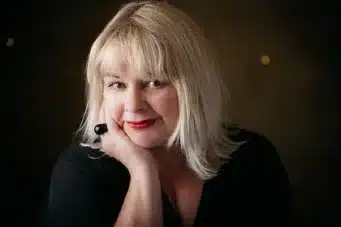
Tracy Fahey is an award-winning Irish author of nine books that are principally concerned with reimagined folklore and female Gothic. Her awards include the 2025 Rubery International Book Award and the 2024 Paul Cave Prize for Literature. Fahey has been a British Fantasy Award finalist in 2017, 2022, and 2024. In 2023 she received a Saari Fellowship from the Kone Foundation for her writing. Fahey’s short fiction has appeared in more than sixty Irish, UK, US, and Australian anthologies and been reprinted in the British Library Tales of the Weird series and Stephen Jones’ Best New Horror.
Her stories have been shortlisted for numerous awards including Fractured Lit, the London Independent Story Prize, and the Leicester Short Story Prize. She has given keynotes addresses at conferences and has appeared as Guest of Honour at the UK Ghost Story Festival and Fantasticon, Denmark. Fahey’s writing is supported by residencies in Ireland, Scotland, Greece, and Finland, and funded by Irish Grants Under The Arts and an Individual Arts Bursary. She holds a PhD in the Gothic and lectures in creative writing, contemporary Gothic, and folk horror at the Limerick School of Art and Design.
In 2026 she has two major releases – her linked collection Queens Of The Crone Age with PS Publishing (order the signed hardback here and the trade paperback here) – and her Gothic crime collection, Down We Go Together (Black Shuck Books (pre-orders here). World rights for her ninth book, Women Changing have been acquired by Fly On The Wall Press who will publish it in February 2027. You can already pre-order it here.
Catch her live in 2026, giving her Seed Talk on the research behind her new book, Queens of the Crone Age – ‘Folklore, Female Ageing and the Hag.’ Talks in Dublin and Cork sold out, so do reserve early for talks in London, Cambridge, Bristol here.
SHORT STORIES: FREE TO READ
– ‘I Look Like You, I Speak Like You, I Walk Like You’ (2014) in JU Lit-Zine Vol. 10 (ed. Nick Gerrard) can be read here This story has featured on several Best Short Story lists, and the film rights for it were acquired in 2021.
– ‘An Chailleach Bhéarra’ (2026) in Rejoinder Issue11: Spring 2026, Ritual, Healing and World-Making, Institute for Research on Women, School of Arts and Sciences, Rutgers, New Brunswick can be read here
– ‘There Where I Am Not’ (2026) published by Tractor Beam Vol 4: Thaw issue, illustrated by Julia Dufosse and annotated by Jeff Vandermeer, can be read here.
Ginger Nuts of Horror: The Heart and Soul of Horror Reviews
Jim "The Don" McLeod has been reading horror for over 35 years and reviewing it for more than 16. He's the editor of Ginger Nuts of Horror, Europe's largest independent horror review and culture site, and a British Fantasy Award nominee for his work in the genre. When he's not busy inflicting his opinions on the horror community, he can be found annoying his family or getting thoroughly outwitted by his two dogs, Casper and Molly.